
Peak Oil is You

Donate Bitcoins ;-) or Paypal :-)


Page added on February 18, 2019

As More Electric Cars Arrive, What’s The Future For Gas-Powered Engines?
Most American automobiles are powered by internal combustion engines: Gas or diesel goes in, tiny explosions power pistons and turn a crankshaft, the car moves forward, and carbon dioxide goes out.
But a growing chorus environmental activists, business analysts and auto executives are predicting a sea change as battery-powered electric vehicles grow in popularity.
Going electric is not just an eco-friendly goal, an ambition that would help fight climate change. It’s a business reality, according to industry analysts. But if the general path ahead is widely agreed on, the speed of the change — and the role that combustion vehicles will play during the transition — is far from clear.
‘You cannot stop it any more — it’s coming’
“Electrification, you cannot stop it anymore — it’s coming,” says Elmer Kades, a managing director with the consulting firm AlixPartners. “We have fantastic growth rates, between 50 and 60 percent on a global level.”
Electric vehicles are currently a tiny fraction of the car market, which is dominated by internal combustion engines. But many more electric car models will hit showrooms in the next few years, and several factors have analysts convinced that is part of a major transition in the industry.
Don’t see the graphic above? Click here.
Government policies — particularly in Europe and China — are giving a boost to electric vehicles, as regulators consider not only the devastating impacts of climate change but also the value of improved air quality in cities.
Auto companies around the world are gearing up for what will be a massive financial commitment. Carmakers plan to invest more than $90 billion in the shift to electric vehicles over the next decade or so, according to a Reuters analysis.
Electric motors are simpler, making them easier to maintain and meaning they should last longer. Keeping them charged is cheaper than buying gas, an advantage that will become even more significant if gas prices rise.

An electric motor is seen at the YASA factory in Oxford, England, in February 2018. Electric motors are much simpler than internal combustion engines, with fewer moving parts.
Chris J. Ratcliffe/Getty Images
Plus, “they are fun to drive,” says Tom Murphy, a managing editor at Wards Auto, which ranks the world’s best engines. “They’re enjoyable, they’re quiet … and there’s loads of torque” — which means instant acceleration, he says.
On the other hand, gas-powered cars are cheaper to buy than electric vehicles. It’s also quicker to fill up at the pump than it is to recharge, and the country is packed with gas stations, while charging station infrastructure is still in its infancy.
But experts predict batteries will get cheaper, charging will get quicker, and chargers will become more readily available.
At some point, industry watchers say, the balance will shift.


“Probably in the mid-2020s time frame, it becomes comparable or cheaper to actually buy and operate an EV than an internal combustion vehicle,” says Sam Abuelsamid, an auto analyst with Navigant.
Felipe Munoz, a global analyst at JATO, predicts electric vehicles will outsell conventional ones by 2030.
Other analysts say this change could be slower — but most agree it is coming.
Even people who love the internal combustion engine see the writing on the wall. John Woods owns a 1972 Porsche 914. On a recent Sunday, he joined other car enthusiasts at a parking lot in Alexandria, Va., to rev his engine and grin at the sound of it.
The internal combustion engine is “the beginning of automotive engineering,” Woods says. “But the electric car will be the future.”
‘Combustion engines really aren’t going anywhere for quite some time’
The rise of electric vehicles, however, doesn’t automatically mean the end of the reign of the gas-powered car.
Putting more battery-powered cars into circulation is only half of the equation. The next question is, what happens to all the combustion vehicles already on the road?
One possibility is that they might get replaced quite quickly with electric vehicles.
That’s what environmental activists want, for the sake of curbing climate change. For instance, the Green New Deal proposed by Democrats calls for phasing out carbon-emitting vehicles within a decade — which would require not only very fast production of electric vehicles but also a sudden withdrawal of combustion vehicles from roads.
That’s an ambitious target. But some version of that fast timeline could be triggered by very high gas prices or by bans or restrictions on internal combustion vehicles (like some cities have discussed, at least hypothetically).
It could also be motivated by consumer choices, argues Dan Neil, automotive columnist at The Wall Street Journal.
Electric vehicles “are such better machines than the machines they’re replacing,” he says, that consumers might choose to retire their gas guzzlers long before the end of the vehicles’ useful lives.
“Just like plasma TVs,” he says. “A lot of plasma TVs didn’t see the useful end of their lives before they were replaced by much cheaper, but also much better, LCD screens.”
Others are far more skeptical of an accelerated timeline and anticipate the two types of vehicle will coexist on the road for a long time.
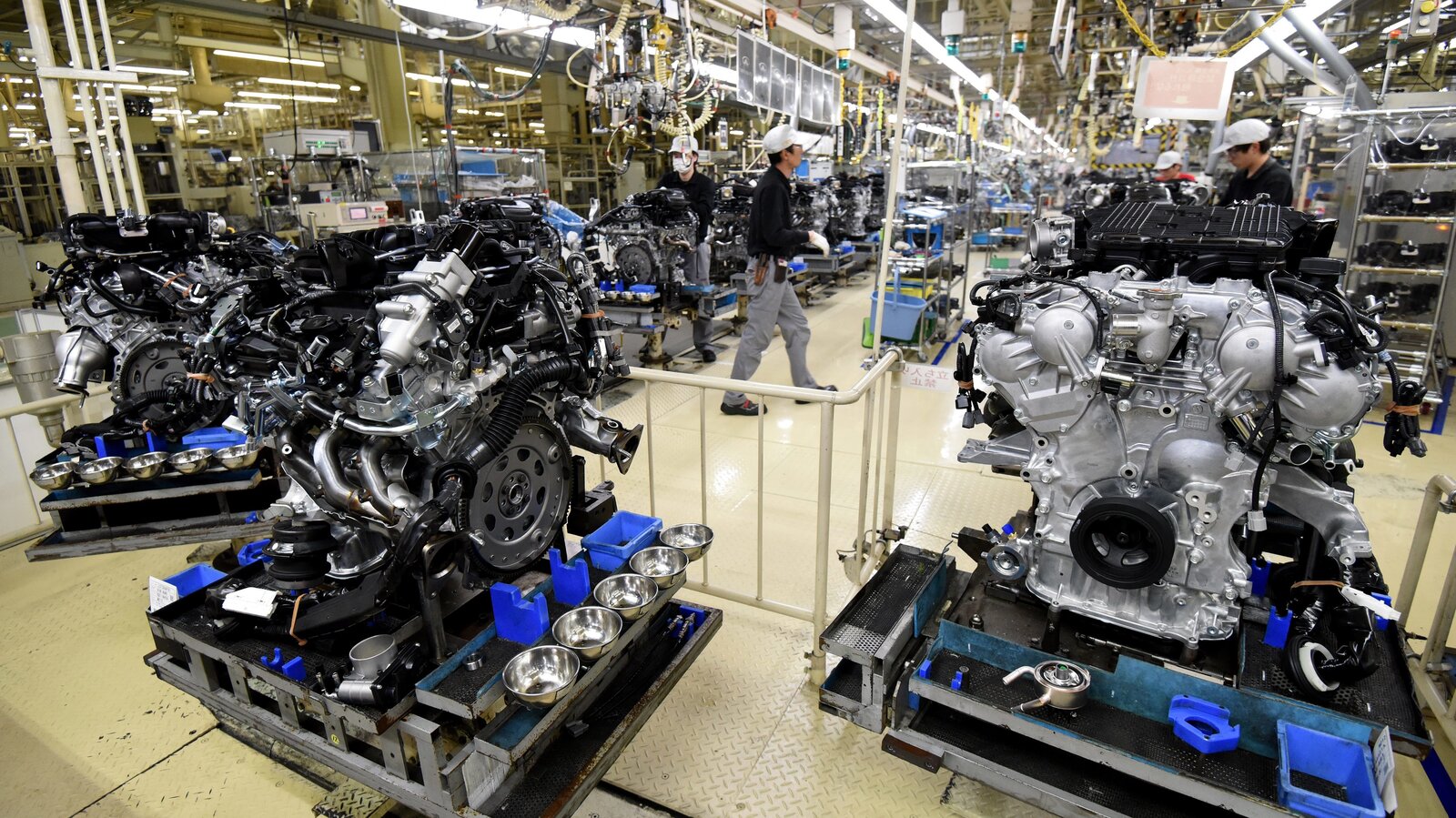
Employees work at the main assembly line of V-6 engines at a Nissan Motor plant in Iwaki, Japan, in 2016.
Toru Yamanaka/Getty Images
“The average age of a vehicle on the road today is almost 12 years old in the United States,” says Abuelsamid, the Navigant analyst. “Even if … 100 percent of vehicles sold were electric starting today, it would still take 20 to 25 years to replace the entire vehicle fleet with electric vehicles.”
Bill Visnic, editorial director at the Society of Automotive Engineers, is more blunt. “Combustion engines really aren’t going anywhere for quite some time,” he says.
Increasingly eco-friendly combustion vehicles
Mary Nichols, who heads the California Air Resources Board, agrees that internal combustion engines aren’t going away anytime soon.
“We can’t turn them all into planters or sculptures,” she says. “So I think we’re going to have to provide for them to continue to exist.”
But Nichols emphasizes that modern cars are cleaner than they used to be.
“I started working in this area of air pollution control back in 1971,” she says. “And in that time, the air emissions from internal combustion engines have been slashed by over 90 percent — twice.”
That’s important for air quality, a major concern in the world’s cities. Meanwhile, improved fuel efficiency has reduced the amount each car contributes to climate change.
“It highlights the importance of making sure … that we continue to have standards for conventional vehicles that push us towards more efficient, cleaner combustion engines,” says David Reichmuth, a senior engineer at the Union of Concerned Scientists. “In the next five years, we’re going to sell an awful lot of gasoline and diesel-powered vehicles, and not having those standards in place will lock in a large amount of emissions.”
And there’s one last wrinkle when considering the future of the combustion engine: The rise of the plug-in hybrid, which can run exclusively off battery power or use a combustion engine.
“It’s not like the internal combustion engine is just going to go away in the near future,” says Murphy of Wards. “It’s a little more nuanced than that.”
The transformation of the auto industry is real, experts say — and happening much faster than skeptics would have predicted just a few years ago.
But the turnover of the fleet will take time, and the phaseout of combustion vehicles likely won’t be fast enough to satisfy environmental advocates concerned about global warming.
“We’re moving in the right direction with electric cars,” Reichmuth says. “But the question is: How fast do we get there? And, you know, if you look at what we’re already seeing with climate change, we’re going to have to move faster.”
53 Comments on "As More Electric Cars Arrive, What’s The Future For Gas-Powered Engines?"
Robert Inget on Mon, 18th Feb 2019 8:54 am
Believe it or not, we may have already seen the peak year of internal-combustion-engined (ICE) vehicle sales come and go, as the market begins its gradual shift toward zero-emissions cars, according to a new Financial Times report.
Yes, 2018 may have been the peak year globally for ICE sales, with gasoline-powered cars sales on track to decline this year due to a number of factors.
They include, but are not limited to, Brexit; the U.S. trade war with China; the Iran embargo; and more stringent emissions standards across the board.
In China, sales of ICE vehicles fell below 18 million in the first 10 months of 2018, compared to 18.7 million sales for the same time period in 2017. Meanwhile, the sales of zero-emissions (mostly electric) vehicles almost doubled, from 405,000 to 793,000.
Predictions for 2019 are not unified, with some analysts saying the forecast shows a rebound in global ICE sales of 1.2 percent; and others saying they’ll contract by 0.6 percent.
https://driving.ca/auto-news/news/2018-may-have-been-the-peak-year-for-gasoline-engined-vehicles
OTOH; here are WW numbers for pure electrics sold in 2018
Nissan Leaf
Tesla Model S
BAIC EC-Series
Mitsubishi Outl․ PHEV
Chevrolet Volt
Toyota Prius PHEV
Tesla Model 3
BYD Qin PHEV
Renault Zoe
BMW i3
363,940 units
243,200
172,850
172,640
171,670
168,440
148,080
168,440
114,310
108,560
https://www.theatlas.com/charts/HJt3Z0DHE
Robert Inget on Mon, 18th Feb 2019 9:12 am
For those here that followed my posts in the past,
an update.
After getting a lump sum settlement from VW for my TDI, I turned around and bought an e.Golf.
This great car lacked range but nothing else.
(80 miles on a spring or fall day)
Although it handles like a race car, I don’t do racing. So after two years I gifted the car to my daughter who commutes less than 40 miles a day.
After getting another VW settlement for yet another, I turned around and bought a Leaf.
Now I can drive (carefully) 145 miles before needing a 50 minute ‘fill-up’. (lunch, peeing)
The Leaf is more suited to my needs, comforts.
At 84 driving longer than three hours w/o stop
is impossible, in any event.
At age 14 in Miami Fl, I got my first driving permit.
diesel
Cloggie on Mon, 18th Feb 2019 11:29 am
Government policies — particularly in Europe and China — are giving a boost to electric vehicles, as regulators consider not only the devastating impacts of climate change but also the value of improved air quality in cities.
Not to mention reduced noise levels.
Electric motors are much simpler than internal combustion engines, with fewer moving parts.
And go on for ever without maintenance, think your fridge, that will function for 20-30 years uninterruptedly.
And then there is a completely unexpected possibility of hydrogen-powered cars as storage facilities for households. In Holland until the early sixties we had a Shell truck that delivered heating oil via the backyard to an oil-drum, located in the garden, a couple of times per year. At some point that was replaced by natural gas.
With a hydrogen car however, it is possible to take over the role from that Shell truck mentioned, by connecting your household to the car, rather than the other way around!
Listen to Dutch hydrogen guru Ad van Wijk elaborating on the idea:
https://www.youtube.com/watch?v=pETr4tXMr90
Robert Inget on Mon, 18th Feb 2019 11:39 am
As Cloggie points out EV’s great virtue is simplicity. One look at the complicated plumbing on a hydrogen vehicle and one sees at once;
“A gracious woman is respected, but a woman without virtue is a disgrace”.
Robert Inget on Mon, 18th Feb 2019 11:58 am
Where are those V2G cars?
https://en.wikipedia.org/wiki/Vehicle-to-grid
https://cleantechnica.com/2018/03/23/vehicle-grid-cars/
Answer; ‘Build them and they will come’.
My project, just be able to tap the Leaf for
emergency power when the grid is down.
As PV (grid tie) owners know when the Grid goes
so goes all your un-storaged power.
Setting up an elaborate (expensive) battery storage for the few hours, or days, of a power outage may be great for YouTube videos or
end of days types but plugin in the EV would painless.
I’m waiting for Ballard Power or some such to market home power ‘Fuel Cells’ to provide
both heat and pure syne-waves.
Since propane, fuel cell fuel, is a refinery bi product, expect it to be around longer than you.
tahoe1780 on Mon, 18th Feb 2019 12:45 pm
The sooner we get off fossil fuels the better.
https://youtu.be/vq7ngZgzU-k?t=4
makati1 on Mon, 18th Feb 2019 6:01 pm
NPR = National Propaganda Radio
This is nothing more than an ad for a product that has no future. FF cars will be here until there is no FFs to power them. EVs will end when FF cars end. (EVs require FFs to exist.) But no one wants to think thru to that point. They dream of a “George Jetson” future where we will live happily ever after in some techie paradise.
About 79,000,000 FF cars were produced in 2018 alone. Most of those will still be on the road 10 years from now and many will last much longer. A similar number will be produced and sold this year around the world.
https://www.statista.com/statistics/200002/international-car-sales-since-1990/
Whereas…EV production is about 2,000,000 worldwide. Hmm. Seems that it will take about forever to replace even the existing FF cars.
http://www.ev-volumes.com/country/total-world-plug-in-vehicle-volumes/
Ah well, if it make the techies happy happy, dream on!
DMyers on Mon, 18th Feb 2019 6:54 pm
I had my first EV more than fifty years ago, in the form of a homemade go-cart powered by an electric motor from an old lawn mower. As battery technology had not progressed far at that time, my range was limited by an electric cord.
I would contend there are three critical factors that will determine whether EV displaces IC. Everyone knows that battery technology is number one. The standard line is that batteries will continue to be more powerful and long lasting and more easily chargeable (and don’t forget, cheaper!). If they don’t improve substantially along those lines, no guarantee that they will, then what?
Second is the re-charge infrastructure. We don’t know what complications may still arise in that arena, as it strives to accommodate mass demand.
Third is the grid itself, what it can bear, and what would be required to make it bear much more.
Robert has furnished the numbers of EVs sold in 2018. The numbers are impressive but sill very small when compared with the overall IC vehicle phenomenon. The only thing I would find relevant about number of EVs sold is good honest feedback from the thousands of purchasers. Do they like their EVs? Any problems? Are they worth it? Would they recommend it to a friend? How are they doing on heating/AC issues?
Pete Bauer on Mon, 18th Feb 2019 7:14 pm
Chinese auto sales in 2019-01.
While the overall vehicle sales dipped 15.8% to 2.37 million, the plugins surged 140% to 95,700.
https://www.cnbc.com/2019/02/18/chinas-jan-car-sales-fall-nearly-16percent-from-2018-7th-month-of-decline.html
This will send a chill down the spine of OPEC. 2019 may be the 1st year that the ICE vehicle sales declined while Plugin vehicle sales increased 100%.
FuelShortageComingYouAreDeadLoser on Mon, 18th Feb 2019 7:55 pm
I have been saying this. If you are White, you most likely have a better tolerance to the cold. when the shit hit the fan, White people should look for the protection of the forest, cold and snow. Do like the this guy
https://www.youtube.com/watch?v=eeMfe_6j3QM
Shit skin don’t have the tolerance to the cold that White man have. Don’t fight in the city if you are Whites. The number are not in our favor
FuelShortateComingYouAreDeadLoser on Mon, 18th Feb 2019 8:22 pm
Electrical car don’t work in cold water. Chemical reaction are depend on temperate.Colder it is slower are the chemical reaction.
http://www.startribune.com/aaa-cold-weather-can-cut-electric-car-range-by-40-percent/505489192/
If a global cooling happen as predicted by low solar activity, electrical car are not an option
Free Speech Message Board on Mon, 18th Feb 2019 11:16 pm
What do we need government for anyway?
If a private association like the MPAA can regulate movies, why can’t the private market regulate other things?
When the TSA fingers your asshole and pulls your cock, is the real purpose to protect you or to make you feel like a degraded slave?
When people smoke now, people just call the police on them, but people in the past either took some personal responsobility and ignored smokers, moved away from smokers, or asked smokers to go somewhere else. The problem with a police state is everyone now is either or a slave or a criminal. Who pays the taxes to pay for tyranny?
If smoking is dangerous, can’t nonprofits raise funds to pay for educational campaigns that warn of the dangers of smoking instead of outlawing smoking?
Can’t people use the BBB to verify if a business is good or not instead of forcing companies to pay fees to get a government business license?
Can’t private charities funded by volunteer donations provide homeless shelters and soup kitchens instead of being at forced at the point of a gun by the government to pay taxes that fund welfare?
Can’t people use to protect themselves instead of relying on the Gestapo?
Can’t neighbourhoods hire private security firms to protect their homes?
Can’t the free market provide toll roads?
Can’t the free market provide private airports?
Can’t the free market provide private schools?
Can’t the free market provide disaster relief instead of FEMA?
Can’t the free market run delivery services instead of the USPS?
Can’t the free market run railroads instead of Amtrack?
Think.
makati1 on Tue, 19th Feb 2019 12:17 am
“The ‘serious’ newspapers which draw the greatest attention include the Financial Times, the New York Times, the Washington Post and the Wall Street Journal….
Gideon Rachman is a senior columnist for the FT who travels around the world and has a unique ability to preach ‘western values’ . . . selectively. Commentating on contemporary US and EU politics, Rachman attributes to them ‘western values’– representative democracy, individual freedom and the rule of law…. overlooking two decades of imperial invasions, several hundred US bases around the world and countless violations of international law….
… while Rachman has consistently condemned Syria for human rights violations, he systematically avoids Israel’s weekly murder and wounding of hundreds of unarmed Palestinian protestors….
John Paul ‘Ratface’ Rathbone is one of FT leading contributors on Latin America who specializes in celebrating murderous regimes and promoting US policies which overthrow freely elected democracies…
Rathbone evokes occasional cynical smiles from columnists who are embarrassed by his toadying to Washington’s intelligence operatives…”
And on and on about other FT authors bullshit called “news”.
https://www.globalresearch.ca/laughter-for-all-financial-times-armchair-militarists-and-western-values/5668884
This is just another sign of the US’ decay and decline. Slip slidin’…
makati1 on Tue, 19th Feb 2019 12:28 am
BTW: “It is part of the FT propaganda war to downgrade Beijing’s economic advances in the world economy. In the January 14, 2019 issue the entire editorial board went on a rampage, ranting about China’s technological theft, its ‘slow down’ and pending crises … always reaching gloomy conclusions.
The FT expert observers note ‘big facts’ — that China is declining . . . all of one tenth of one percent over the previous year. Most China observers chuckle over the FT’s China ‘crises’ and wonder how the EU is ‘robust’ when it touches two percent and the US a shade higher?…
Jamil Anderlini tags China as a ‘colonial power’ . . . with its single base in Djibouti and for financing hundreds of billions in infrastructure, while the colonialism label is not applied to the US with several hundred military bases in five continents….
China’s economy is on the verge of crises–which prediction never occurs and smart investors ignore while smirking all the way to their bank accounts….
The fact is, the Times is part and parcel of the imperial revival which attempts to block China from establishing its pre-eminence in the world.”
https://www.globalresearch.ca/laughter-for-all-financial-times-armchair-militarists-and-western-values/5668884
Americans suck up this USMSM bullshit and argue with those who see reality, not propaganda. The “frogs” are not hot enough for them to take notice that they are becoming serfs to their corporate masters. But the water is approaching the boiling point. Exciting times. Best to be outside the pot. LOL
Cloggie on Tue, 19th Feb 2019 12:41 am
“Gideon Rachman is a senior columnist for the FT who travels around the world and has a unique ability to preach ‘western values’ . . . selectively.”
He is a Jew.
https://en.wikipedia.org/wiki/Gideon_Rachman
Antius on Tue, 19th Feb 2019 4:40 am
Tim Morgan’s latest SEEDS article. Well worth a read for anyone that wants a heads up on the economic disaster we are heading into.
https://surplusenergyeconomics.wordpress.com/2019/02/18/147-primed-to-detonate/
Some highlights:
‘According to SEEDS – the Surplus Energy Economics Data System – the riskiest countries on the planet are Ireland, France, the Netherlands, China, Canada and the United Kingdom.’
‘… It’s noteworthy, though, that the three highest-risk countries are all members of the Euro Area. It’s also noteworthy that, amongst the emerging market (EM) economies, only China and South Korea (ranked #9) make the top ten.’
Davy on Tue, 19th Feb 2019 4:47 am
“Rabobank: China’s Borrowing Was Insane: In January It Borrowed 5% Of GDP In One Month”
https://tinyurl.com/y5xhb7wp
graph https://tinyurl.com/yxoowjzc
“From China’s side, Friday’s PPI data said it is sliding into deflation again – and borrowing for January was insane. I won’t describe the numbers because they are so large it is meaningless. Yes, this is one month, and Lunar New Year means we need to see the February/March data too; but if the January pace is kept up China is already throwing the whole kitchen at the economy. It borrowed FIVE PERCENT OF GDP IN ONE MONTH. That’s 60% of GDP in a year. That’s a peak-WW2 level of borrowing. Does it suggest a real trade deal is coming? Or that China is backing away from its state-led model? Try to understand that. (And be very nervous on CNY.)”
Davy on Tue, 19th Feb 2019 5:05 am
“Are We on the Road to Civilization Collapse?”
https://tinyurl.com/y5xkvols
graph https://tinyurl.com/y5jfrw6p
“Great civilisations are not murdered. Instead, they take their own lives. That’s why the Deep Civilisation season will explore what really matters in the broader arc of human history and what it means for us and our descendants. So concluded the historian Arnold Toynbee in his 12-volume magnum opus A Study of History. It was an exploration of the rise and fall of 28 different civilisations. He was right in some respects: civilisations are often responsible for their own decline. However, their self-destruction is usually assisted. “
“Modern society is suffering from “temporal exhaustion”, the sociologist Elise Boulding once said. “If one is mentally out of breath all the time from dealing with the present, there is no energy left for imagining the future,” she wrote.”
“We may be more technologically advanced now. But this gives little ground to believe that we are immune to the threats that undid our ancestors. Our newfound technological abilities even bring new, unprecedented challenges to the mix. And while our scale may now be global, collapse appears to happen to both sprawling empires and fledgling kingdoms alike. There is no reason to believe that greater size is armour against societal dissolution. Our tightly-coupled, globalised economic system is, if anything, more likely to make crisis spread.”
“While there is no single accepted theory for why collapses happen, historians, anthropologists and others have proposed various explanations, including: CLIMATIC CHANGE ENVIRONMENTAL DEGRADATION INEQUALITY AND OLIGARCHY COMPLEXITY EXTERNAL SHOCKS RANDOMNESS/BAD LUCK”
Karle on Tue, 19th Feb 2019 5:12 am
A rough machine assisted translation:
Death Trap electric car
(Summary of an article from Germany)
Rescue workers report life-threatening problems in accidents with
e-cars. Injured people cannot be cut out of wrecks for fear of
short circuits and electric shocks.
In case of fire, even the fire brigade is helpless.
The number of electric cars on Germany’s roads is rising.
The German government wants to promote electric mobility. The
electric car is regarded as the means of transport of the future.
But when these vehicles become involved in accidents, they present
the fire brigades with major, sometimes insoluble or rather
indelible problems.
Especially when the battery of the electric car is set on fire.
Andreas Ruhs, fire protection expert of the Frankfurt fire
brigade: “Actually, you can’t put it out. The car must burn down
or burn out in a controlled manner.”
And it takes two to three days to burn; how much CO2 and other
gases are emitted is not yet known.
But the fact that an electric car that has caught fire may also
have to burn out in a controlled manner on a federal motorway is
not the only problem.
If an electric car is set on fire, the battery will not only
release extremely toxic vapours and gases, but also corrosive
ones. In addition to the quasi-immolable hellfire, there is also
smoke, which is more corrosive and poisonous and endangers the
rescuers.
Circuit diagrams are vital for the survival of accident victims
and emergency forces.
But burning batteries and toxic gases are not the only dangers
for the rescuers.
Seite 1tesla.txt
On 27 January 2019, for example, there was an accident with a
Tesla Roadster on the A661 near Dreieich (Offenbach). The driver
of a small car obviously overlooked the rare, powerful electric
sports car.
There was a collision. Both cars skidded and collided with a
concrete wall.
This was an extraordinary and dangerous operation for the
emergency forces on site: electric shock was imminent!
Fortunately, in this accident the electric car was not so damaged
that an emergency shutdown would have been necessary.
Many fire brigades are now increasingly practicing the handling of
electric cars that have been involved in an accident; knowledge of
the circuit diagrams is vital for survival. If an injured driver
is trapped, he cannot simply be cut out of the passenger
compartment.
It must first be clarified whether the battery is threatened with
damage or even a short circuit.
Horror scenario underground car park
The fire brigade is particularly concerned about one scenario: a
fire in the underground car park! Even with normal vehicles, such
a fire is a challenge for the emergency services, but “if there
are still electric vehicles with them that can make a considerable
contribution to a fire with their batteries, then this honestly
presents us with great challenges,” says fire protection expert
Ruhs.
The toxic and corrosive gases put rescuers and technology to the
test. The smoke extraction system in the underground car park must
then work particularly reliably.
For the fire brigade, it is also important to drag the indelible
electric car out of the underground car park as quickly as
possible – it must burn out outside in a controlled manner.
According to Ruhs, this scenario has to be taken into account when
planning the construction of new underground garages and
Seite 2tesla.txt
multi-storey car parks in the future – it remains unclear what is
the case with older car parks.
——————————
Municipal utilities prohibit superchargers for electric cars in
residential areas
February 16th, 2019
Bad surprise in Bliestal / Saarbrücken: The municipal utilities
banned the construction of a fast loader because of the danger of
blackout. There is a risk of a power failure if three electric
cars charge at the same time because the networks are not designed
for this.
The head of Stadtwerke Bliestal (Saarbrücken) stopped the wish of
an electric car driver to have his new vehicle refueled with
electricity. He wanted to draw an output of 22 kilowatts (kW) from
the local power grid, but the municipal utilities approved him
only for 11 kW.
The municipal utilities feared an overload of the grid and thus a
power failure if the three electric cars in the street were to be
charged simultaneously and some instantaneous water heaters and
electric cookers were to be in operation in addition to normal
consumption by lamps or televisions.
Appliances with a high power consumption, such as a continuous
flow heater with an output of 18 to 24 kW, only run for a few
minutes. “But an electric car will demand this power for hours on
end,” says network specialist Fixemer, highlighting the problem.
Seite 3
Davy on Tue, 19th Feb 2019 5:14 am
“China’s loans hit all-time high as banks open floodgates in January to help slowing economy”
https://tinyurl.com/y3cpbslt
“The People’s Bank of China (PBOC), China’s central bank, said on Friday that new yuan loans surged to 3.23 trillion yuan (US$476.97 billion) last month. Photo: BloombergThe People’s Bank of China (PBOC), China’s central bank, said on Friday that new yuan loans surged to 3.23 trillion yuan (US$476.97 billion) last month. The People’s Bank of China (PBOC), China’s central bank, said on Friday that new yuan loans surged to 3.23 trillion yuan (US$476.97 billion) last month. New loans in China surged to an all-time high in January, highlighting Beijing’s scramble to bolster economic activities at home amid the trade war with the United States. The People’s Bank of China (PBOC), China’s central bank, said on Friday that new yuan loans surged to 3.23 trillion yuan (US$476.97 billion) last month. The figure almost tripled the 1.08 billion yuan (US$159.48 million) of loans in December, while also beating the 1.6 trillion yuan (US$236.27 billion) of loans issued in January 2009 when Beijing looking to put growth on track during the global financial crisis. Total social financing, the more broadly defined measure of credit in the economy that includes loans, bonds and other non-traditional financing instruments, grew to 4.64 trillion yuan (US$685.18 billion) in January. The data confirms that the world’s second largest economy is taking an ultra loose monetary position, even though Beijing has refrained from a benchmark interest rate cut or officially call for a shift in its monetary policy stance.”
Cloggie on Tue, 19th Feb 2019 5:25 am
A global financial collapse could very well be the trigger for WW3 and the elimination of the dollar from Eurasia.
If the financial collapse will begin in China, expect them deflect the attention from inner problems, blame them on “foreigners”, install an emergency regime and begin to expand in SE-Asia, first of all the South-China Sea.
Before America became the new #1 in 1945, it suffered a depression from 1928-1940. A war could be a means to get out of a depression.
Davy on Tue, 19th Feb 2019 5:28 am
“Zombie Kansas Wind Transmission Project Rises Again, In Missouri”
https://tinyurl.com/yxdatpum
“The expectation is that the Grain Belt Express will deliver 500 megawatts directly to the Missouri grid, instead of just passing through on its way to Illinois and Indiana.”
“The Missouri Chamber of Commerce and Industry is a case in point. Last week, the MO Chamber put its weight fully behind the new wind transmission project. Along with the benefit to ratepayers, Chamber President and CEO Daniel Mehan cited Clean Line’s $500 million investment in the state, and the role that access to clean power plays in attracting (and keeping) business. The Missouri-based companies General Cable, Hubbell Power Systems, and ABB are among those directly involved in the project. The construction contractor, PAR Electric, is based in Kansas but has pledged to hire Missouri workers when possible.”
Cloggie on Tue, 19th Feb 2019 5:32 am
Missouri has reasonable wind resources, Kansas has better though:
https://cleantechnica.com/files/2018/02/txawstwspd100onoff3-1-570×440.jpg
FuelShortageComingYouAreDeadLoser on Tue, 19th Feb 2019 5:48 am
We’ve been treated unfairly’: Truck convoy sets off from Alberta to protest Ottawa’s oil and gas policies
https://www.cbc.ca/news/canada/calgary/truck-convoy-red-deer-calgary-regina-ottawa-protest-1.5019118
After months of pro-pipeline rallies across Alberta, a protest convoy of about 170 trucks, big and small, left Red Deer early Thursday morning for a four-day trek to Ottawa.
Convoy participants and their supporters gathered before dawn, with the temperature sitting at about –25 C. Their vehicles were dressed up in banners denouncing Prime Minister Justin Trudeau and many of his government’s policies.
They want to show their opposition to the federal carbon tax and Bill C-69, federal legislation that would change the way energy projects are reviewed, as well as a host of other policies they believe are adding to the economic pain that first hit Alberta when the price of oil plummeted four years ago.
Me: Something is happening with the debt in Canada. A lot of layoff in the oil patch there. A lot of distress in Alberta
FuelShortageCominYouAreDeadLoser on Tue, 19th Feb 2019 6:15 am
Regarding the SEED article. Some rumors are saying the yellow vest protest are organizing in Ireland. News that you will not find in lame street media.
https://www.youtube.com/watch?v=lduwIQJcKhk
FuelShortageComingYouAreDeadLoser on Tue, 19th Feb 2019 6:16 am
How the Yellow Vest movement is mobilising in Ireland in the war against globalism
https://www.youtube.com/watch?v=9zaypAdXvwI
Cloggie on Tue, 19th Feb 2019 6:19 am
Are We on the Road to Civilization Collapse?
Yes, thank God!!
I had hoped that peak oil would deliver the desired collapse of the West, but Heiny hadn’t done his homework properly.
Now CW2 is our best hope to get the f*cker torpedoed once and for all, USSR-1989-style and pave the way for a European revival, extended into North-America, but on continental European terms (PBM), powered by renewable energy, radical environmentalism and archaic post-modernist, post-libtard, reactionary values a la the French New Right, where pagan Antiquity has more to offer than Christianity:
https://www.amazon.com/Archeofuturism-European-Visions-Post-Catastrophic-Age-ebook/dp/B007UQYJV8/ref=sr_1_1
FuelShortageComingYouAreDeadLoser on Tue, 19th Feb 2019 6:23 am
Whites people
https://www.youtube.com/watch?v=FbBKezzwTZ0
Cloggie on Tue, 19th Feb 2019 7:40 am
Just received yet another email from MarineTraffic:
https://www.marinetraffic.com/en/ais/home/shipid:257828/zoom:10
Again 4 more monopiles, destines to carry 8 MW turbines each. Will be installed in 4 days time.
Never understood that peculiar route with loop the Aeolus is taking.
This is how the Aeolus operates:
https://www.youtube.com/watch?v=JV9PykR5bHo
Gone are the days that the incremental cost of an additional installed offshore windturbine is more expensive than a land-based one. The latter often comes with public resistance (not in my back yard), occupying valuable land (especially in overcrowded Holland). And then there are the superb offshore wind conditions: 10 m/s average wind speed, compared to 4-6 m/s onshore.
Purpose: Borssele I-V windpark:
https://deepresource.wordpress.com/2018/12/27/1484-mw-borssele-to-become-the-largest-windfarm-in-the-world/
Delivery date 2021.
https://nl.wikipedia.org/wiki/Windpark_Borssele
Antius on Tue, 19th Feb 2019 7:58 am
“How the Yellow Vest movement is mobilising in Ireland in the war against globalism”
Not surprised. According to this article, Cloggie’s Netherlands could be the next flashpoint for yellow vest populism.
https://surplusenergyeconomics.wordpress.com/2019/02/18/147-primed-to-detonate/
Whereas Italy has seen most of its per capita prosperity decline due to the economy, in the Netherlands, most of the decline has been due to higher taxation. Before tax, per capita prosperity has declined 4% since 2001. So the average Dutchman has about the same pre-tax prosperity now as he did in 2001; but taxation has reduced prosperity by a whopping 24%.
https://surplusenergyeconomics.wordpress.com/2018/12/30/143-fire-and-ice-part-one/
The Netherlands has one of the highest ratios of financial assets to prosperity (1881%) in the world; second only to Ireland at 3026% and greater even than the UK at 1591%. All three countries are set for massive economic disruption when the world hits the second global financial crisis. Given the way in which industrial production is declining across the world; that event may be no more than a year away.
There seems to be a disconnect between what statistics are showing in this article and what Cloggie has told us about record high prosperity in Holland. Could it be that Cloggie is a man of 60; who bought his home in the 1980s, when it was relatively cheap and has a job for life with a final salary pension? If so, his experience may not be representative of what life is like for many younger Dutch people, trying to pay an inflated rent, higher taxes and higher living costs, with not much more money than they would have had 20 years ago.
FuelShortageComing on Tue, 19th Feb 2019 8:01 am
To complement Antius comment about housing price inflation
New Zeland had homeless people in the street and empty houses. Money is useless now because of inflation.
https://www.youtube.com/watch?v=tNAEQAsBZBU
I AM THE MOB on Tue, 19th Feb 2019 8:19 am
Are we on the road to civilization collapse? BBC
Studying the demise of historic civilisations can tell us how much risk we face today, says collapse expert Luke Kemp. Worryingly, the signs are worsening.
http://www.bbc.com/future/story/20190218-are-we-on-the-road-to-civilisation-collapse
We’re ripe for a total breakdown. No clean water, no food, no law and order. Just chaos.
I AM THE MOB on Tue, 19th Feb 2019 8:21 am
“”Introduce a little anarchy. Upset the established order, and everything becomes chaos. I’m an agent of chaos…”
― The Joker – Heath Ledger
Cloggie on Tue, 19th Feb 2019 8:53 am
There seems to be a disconnect between what statistics are showing in this article and what Cloggie has told us about record high prosperity in Holland. Could it be that Cloggie is a man of 60; who bought his home in the 1980s, when it was relatively cheap and has a job for life with a final salary pension?
Yes, I’m 6x years old.
Yes, I bought my home in the eighties, at a price 8 times it is worth now, when the market was at a (local) historic low.
I didn’t say that the current Dutch public was the richest in history. What I did suggest was that the Dutch society as whole (consumers + corporations + state) was combined richer than ever. Actually, a recent Rabo-bank report admitted that ordinary households did not profit at all from the years of economic growth: most of the growth went to the corporate sector and the state wasn’t doing too bad either. Here a discussion of that Rabo-article:
https://www.volkskrant.nl/economie/huishoudens-in-nederland-gaan-er-al-40-jaar-amper-op-vooruit-beweert-rabobank-is-dat-echt-zo-~b0b7560f/
(“Households didn’t improve their income over the last 40 years, is that true?”)
Answer: yes and no. The catch: yes household income did not improve, but households got a lot smaller over that 40 years! So the per capita spending power did very well increase.
Duh!
The Netherlands (like everywhere else in the West): emancipated hedonists (m/f), planning their next world trip, not a family. That’s what you get with a society that promotes feminism, easy divorce, free sex, women forced to work because life-long marriage is no longer guaranteed. Bye-bye offspring.
Yesterday I had a short discussion with a young female cashier, who complained that it was impossible for her and her boyfriend to find a home, as rents in boomtown Eindhoven begin at 1300 euro. Buying something was out of question anyway.
Never had a permanent job in my life, always have been a international IT-yuppie contractor, where freedom in between contracts was just as important as (much) higher income during contracts. Apart from the first few years, financial problems were/are unknown to me, always kept a tight lid on spending (go ask the too many women in my life). During job-interviews I always say that the many large holes in my CV were a result of leaving less interesting projects out, as I don’t want my CV to have more than 6 pages. It’s a lie, I have been reading history books instead or some other interest, the holes are real. When I will be 70, I’ll probably haven’t worked (for clients) cumulatively more than 20 years full-time. Money only interests me as a means towards freedom, meaning time filled by myself, not an employer.
I AM THE MOB on Tue, 19th Feb 2019 8:55 am
Democratic socialist Sen. Bernie Sanders enters the 2020 presidential race
https://www.cnbc.com/2019/02/19/bernie-sanders-2020-campaign.html?__source=facebook%7Cmain&fbclid=IwAR3EPtDVT-WEt6JHCqZAg9FY70KJPRl2nDKskf5FfMPV3m5TLDZUvJNhy0s
First Bernie wins than Corbyn!
I AM THE MOB on Tue, 19th Feb 2019 9:03 am
Clogg has a boomer brain..LOL
Antius
They are primed for collapse soon..
Antius just look up the GDP numbers for Europe and it will explain everything
Netherlands Economy (GDP) Per Capita
1965 7.1
1973 4.5
1989 3.7
1996 3.0
2016 1.6
2028 0.0 > Economic Collapse
Source: World Bank
https://data.worldbank.org/indicator/NY.GDP.PCAP.KD.ZG?locati&locations=NL
And they are running out of the largest export Natural Gas..And no amount of wind turbines can replace that export..
https://www.bloomberg.com/news/articles/2016-09-16/europe-s-biggest-natural-gas-producer-is-running-out-of-fuel
Cloggie on Tue, 19th Feb 2019 9:05 am
The Netherlands has one of the highest ratios of financial assets to prosperity (1881%) in the world; second only to Ireland at 3026% and greater even than the UK at 1591%.
The Netherlands has indeed a high “debt” ratio and that has one reason only: exceptionally high mortgages. I would argue that a mortgage is not really a debt, like one remaining after a bad hand of cards after a poker game. The home is the counter value. In Holland there are no PC Fanny May banks that dole out mortgages irresponsibly. So what is the secret of high Dutch mortgages? This:
https://nl.wikipedia.org/wiki/Hypotheekrenteaftrek_(Nederland)
In Holland we have the internationally unique situation that interest paid by consumers is completely deductible from pre-tax income. It was an old measure to stimulate home ownership. This stimulates people engaging in high mortgages because the financial burden isn’t that high as a foreign observer might think. This has driven up prices enormously and politicians are now openly thinking of gradually abolishing mortgages interest deduction.
I remain pretty upbeat about the Dutch situation, do not expect financial trouble to begin here, but if it does in China and/or the US, we are obviously going to be implicated.
I AM THE MOB on Tue, 19th Feb 2019 9:35 am
Clogg
Those government benefits you are living off of are about to be cut..When you run out of natural gas..
Another angry incel bites the dust!
Cloggie on Tue, 19th Feb 2019 9:47 am
“Geschiedenis[bewerken]
De hypotheekrenteaftrek dateert uit 1893, toen de door de liberale minister van financiën Nicolaas Pierson voorgestelde wet Vermogensbelasting 1892 in Nederland werd ingevoerd”
No you fool, that benefit dates from 1892, when the only natural gas could be found between the bed sheets.lol
Robert Inget on Tue, 19th Feb 2019 9:57 am
He Got Out in Time
Wallace Broecker, a climate scientist who brought the term “global warming” into the public and scientific lexicon, died on Monday. He was 87.
Broecker, a professor in the department of earth and environmental science at Columbia, was among the early scientists who raised alarms about the drastic changes in the planet’s climate that humans could bring about over a relatively short period of time.
His 1975 paper “Climatic Change: Are We on the Brink of a Pronounced Global Warming?” predicted the current rise in global temperatures as a result of increased carbon dioxide levels — and popularized the term “global warming” to describe the phenomenon.
The geoscientist was also known for recognizing the global “conveyor belt,” a system of deep-ocean currents that circulate water between the continents.
Sean Solomon, director of Columbia’s Lamont-Doherty Earth Observatory, where Broecker worked, called his late colleague a force for scientific innovation.
“It is difficult to imagine … a Columbia University without [Broecker’s] intellectual vision, his gift for distilling the important from the merely interesting, and his sustained passion for his science, his colleagues, and his planet,” Solomon wrote in an email to colleagues that he shared with NPR. “One of the last of the giants of our field no longer walks among us.”
Antius on Tue, 19th Feb 2019 10:09 am
“The Netherlands has indeed a high “debt” ratio and that has one reason only: exceptionally high mortgages. I would argue that a mortgage is not really a debt, like one remaining after a bad hand of cards after a poker game. The home is the counter value. In Holland there are no PC Fanny May banks that dole out mortgages irresponsibly. So what is the secret of high Dutch mortgages? This:
https://nl.wikipedia.org/wiki/Hypotheekrenteaftrek_(Nederland)
In Holland we have the internationally unique situation that interest paid by consumers is completely deductible from pre-tax income. It was an old measure to stimulate home ownership. This stimulates people engaging in high mortgages because the financial burden isn’t that high as a foreign observer might think. This has driven up prices enormously and politicians are now openly thinking of gradually abolishing mortgages interest deduction. ”
A lot to think about here; but it does sound to me like the mother of all property bubbles. The fact that young people can no longer afford to buy suggests that a crash of sorts is only a matter of time.
Hello on Tue, 19th Feb 2019 10:14 am
Netherlands Economy (GDP) Per Capita
Source: World Bank
https://data.worldbank.org/indicator/NY.GDP.PCAP.KD.ZG?locati&locations=NL
That’s GDP GROWTH, not per capita.
If you’re a fully developed country with stable population you don’t need growth.
3rd world needs growth, not 1st. Low (or no) growth is desirable nowadays. Ever heard of depleting resources and global warming and stuff?
Antius on Tue, 19th Feb 2019 10:24 am
“The Netherlands (like everywhere else in the West): emancipated hedonists (m/f), planning their next world trip, not a family. That’s what you get with a society that promotes feminism, easy divorce, free sex, women forced to work because life-long marriage is no longer guaranteed. Bye-bye offspring.”
Agree completely with this. The 1960s student Marxism was basically a rejection of all traditional rules and authority. It also encouraged people to reject responsibilities and it built an expectation of entitlement. Feminism is simply a branch of Marxism that encourages women to view themselves as victims; to hate the world around them and to reject all traditional rules, especially those governing sex. The problem is that traditional rules and attitudes towards women and sex are shaped by evolutionary forces that aren’t negotiable. You can ignore the rules, but you cannot ignore the consequences of ignoring the rules. You can enjoy free sex; lose your virginity outside of marriage; get STDs, etc. But don’t expect any man to want to marry you afterward. Some things in life depend not on your expectations, but upon your worth.
Cloggie on Tue, 19th Feb 2019 11:35 am
If you’re a fully developed country with stable population you don’t need growth.
3rd world needs growth, not 1st. Low (or no) growth is desirable nowadays. Ever heard of depleting resources and global warming and stuff?
I agree. Again I was disappointed when I gradually began to understand after 2012 that the peak oil supply induced collapse of industrial civilization, as professed by the likes of Heinberg c.s., had been called off.
If you understand that divinity is in the potential of DNA and not in yet another Black Friday, than all of a sudden a “collapse” becomes a desirable thing.
We need to kill modernity before it kills us. And as a consequence get tough with those who promote that modernity.
Sissyfuss on Tue, 19th Feb 2019 11:40 am
Antius, Cloggenfruiten also receives a pension from the Third Reich Foundation out of Argentina and a small stipend from his Hitlers Youth days.
Duncan Idaho on Tue, 19th Feb 2019 11:43 am
The Pope before last was a member of Hitler Youth.
I thought it was fitting.
Cloggie on Tue, 19th Feb 2019 11:53 am
Elaborating a little on “debt”…
https://en.wikipedia.org/wiki/List_of_countries_by_household_debt
Household debt (including mortgages) in % GDP
Switzerland – 127
Holland – 105 (coming down from 118 3yr earlier)
Norway – 101
Canada – 101
Britain – 86
America – 79
France – 57
Germany – 53
Italy – 43
This is mostly mortgage. Italians btw have an average mortgage of merely 17k, they all live in paid off real estate. No need for pity with the Italians, they are financially the most stable country of the western world:
https://deepresource.wordpress.com/2012/12/11/the-real-state-of-western-finances/
They have a high public debt because these frauds/libertarians refuse to pay tax and prefer to put their money into there own pocket. And they get away with it because Italy has a weak state.
Back to Holland…
https://www.elsevierweekblad.nl/economie/achtergrond/2018/01/hypotheekschuld-stijgt-naar-recordhoogte-579977/
Average Dutch mortgage: 290k euro
According to Elsevier this is NOT alarming, because it is merely 41% of the value of the houses involved. The main cause for this high sum is, as I mentioned, the hypotheekrenteaftrek. So much for a bubble. Most people would get rid of their real estate without being stuck with a debt afterwards.
Cloggie on Tue, 19th Feb 2019 11:57 am
Antius, Cloggenfruiten also receives a pension from the Third Reich Foundation out of Argentina and a small stipend from his Hitlers Youth days.
Even simple arithmetic is too much to ask for our resident Marxist virtue signaler. 2019-6x, too difficult. Should you not barricade your doors in anticipation of CW2 or park yourself in a plane to Manila or Italy or Colombia, after you granted yourself a lifelong vacation from the Darwinian aspects of life?
Dredd on Tue, 19th Feb 2019 2:42 pm
“Renewable energy will be world’s main power source by 2040, says BP” (Guardian UK).
Gov Mule on Tue, 19th Feb 2019 5:51 pm
I think if EVs are going to succeed their rollout will need to be coupled with a build-out of a passenger rail system to address the range issue. Even then, there is a lot of embedded energy in any car, EV or ICE and if fossil fuel and other commodity prices get steep enough it’ll only be the well-off driving around in cars.