
Peak Oil is You

Donate Bitcoins ;-) or Paypal :-)


Page added on August 9, 2016

An Updated Version of the “Peak Oil” Story

The Peak Oil story got some things right. Back in 1998, Colin Campbell and Jean Laherrère wrote an article published in Scientific American called, “The End of Cheap Oil.” In it they said:
Our analysis of the discovery and production of oil fields around the world suggests that within the next decade, the supply of conventional oil will be unable to keep up with demand.
There is no single definition for conventional oil. According to one view, conventional oil is oil that can be extracted by conventional methods. Another holds it to be oil that can be extracted inexpensively. Other authors list specific types of oil that require specialized techniques, such as very heavy oil and oil from shale formations, that are considered unconventional.
Figure 1 shows the growth in unconventional oil supply for three parts of the world:
- Oil from shale formations in the US.
- Oil from the Oil Sands in Canada.
- Oil characterized as unconventional in China, in a recent academic paper of which I was a co-author. (Temporarily available for free here.)

Figure 1. Approximate unconventional oil production in the United States, Canada, and China. US amounts estimated from EIA data; Canadian amounts from CAPP. Oil prices are yearly average Brent oil prices in $2015, from BP 2016 Statistical Review of World Energy.
Oil prices in 1998, which is when the above quote was written, were very low, averaging $12.72 per barrel in money of the day–equivalent to $18.49 per barrel in 2015 dollars. From the view of the authors, even today’s oil prices in the low $40s per barrel would be quite high. Since the above chart shows only yearly average prices, it doesn’t really show how high prices rose in 2008, or how low they fell that same year. But even when oil prices fell very low in December 2008, they remained well above $18.49 per barrel.
Clearly, if oil prices briefly exceeded six times 1998 prices in 2008, and remained in the range of six times 1998 prices in the 2011 to 2013 period, companies had an incentive to use techniques that were much higher-cost than those used in the 1998 time-period. If we subtract from total crude oil production only the production of the three types of unconventional oil shown in Figure 1, we find that a bumpy plateau of conventional oil started in 2005. In fact, conventional oil production in 2005 is slightly higher than the later values.

Figure 2. World conventional crude oil production, if our definition of unconventional is defined as in Figure 1.
I would argue that far more crude oil production was enabled by high oil prices than I subtracted out in Figure 2. For example, Daqing Oil Field in China is a conventional oil field, but greater extraction has been enabled in recent years by polymer flooding and other advanced (and thus, high-cost) techniques. In the academic paper referenced earlier, we found that the amount of unconventional oil extracted in China in 2014 would be increased by about 55%, if we broadened the definition of unconventional oil to include oil made available by polymer flooding in Daqing, plus some other types of Chinese oil extraction that became more feasible because of higher prices.
Clearly, this same kind of shift to more expensive extraction methods has occurred around the world. For example, Brazil has been attempting to extract oil from below the salt layer of the ocean using advanced techniques. According to this article, Brazil’s “pre-salt” oil production was expected to exceed 600,000 barrels per day by the end of 2014. This oil should count, in some sense, as unconventional oil.
Massive investments in the Kashagan Oil Field in Kazakhstan were enabled by high oil prices. Some initial production began, but was discontinued, in September 2013. Production is expected to resume in October 2016.
There are clearly many smaller fields where higher extraction was made possible by high oil prices that allowed oil companies to utilize more advanced techniques. Deepwater drilling also became more feasible because of higher prices. Another example is Russia, which is reported to have heavy oil extraction that would not be commercially feasible if oil prices were below $40 to $45 per barrel. If we were to add up all of the extra oil production in many areas of the world that was enabled by higher prices, the total amount would no doubt be substantial. Subtracting this higher estimate of unconventional oil in Figure 2 (instead of the three-country total) would likely result in more of a “peak” in conventional oil production, starting about 2005.
Thus, if we think of conventional oil production as that which is possible at low oil prices, the forecast by Colin Campbell and Jean Laherrère was pretty much correct. Production of conventional oil did seem to peak about 2005 or shortly thereafter. We simply don’t have the data to estimate how much we could have extracted, if oil prices had remained low. Furthermore, oil prices did rise substantially, relative to 1998 prices, making Campbell’s and Laherrère’s forecast of higher prices correct.
I suppose that we could even say that if conventional oil were all that we had in 2005 and subsequent years, supply would have fallen far short of demand, based on Figure 2. This last statement is somewhat debatable, however, because there would have been other feedbacks, as well. It is possible that if total supply were very short, oil prices would have spiked to even a higher level than they really did. The resulting recession would likely have brought prices down, and temporarily brought demand back in line with supply. If prices had stayed low, there might have been a second round of shortages, with even a greater supply problem. This, too, might have been resolved by another price spike, quickly followed by another recession that brought world demand back down to the level of supply.
Of course, conventional crude oil isn’t the only type of liquid fuel that we use. When we add all of the pieces together, including substitutes, what we find is that since 1998, broadly defined oil production (“liquids”) has been rising quite rapidly.
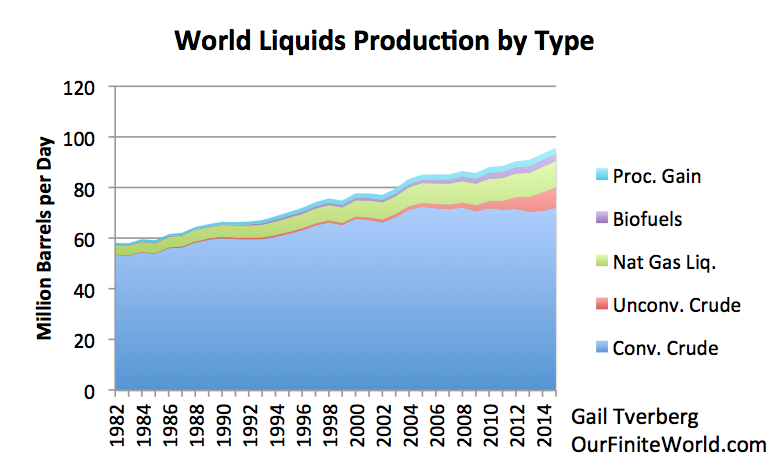
Figure 3. World Liquids by Type. Unconventional oil is from Exhibit 1. Conventional oil is total crude oil from EIA, and other amounts are estimated from EIA International Petroleum Monthly amounts through October 2015. (EIA’s category “Other Liquids” is referred to as Biofuels in Figure 3, since this is its primary component. Other liquids also include coal and gas to liquids and other small categories.)
In fact, since 2005, Figure 4 shows that the single highest year of growth in oil production (broadly defined) was 2014, with 2.47 barrels per day. (This is based on crude oil data from EIA Beta Report Table 11.b, plus values for other liquids from EIA’s International Energy Statistics. Annual amounts for 2015 were estimated based on data through October.)
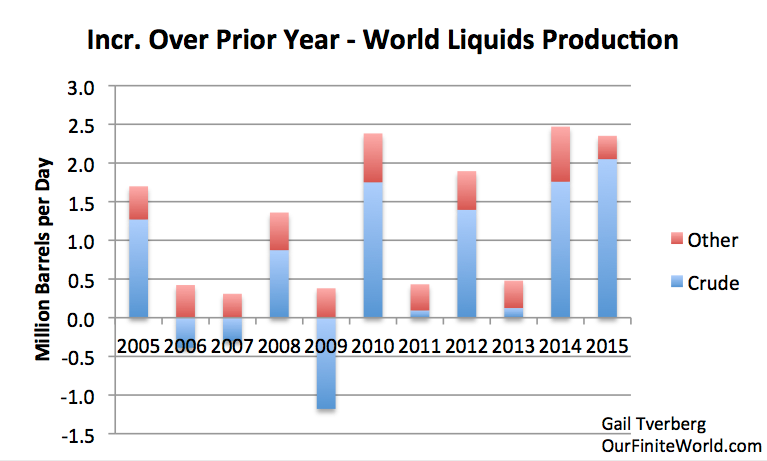
Figure 4. Increase over prior year in total oil liquids production, based on EIA data. 2015 other liquids amounts estimated based on data through October 2015.
Figure 4 shows that the increase in oil supply in 2015 is almost as high as in 2014. The 2005 to 2015 period shown indicates a lot of “ups and downs.” The only two high years in a row are 2014 and 2015. This would seem to be at least part of our “oil glut” problem.
Exactly by how much oil production needs to increase to stay even with demand depends upon price–the higher the price, the smaller the quantity that buyers can afford. At a price of $100 per barrel, a reasonable guess might be that about 1 million barrels per day in consumption might be added. If categories other than crude oil are increasing by an average of 440,000 barrels per day, per year (based on data underlying Figure 4), then crude oil production only needs to increase by 560,000 barrels per day to provide an adequate supply of fuel on a total liquids basis.
If production of crude oil is actually increasing by more than 2.0 million barrels per day when only 560,000 barrels per day are needed at a price level of $100 per barrel, clearly something is badly out of balance. According to EIA data, the countries with the five largest increases in crude oil production in 2015 were (1) US 723,000 bpd, (2) Iraq 686,000 bpd, (3) Saudi Arabia 310,000 bpd, (4) Russia 146,000 bpd, and (5) UK 106,000 bpd. Thus, US and Iraq were the biggest contributors to the global glut in 2015.
What Is Going Wrong?
Not only did a lot of people hear the Peak Oil story, a great many responded at once. Governments added requirements for more efficient vehicles. This tended to lower the quantity of additional oil supply needed. At the same time, governments added mandates for the use of biofuels, also reducing the need for crude oil. Arguably, the US-led Iraq war, which began in 2003, was also about getting more crude oil.
Oil companies also rushed in and developed oil resources that might be profitable at a higher price. These new developments often take more than ten years to produce oil. Once companies have started the long path to development, they are unlikely to stop, no matter how low oil prices drop.
It is becoming apparent that if oil prices can be raised to a high enough level, a lot more oil is available. Figure 5 shows how I see this as happening. We start at the top of the triangle, where there is a relatively small quantity of inexpensive oil, and we gradually work toward the expensive oil at the bottom.
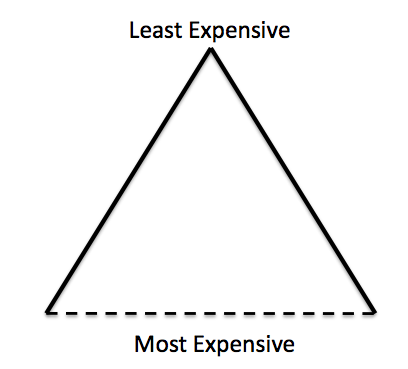
Figure 5. Resource triangle, with dotted line indicating uncertain financial cut-off.
The amount of oil (or for that matter, any other resource) isn’t a fixed amount. If the price can be made to rise to a very high level, the quantity that can be extracted will also tend to rise–in fact, by a rather large amount. The “catch” is that wages for the vast majority of workers don’t rise at the same time. As a result, goods made with high-priced oil soon become too expensive for workers to afford, and the economy falls into recession. The result is prices that fall below the cost of production. Thus, the limit on oil supply is not the amount of oil in the ground; instead, it is how high oil prices can rise, without causing serious recession.
While wages don’t rise with spiking oil prices, increasing debt can be used to hide the problem, at least temporarily. For example, cars and homes become less affordable with higher oil prices, since oil is used in making them. If governments can lower interest rates, monthly payments for new homes and cars can be lowered sufficiently that new car and home sales don’t fall too far. Eventually, this cover-up reaches limits. This happens when interest rates start turning negative, as they now are in some parts of the world.
Thus, by ramping up buying power with low interest rates and more debt, governments were able to get oil prices to stay above $100 per barrel for long enough for producers to start adding production that might be profitable at that price. Unfortunately, the amount of additional oil demand isn’t really very high at that price. So, instead of running out of oil, we ran into the reverse problem–too much oil relative to the amount that the world economy can afford when oil prices are $100+ per barrel.
The attempt by governments to fix the oil shortage problem didn’t really work. Instead, it led to the opposite mismatch from the one we were expecting. We got an oversupply problem–a problem of finding enough space for all our extra supply (Figure 6). Unless we have infinite storage, this pattern clearly cannot continue forever.

Figure 6. Weekly ending stocks of crude oil and petroleum products through July 29. Chart by EIA.
Eventually, this oversupply problem is likely to result in “mother nature” cutting off oil production in whatever way it sees fit–oil prices dropping to close to zero, bankruptcies of oil companies, or collapses of oil exporters. With lower oil supply, we can expect recession.
Misunderstanding the Real Problem
In the early 2000s, the story that Peak Oilers came up with (or perhaps the way it was interpreted in the press) was that the world was “running out” of conventional oil, and that this would lead to all kinds of problems. Oil prices would rise very high, and oil depletion would take place over a long period, as shown in a symmetric Hubbert Curve. As a result, at least small quantities of additional energy products with high “Energy Returned on Energy Invested” (EROI) were needed to supplement the energy products that would be produced based on the slowly depleting Hubbert Curve. Our oil supply problems were viewed as a unique situation, calling for new and unique solutions.
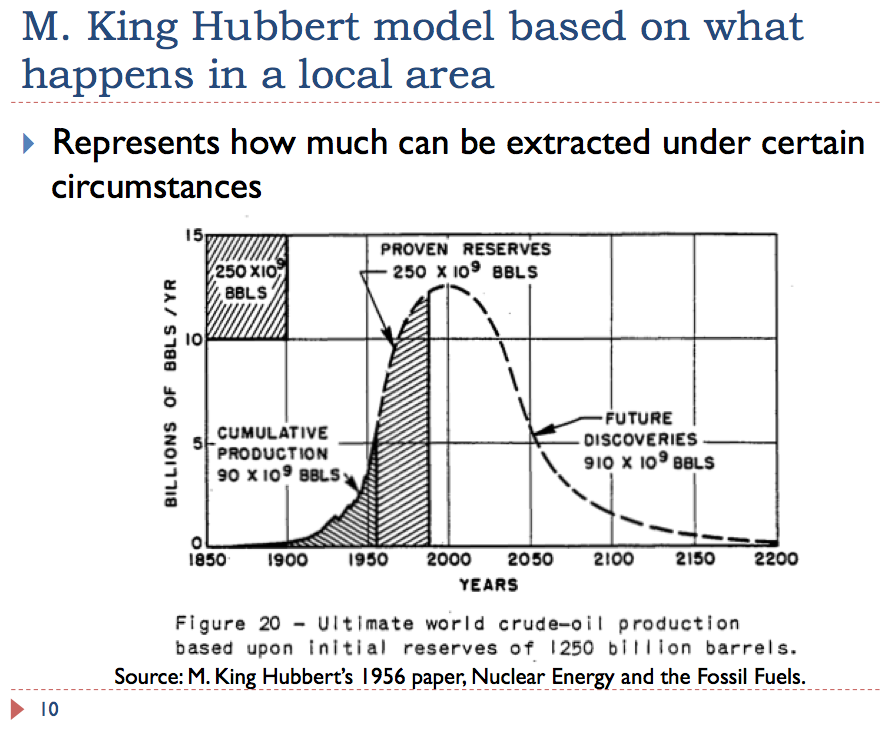
In my view, this story came about through over-reliance on models that likely were accurate for some purposes, but not for the purpose that they later were being used. One of these over-extended models was the supply and demand curve of economists.
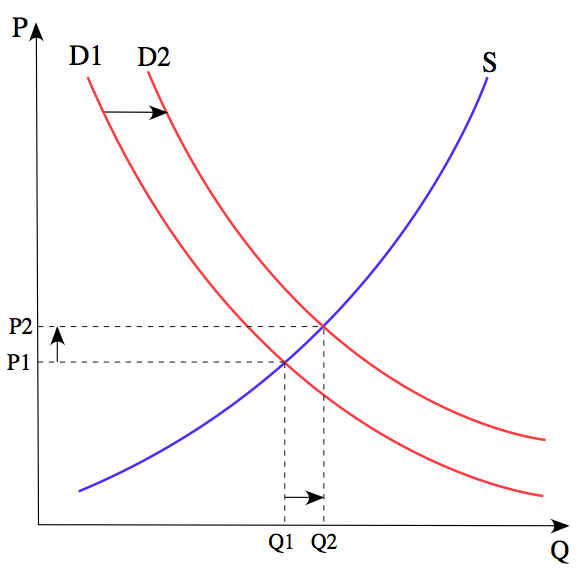
Figure 7. From Wikipedia: The price P of a product is determined by a balance between production at each price (supply S) and the desires of those with purchasing power at each price (demand D). The diagram shows a positive shift in demand from D1 to D2, resulting in an increase in price (P) and quantity sold (Q) of the product.
This model “works” when the goods being modeled are widgets, or some other type of goods that does not have a material impact on the economy as a whole. Substituting high-priced oil for low-priced oil tends to make the economies of oil importing countries contract. This effect indirectly reduces demand (and thus prices) for many products (not just oil), an impact not considered in the simplified Supply and Demand model shown in Figure 7. Also, the very long lead times of the oil industry are not reflected in Figure 7.
Two other models that were used beyond the limits for which they were originally designed were the Hubbert Curve and the 1972 Limits to Growth model. Both of these models are suitable for determining approximately when limits might be hit. Even though Peak Oilers have believed that these models can accurately determine the shape of the decline in oil supply and in other variables after reaching limits, there is no reason why this should be the case. I talk about this problem in my recent post, Overly Simple Energy-Economy Models Give Misleading Answers. Thus, for example, there is no reason to believe that 50% of oil will be extracted post-peak. This is only an artifact of an overly simple model. The actual down slope may be much steeper.
The Real Story of Resource Limits that We Are Reaching
Instead of the scenario envisioned by Peak Oilers, I think that it is likely that we will in the very near future hit a limit similar to the collapse scenarios that many early civilizations encountered when they hit resource limits. We don’t think about our situation as being similar to early economies, but we too are reaching a situation of decreasing resources per capita (especially energy resources). The resource we are most concerned about is oil, but there are other resources in short supply, including fresh water and some minerals.
Research by Joseph Tainter and by Peter Turchin indicates that some of the issues involved in previous resource-based collapses are the following:
Growing Complexity. Citizens who discovered they were reaching resource limits typically tried to work around this problem. For example, hunter-gatherers turned to agriculture when their population grew too large. Later, civilizations facing limits added irrigation to raise food output, or raised large armies so that they could attack neighboring countries. Making these changes required greater job specialization and more of a hierarchical system–two aspects of growing complexity.
This increased complexity used part of the resources that were in short supply, since people at the top of the hierarchy were paid more, and since building new capital goods (today’s example might be wind turbines and solar panels) takes resources that might be used elsewhere in the economy. Eventually, growing complexity reaches limits because costs rise faster than the benefits of growing complexity.
Growing Wage Disparity. With growing complexity, wage disparity became more of a problem.

Figure 8. People at the bottom of a hierarchy are most vulnerable.
I have described this problem as “Falling Return on Human Labor Invested.” Ultimately, this seems to be a major cause of collapse. Workers use machines and other tools, so this return on human labor has been leveraged by fossil fuels and other energy resources used by the system.
Spiking Resource Prices. Initially, when there is a shortage of food or fuel, prices are likely to spike. A major impediment to long-term high prices is the large number of people at the bottom of the hierarchy (Figure 8) who cannot afford high-priced goods. Thus, the belief that prices can permanently rise to high levels is probably false. Also, Revelation 18: 11-13 indicates that when ancient Babylon collapsed, the problem was a lack of demand and low prices. Merchants found no one to sell their cargos to; no one would even buy human slaves–an energy product.
Rising Debt. Debt was used to enable complexity and to hide the problems that people at the bottom of the resource triangle were having in purchasing goods. Ultimately, increased debt was not successful in solving the many problems the economies faced.
Ultimately, Failing Governments. Governments need resources for their purposes, whether hiring armies or making transfer payments to the elderly. The way governments get their share of resources is through the use of tax revenue. When people at the bottom of the hierarchy were cut out of receiving adequate resources (through low wages), the amounts they could afford to pay in taxes fell. Governments would sometimes collapse directly from lack of tax revenue; other times collapses occurred because governments could no longer afford large enough armies to defend their borders.
Ultimately, Falling Population. With low wages and governments requiring higher tax levels to fund their programs, people at the bottom of the hierarchy found it difficult to afford adequate nutrition. They became more susceptible to plagues. Loss of battles to neighboring countries could at times play a role as well.
Lessons We Should Be Learning
Even if we made it past peak conventional oil, there is likely a different, very real collapse ahead. This collapse will occur because the economy cannot really afford high-priced energy products. There are too many adverse feedbacks, including increasing wealth disparity and the likelihood of not enough revenue for governments.
We can’t count on long-term high prices. The idea that fossil-fuel prices will gradually rise, and because of this, we will be able to substitute high-priced renewables, seems very unlikely. In the United States, our infrastructure was mostly built on oil that cost less than $20 per barrel (in 2015 dollars). We know that with added debt and greater complexity, we were temporarily able to get oil to a high-price level, but now we are having a hard time getting the price level back up again. We really don’t know high a price the economy can afford for oil for the long term. The top price may not be more than $50 per barrel; in fact, it may not be more than $20 per barrel.
We need to look for inexpensive replacements for both oil and electricity. Many substitutes are being made to produce electricity, since indirectly, electricity might act to replace some oil usage. There is considerable confusion as to how low these prices need to be. In my opinion, we can’t really raise electricity prices without pushing economies toward recession. Thus, we need to be comparing the cost of proposed replacements, including long distance transport costs and the cost of adjustments needed to match electric grid requirements, to wholesale electricity prices. In both the US and Europe (Figure 9), this is typically less than 5 cents per kWh. (In Figure 9, “Germany spot” is the wholesale electricity price in Germany–the single largest market.) At this price level, producers need to be profitable and to pay taxes to help support governments.

Figure 9. Residential Electricity Prices in Europe, together with Germany spot wholesale price, from http://pfbach.dk/firma_pfb/references/pfb_towards_50_pct_wind_in_denmark_2016_03_30.pdf
Replacements for oil need to be profitable and be able to pay taxes, at currently available price levels–low $40s per barrel, or less.
We need to be careful in aiming for high-tech solutions, because of the complexity they add to the system. High tech solutions look wonderful, but they are very difficult to evaluate. How much do they really add in costs, when everything is included? How much do they add in debt? How much do they add (or subtract) in tax revenue? What are their indirect effects, such as the need for more education for workers?
We need to be alert to the possibility that solar PV and most wind energy may be energy sinks, rather than true energy sources. The two hallmarks of providing true net energy to society are (1) being able to provide energy cheaply, and (2) being able to provide tax revenue to support the government. When actually integrated into the electric grid, electricity generated by wind or by solar generally requires subsidies–the opposite of providing tax revenue. Total costs tend to be high because of many unforeseen issues, including improper siting, long-distance transport costs, and costs associated with mitigating intermittency.
Unless EROI studies are specially tailored (such as this one and this one), they are likely to overstate the benefit of intermittent renewables to the system. This problem is related to the issues discussed in my recent post, Overly Simple Energy-Economy Models Give Misleading Answers. My experience is that researchers tend to overlook the special studies that point out problems. Instead, they rely on the results of meta-analyses of estimates using very narrow boundaries, thus perpetuating the myth that solar PV and wind can somehow save our current economy.
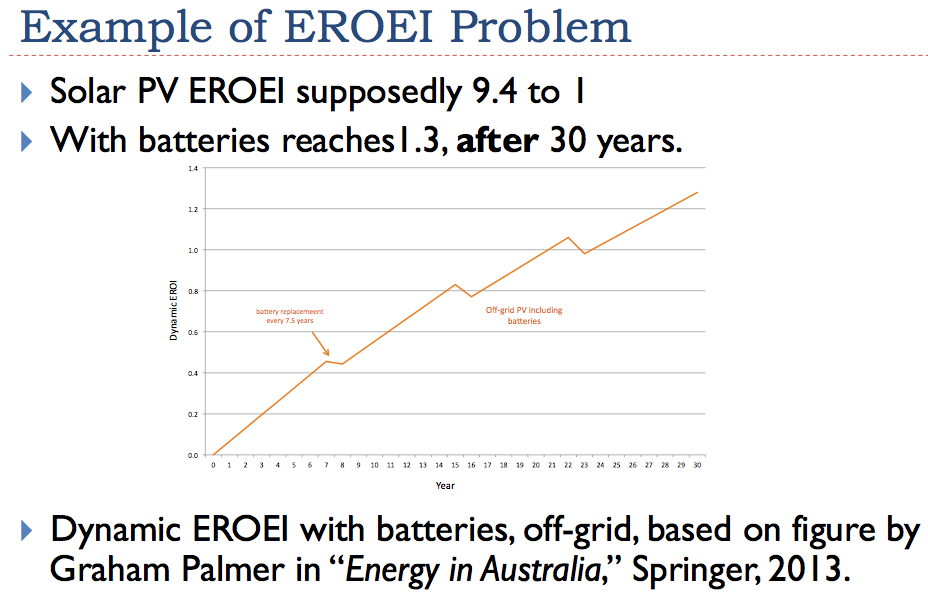
Too much debt, and too low a return on debt, are likely to be part of the limit we will be reaching. Investment in complexity requires debt, because complexity requires capital goods such as wind turbines, solar panels, computers and the internet. The return on this additional debt is likely to drop lower and lower, as complex solutions are added that have less and less true value to society.
We need to remember that as far as the economy is concerned, it is total consumption of energy resources that is important, not just oil. Wages reflect the leveraging impact of all energy sources, not just oil. If energy consumption per capita is rising, more and better machines can help raise output per capita, making workers more productive. If energy consumption per capita is falling, the world economy is likely moving in the direction of contraction. In fact, we may be headed in the direction of early economies that eventually collapsed.
When we look at the data, we see that world energy consumption per capita appears to have peaked about 2013. In fact, the big drop in oil and other commodity prices began in 2014, not long after energy consumption per capita hit a peak.

Figure 10. World energy consumption per capita, based on BP Statistical Review of World Energy 2105 data. Year 2015 estimate and notes by G. Tverberg.
The world seems to have hit peak coal, because of low coal prices. In fact, falling coal consumption seems to be the cause of falling world energy consumption per capita. Whether or not most people regard coal highly, coal is pretty much essential to the world economy. A recent decrease in coal consumption is what is pulling world energy consumption per capita down. We do not have any other cheap fuel to make up the shortfall, suggesting that our current downturn in energy consumption (shown in Figure 10) may be permanent.
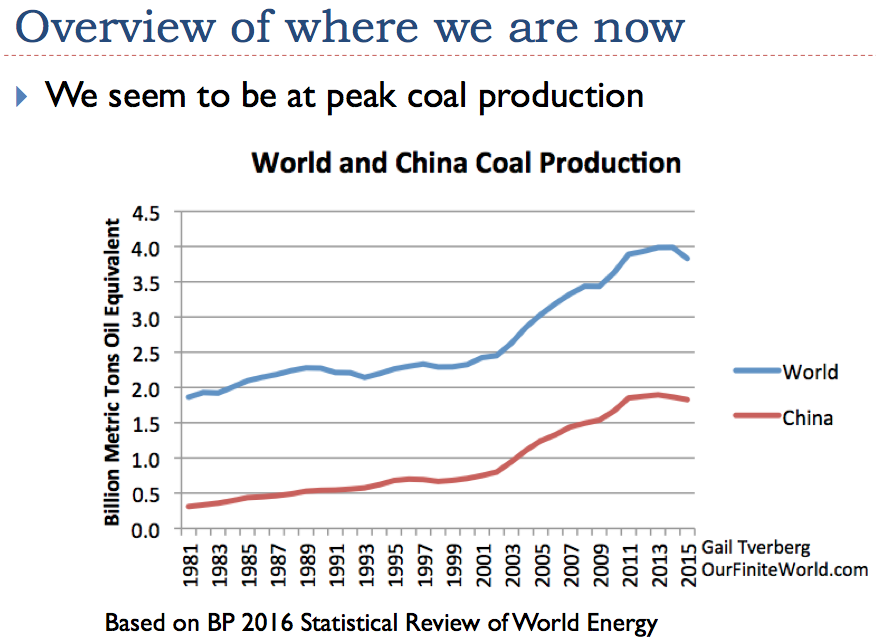
Figure 11. World and China appear to be reaching peak coal.
We should not be surprised if the financial problems that the world is now encountering will eventually resolve badly. This seems to be how the Peak Oil story will finally play out. Without rising energy per capita, the world economy tends to shrink. Without economic growth, it becomes very difficult to repay debt with interest. Wealth disparity becomes more and more of a problem, and it becomes increasingly difficult for governments to collect enough revenue to support their needs. Our problems begin to look more and more like those of earlier economies that hit resource limits, and eventually collapsed.
Gail Tverberg Our Finite World
88 Comments on "An Updated Version of the “Peak Oil” Story"
onlooker on Tue, 9th Aug 2016 6:25 am
I will sum in a brief paragraph . LTG was right back in the 70’s. Any way you look at it, population and consumption levels are depleting the vitality and abundance of Earth even as humans continue endeavoring to grow in both ways. So Nature will not abide and so logically, famine, plague and disease will ensue
shortonoil on Tue, 9th Aug 2016 6:34 am
“There is no single definition for conventional oil.”
Our definition of conventional crude is a liquid hydrocarbon that lays in 30° to 45° API window. We call that the “energy window”. It is the range of specific gravities were liquid hydrocarbons are generally capable of being net energy providers. It is the range of products that are capable of maintaining self sustaining production. Most products outside of that window require energy inputs from other sources to be produced, or provide such small amounts of energy that the system required to produce them could not be adequately powered.
The useable segment of the liquid hydrocarbon group consists of about 40% of the total. Supply and demand relationships can only apply to the net energy producing segment of the liquid hydrocarbon family. The remainder only has value as feedstock to an economic system that is already adequately powered.
http://www.thehillsgroup.org/
penury on Tue, 9th Aug 2016 10:01 am
Short: I really wish that there was a way to force the understanding of what you wrote on the majority of the population, The last two statements seem to sum up the predicament we face.
Don Stewart on Tue, 9th Aug 2016 10:27 am
I attempted to post this as a reply on Gail’s site. It hasn’t appeared, as yet….Don Stewart
PS I do not represent any of the people referenced, and the errors are mine alone.
This will be a sort of philosophical investigation into some of the current issues facing humanity and civilization. Humans are, at the cellular level, eukaryotes. Evolution has provided us with everything we need to prosper at the cellular level. Eukaryotes have branched repeatedly to inhabit a wide array of possible morphological spaces, and we humans are on the branch of the great apes. We are a rather peculiar great ape, however, and we have evolved what we can label ‘civilization’ as a way of living in the world. Given all the complexity of biology and ecology and economics and sociology and so forth for all the sciences, there are an infinite number of questions one might ask about our condition, and seek to use science to find tentative answers.
I want to consider a fairly narrow set of questions. These will be, of necessity, dealt with here mostly as abstractions, but I want to start with something very concrete. Almost every Sunday morning, my wife and I go to the lawn in front of our food co-op. The co-op sponsors bands which play music. I want to focus on one particular group which comes to experience the music and the lawn and the sociology: parents and babies and toddlers and dogs. When the band begins to play, toddlers who can stand, but can’t yet walk, begin to move their bodies up and down in time to the music. If the toddler can propel themselves, they run, not walk, across this great expanse of lawn. Friendships are born and flourish and then dissolve. My wife and I admire the radiant magic parents with their beautiful magic babies. What we see every Sunday morning is, to me, part of the bedrock of value in this world. I, personally, wouldn’t be caught dead listening to a sermon, instead. I joke with my wife that ‘there is no problem that can’t be solved by a good hard run across a lawn’. And dancing to music solves whatever can’t be solved by running.
Adrian Bejan, discoverer of the Constructal Law, would understand completely, if he would drive the dozen miles from Duke University over to my co-op. Bejan describes life as free movement across the landscape with the potential for evolution toward easier movement. Erwin Schrodinger (of quantum physics fame), who wrote the book What Is Life in 1944, would understand. But Schrodinger noted that if he had been writing the book for physicists, he would have focused on Free Energy. He would note that no toddler who can run, ever walks…and would have nodded knowingly.
Now one can identify lots of other characteristics of those toddlers and parents and the economics and the sociology and the political and so forth and so on to talk about. One could spend a lifetime, for example, exploring the development of the fertilized egg into a newborn and then into an adult human. But I want to focus here on the Free Energy angle.
Nick Lane, in his book The Vital Question: Energy, Evolution, and the Origins of Complex Life, traces out how biology becomes a predictive science when we understand the symbiosis between two microbes in our eukaryotic cells, and the enormous gain in free energy per gene which that symbiosis bestowed upon us. Lane quotes a figure of 200,000 times more free energy per gene for the eukaryotic cells than for a bacteria or an archaea. The increased energy allows for the morphological diversity we see around us. But the symbiosis between two autonomous entities also creates complexity. You’ll have to read the book to understand, but imagine a human marriage. Things do not always run smoothly because two people never actually become one. Lane shows how, knowing about the increase in energy and the complexity of dealing with two autonomous entities, we can predict many of the characteristics of eukaryotes, including sex and death. Bacteria and archaea do not have sex and are, in principle, immortal.
So, I will suggest that we focus on Free Energy, Movement, and Complexity. Complexity defined as the friction from the action of autonomous agents, each pursuing their own goals but also part of a larger web of life. We can look at Civilization as the current form taken by humans who have a lot of Free Energy, freedom to Move, and few legal restrictions on Complexity.
Simply by virtue of being eukaryotes, humans have an enormous amount of Free Energy. We have enough Free Energy to live very well as Evolution prepared us to live. But humans also discovered Fossil Energy, and created a world that we did not evolve to live in. If we look closely, we will find analogs to the friction of Complexity that Nick Lane describes. For example, Evolution prepared us to go to sleep at sundown and to wake up at sunrise. But Fossil Energy allows us to aspire to a 24/7 lifestyle. As any doctor will tell you, the 24/7 lifestyle creates friction with our eukaryotic heritage, and disease is the result. So the Fossil Energy heritage is best seen not as some god-given gift, but as a double-edged sword.
So the situation we find ourselves in, early in the 21st century, is that billions of us are dependent on Fossil Energy, and we have indications that the Free Energy from Fossil Energy is actually in decline. We could, of course, choose to revert back to living simply as a great ape with eukaryotic cells, but there are enormous costs in going back. Looking at the lawn at my food co-op, for example, we will find that many of the people drove an automobile to get there. My wife and I live 8 miles away, and would not likely walk the 16 mile round trip very often. A person walking uses about 10 BTUs per day, while the average human on earth uses around 50,000 oil BTUs for transportation. So it is natural that we examine the possibilities for continuing with some semblance of our current Fossil Energy Civilization.
Two methods have been used to estimate the Free Energy available to us to use for transportation. The first method is bottoms up, and the second is top down. The bottom up methods have been studied by Charles Hall and others. (Link at bottom.) These are frequently called EROEI studies, but they have a broader use, which I will discuss later. The bottom up methods can be used to determine EROEIs with different boundaries: at the well head, at the pump, and what Hall calls ‘extended EROEI’, which is the energy boundary which is necessary to make the product minimally useful to society, such as having a truck to burn the diesel. The top down method is featured in The Hills Group’s thermodynamic model based on an analysis of time series data, the ETP model. The ETP model is featured in Louis Arnoux’s three articles on Ugo Bardi’s site (link at bottom). Both the bottom up and the top down approaches yield consistently pessimistic analyses of the prospects for continuation of our current approach to Fossil Energy Civilization. The top down model indicates that, doing business the way we do it today, we will have a continuously declining Free Energy from oil (which is the key transport fuel). And since transportation is a key to the functioning of the global economy, less oil means declining money incomes. A comparison of outstanding debt to expected production of Free Energy from oil indicates that most of the debt will never be repaid. Consequently, many people who perceive themselves to be rich because they have paper claims on the future, are actually quite poor. It is worthwhile to look at a paper dollar and see it labeled as a ‘Note’…a debt.
While the ETP model is based on time series data, there is also considerable data about components of interest, such as the energy cost of refining oil. The ETP model was constructed so that a conventional EROEI could be calculated. The bottom up methods also look at these components. So, for example, Charles Hall and collaborators looked at how the energy in a barrel of oil is spent:
Out of 100 units…10 for extraction, 27 for refining, 5 for distribution, 37.5 for infrastructure, leaving 20.5 for consumer use.
These data are generally consistent with the data collected by The Hill’s Group. One should also note that oil is generally used in an internal combustion engine, which is about 20 percent efficient, and vehicles are inefficient due to things like embodied energy, air drag and rolling resistance. So small amounts of the original energy in the oil are actually available to do useful work. The takeaway here is that if energy can be saved with less costly refining and more efficient engines, then perhaps it is possible to extend Fossil Energy Civilization for some additional years. Both Arnoux and The Hill’s Group are currently involved in exploring such avenues.
Other individuals and groups have looked at the same questions, and have arrived at much the same answers. The physicist Robert Ayres, for example, produced estimates of very low efficiency of transportation a decade or so ago. The Ellen MacArthur Foundation sponsored a study of personal automobile use in Europe which concluded that personal automobiles operate at very low efficiency, measured by payload delivered over distance:
‘The core challenge is the waste embedded in the transport system. The European car is parked (often on expensive inner-city land) 92 percent of the time. When the car is used, only 1.5 of its 5 seats are occupied. Although energy conversion cannot reach 100 percent due to the Carnot cycle, less than 20 percent of petrol propels the wheels. With a deadweight ratio around 12:1, only 1–2 percent of the energy moves people.’
Charles Hall states regarding bottom up EROEI studies that:
‘Societal EROI (EROISOC): Societal EROI is the overall EROI that might be derived for all of a nation’s or society’s fuels by summing all gains from fuels and all costs of obtaining them. To our knowledge this calculation has yet to be undertaken because it is difficult, if not impossible, to include all the variables necessary to generate an all-encompassing societal EROI value’
We may consider the work of The Hill’s Group as being a study of oil from a societal point of view, but the time series methodology is not that of a bottom up EROEI study. It is interesting that Hall has asked The Hill’s Group to submit their study for publication in his Journal. It is my understanding that several PhDs are collaborating with The Hill’s Group for the published study.
The innovation efforts by The Hills Group, Louis Arnoux, and the Ellen MacArthur Foundation are all attempts to extend Fossil Energy Civilization. On the other side of the coin, some groups are working on simply adapting to lower Free Energy by reverting to the lifestyle that Evolution prepared us to lead: big brained primates. Transition Towns and Simplicity movements and New Agrarianism or Neo-Peasant movements all accept that we are just going to have to live with less Free Fossil Energy.
I hope that this survey clarifies some questions…Don Stewart
Links:
Charles Hall
EROI of different fuels and the implications for society
http://www.sciencedirect.com/science/article/pii/S0301421513003856
Ellen MacArthur Foundation download study of transportation:
https://www.ellenmacarthurfoundation.org/publications/growth-within-a-circular-economy-vision-for-a-competitive-europe
Louis Arnoux, building on The Hill’s Group
http://cassandralegacy.blogspot.com/2016/07/some-reflections-on-twilight-of-oil-age_88.html
(click links for 2 earlier installments)
JGav on Tue, 9th Aug 2016 10:42 am
Yes Short and Pen,
Big predicament indeed! Available energy per capita already declining! Which means price hikes will ensue for electricity of all kinds, natural gas and petroleum products. There are two things we can’t say with a high degree of certainty for the moment: One is the time frame for a major reckoning, paradigm shift, whatever you want to call it. However, beyond 10 years looks like a stretch at this point, due to potential financial-system and climatic/environmental upheaval. The second is the speed and depth of the shift. How far, how fast? Gradual and semi-managed or a ‘Big Lurch’ into chaos? I don’t pretend to have the answers. If you do, please fill me in …
rockman on Tue, 9th Aug 2016 10:45 am
“Our definition of conventional crude is a liquid hydrocarbon that lays in 30° to 45° API window.” That’s OK: these days everyone is free to make up there own definitions to fit their preferred spin. But it can make for some confusion. For the oil patch definition there is no such thing as “conventional/unconventional” oil. But there is oil produced from conventional/unconventional RESERVOIRS.
Such as the BILLIONS of bbls of oil with an API less the 30 that have been produced from CONVENTIONAL sandstone reservoirs. Just as there has been BILLIONS of bbls of light condensate that have been produced from conventional NG reservoirs. And thus a source of confusion. Consider that the Texas Rail Road Commission doesn’t even use the API weight to distinguish “oil” from “condensate”: one field mighmighht have production posted for 42 API OIL from one field and 38 API CONDENSATE from another field.
“Massive investments in the Kashagan Oil Field in Kazakhstan were enabled by high oil prices.” And again another lazy writer that didn’t bother to do a 5 minute web search. The field was discovered in 2000 with development beginning in 2001. The inflation adjusted oil price during the first 4 years of development was less than $40/bbl. But glad they mention the field because it can highlight the misuse of ultimate recoverable reserves as some aspect of the PO dynamic. The 13 BILLION BBLS OF URR might give the impression of significant relief from the negative effects of PO. But consider that the max production rate (what matters in a PO world) is 450,000 bopd…about 0.5% of current global production. And while they are still years away from reaching that max rate it will still take 80 years to produce the 13 billion bbls of oil. Which isn’t true since that calc assumes no production decline over time and that’s impossible. The field might be the biggest discovery in 30 years but it will have the slowest recovery of any giant oil field in the history of the petroleum age.
PracticalMaina on Tue, 9th Aug 2016 12:50 pm
This puts things in perspective IMHO. Why does someone need to get millions in revenue for overseeing a destructive act. Are they going to get black lung? If Bush, Trump and the likes of them can run a company, a drunk chimp can…
http://www.greentechmedia.com/articles/read/one-year-of-coal-ceo-pay-could-retrain-all-workers-for-solar-industry
Plantagenet on Tue, 9th Aug 2016 1:06 pm
One of Gail’s best posts ever.
She accurately sums up what went wrong with earlier predictions of peak oil and its consequences, and lays out an approach that can be used to face up to the actual problems we face today including the current oil glut, and the potential shortfall in global oil production that will likely follow in a few years.
Cheers!
Plantagenet on Tue, 9th Aug 2016 1:08 pm
PS: I recommend Rockman’s post above. There is some confusion about what is conventional oil and what isn’t, and Rockman’s focus on CONVENTIONAL reservoirs vs. UNCONVENTIONAL reservoirs is a logical way to think about this issue.
Cheers!
PracticalMaina on Tue, 9th Aug 2016 1:16 pm
Plant, oil cos hemorrhaging money sounds more like the solution than the problem to me.
We waste 50% of all food produced in this country. Therefore we could do with 50% less industrial agriculture.
If everyone in this country spent the time growing sustainable food we do driving or flying or sitting in front of electronics, the worlds ecosystems would not be getting nearly as devastated.
IPissOnLoser on Tue, 9th Aug 2016 2:17 pm
There is no single definition for conventional oil.
This women simple does not know what she is talking about. A simple google search will have given her a valid definition of conventional oil. If everyone uses the same definition of conventional oil, it means there is one single definition,
http://www.albertacanada.com/business/industries/og-conventional-crude-oil-and-oil-sands.aspx
Conventional oil is a mixture of mainly pentanes and heavier hydrocarbons recoverable at a well from an underground reservoir and liquid at atmospheric pressure and temperature. Unlike bitumen, conventional oil flows through a well without stimulation and through a pipeline without processing or dilution.
Alberta’s oil industry began producing conventional oil in 1914 at the Turner Valley field before the major discovery of Leduc Woodbend in 1947. In Alberta, conventional oil includes light, medium and heavy crude oils.
Conventicle oil is oil that provide the most net energy to society. There is nothing else to add. Peak net energy was in 2005 at the same time of peak conventional oil.
Apneaman on Tue, 9th Aug 2016 2:31 pm
Low oil prices keep oilsands project shuttered long after wildfire put out
“CALGARY – The operator of one of Alberta’s oldest thermal oilsands projects, shut down during the Fort McMurray wildfire in May, says it will remain closed until benchmark oil prices improve to above US$50 per barrel.”
http://www.660news.com/2016/08/08/low-oil-prices-keep-oilsands-project-shuttered-long-after-wildfire-put-out/
marmico on Tue, 9th Aug 2016 2:35 pm
Peak net energy was in 2005 at the same time of peak conventional oil.
So if there were 73 units (mb/d) of oil produced in 2005 and 80 units of oil produced in 2015, there is no net gain in oil energy?
Bull shit.
The Turdburger does serve up semi-monthly shit sandwiches for those who choose to belly up to the table. When do they start belly laughing instead of bellying up?
Apneaman on Tue, 9th Aug 2016 2:38 pm
“There is no single definition for conventional oil.”
Why do folks think that?
How changing the definition of oil has deceived both policymakers and the public
“It’s wrong not because the range quoted above can’t be found in official sources. It’s wrong because the numbers include things which are not oil such as natural gas plant liquids and biofuels. If you strip these other things out, then world oil production has been running around 75 mbpd this year. The main thing you need to know about the worldwide rate of production of crude oil alone is that it has been stuck between 71 and 75 mbpd since 2005 (calculated on a monthly basis). And, that has already had huge negative effects on the world economy and world society through high energy prices that are partly responsible for our current economic stagnation.”
http://resourceinsights.blogspot.ca/2012/07/how-changing-definition-of-oil-has.html
ghung on Tue, 9th Aug 2016 2:52 pm
I figured that marmiscum would show up eventually to confirm that he doesn’t know the difference in total production and net per-unit energy derived from that production. Same marmiscum that ignores that markets have been grossly distorted by cheap credit, growing debt levels, and outright fraud in the sector he so worships.
Thanks for the laughs, marmi. Go back to church.
onlooker on Tue, 9th Aug 2016 3:00 pm
What can you say to someone who compares total to net oil ? Nothing because your talking to an imbecile.
marmico on Tue, 9th Aug 2016 4:09 pm
You need some Viagara to keep impregnating those rutabagas, ghung?
Any grade schooler knows more about EROI (net energy) than the Turdburger.
EROI is about supply of energy. The supply of gasoline in my tank is the highest EROI in the history of the oil market.
On the demand side I can drive from NYC to LA for half the gasoline gallons than 50 years ago.
More net energy supplied, 50% less net energy demanded to travel cross country.
On the EROI supply side,
Formula 1 (1966 proxy):
100 x (0.97) x (0.90) x (0.80) x (0.90)
Formula 2 (2016 proxy):
100 x (0.93) x (0.95) x (0.90) x (0.95)
What’s the highest number for grade school arithmeticians?
The 4 numbers in brackets, in order are:
1. well head energy efficiency
2. transportation energy efficiency from the well head to the refinery
3. refining and processing energy efficiency
4. distribution energy efficiency from the refinery to the gasoline station
Apneaman on Tue, 9th Aug 2016 4:21 pm
marmi, can you afford the gas? Apparently for an entire generation the gas is all they can afford and half the time they need a payday loan or to pawn their laptop to fill up. Fill up the car they bought on 7 year financing. Yep your neoliberal paradise is looking reeeeeeeel good. Bright future.
Homeownership Rate in the U.S. Drops to Lowest Since 1965
http://www.bloomberg.com/news/articles/2016-07-28/homeownership-rate-in-the-u-s-tumbles-to-the-lowest-since-1965
Why are millennials turning to payday loans and pawn shops
http://www.pbs.org/newshour/making-sense/why-are-millennials-turning-to-payday-loans-and-pawn-shops/
Four Ways Student Debt Is Wreaking Havoc on Millennials
http://www.bloomberg.com/news/articles/2015-12-10/four-ways-student-debt-is-wreaking-havoc-on-millennials
ghung on Tue, 9th Aug 2016 4:27 pm
Is it just me, or does anyone else find marmico’s fascination with vegetables as sex objects, and his repeated anthropomorphising of fecal matter, pretty nauseating? Maybe he should stick to formulas that describe how he combines those things into one comment, as he has a habit of doing. Maybe someone will listen for a change; someone doing a psychiatry thesis on encopresis/coprophilia combined with a vegetable fetish.
Get help, marmi.
Sissyfuss on Tue, 9th Aug 2016 5:08 pm
Smarmis’ foul mouth is the manifestation of his foul mind. And his math skills the product of having a rutabaga for a father.
Hello on Tue, 9th Aug 2016 7:53 pm
AdamB the village know-it-all won’t like this story. Could it be that after all the earth is in fact finite? Not if you’re to believe AdamB’s gibberish.
shortonoil on Tue, 9th Aug 2016 8:39 pm
Hi Don Stewart,
As always interesting thoughts from you. Maybe another PH.D joins the fray. These guys love doing this stuff – I love finishing it. Maybe that is why I never got a PH.D. Couldn’t have stood myself. Thanks for your support.
BW Hill
Plantagenet on Tue, 9th Aug 2016 8:45 pm
@Practical mania
Do you really spend all your time growing your own food? Wow! that’s impressive.
But don’t you ever get bored and just want to go out shopping? On friday night don’t you want to kick back and relax for one night and go to a comedy club and order a beer and a burger?
Cheers!
Plantagenet on Tue, 9th Aug 2016 8:53 pm
I enjoyed Don Stewart’s erudite post above, but I can tell Don Stewart is a new poster at this site. He keeps saying that we are all eukaryotes—-but based on their posts there are a few folks here who probably aren’t eukaryotes.
Please post more cool stuff, Don. And don’t let yourself get distracted by the highly negative replies you may get from the occasional non-eukaryote.
Cheers!
shortonoil on Tue, 9th Aug 2016 8:56 pm
“EROI is about supply of energy. “
EROI is a dimensionless ratio. It is an F’ing number you dimwitted escapee from the Zoo. Pour the gasoline up your left nostril and smoke a Camel. You are crazier than two bats in a belfry. Consider getting a brain transplant from a turnip. It would smarten you up and improve your rather limited vocabulary. Find a shrink that uses hydraulic presses. Stop pretending that you are the Three Stooges all rolled into one.
Sissyfuss on Tue, 9th Aug 2016 9:01 pm
Smarmis’ foul mouth is a manifestation of his foul mind. His poor math skills are a result of being fathered by a rutabaga.
Boat on Tue, 9th Aug 2016 9:07 pm
What I find interesting is the Hill group thinks oil with api’s outside the range of 30 to 45 is not viable. Yet US refiners import 60 percent of their oil outside that range.
https://www.eia.gov/todayinenergy/detail.cfm?id=26132
Roger on Tue, 9th Aug 2016 9:31 pm
Fantastic start to this article…
“Thus, if we think of conventional oil production as that which is possible at low oil prices, the forecast by Colin Campbell and Jean Laherrère was pretty much correct. Production of conventional oil did seem to peak about 2005 or shortly thereafter. We simply don’t have the data to estimate how much we could have extracted, if oil prices had remained low. Furthermore, oil prices did rise substantially, relative to 1998 prices, making Campbell’s and Laherrère’s forecast of higher prices correct.”
Exactly.
For future reference (i.e., see below) in the following paragraph discussing the ramifications of peak “conventional (aka, cheap) oil” the author notes (that the law of supply and demand is applicable to oil):
“It is possible that if total supply were very short, oil prices would have spiked to even a higher level than they really did.”
However, after admitting the obvious, she attempts to cover her thesis in this article with the unsupported disclaimer that:
“The resulting recession would likely have brought prices down, and temporarily brought demand back in line with supply.”
One need only look at the last 10 years of world wide oil consumption (steadily growing at around 1 MM bbl/d each year–despite quadrupling in price) to realize this simply isn’t true. In fact, Fig. 8 from another article by this same author presents the case:
https://ourfiniteworld.com/2015/06/23/bp-data-suggests-we-are-reaching-peak-energy-demand/
Following this, the author veers off on the “total liquids” vs crude oil tangent. I won’t pursue this now beyond the hopefully obvious observation that for the most part, the two (condensate and GPLs vs crude) are distinct and not interchangeable in application. (Of course, this tangent is needed for the article…that is, demonstrating growth in “total liquids” after acknowledging a peak in “cheap oil.” Perhaps that’s why they took to reporting such…instead of crude oil?)
The author then once again (as above) restates the “obvious” law of supply and demand):
“The amount of oil (or for that matter, any other resource) isn’t a fixed amount. If the price can be made to rise to a very high level, the quantity that can be extracted will also tend to rise–in fact, by a rather large amount.”
However, she then divulges her thesis…a “catch” to the law of supply and demand she has “discovered”:
“The “catch” is that wages for the vast majority of workers don’t rise at the same time. As a result, goods made with high-priced oil soon become too expensive for workers to afford, and the economy falls into recession. The result is prices that fall below the cost of production. Thus, the limit on oil supply is not the amount of oil in the ground; instead, it is how high oil prices can rise, without causing serious recession.”
Let’ break this down:
1. Wages don’t rise…agreed.
2. Goods made with oil become unaffordable…agreed, with the provision that a $5 cup of coffee will become unaffordable long before a $10 gallon of gasoline.
3. The economy falls into recession…agreed, with the provision that the “central banksters” aren’t able to find a new way to drop “helicopter money” into the public’s lap…while at the same time convincing other nations to accept their fiat currency as payment for tangible goods.
4. The price of oil falls below the cost of production…agreed, with the provision that John Q. Public is unaware that “peak oil” is in the rear view mirror. When that happens, “fear” will replace “greed” as the market driver. Hoarding will result (e.g. building “strategic reserves” as China and India are doing), and the markets will change. It won’t be a straight path up, but the boyz on Wall Street won’t be able to push it below the cost of production for a significant timespan…to many buyers.
5. Thus, the limit on oil supply isn’t the amount in the ground…agreed.
6. The limit on oil supply is how high prices can rise without causing a serious recession…wrong. See above graph–worldwide demand is growing steadily. If and until population, or the desire for a “western lifestyle”, reverses, that will continue. Do note, demand in the “first world” nations is about flat…we’re no longer driving the price.
Most strangely, after twice affirming the law of supply and demand regarding oil (see above) she next attempts to make the case it’s not really applicable. Really? Or is it merely a case of “you can’t handle the truth.”
One final comment, the author’s (lack of) understanding of Bible prophecy is on par with her fluency in basic economics:
“Also, Revelation 18: 11-13 indicates that when ancient Babylon collapsed, the problem was a lack of demand and low prices. Merchants found no one to sell their cargos to; no one would even buy human slaves–an energy product.”
Revelation 18 is a prophecy pertaining to the future…it has absolutely nothing to do with “ancient” Babylon. It’s “collapse” as she phrases is brought about by a direct judgement of God…and has absolutely nothing to do with “low prices.” In fact, the book of Revelation actually foretells unbearably high prices relative to wages:
“When He broke the third seal, I heard the third living creature saying, “Come.” I looked, and behold, a black horse; and he who sat on it had a pair of scales in his hand. And I heard something like a voice in the center of the four living creatures saying, “A quart of wheat for a denarius, and three quarts of barley for a denarius; and do not damage the oil and the wine.””
Revelation 6:5-6 NASB
Survivalist on Tue, 9th Aug 2016 9:56 pm
it’d be interesting is crude plus condensate would be presented more clearly. I’d like to know how much is crude and how much is condensate. Of the cruse portion I’d like to know the break down of the various API’s that contribute to the total. Regarding BP and it’s ‘all liquids’, crude+condensate+Biofuels+refinery gains+NGL’s…. I’d like to know how many barrels of oil and MCF of gas went into producing the biofuels they count, otherwise it seems like double counting to me. As well if one burns all their natural gas to mine bitumen you onlyhave bitumen at the ned of the day so to count the natGas and the Bitumen in totals is also double counting. I suspect that decreasing EROI and the current 4.2% annualized decline rate in global C+C production will catch up with us shortly. I doubt the global economy can sustain high oil prices.
In Q1 2016 the USA generated 64 billion in GDP and accumulated 644 billion in debt (public and private). That’s 10 in debt for every one in GDP. 8 years after the GFC and 8 years of rock bottom interest rates and that’s all we got.
It won’t be long now. We’re on the edge of the Seneca Cliff.
ghung on Tue, 9th Aug 2016 10:10 pm
Gosh, Roger, you worked pretty hard on that. Especially the last part. You conclude:
“Thus, the limit on oil supply is not the amount of oil in the ground; instead, it is how high oil prices can rise, without causing serious recession.”
Hoping you know it’s both, and a slew of other complex/inter-related factors. Depletion of all things as demand remains stubborn because there’s no viable Plan B. Societies will be robbing Peter to pay Paul’s fuel bill for decades (barring the Second Coming).
Northwest Resident on Tue, 9th Aug 2016 10:31 pm
“EROI is about supply of energy.”
Wrong, as usual.
“The energy return on investment (EROI) is a key determinant of the price of energy, as sources of energy that can be tapped relatively cheaply will allow the price to remain low. The ratio decreases when energy becomes scarcer and more difficult to extract or produce.”
http://www.investopedia.com/terms/e/energy-return-on-investment.asp
But wait! Then the brilliant mind(s) at Investopedia, having gotten the basic definition more or less correct, go on to claim:
“The EROI for oil has decreased dramatically over the past hundred years. The amount of energy required to produce one barrel of oil has decreased as superior methods, such as fracking, have been introduced.”
Now we know where Marmico gets all his information. Figures.
By the way, excellent article on EROEI and the perilous future of oil that we must face at the following article, with lots of attribution to our resident rock star, shortonoil (aka: Hills Group)
THE COMING BREAKDOWN OF U.S. & GLOBAL MARKETS EXPLAINED… What Most Analysts Miss
https://srsroccoreport.com/the-coming-breakdown-of-u-s-global-markets-explained-what-most-analysts-missed/
Living on borrowed time. Back in 1970, it took “billion$” in debt to compensate for declining EROEI. Today, it takes TRILLION$, repeatedly, constant regular injection of massive debt into the veins of global finance to keep this brain dead and comatose patient (yeah, talking about you, BAU) zombified and lurching forward for a little while longer, one massive injection at a time. Won’t work forever, or even much longer.
shortonoil, if you’re reading this post, I have one disagreement with that SRSRocco article and what you have to say in it: We’ll never get to 25% of currently operating gas stations, not even close. Long before then, all hell will break loose and chances are that there will be a total breakdown of delivery systems. Well, that’s my prediction.
theedrich on Wed, 10th Aug 2016 12:05 am
Solution? Hillary: “Talk about it.” (But don’t actually DO anything about it, like that scary Trump fellow threatens to.)
John on Wed, 10th Aug 2016 12:27 am
I still don’t see why major governments will allow their economies to grind to a halt before (most all of) the oil is used. Who cares if Exxon goes broke? Either bail them out, or change the money rules some other way. One thing is for certain; at some point in time, the remaining oil resources will be socialized, and the free market zealots will be beside themselves.
I just don’t see where the money system has much bearing on the end game.
Apneaman on Wed, 10th Aug 2016 12:57 am
Roger and don’t forget that Gandalf said
“Until at last, I threw down my enemy and smote his ruin upon the mountainside.”
“There is only one Lord of the Ring, only one who can bend it to his will. And he does not share power.”
“The board is set, the pieces are moving. We come to it at last, the great battle of our time.”
“Many that live deserve death. And some that die deserve life. Can you give it to them? Then do not be too eager to deal out death in judgement.”
“All we have to decide is what to do with the time that is given us.”
I also have some highly relevant quotes from Aragorn, but we’ll save those for when we next play fantasy story time.
JR on Wed, 10th Aug 2016 1:28 am
Any fucking idiot that quotes biblical verses should be locked up as mentally unstable, especially when they continue to claim that such verses are “prophecy pertaining to the future”. This is a primary cause of stupid in today’s world, the denial of reality and the waiting for fantasy fulfillment, which everyone should well note, NEVER HAPPENS. It never will because the entire fraud has been exposed as a fabrication, yet idiots continue to believe in fairy tales to govern lives (lies).
Yeah, it’s personal. I’ve seen first-hand the staggering damage this sort of thinking embraces. I categorically reject this falsehood as a dangerous delusion infecting the whole species.
This website is interesting. It attracts intelligence — and idiots, yet it always seems to miss reality.
Example: Numbers are nothing more then representations of human behavior and activities (as applied to issues like peak oil). They poorly represent “what we are”, and better represent “what we do” in a finite world.
We wrestle around with these numbers, never addressing what we are and only rarely consider what we do. The issue it seems is the Earth doesn’t provide enough for what we are, and what we do; therefore, we need to “figure out a way to make it do so” if at all possible. This too is yet another fantasy — a modern development of another religion, endless growth, consumption and “development”, all ostenstiously for the betterment of mankind (exclusively so, as it would appear).
This sort of thinking and approach is doomed and always will be. It does not answer human nature, predatory evolution or its bastard offspring, capitalism. It does not even comprehend resource destruction or finite limits, species extinction or biosphere collapse. The sheer failure to admit to interconnected biological dependencies will forever make such “measurements” nebulous fantasies with virtually no basis in reality.
There is as the evidence already shows, no hope for the species, which insists on survival in a vaccuum of reality. Depleting the life and resources around the species for the benefit of our “exclusivity” is the ONLY discussion we can entertain with any measure of true intentions. This is certainly our doom and rightly so, arrogance deserves no place in the Universe.
Apneaman on Wed, 10th Aug 2016 1:29 am
Douchy, why don’t you answer the call? Trump just today asked for a 2nd ammendment person to do something. You’re the one constantly sniveling and moaning about the poor white race and how something needs to be done, so why not get off the fucking couch and internet and do it yourself? You been on here sissy whining for years, but all you do is ‘“Talk about it.” (But don’t actually DO anything about it’
Why not douchy? How about because you want someone else to do the dirty work because you are nothing but a big fucking helpless, useless crybaby. Talk, talk, talk. You’re nothing but a candy ass yellow-bellied cock sucker. Wha wha wha wha wha someone do something wha wha wha wha I’m angry aaa! aaa! aaa! aaa! someone fix it for me wha wha wha wha.
Sigh... on Wed, 10th Aug 2016 1:37 am
Fuck your “civilization” and your “plans”, “privilege” and “positioning” for the future. It’s all utterly fucking irrelevant and almost none can see it. There is no grasp of truth here, only the machinations of man and his kind which fully intends to do what he has always done; rape, pillage, plunder and destroy all in his name. What a fucking joke this all is. What a horrible crimes have been and will be committed. Ecocide isn’t a forgivable sin you fucking idiots. It’s the path to self-extinction.
Apneaman on Wed, 10th Aug 2016 1:43 am
JR, nicely put, especially your insight on deluding with numbers. Get a lot of that around here.
sparky on Wed, 10th Aug 2016 1:54 am
.
I take conventional oil as
under normal atmospheric pressure and at 20C temperature
“a naturally occurring carbon based liquid which float on water and can sustain combustion ”
this might not be very scientific but it work just fine for me
then again as Rockman point out there is conventional fields and some much less so
Ralph on Wed, 10th Aug 2016 4:09 am
I think it very unlikely that peak net energy was in 2005. China’s massive increase in coal consumption since that date is enough alone to contradict it.
Peak net energy from oil, possibly.
Peak energy per capita really only matters if we do not employ that energy more efficiently. US in particular is extremely inefficient in its use of oil and electricity. My (family of 4)’s transport needs can be met by 6KWh of renewable electricity per day (fuel costs) using our Nissan Leaf. However the breakdown of costs
of ownership are instructive.
Fuel £1 / day
insurance £1 /day
maintenance £1 /day
purchase over 10 years £4 /day
Investment in windfarm to generate electricity £3 /day
tax £0 / day
Low running costs from efficient use of renewable energy sources need to be balanced against high embedded energy reflected in the high capital costs of building both the car and energy infrastructure. The tax breaks given by the government also need to be factored in, as general social infrastructure needs to be funded by tax elsewhere in the overall social system.
We have left it very late to transition away from fossil fuels, and that is only one factor in LTG.
marmico on Wed, 10th Aug 2016 6:16 am
Still can’t do arithmetic, ghung?
Formula 1: 62.9
Formula 2: 75.5
ETP Fuctard Formula: <50
The EROI in a gasoline tank is 20% higher in 2016 than in 1966.
shortonoil on Wed, 10th Aug 2016 7:17 am
““Thus, the limit on oil supply is not the amount of oil in the ground; instead, it is how high oil prices can rise, without causing serious recession.”
The limit on oil supply is controlled by the energy content of the oil. Its energy content is a matter of the molecular structure of that oil. Because the entire universe is ruled by the Second Law, we know that the process of producing oil must require ever more energy as the process goes forward. When the energy to produce it becomes equal to its energy content the process stops.
The Second Law doesn’t give two hoots for what humans want to do with their latest creation; money. Money is completely irrelevant to the Laws of Physics. Attempting to supersede those laws with is usage is simply an assurance that it will absolutely, completely fail.
shortonoil on Wed, 10th Aug 2016 7:35 am
“The EROI in a gasoline tank is 20% higher in 2016 than in 1966.”
What a complete total imbecile?? EROI in any system can not go up. It always goes down as the process goes forward. There is an inconvenient little Law, called the Second Law that assures it. There is no question about it, the only question is how that batch of neurons in your head got so screwed up.
shortonoil on Wed, 10th Aug 2016 8:05 am
ROCK STAR???
Well — one of us plays a banjo – does that count?
https://srsroccoreport.com/the-coming-breakdown-of-u-s-global-markets-explained-what-most-analysts-missed/
John on Wed, 10th Aug 2016 8:42 am
Shortonoil,
Thanks for the simple explanation.
ghung on Wed, 10th Aug 2016 9:03 am
Marmi asks ; “Still can’t do arithmetic, ghung?”
It’s not your arithmetic, marm…. Can’t get past your insanity.
Sissyfuss on Wed, 10th Aug 2016 9:21 am
But Smarmi, there are millions more gas tanks in 2016 than 1966. That counts for something, you innumerate rutabaga.
yoshua on Wed, 10th Aug 2016 10:17 am
marmico is saying that the third world oil producers are today subsidizing the U.S with cheap oil in dollars. The oil price fell in dollars… but not in rubles.
https://www.bing.com/images/search?q=oil+price+ruble&view=detailv2&id=048CC73E895F823A9B6F9F5B8AD9FA53938DE59F&selectedindex=16&ccid=lblX99%2BI&simid=608017892477829126&thid=OIP.M95b957f7df88525e898a09f9b730bda5o0&mode=overlay&first=1
marmico on Wed, 10th Aug 2016 10:21 am
EROI in any system can not go up. It always goes down as the process goes forward.
You are the imbecile if you believe that 2016 refinery throughput is not more energy efficient than 1966 throughput. Dispute the data in Formulas 1 and 2, and produce the data for the ETP Fuctard Formula.
Boat on Wed, 10th Aug 2016 11:09 am
EROI in any system can not go up.
Most systems are comprised of components. As components are replaced with better tech the erio can certainly go up. Think hydraulic dam turbines and generators.