
Peak Oil is You
Donate Bitcoins ;-) or Paypal :-)


Page added on September 9, 2014

An Energy-Related Reason Why US Healthcare Outcomes are Awful

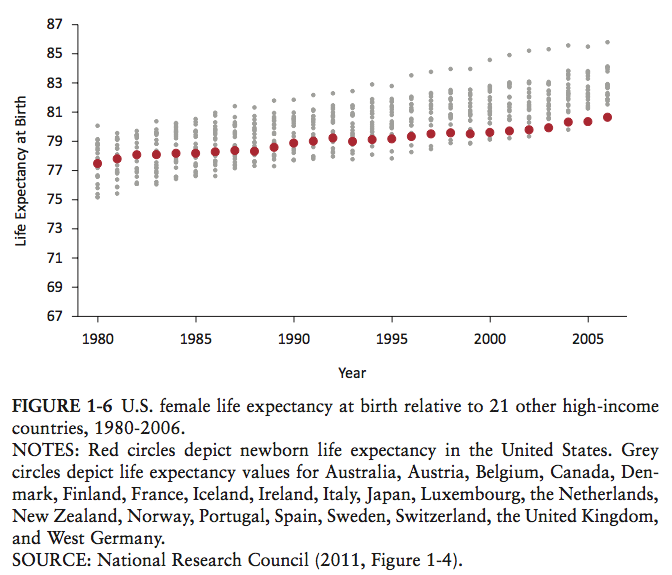
Back in January 2013, the US Institute of Medicine published a report called U.S. Health in International Perspective: Shorter Lives, Poorer Health. This poor health outcome for US citizens is in spite of the US spending twice as much as a percentage of GDP on healthcare as other high-income nations.
As an example of the problems the US has, the report showed the following exhibit, pointing out that the US has made much smaller advances in life expectancy since 1980 than other high-income nations. The US is now seventeenth of the seventeen countries analyzed in male life expectancy, and sixteenth out of seventeenth in female life expectancy.
I am sure I do not know all of the reasons for the US divergence from patterns seen elsewhere, but let me try to explain one energy-related reason for our problems. It has to do with a need to get a wide variety of nutrients at the same time we need to balance (Energy In) = (Energy Needed for Life Processes), in a period of time when the food we eat is increasingly of the “processed” variety. There may also be an issue of eating too much animal protein in our food mix, thanks to today’s ability to ramp up meat production using grains grown and shipped around the world, using fossil fuels.
An Overview of Energy-Related Modifications to Food
If look at primates in general, it is pretty clear that all of the nutrients such animals need come prepackaged in the food that they gather with their limbs. They get the level of exercise they need from gathering this food and from their other daily activities. They have a pretty good balance between (Energy In) = (Energy Needed for Life Processes), without any special effort.
We humans have been modifying food for a very long time, dating back to the days of being hunter-gatherers. Our earliest changes were successful from the point of making humans more dominant. They allowed us to grow larger brains and allowed human population to grow.
The changes made in recent years, thanks to abundant fossil fuels, seem to be excessive, however. The new processed foods are often missing necessary nutrients and fiber, providing mostly empty calories. It becomes a balancing act to get enough of the right nutrients without filling our bodies with calories we don’t need. Some foods (juices, added sugars, very finely ground grains) are sufficiently different from natural foods that our systems don’t react properly to such food. Also, the exercise our body was expecting is often much reduced.
The way our current system works, the food that is closest to its original form is hardest to ship and store, so tends to be highest-priced. The most calorie-dense, over-processed food tends to be cheapest. As a result, the least-educated people (who tend to be poorest) tend to be most damaged by our poor food supply. According to one study, at age twenty-five, men with less than a high school education have a sixteen-year shorter life expectancy than men with a graduate degree.
 Of course, at least part of the problem is the disproportionate lack of health care of less-educated US citizens. There are no doubt effects related to feeling like second-class citizens as well, because of reduced work-opportunities for those with poor educations. But having to work around a poor food system with an inadequate income is an issue that likely plays a major role as well.
How Did Humans Develop Larger Brains?
There is a popular belief that eating meat made us human. While meat eating may have played a role, there seem to be other factors as well. National Geographic in an article in the September 2014 issue, The Evolution of Diet, observes that modern day hunter-gatherers typically get about 30% of their calories from meat. When meat supplies are scarce, they often live for long periods on a plant-based diet. The article says, “New studies suggest that more than a reliance on meat in ancient human diets fueled the brain’s expansion.”
The point National Geographic mentions is the one I have brought up previously–the theory advanced by Richard Wrangham in Catching Fire: How Cooking Made Us Human. It seems to be the ability to control of fire, allowing humans to burn biomass, which set us apart from other primates. This allowed us to cook food, and in doing so, allowed the food to be more easily chewed and digested. Reduced chewing time freed up time for other activities, such as making tools. Nutrients could be more easily absorbed from cooked food. The fact that the food was easier to chew and digest allowed chewing and digestive systems to shrink, and brains to increase in size. It probably also made it easier for more human children to survive.
Furthermore, we now know that some other primates eat meat, so humans are not unique in this regard. Chimpanzees even hunt animals for their meat. National Geographic reports that baboons eat birds, rodents, and even the young of larger mammals, such as antelopes and sheep. But meat makes up only a small share of their diet. We also know that when monkeys are fed a diet that includes very much meat, they gain weight and experience degenerative diseases like humans.
Food Processing: A Little of a Good Thing vs. Too Much of Good Thing
The experience with cooking some food back in hunter-gatherer days shows that a little help in getting more nutrition from foods can be helpful. Plant cell walls are made of cellulose. Cooking vegetables helps break down these cell walls, making nutrients more accessible. There are other ways of processing food–pounding meat to make it more tender or using a blender to chop it into fine pieces. Humans have been milling grains for a very long time.
But it is easy to overdo the processing of food, especially with the help of fossil fuels. Grains can be ground very finely, far more finely they would have been ground, years ago. Sweeteners of various types can be derived from sugar cane, sugar beets, and corn, and added to products of many types. Parts of fruits and vegetables that are deemed “less desirable” such as skins can be removed, even if these parts have a disproportionate share of the nutrients in them.
There is even a second order kind of change to the food supply that can be put in place. For example, before recent “improvements,” cattle ate a mixture of grasses and digested them in their four-part stomachs that are designed from that purpose. Now cattle are being fed all kinds of foods that are not suitable for their digestive systems, including corn and dried distillers grain, a byproduct of making ethanol from corn. There are many other shortcuts taken, from hormones to antibiotics, so as to produce more meat at less expense. Our bodies aren’t necessarily adapted all of these changes. For one thing, there is much more fat in the beef, and for another, the ratio of Omega 3 fatty acids to Omega 6 fatty acids is badly skewed.
There is the additional issue of whether plants actually contain the nutrients that they did years ago. Many of us have learned Liebig’s Law of the Minimum, which states that plant growth is not controlled by total amount of resources available, but by the scarcest resource. In other words, a plant needs all of its nutrients–just adding more of the most abundant nutrient isn’t good enough. But Liebig’s Law of the Minimum doesn’t remove all deviations in nutrient quantity. Plants will still grow, even if some of the trace elements are present in smaller than the usual quantities. Adding fertilizer (or even crop rotation) does not entirely fix this situation. We still end up with soil that is deficient in some micronutrients. This situation tends to get worse with time, as our sewer systems send human wastes out to sea.
In recent years, we have been hearing more about the role intestinal bacteria play. The processing of our food is especially likely to remove the less digestible portions of our food that these bacteria depend on for their nutrition. This adds yet another dimension to the problem of food that deviates from what our bodies are expecting us to eat.
Thanks to fossil fuels, processing of all kinds is cheap. So is adding sugar, artificial colors and artificial flavors to help cover up deficiencies in the original crop. The shortcuts farmers take, including heavy use of fertilizers and pesticides, are ways to produce food more cheaply. The food we end up with is inexpensive and convenient, but doesn’t necessarily match up well with what human digestive systems are adapted to.
What Kind of Exercise Do We Need?
The story I keep reading is that we need a certain amount of high-intensity intermittent exercise to help our bodies operate as they are intended to. Running for even an average of five or ten minutes a day is said to reduce cardiac causes of death by 30% to 45%, and to increase overall life expectancy by three years. We can easily imagine that hunter-gatherers quite often needed to sprint from time to time, either to avoid predators or to catch potential prey. The finding that human beings need short bursts of high intensity exercise, such as running, would seem to be consistent with what our ancestors did. We also can’t sit for long periods–something our ancestors didn’t do either.
How about strength training? One thing that occurred to me when I visited India is how unnatural it is to have chairs to sit on. Much of the world’s population, even today, sits on the ground when they want to sit down. Needless to say, people who don’t sit on chairs get up from the floor many times a day. This is a type of fitness training that we in this country miss. We in the West also don’t squat much–another type of fitness training.
Even with the beneficial effects of exercise, some researchers today believe that food plays a more important role than exercise in obesity. (Obesity is linked to ill health and shorter life expectancies.) A recent study by Herman Pontzer and others compared the energy expenditure of the Hazda hunter-gatherers to Westerners. The study found that average daily energy expenditure of traditional Hazda foragers was no different from that of Westerners, after controlling for body size. The body seemed to compensate for higher energy expenditure at times, with lower energy expenditure at other times.
Conclusion
It seems to me that our appetites don’t work correctly when we fill ourselves with overly processed foods that are lacking for essential nutrients. We don’t stop eating soon enough, and we quickly feel hungry again. In part this may be from eating foods highly processed foods that would never be found in nature; in part it may be because the foods are missing the micronutrients and fiber that our bodies are expecting. Low-income people especially have a problem with such diets, since diets rich in fruits and vegetables are more expensive.
Many people believe doctors can fix our health problems. Looking across countries, diet and public health issues tend to be much more important than the medical care system in the health of a population. With most chronic health conditions, doctors can only take bad health situations and make them somewhat better. High rates of illness and increased mortality remain, similar to what we see in the United States.
Many of us have heard about the so-called calorie restriction diets of monkeys. This is a misnomer, in my view. In at least one version of it, it is a comparison of monkeys fed a low calorie diet that provides a wide range of nutrients found in vegetables, with a diet typical of Americans. If, in fact, we humans also need a wide range of nutrients found in vegetables, we should not be surprised if we have similarly poor health outcomes.
 According to the graphic, Owen, 26, is affected by arthritis. His skin is wrinkled and his hair is falling out. He is frail and moves slowly. His blood work shows unhealthy levels of glucose and triglycerides. Canto, 25, is aging fairly well.
I personally have been eating a diet that is close to vegetarian for twenty years (heavy on vegetables, fruits and nuts; some fish and diary products; meat only as flavoring in soups). I also cut way back on processed foods and foods with added sugar or corn by-products. When I first changed my diet, I had a problem with arthritis and was concerned that I was at high risk for Type II diabetes. I lost weight, and my arthritis disappeared, as did my blood sugar problems. In fact, I rarely have reason to visit a doctor. In many ways, I feel like Canto on the left.
As I pointed out at the beginning of the post, we need to get a wide variety of nutrients at the same time we need to balance (Energy In) = (Energy Needed for Life Processes). Back in hunter-gatherer days, this was easy to do, but it is increasingly difficult to do today. Besides cutting back on processed foods, eating a diet at that is low in meat may be a way of doing this. Studies of people who eat mostly vegetarian diets show that they tend to have longer life spans. There is also direct evidence that diets that are higher in animal protein tend to shorten life spans. These findings don’t necessarily correlate with studies of what works best for losing weight, which is what most people are concerned about in the short term. Thus, we are deluged with a lot of confusing findings.
Food and health problems are issues that tend to strike a nerve with a lot of people. I can’t claim to be an expert in this area. But stepping back and looking at the issue more broadly, as I have tried to do in this article, can perhaps add some new perspectives.
16 Comments on "An Energy-Related Reason Why US Healthcare Outcomes are Awful"
Northwest Resident on Tue, 9th Sep 2014 2:15 pm
One of the best things that could happen to Americans would be for fast food chains such as McD’s to just DIE and go away, forcing people to reconsider their diets. Even when I go to the supermarket and see what people are piling into their shopping carts — frozen pizzas, cartons of soda, all types of processed canned or frozen foods — it makes me cringe. But one thing I must admit, and that is, eating a big juicy T-Bone steak every couple of weeks or so makes me feel really good, as do occasional BBQ’d hamburgers and pork ribs! (I think…)
Perk Earl on Tue, 9th Sep 2014 2:45 pm
Something I think a lot of people fail to recognize is skin color as it relates to health. If someone looks sort of pasty white or grayish, then it’s time to change the diet to add more fruits and vegetables.
Even though my wife is slim a few years back she had a stroke and lost vision in one of her eyes. It was a wake up call for both of us and we changed our diets to vegan. No meat, no dairy. Ok, I’m not as religious about it as she is and occasionally slip in an In & Out cheeseburger, but the rest of the time my diet is much better and so is my color.
The reason why is because our vascular system is lined with Endothelium (not sure that spelled right), and our health is in great part determined by how well blood flows in the body. The less meat and cheese and other types of foods with saturated fat the less garbage build up and damage occurring to that lining, the healthier the endothelium gets. I’m 58 but have good pinkish color in my face now whereas before it was devoid of color. That’s thanks to good blood-flow from a better diet.
My advise is to not wait until you are in the hospital (like an in-law of ours is right now).
All that stuff that tastes great is manufactured to bait our taste buds with instant gratification but we pay a price for it with poor health.
After changing diet it takes a while but then suddenly your taste buds become accustomed to fruit and vegetables and that’s what tastes great.
Go to the vegan part of the grocery store and try peppered Tofurky slices made from soy – they taste great. Try vegan Monterey pepper slices made from soy. Use 1% low fat mayo, hot & spicy mustard, dice up some red onion, add avocado, put some mixed lettuce greens on the sandwich with toasted slices of French bread and it is great and vegan.
Here’s one thing you can do that is really simple if you cannot bring yourself to change your diet. Get organic 50/50 mixed lettuce greens (red, green and spinach) from the grocery store, then stuff some in your mouth once a day – that stuff is chalk full of nutrients and you will notice the difference.
herrmeier on Tue, 9th Sep 2014 3:50 pm
Everybody has access to internet and is able to determine a good diet for himself. If you’re too stupid to read, learn and understand, don’t blame it on McD.
As the old saying goes: Everything in moderation, even moderation.
J on Tue, 9th Sep 2014 4:35 pm
That first chart seems to say that there will be no impact on life expectancy from loosing > 50% of oil supply in the next 50 years. That doesn’t seem realistic. But like many other BAU things, admitting this will not be easy.
Makati1 on Tue, 9th Sep 2014 8:29 pm
Any graph or chart that project into the future based on he past is likely to be off by a large margin. None take into account limiting factors that are obvious to the blind. Pollution, loss of the medical systems due to collapse, etc. No, I think that we have peaked at our life expectancy in most of the world and are sliding back into historic ages past where you married at 16 and were dead by 40.
Davy on Tue, 9th Sep 2014 11:46 pm
This may be a little off subject which as you folks know is nothing new for Davy. Tonight I watched The PBS Television documentary program called “Frontline”.
http://www.pbs.org/wgbh/pages/frontline/ebola-outbreak/
Tonights subject was a two part program that started with Ebola in the field with folks that go out and find the infected cases and get them to the hospitals then they showed the hospital. This hospital was a Doctors without borders (Médecins Sans Frontières). I am pretty thick skinned anymore but man this was heart wrenching to see how families are destroyed and how people go to die alone in an environment of human separation. It is a virus that has to be quarantined and 70% die so if you go away to these hospitals chances are you will not return. Kids are showing up there with no parents scared and confused. If that was not enough then there was the Boko Haram in Nigeria. We know how bad the Boko Haram folks are. They appear to be even more savage than the Taliban pretty much on the level of ISIL. What is sad and disturbing is the army and the militias charged with fighting Boko Haram. These folks are as bad or worse than who they are supposed to be protecting the population from. I then reflected on my doomer/prepper thinking and said to myself “self this is what we have in store for the future”. Not every location is going to sink to these lows of human existence but we are going to find ourselves increasingly in desperate and painful situations. The coming descent will correspond to a descent of human rights and human treatment. In addition we are going to see physical descent of our healthcare and human health. If I express optimism here on this board it is the hope we have several decent years ahead. They may be harder and harder years and gloomy lacking joy but it is my hope we can buy time to adjust and mitigate these terrible times ahead. I hope I am completely wrong and something wonderful happens to save the day but that is foolish thinking.
Perk Earl on Wed, 10th Sep 2014 4:53 am
Ebola infections are rising so fast in Liberia they are turning people away. They go home to die or recover in the company of others that can become infected. In one report they said it takes 200-250 healthcare workers to care for 75 Ebola patients. At one clinic they had just set up for 30 patients, 75 showed up and they had to turn away the other 45.
Many healthcare workers at the end of their shift are in a state of physical and emotional exhaustion and forget important protective procedures. When they remove their protective gear they wipe away the sweat on their faces only to inadvertently touch their eyes, nose or mouth and become infected.
JuanP on Wed, 10th Sep 2014 7:44 am
I advice all preppers to go over their first aid kits and medical supplies, and improve them. I built myself a level 2 FAK based on Nutnfancy’s YouTube video.
I also want to recommend two medicine books for preppers:
When There is no Doctor
When There is no Dentist
ghung on Wed, 10th Sep 2014 8:15 am
The Merck Veterinary Manual… great reference for animals with most of it applying to humans as well. Good luck getting your doctor to prescribe a lot of antibiotics for your doomer kit. A good vet supply or feed store has many of the same antibiotics on the shelf for much less. Dose as for swine.
Sutures? Surgical glue? Ringers lactate, IVs and syringes? All in our animal first-aid kit. Same stuff; different reason for acquiring it. I’ve also vacuum-packed things like sterile bandages and surgical tools that have indefinite shelf-lives. A manual blood pressure cuff and stethoscope (everyone should learn to use both) is also part of our kit. Non-electronic thermometers, oral and anal? Got those w/spares.
Who’s going to look in the kennel to steal your medical supplies?
JuanP on Wed, 10th Sep 2014 8:41 am
Thanks, Ghung. I added the book to my wish list. I do practice my suturing skills on pork skin.
ghung on Wed, 10th Sep 2014 8:51 am
Juan, practice with surgical glue as well. Get someone to hold the wound closed, lay a piece of gauze across the wound and dab a bit of glue around the edges. Works (as they say down here) ‘slicker’n shit’. I’ve repaired several of my dogs this way, even after the expensive sutures the vet put in failed. Less scarring also.
Regular Super Glue will work, but can irritate sensitive skin. The glue patch will fall off on its own about the time the wound is healed.
Davy on Wed, 10th Sep 2014 10:19 am
Damn G, Do I need to start sending you a check for all the good info you are giving me?..LOL
ghung on Wed, 10th Sep 2014 10:36 am
Nah, Davy, then I would have to hire a legal department and include disclaimers in most of my posts 😉
PrestonSturges on Wed, 10th Sep 2014 11:16 am
Life expectancy is dropping fast in the US in the areas that voted for McCain and Romney by double digits. These are the reddest of the red areas, and the life expectancy of white people is plunging due to untreated diabetes and METH but also lots and lot Rx pain killer overdoses. Black life expectancy is lower but stable.
http://www.nytimes.com/2012/09/21/us/life-expectancy-for-less-educated-whites-in-us-is-shrinking.html?pagewanted=all&_r=0
The people who were ready to start a civil war over Obamacare are the ones dying off. They’ve never had health insurance and they are convinced anyone that does is a communist.
AgentR11 on Wed, 10th Sep 2014 4:14 pm
Touching anything about diet is probably more explosive on the web than the old abortion and evolution debates. lol.
I can only comment from my own experiences.
calorie surplus = got fat and ill
large cal deficit = bloodwork awesome,lost weight, but got frail.
calorie balance, no exercise, ok health, but felt crappy, couldn’t run.
calorie balance with exercise to avg 3500kcal/day; 70-120g protein/day, healthy, good bloodwork, strong, fast, and lively. fat vs carb made no noticeable difference. type of fat or carb made no dif. (surprised me too)
That’s over about four years of measuring stuff. Not sure it applies to anyone but me.
I do have one other comment though… on a doomer forum, exactly why are we interested in life expectancy rates that far exceed human productive ranges? If you make it to 70, strong and fast, you’ve won the doomer lottery as far as I’m concerned.
Makati1 on Wed, 10th Sep 2014 8:28 pm
All I can say to the younger readers:
From my own experience:
1. I never smoked beyond trying it a few times.
2. I never drank alcohol other than socially, and that was rare.
3. I always had a job that required exercise (construction) or I was putting additions on my home in the evenings or working in our garden.
4. I ate a balanced diet and never watched calories, but always had a BMI around 24. My youth was the time of lard, bacon, sausage, etc, but I also ate a lot of fruits and veggies.
5. I tried to keep stress levels down, even though I helped to raise 4 kids.
6. But, most important of all, I never used any drugs, legal or illegal. A vitamin/mineral tablet everyday has been a habit for 60 years.
Now: I am 70, ~5’10”, 160#, Glasses for reading only. No arthritis, or other problems requiring meds. I do have an allergy that seems to be caused by petroleum products and may be from a short stint, when I was 24, with the government in West Yellowstone Park spraying trees for beetles with a kerosine based poison that I developed a rash from then.
I STILL take that one-a-day vitamin/mineral though, and an 8mg aspirin. ^_^