
Peak Oil is You

Donate Bitcoins ;-) or Paypal :-)


Page added on July 30, 2013

A Post-Growth Economy in France?
I’ve recently returned from France’s first high-level “beyond growth” event, entitled An Innovative Society for the 21st Century. The conference, which included five separate sessions for the 250 or so attendees, was officially sponsored by François Hollande, President of the French Republic. It is one of only a handful of events that has received official government support for the topic of building a post-growth economy. The event was organised by IDDRI, the Institute for Sustainable Development and International Relations, and was held in one of the historic buildings of the French National Assembly.
A number of politicians spoke at the event, including Claude Bartolone, the President of the National Assembly, who gave the opening address. Mr. Bartolone was more to the point than I was expecting and seemed to accept the end of the era of economic growth in France. He was careful to say that low growth does not mean an end to progress, and that the “social economy” could provide answers to the problems that we face. He made the particularly strong statement that “we can accept a 4 percent deficit, but we cannot accept 4 degrees of global warming”. To close, he said that “we must invent the world we want, starting now”.
The session that followed, entitled “Have our models of growth entered into an exhaustion phase?”, included talks by both Nicholas Stern (author of The Stern Review) and Andrew Simms (the unofficial ambassador of the New Economics Foundation). Stern opened by saying that he was not going to talk about “growth indefinitely”, because — in the words of Woody Allen — “eternity is a very long time, especially towards the end”. He did, however, say that he believed growth is needed over the next twenty to thirty years to drive investment and innovation to avoid climate change.
Stern’s reasoning was challenged by Andrew Simms, who provided one of the liveliest talks of the event. He emphasised that relying on economic growth to solve our problems is not a scientifically credible strategy due to the multiple planetary boundaries that we face. Simms also highlighted the diminishing social returns of growth, and the appearance of “jobless, voiceless, and futureless growth”. He likened our situation to a man falling from a 100-storey building. The man will pass the first 99 storeys unscathed, and may become increasingly confident about his predicament, until he passes the final floor and his fall is abruptly ended. In closing, Simms suggested that economic policy should pass three tests: Does it reduce the pressure that we put on the environment? Does it make society more equal? And does it contribute to human well-being?
The second panel of the day moved on to ask the question, “Can we build a post-growth society?” The first speaker was Laurent Baumel, a French MP and member of the governing Socialist Party. He said it was useful to question the need for growth, and to challenge GDP as a measure of progress. However, he claimed that growth still remains necessary for the functioning of society. He seemed particularly concerned about what a lack of growth would mean for the government’s ability to reduce inequality and fight unemployment.
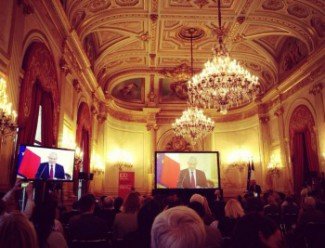
Claude Bartolone at the post-growth conference, “An Innovative Society for the 21st Century” (photo credit/copyright: M. Brun)
Baumel’s talk was followed by my own contribution, in which I described some of the policy changes needed to achieve a prosperous economy without growth (ideas that are discussed in Enough Is Enough). I pointed to the weak relationship between economic growth and the level of employment and to the ways that greater equality may act as a substitute for growth. I also discussed the importance of financial reform, in particular the need for a full-reserve banking system. Finally, I stressed that the goal of a steady-state economy is not zero GDP growth. The goal is to achieve a high quality of life for all people within ecological limits, something that GDP can’t possibly measure.
My talk was followed by a contribution from Jean Pisani-Ferry, the director of the French Prime Minister’s economic policy planning staff. Pisani-Ferry claimed that a post-growth perspective was “fatalistic and Malthusian”, but did not respond to any of the policy proposals that I made, despite an attempt from the chair to get his opinion on these issues. Instead, he focused on the price system and the need to invest in low-carbon infrastructure while interest rates remain low.
The final speaker of the session, the former Swedish Environment Minister Lena Sommestad, emphasised the role of human capital and the need to invest in social programs. She made the important point that more equal societies are better at dealing with environmental problems like climate change.
The next two sessions focussed less on growth and more on social innovation, and I did not find them as engaging overall. One exception was a talk by Rob Hopkins, founder of the Transition Towns movement. Hopkins discussed what a bottom-up response to the challenges of a post-growth society might look like, drawing on examples from the Transition movement. He stressed that the main reason people are engaging in Transition projects is not the environmental benefit of these projects, but the social connections and greater sense of community that people gain from them.
The final session of the conference, which was entitled “What development model for the 21st Century?”, included contributions from Pascal Canfin (the French Deputy Minister for Development), George Papandreou, (the former Prime Minister of Greece), and Jeffrey Sachs (the well-known economist from Columbia University).
To my surprise, Sachs led with what was probably the most direct criticism of the pursuit of growth at the conference. He said that it’s a hard reality to accept, but growth is no longer a viable strategy for the planet, and politicians need to accept this. He said that even the notion of allowing developing countries to “catch up” before beginning the transition to a new development model is unrealistic. Instead, he emphasised that all countries need to pursue a new model of development, and not just “follow the one in front”. He was also the only speaker to raise the issue of the need to stabilise global population.
The strong speeches continued with George Papandreou, the former Prime Minister of Greece. Papandreou suggested that the collective response of policy makers to the Greek deficit, Lisbon Treaty, and Copenhagen Climate Change Conference had been wrong. These issues were dealt with separately, he lamented, when they should have been addressed together. He claimed that the Greek government had borrowed unsustainably in the name of increasing GDP, and the result was recession, unemployment, a democratic crisis, and no progress on climate change. He said that the financial crisis had happened too quickly for the political system to deal with, and that too much power now rested with institutions beyond national boundaries. He also said that politics had become unpopular and the trust of citizens had been lost, which made it difficult to implement big changes. Much like proponents of degrowth, he advocated a deepening of democracy as the solution. Finally, Papandreou suggested we need new indicators and new values, and that “maybe happiness is more important than GDP”.
Although the conference was high on rhetoric and low on solutions at times, I still believe it was a success. For the first time, politicians and researchers were discussing the possibility of a post-growth economy in the halls of the French National Assembly — no small achievement. It was clear from who was present, however, that the idea of a prosperous non-growing economy still resonates more with the left than the right. Moreover, it seemed like there were quite a few former left-wing parliamentarians offering their support. A more cynical person might question whether they would still do so if returned to power!
Nevertheless, as I was saying my goodbyes on the stairs of the National Assembly, Damien Demailly, the head of IDDRI’s New Prosperity program assured me, “This is only the beginning”.
5 Comments on "A Post-Growth Economy in France?"
BillT on Wed, 31st Jul 2013 12:54 am
More political bullshit and lies. France cannot go to a ‘non-growth economy’ because they are part of the EU and the current world economy. Until the whole system collapses, no country can do anything but continue BAU until the end.
This was just another excuse to spend the taxpayer’s money while living in expensive hotels and eating gourmet meals. But then, that is all politicians are good for these days. A meeting of losers.
kervennic on Wed, 31st Jul 2013 10:22 am
Exactly at the same time and and the same people signed a bill to ease the authorization of big pig farming which has alrady polluted west coast river to the point that we officially rely on plastic bottle.
This is usual with french social democrat. They always achieve what ultra liberal cannot by organizing such doublegame politics. In te fact,Socialist have always been the worse as they have betrayed systematically their voters.
For instance Hollande has already fired his two environement minister (bricq and batho) because they questionned his real views on the matter.
Do not forget two things: socialist have massively signed full power to Petain, Hitler’s pet,they more recently massively sold state industries at very low price.
These betrayalare no accident.
Socialist represent a class of people (called bobo, bohemian bourgeois by the right) that benefit from the growth-slave economy but feel the potential danger of the situation and the possibility of a social explosion or ecological catastrophy.
They are not ready to damp their privilege but, contrary to the right, choose to defend them using tricks and lies instead of brute force like the conventional right.
Thsi is why they are at least as dangerous and possibly even more.
Laci on Wed, 31st Jul 2013 12:48 pm
These granola munchers are a little bit like those high-priests who start a cult, and convince everyone to commit suicide. These guys would have the western world lie down and die for the greater global good, while we are being out-competed by India China and Banglades, who do the opposite and thus benefit from all the jobs we chase away through these hare-brain ideas.
Kristen on Wed, 31st Jul 2013 6:22 pm
I’m not sure what measurement would replace the GDP, but the need of equalization is great in our modern Utopia. We must reeducate towards a holistic approach versus individualism which pits people against one another. We need a higher minimum wage and a maximum wage. Any money left over should be pooled back into society. The government should reduce the use of technology for efficiency and once again employee human capital. If not that then people should rotate jobs so everyone has a chance to work. Capitalism and competition is killing the planet and the morale of the worlds citizens. It’s time for cooperation
BillT on Thu, 1st Aug 2013 12:04 am
Kristen, if we had say, three generations, we might be able to change, as you suggest, but we don’t. The change will happen anyway but it will be painful and will kill off a lot of us over the next few decades as ‘for profit’ capitalism dies.