
Peak Oil is You

Donate Bitcoins ;-) or Paypal :-)


Page added on January 21, 2015

A New Theory Of Energy & The Economy
How does the economy really work? In my view, there are many erroneous theories in published literature. I have been investigating this topic and have come to the conclusion that both energy and debt play an extremely important role in an economic system. Once energy supply and other aspects of the economy start hitting diminishing returns, there is a serious chance that a debt implosion will bring the whole system down. In this post, I will look at the first piece of this story, relating to how the economy is tied to energy, and how the leveraging impact of cheap energy creates economic growth.
Trying to tackle this topic is a daunting task. The subject crosses many fields of study, including anthropology, ecology, systems analysis, economics, and physics of a thermodynamically open system. It also involves reaching limits in a finite world. Most researchers have tackled the subject without understanding the many issues involved. I hope my analysis can shed some light on the subject.
I plan to add related posts later.
An Overview of a Networked Economy
The economy is a networked system of customers, businesses, and governments. It is tied together by a financial system and by many laws and customs that have grown up over the years. I represent the economic network as a child’s toy made of sticks that connect together, but that can, if disturbed in the wrong way, collapse.

The economy is a self-organized system. In other words, it grew up gradually over time, one piece at a time. New businesses were added and old ones disappeared. New customers were added and others left. The products sold gradually changed. Governments gradually added new laws and removed old ones. As changes were made, the system automatically re-optimized for the changes. For example, if one business raised its price on a product while others did not, some of the customers would move to the businesses selling the product at a lower price.
The economy is represented as hollow because, as products become obsolete, the economy gradually adapts to the replacement product and loses support for earlier products. An example is cars replacing horse and buggy in the United States. There are fewer horses today and many fewer buggy manufacturers. Cities generally don’t have places to leave horses while shopping. Instead, there are many gasoline stations and parking lots for cars.
Because of the way an economy adapts to a new technology, it becomes virtually impossible to “go backwards” to the old technology. Any change that is made must be small and incremental–adding a few horses at the edge of the city, for example. Trying to add very many horses would be disruptive. Horses would get in the way of cars and would leave messes on the city streets.
The Economy as a Complex Adaptive System and Dissipative Structure
Systems analysts would call a system such as the economy a complex adaptive system, because of its tendency to grow and evolve in a self-organizing manner. The fact that this system grows and self-organizes comes from the fact the economy operates in a thermodynamically open system–that is, the economy receives energy from outside sources, and because of this energy, can grow and become more complex. The name of such a system from a physics perspective is a dissipative structure. Human beings, and in fact all plants and animals, are dissipative structures. So are hurricanes, galaxies, and star formation regions. All of these dissipative systems start from small beginnings, grow, and eventually collapse and die. Often they are replaced by new similar structures that are better adapted to the changing environment.
The study of the kinds of systems that grow and self-organize is a new one. Ilya Prigogine was awarded the Nobel Prize in Chemistry in 1977 for his pioneering work on dissipative systems. One writer (in French) about the economy as a dissipative structure is François Roddier. His book, published in 2012, is called Thermodynamique de l’evolution.
Why Energy is Central to the Economy
If the economy is a dissipative system, it is clear that energy must be central to its operation. But suppose that we are coming from a step back, and trying to show that the economy is an energy-based system that grows as more external energy is added.
Let’s start even before humans came onto the scene. All plants and animals need energy of some kind so that the organism can grow, reproduce, move, and sense changes to the environment. For plants, this energy often comes from the sun and photosynthesis. For animals, it comes from food of various kinds.
All plants and animals are in competition with other species and with other members of their own species. The possible outcomes are
- Win and live, and have offspring who might live as well
- Lose out and die
Access to adequate food (a source of energy) is one key to winning this competition. Outside energy can be helpful as well. The use of tools is as approach that is used by some types of animals as well as by humans. Even if the approach is as simple as throwing a rock at a victim, the rock amplifies the effect of using the animal’s own energy. In many cases, energy is needed for making a tool. This can be human energy, as in chipping one rock with another rock, or it can be heat energy. By 70,000 years ago, humans had figured out that heat-treating rock made it easier to shape rocks into tools.
A bigger step forward for humans than learning to use tools–in fact, what seems to have set them apart from other animals–was learning to use fire. This began as early as 1 million years ago. Controlled use of fire had many benefits. With fire, food could be cooked, cutting the amount of time needed for chewing down drastically. Foods that could not be eaten previously could be cooked and eaten, and more nutrition could be obtained from the foods that were eaten. The teeth and guts of humans gradually got smaller, and brains got larger, as human bodies adapted to eating cooked food.
There were other benefits of being able to use fire. With time freed up from not needing to chew as long, there was more time available for making tools. Fire could be used to keep warm and thus expand the range where humans could live. Fire could also be used to gain an advantage over other animals, both in hunting them and in scaring them away.
Humans were incredibly successful in their competition with other species, killing off the top carnivore species in each continent as they settled it, using only simple tools and the burning of biomass. According to Paleontologist Niles Eldridge, the Sixth Mass Extinction began when humans were still hunter-gatherers, when humans first moved out of Africa 100,000 years ago. The adverse impact of humans on other species grew significantly greater, once humans became farmers and declared some plants to be “weeds,” and selected others for greater use.
In many ways, the energy-based economy humans have built up over the years is simply an approach to compensate for our own feeble abilities:
- Need for warm temperature–clothing, houses, heat when cold, air conditioning if hot
- Need for food–metal tools, irrigation, refrigeration, fertilizer, herbicides, pesticides
- Knowledge/thinking ability of humans–books, schools, Internet
- Mobility–airplanes, cars, trucks, ships, roads
- Vulnerability to germs–medicine, sanitation
A key component in any of these types of adaptations is energy of some appropriate kind. This energy can come in various forms:
- Embodied energy stored up in tools and other capital goods that can be reused later. Some of the energy in making these tools is human energy (including human thinking capacity), and some of this is energy from other sources, such as heat from burning wood or another fuel.
- Human energy–Humans have many abilities they can use, including moving their arms and legs, thinking, speaking, hearing, seeing, and tasting. All of these are made possible by the energy that humans get from food.
- Energy from animals – Dogs can help with hunting and herding; oxen can help with plowing; horses can be ridden for transportation
- Energy from burning wood and other forms of biomass, including peat moss
- Energy from burning fossil fuels (coal, natural gas, or oil)
- Electricity produced in any number of ways–hydroelectric, nuclear, burning coal or natural gas, and from devices that convert wind, solar, or geothermal energy
- Wind energy – Used in sail boats and in wind powered devices, such as windmills to pump water. Wind turbines (with significant embodied energy) also generate electricity.
- Solar energy – Most energy from the sun is “free”. It keeps us warm, grows food, and evaporates water, without additional “help.” There are also devices such as solar PV panels and solar hot water heaters that capture energy from the sun. These should perhaps be classified as tools with significant embodied energy.
One key use of supplemental energy is to reduce the amount of human labor needed in farming, freeing-up people to work at other types of jobs. The chart below shows how the percentage of the population working in agriculture tends to drop as the amount of supplementary energy rises.
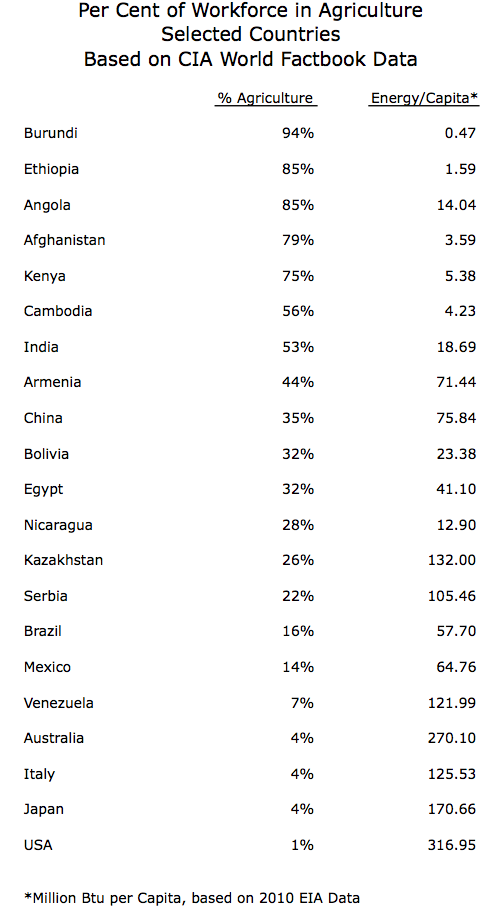
The energy per capita shown on Figure 2 is includes only energy sources that are bought and sold in markets, and thus that can easily be counted. These would include fossil fuel energy and electricity made from a variety of sources (fossil fuels, hydroelectric, nuclear, wind, solar PV). It does not include other sources of energy, such as
- Embodied energy in previously made devices
- Human energy
- Animal energy
- Locally gathered dung, wood, and other biomass.
- Free solar energy, keeping people warm and growing crops
Besides reducing the proportion of the population needed to work in agriculture, the other things that “modern” sources of energy do are
- Allow many more people to live on earth, and
- Allow those people to have much more “stuff”–large, well-heated homes; cars; lighting where desired; indoor bathrooms; grocery stores filled with food; refrigeration; telephones; television; and the Internet.
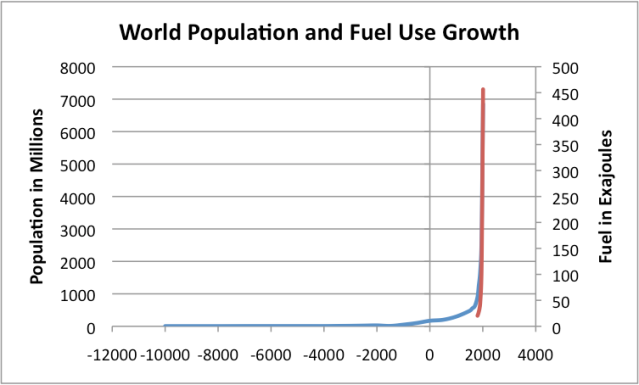
Figure 3 below shows that human population has risen remarkably since the use of modern fuels began in quantity about 200 years ago.

Besides more and better food, sanitation, and medicine, part of what allowed population to rise so greatly was a reduction in fighting, especially among nearby population groups. This reduction in violence also seems to be the result of greater energy supplies. In the animal kingdom, animals similar to humans such as chimpanzees have territorial instincts. These territorial instincts tend to keep down total population, because individual males tend to mark off large areas as territories and fight with others of their own species entering their territory.
Humans seem to have overcome much of their tendency toward territoriality. This has happened as the widespread availability of fuels increased the use of international trade and made it more advantageous for countries to cooperate with neighbors than to fight with them. Having an international monetary system was important as well.
How the System of Energy and the Economy “Works”
We trade many products, but in fact, the “value” of each of these products is very much energy related. Some that don’t seem to be energy-related, but really are energy-related, include the following:
- Land, without buildings – The value of this land depends on (a) its location relative to other locations, (b) the amount of built infrastructure available, such as roads, fresh water, sewer, and grid electricity, and (c) the suitability of the land for growing crops. All of these characteristics are energy related. Land with good proximity to other locations takes less fuel, or less time and less human energy, to travel from one location to another. Infrastructure is capital goods, built up of embodied energy, which is already available. The suitability of the land for growing crops has to do with the type of soil, depth of the topsoil, the fertility of the soil, and the availability of fresh water, either from the sky of from irrigation.
- Education – Education is not available to any significant extent unless workers can be freed up from farming by the use of modern energy products. Students, teachers, and those writing books all need to have their time freed up from working in agriculture, through advanced energy products that allow fewer workers to be needed in fields. Howard T. Odum in the Prosperous Way Down wrote about education reflecting a type of embodied energy.
- Human Energy – Before the advent of modern energy sources, the value of human energy came largely from the mechanical energy provided by muscles. Mechanical energy today can be provided much more cheaply by fossil fuel energy and other cheap modern energy, bringing down the value of so-called “unskilled labor.” In today’s world, the primary value humans bring is their intellectual ability and their communication skills, both of which are enhanced by education. As discussed above, education represents a type of embodied energy.
- Metals – Metals in quantity are only possible with today’s energy sources that power modern mining equipment and allow the huge quantities of heat needed for refining. Before the use of coal, deforestation was a huge problem for those using charcoal from wood to provide the heat needed for smelting. This was especially the case when economies tried to use wood for heating as well.
Two closely related concepts are
- Technology – Technology is a way of bringing together physical substances (today, often metals), education, and human energy, in a way that allows the production in quantity of devices that enhance the ability of the economy to produce goods and services cheaply. As I will discuss later, “cheapness” is an important characteristic of anything that is traded in the economy. As technology makes the use of metals and other energy products cheaper, extraction of these energy-related items increases greatly.
- Specialization – Specialization is used widely, even among insects such as bees and ants. It is often possible for a group of individuals to obtain better use of the energy at their disposal, if the various individuals in the group perform specialized tasks. This can be as simple as at the hunter-gatherer level, when men often specialized in hunting and women in childcare and plant gathering. It can occur at advanced levels as well, as advanced education (using energy) can produce specialists who can perform services that few others are able to provide.
Technology and specialization are ways of building complexity into the system. Joseph Tainter in the Collapse of Complex Societies notes that complexity is a way of solving problems. Societies, as they have more energy at their disposal, use the additional energy both to increase their populations and to move in the direction of greater complexity. In my Figure 1 (showing my representation of an economy), more nodes are added to the system as complexity is added. In a physics sense, this is the result of more energy being available to flow through the economy, perhaps through the usage of a new technology, such as irrigation, or through using another technique to increase food supply, such as cutting down trees in an area, providing more farmland.
As more energy flows through the system, increasingly specialized businesses are added. More consumers are added. Governments often play an increasingly large role, as the economy has more resources to support the government and still leave enough resources for individual citizens. An economy in its early stages is largely based on agriculture, with few energy inputs other than free solar energy, human labor, animal labor, and free energy from the sun. Extraction of useful minerals may also be done.
As modern energy products are added, the quantity of energy (particularly heat energy) available to the economy ramps up quickly, and manufacturing can be added.

As these energy products become depleted, an economy tends to shift manufacturing to cheaper locations elsewhere, and instead specialize in services, which can be provided with less use of energy. When these changes are made, an economy becomes “hollowed out” inside–it can no longer produce the basic goods and services it could at one time provide for itself.
Instead, the economy becomes dependent on other countries for manufacturing and resource extraction. Economists rejoice at an economy’s apparently lesser dependence on fossil fuels, but this is an illusion created by the fact that energy embodied in imported goods is never measured or considered. The country at the same time becomes more dependent on suppliers from around the world.
The way the economy is bound together is by a financial system. In some sense, the selling price of any product is the market value of the energy embodied in that product. There is also a cost (which is really an energy cost) of creating the product. If the selling cost is below the cost of creating the product, the market will gradually rebalance, in a way that matches goods and services that can be created at a break-even cost or greater, considering all costs, even indirect ones, such as taxes and the need for capital for reinvestment. All of these costs are energy-related, with some of this energy being human energy.
Both (a) the amount of goods and services an economy produces and (b) the number of people in an economy tends to grow over time. If (a), that is, the amount of goods and services produced, is growing faster than (b), the population, then, on average, individuals find their standard of living is increasing. If the reverse is the case, individuals find that their standard of living is decreasing.
This latter situation, one of a falling standard of living, is the situation that many people in “developed” countries find themselves in now. Because of the networked way the economy works, the primary way that this lack of goods and services is transmitted back to workers is through falling inflation-adjusted wages. Other mechanisms are used as well: fewer job openings, government deficits, and eventually debt defaults.
If the situation is reversed–that is, the economy is producing more goods and services per capita–the way this information is “telegraphed” back to the people in the economy is through a combination of increasing job availability, rising inflation adjusted-wages, availability of new inexpensive products on the market place, and government surpluses. In such a situation, debt is likely to become increasingly available because of the apparently good prospects of the economy. The availability of this debt then further leverages the growth of the economy.
External Energy Products as a Way of Leveraging Human Energy
Economists tell us that value comes from the chain of transactions that are put in place whenever one of us buys some kind of good or service. For example, if I buy an apple from a grocery store, I set up a chain of payments. The grocer pays his employees, who then buy groceries for themselves. They also purchase other consumer goods, pay income taxes, and perhaps buy oil for their vehicles. The employees pay the stores they buy from, and these payments set up new chains of transactions indirectly related to my initial purchase of an apple.
The initial purchase of an apple may help also the grocer make a payment on debt (repayment + interest) the store has, perhaps on a mortgage. The owner of the store may also put part of the money from the apple toward paying dividends on stock of the owners of the grocery story. Presumably, all of the recipients of these amounts use the amounts that initially came from the purchase of the apple to pay additional people in their spending chains as well.
How does the use of oil or coal or even the use of draft animals differ from simply creating the transaction chain outlined above? Let’s take an example that can be made with either manual labor plus some embodied energy in tools or with the use of fossil fuels: shoes.
If a cobbler makes the shoes, it will likely take him quite a long time–several hours. Somewhere along the line, a tanner will need to tan the hide in the shoe, and a farmer will need to raise the animal whose hide was used in this process. Before modern fuels were added, all of these steps were labor intensive. Buying a pair of shoes was quite expensive–say the equivalent of wages for a day or two. Boots might be the equivalent of a week’s wages.
The advantage of adding fuels such as coal and oil is that it allows shoes to be made more cheaply. The work today is performed in a factory where electricity-powered machines do much of the work that formerly was done by humans, and oil-powered vehicles transport the goods to the buyer. Coal is important in making the electricity-powered machines used in this process and may also be used in electricity generation. The use of coal and oil brings the cost of a pair of shoes down to a much lower price–say the equivalent of two or three hours’ wages. Thus, the major advantage of using modern fuels is that it allows a person’s wages to go farther. Not only can a person buy a pair of shoes, he or she has money left over for other goods.
The fact that the wage-earner can now buy additional goods with his income sets up additional payment chains–ones that would have not been available, if the person had spent a large share of his wages on shoes. This increase in “demand” (really affordability) is what allows the rest of the economy to expand, because the customer has more of his wages left to spend on other goods. This sets up the growth situation described above, where the total amount of goods and services in the economy expands faster than the population increases.
Thus, the big advantage of adding coal and oil to the economy was that it allowed goods to be made cheaply, relative to making goods with only human labor. In some sense, human labor is very expensive. If a person, using a machine operated with oil or with electricity made from coal can make the same type of goods more cheaply, he has leveraged his own capabilities with the capabilities of the fuel. We can call this technology, but without the fuel (to make the metal parts used in the machine, to operate the machinery, and to transport the product to the end user), it would not have been possible to make and transport the shoes so cheaply.
All areas of the economy benefit from this external energy based approach that essentially allows human labor to be delivered more efficiently. Wages rise, reflecting the apparent efficiency of the worker (really the worker + machine + fuel for the machine). Thus, if a worker has a job in the economy affected by this improvement, he may get a double benefit–higher wages and plus the benefit of the lower price of shoes. Governments will get higher tax revenue, both on wages (because of the new value chain and well as the higher wages from “efficiency”), and on taxes paid relating to the extraction of the oil, assuming the extraction is done locally. The additional government revenue can be used on roads. These roads provide a way for shoe manufacturers to deliver their goods to more distant markets, further enhancing the process.
What happens if the price of oil rises because the cost of extraction rises? Such a rise in the cost of extraction can be expected to eventually take place, because we extract the oil that is easiest and cheapest to extract first. When additional extraction is performed later, costs are higher for a variety of reasons: the wells need to be deeper, or in more difficult to access location, or require fracking, or are in countries that need high tax revenue to keep local populations pacified. The higher costs reflect that we are using are using more workers and more resources of all kinds, to produce a barrel of oil.
Some would look at these higher costs as a “good” impact, since these higher costs result in new payment chains, for example, related to fracking sand and other products that were not previously used. But the higher cost really represents a type of diminishing returns that have a very adverse impact on the economy.
The reason why the higher cost of oil has an adverse effect on the economy is that wages don’t go up to match this new set of oil production costs. If we look back at the previous example, it is somewhat like going part way back to making shoes by hand. Economists often remark that higher oil prices hurt oil importers. This is only half of the problem, though. Higher costs of oil production result in a situation where fewer goods and services are produced worldwide(relative to what would have otherwise been produced), because the concentrated use of resources by the oil sector to produce only a tiny amount more oil than was produced in the past. When this happens, fewer resources (including workers) are left for the rest of the world to produce other products. The growing use of resources by the oil sector is sort of like a growing cancer sapping the strength of a patient. Oil importing nations take a double “hit,” because they participate in the world drop in output of goods, and because as importers, they miss out on the benefits of extracting and selling oil.
Another way of seeing the impact of higher oil prices is to look at the situation from the point of view of consumers, businesses and governments. Consumers cut back on discretionary spending to accommodate the higher price of oil, as reflected in oil and food prices. This cutback triggers whole chains of cutbacks in other buying. Businesses find that a major cost of production (oil) is higher, but wages of buyers are not. They respond in whatever ways they can–trimming wages (since these are another cost of production), outsourcing production to a cheaper part of the world, or automating processes further, cutting more of the high human wages from the process. Governments find themselves saddled with more unemployment claims and lower tax revenue.
In fact, if we look at the data, we see precisely the expected effect. Wages tend to rise when oil prices are low, and lose the ability to rise when oil prices are high (Figure 5). The cut off price of oil where wages stop rising seems to be about $40 per barrel in the United States.

What if oil prices are artificially low, on a temporary basis? The catch is that not all costs of oil producing companies can be paid at such low prices. Perhaps the cost of operating oil fields still in existence will be fine, and the day-to-day expenses of extracting Middle Eastern oil can be covered. The parts of the chain that get squeezed first seem to be least essential on a day to day basis–taxes to governments, funds for new exploration, funds for debt repayments, and funds for dividends to policyholders.
Unfortunately, we cannot run the oil business on such a partial system. Businesses need to cover both their direct and indirect costs. Low oil prices create a system ready to crash, as oil production drops and the ability to leverage human labor with cheaper sources of energy decreases. Raising oil prices back to the full required level is likely to be a problem in the future, because oil companies require debt to finance new oil production. (This new production is required to offset declines in existing fields.) With low oil prices–or even with highly variable oil prices–the amount that can be borrowed drops and interest costs rise. This combination makes new investment impossible.
If the rising cost of energy products, due to diminishing returns, tends to eliminate economic growth, how do we work around the problem? In order to produce economic growth, it is necessary to produce goods in such a way that goods become cheaper and cheaper over time, relative to wages. Clearly this has not been happening recently.
The temptation businesses face in trying to produce this effect is to eliminate workers completely–just automate the process. This doesn’t work, because it is workers who need to be able to buy the products. Governments need to become huge, to manage transfer payments to all of the unemployed workers. And who will pay all of these taxes?
The popular answer to our diminishing returns problem is more efficiency, but efficiency rarely adds more than 1% to 2% to economic growth. We have been working hard on efficiency in recent years, but overall economic growth results have not been very good in the US, Europe, and Japan.
We know that dissipative systems operate by using more and more energy until they reach a point where diminishing returns finally pushes them into collapse. Thus, another solution might be to keep adding as much cheap energy as we can to the system. This approach doesn’t work very well either. Coal tends to be polluting, both from an air pollution point of view (in China) and from a carbon dioxide perspective. Nuclear has also been suggested, but it has different pollution issues and can be high-priced as well. Substituting a more expensive source of electricity production for an existing source of energy production works in the wrong direction–in the direction of higher cost of goods relative to wages, and thus more diminishing returns.
Getting along without economic growth doesn’t really work, either. This tends to bring down the debt system, which is an integral part of the whole system. But this is a topic for a different post.
A Note on Other Energy Measures
The reader will note that in my analysis, I am using the cost (in dollars or other currency unit) of energy production, including indirect costs that are hard to measure, such as needed government funding from taxes, the cost of interest and dividends, and the cost of new investment. The academic world uses other metrics that purport to measure energy requirements. These do not measure the same thing.
Caution is needed in using these metrics; studies using these metrics often seem to recommend using a source of energy that is expensive to produce and distribute when all costs are considered. My analysis indicates that high-cost energy products promote economic contraction regardless of what their EROEI or Life Cycle Assessment results would seem to suggest.
91 Comments on "A New Theory Of Energy & The Economy"
Plantagenet on Wed, 21st Jan 2015 6:58 pm
Clearly we need cheap energy to keep the global economy growing.
Oil is cheap right now thanks to the oil glut, but this is likely to be a temporary condition.
Fortunately solar and wind power are becoming cheaper every day, and are already supplying significant amounts of energy to the grid. And unlike Gail, I agree with M. King Hubbert that nuclear power will play a big role in the post-carbon economy.
Apneaman on Wed, 21st Jan 2015 7:18 pm
Clearly keeping the global economy growing will only destroy what’s left of the biosphere.
Clearly few understand this or care.
Are Humans Going Extinct?
http://www.truth-out.org/news/item/27714-are-humans-going-extinct
The Methane Monster Roars
http://www.truth-out.org/news/item/28490-the-methane-monster-roars
Makati1 on Wed, 21st Jan 2015 7:54 pm
Better the “economy” dies than humans become extinct. I see 2020 as a whole new world. By then, most of what we now know and consider ‘normal’ will have been proven to be the exceptional exception. What happens between now and then is going to be earth shaking as in terrifically exciting and, for many, painful.
GregT on Wed, 21st Jan 2015 9:19 pm
“Clearly we need cheap energy to keep the global economy growing”
Clearly we do, and that cheap energy was in the form of ~25/bbl oil. Oil is still around twice the price of what built our economies, and the price that allowed our economies to grow. Oil is not cheap right now. Some people just have extremely short memories.
I can’t help but wonder Plant, how many people will be foolishly rambling on about an ‘oil glut’, when there are still billions of barrels of oil available, and nobody is able to afford them.
Oh, and once oil becomes cost prohibitive you could be correct Plant, a big role in the post carbon economy is going to be trying to figure out a way to safeguard all of these nuclear facilities, and how to deal with all of the waste for the next thousand years. If we can’t figure it out now with all of this cheap energy at our disposal, I suspect that things will become a little bit more challenging once modern industrial society comes grinding to a halt.
Dave Thompson on Wed, 21st Jan 2015 10:10 pm
As EROEI has diminished, the economy has gone in the tank. The PTB are well aware that we no longer can sustain our expectations of BAU. We have gone from upwards of 100 to one EROEI, (America, leading up into the 60’s) to maybe, 20 to one EROEI now on average. The price of crude will soon be back up over $125. The price does not change EROEI. EROEI runs the Economy.
Plantagenet on Wed, 21st Jan 2015 10:20 pm
@Apneaman
Your suggestion that switching to wind and solar power will “destroy the biosphere” doesn’t make any sense.
Renewable energy emits no CO2 and does not destroy the biosphere.
Apneaman on Wed, 21st Jan 2015 10:43 pm
Did you get beat up at school a lot, Plant? Betcha did little game player.
GregT on Wed, 21st Jan 2015 10:58 pm
“Renewable energy emits no CO2 and does not destroy the biosphere.”
Alternate energy infrastructure requires massive inputs from fossil fuels. CO2 is accumulative in the environment. Building out enough alternate energy infrastructure to replace a small percentage of fossil fuels in the generation of electricity, will add to the destruction of the biosphere.
Your suggestion Plant that switching to alternate energy infrastructure will not add to environmental degradation is what doesn’t make sense. Just like 90% of everything else that you say.
Bandits on Wed, 21st Jan 2015 11:16 pm
This BS of slapping lipstick on a pig and renaming it “diminishing returns” just confuses a simple premise. Just about the entire edifice of modern civilization was built off the high EROI of easy to exploit fossil fuels. It enabled the population explosion and the means to feed us.
EROI determines life, the economy does not have to be included.
Plantagenet, indirect man, indirect (get it) renewables are extending the duration of FF burning and kept us on the plateau of peak burning for longer. They enabled the exploitation of the even more damaging non-conventional FF’s. They changed a serious predicament to one that now has lethal consequences. Without the massive additions of Ethanol and the ramping up of solar and wind (constructed with and supported by fossil fuels and legacy infrastructure) a collapse to a much lower or negligible state of burning would have most likely occurred a couple of decades ago.
Anyone that thinks so called renewable energy technology, is a stand alone energy producing miracle without a negative consequence, is an idiot and a dangerous idiot to boot.
Perk Earl on Thu, 22nd Jan 2015 1:32 am
“Controlled use of fire had many benefits.”
I like Gail’s articles, but somehow she always tosses in the primeval origins of man. We learned to control fire. No, really!
yoananda on Thu, 22nd Jan 2015 2:25 am
@Plant
solar and did don’t emit CO2 where they are USED, but they do where they are MANUFACTURED and TRANSPORTED and RECYCLED.
And they DO HURT biosphere as much as anything else.
Can’t you understand such simple things ?
Are you in solar business to be such blind ?
Ralph on Thu, 22nd Jan 2015 5:34 am
The economy needs cheap TO PRODUCE energy for growth.
The price the end user gets charged is entirely a detail of the market. If demand exceeds supply then the price is higher than production cost, oil companies make profits, and the profits are recycled into the global economy, building luxury yachts an artificial islands, whatever. If the cost of production exceeds the sale price, then no profits, ‘money’ evaporates as debt defaults, people are thrown out of work, be it oil drillers or artificial island builders. Economy contracts.
Don’t confuse price and cost.
Davy on Thu, 22nd Jan 2015 5:51 am
Dave T said “The price of crude will soon be back up over $125. The price does not change EROEI. EROEI runs the Economy”. Maybe Dave but I would say likely not for long with global BAU sick. I would also say maybe or maybe not. We may be in the bumpy descent where the combination of both demand and supply destruction coupled with a debt spiral will be a vicious cycle circling global BAU down a drain of short term or long term collapse.
Everything I am seeing fits the definition of an ecosystem bifurcation in the making. Time frame should be the debate not if. Our finite world is at limits to growth with resources and ecosystem degradation. There is diminishing returns of energy and finance that cannot last. Social fabric destroying policies of overpopulation, wealth transfer, and hyper urbanization cannot be sustained. Food productivity growth is in decline with the dangerous situation of massive monocultures distributed globally. These conditions are human suicide in the making. Uncontrolled carbon releases from global BAU is the brick wall for our species at some point. There is nothing in the above paragraph suggesting sustained growth is possible very long.
When one realizes at any time or currently a cycle shift to a lower economic level is in the making then one must accept the price of oil could be through rising. We may be in a deflationary spiral heading for hyperinflation of fiat currency based global BAU with nothing else to take its place. Globalism’s complexity cannot shrink without implosion. If you understand complexity and energy intensity relationship and carrying capacity issues related to that then one accepts a break could be near I believe it is in fact inevitable. This has been the case historically with human civilizations and biologically with all species in a overshoot mode.
meld on Thu, 22nd Jan 2015 7:25 am
Catabolic collapse is the order of the day
westexas on Thu, 22nd Jan 2015 7:56 am
No worries. Three headlines from Drudge today:
Keel laid for ‘most luxurious cruise ship ever’…
Gallon Of Gas Now Cheaper Than Sparkling Water…
National average to hit $1.99 this week…
orbit7er on Thu, 22nd Jan 2015 8:59 am
“The economy is a self-organized system. In other words, it grew up gradually over time, one piece at a time. New businesses were added and old ones disappeared. New customers were added and others left. The products sold gradually changed. Governments gradually added new laws and removed old ones.”
This is really not true. From the beginning government policy has had a huge influence on what gets produced by who, how and who profits. While James Watt’s steam engine powered by coal provided the possibility of industrial textile production it was the enclosure movement in which the English commons was commandeered by privatizing aristocratic landowners to provide sheep for wool that provided a critical raw resource. Later slave cotton production in the American South provided more grist for the English coal powered cotton mills. (lol) Both the US and British governments supported government sponsored canals and then Railroads. From 1942-45 the US elite had deliberately stopped the growth of Auto Addiction in its track to redirect the huge resources of the Auto Addiction buildout to the War effort. This not only led to a virtual halt in US car production but an increase of 4 times in intercity Rail, bus and intracity transit ridership in just 3 years. But after the War, fearing another Depression, the US government went whole hog on US Auto Addiction paying 90% of the costs of Interstate Highways and standing by as the Trolley Conspiracy of GM, Chevron, Firestone and others in the Auto lobby systematically bought up and destroyed Urban streetcar lines all over the US to be replaced with Cars at huge profit but also huge wastes of resources and 30,000 deaths a year.
On the other hand the Federal government has also fostered distributed development as with the Homestead Act, the 1787 Northwest Ordinance Act which set aside land for the first public schools, open to all citizens, boys and girls in the world.
These more democratic distributions helped build the vaunted stable American middle class. Later Land-Grant colleges boosted agriculture and mining methods but also provided advanced education beyond just the blueblood elites in the Social Register.
Most Corporate mainstream economists and technocrats deliberately try to divorce economics from politics as if economics is some autonomous sphere independent of government policy. But the reality as Marx and other radical economists have known for 100 years is that there is in reality “political economy” – politics sets the rules and investments whether for Wars or schools, coops or plutocratically owned sports teams, public institutions open to all or privatized fiefdoms controlled by the rich.
Revi on Thu, 22nd Jan 2015 9:23 am
I really like Gail’s analysis of the situation. She just states the facts, and it’s really refreshing to hear it.
I think we are headed into the Peak Oil storm now. Enjoy the nice weather while it lasts.
And remember:
Any port in a storm!
orbit7er on Thu, 22nd Jan 2015 9:49 am
Gail’s analysis is a guide but again as in my points above ignores POLITICAL economy! Germany’s government policy promoting renewables and closing nuclear energy which has been far more successful than anyone expected was set way back in the 80’s when the Greens were part of the Red-Green governing coalition. As oft noted 70% of US oil usage goes to Auto Addiction – this is a policy choice NOT fate. Thus Americans are forced to spend more than 2 times as much for transit as the EU and per capita driving is 3x Europeans.
As from 1942-45 US oil usage and greenhouse emissions could be easily cut 10% in a year by simply running the Green Transit that already exists in the 79% of the US which lives in urban areas. This is a POLITICAL choice it is not destiny…
Plantagenet on Thu, 22nd Jan 2015 10:15 am
@yoananda
Your suggestion that wind and solar “hurt the environment as much as anything else” is an absurdity
Let’s compare a windmill to a coal fired power plant. Once both are built the coal fired plant spews out millions of tons of CO2. The wind power plant does not
Do the math. Your claim Is beyond ridiculous
Cheers!
Mike999 on Thu, 22nd Jan 2015 10:37 am
Wow, You’re showing a LOT of HOCKEY STICK GRAPHS there. You’re credibility is going to be under attack.
We CANNOT Have HOCKEY STICK GRAPHS!
/s
steve on Thu, 22nd Jan 2015 10:46 am
Gails arguments are good but they are really rehashed arguments maybe even plagiarism of Nicole Foss and her ideas; so it is tiresome to see her keep saying the same thing but with new titles, even the sycophants on her site are a ever changing lot. I remember one time a discussion on her site about eating children…..very childish no pun intended….
GregT on Thu, 22nd Jan 2015 11:29 am
Perk said:
““Controlled use of fire had many benefits.” I like Gail’s articles, but somehow she always tosses in the primeval origins of man.”
So are you saying that we are still primeval? If so then I would have to agree with you. It is still the controlled use of fire that we use today, we just found something that releases more energy when we burn it.
ghung on Thu, 22nd Jan 2015 11:34 am
steve: “I remember one time a discussion on her site about eating children…..very childish no pun intended….”
Nothing new there:
“A Modest Proposal, is a Juvenalian satirical essay written and published anonymously by Jonathan Swift in 1729. Swift suggests that the impoverished Irish might ease their economic troubles by selling their children as food for rich gentlemen and ladies.[2] This satirical hyperbole mocks heartless attitudes towards the poor, as well as Irish policy in general.” (wikipedia)
Even Leviticus broaches the subject:
“Then you will eat the flesh of your own sons and daughters. …. Therefore in your midst parents will eat their children, and children will eat their parents.”
Seems we haven’t changed much.
ghung on Thu, 22nd Jan 2015 11:36 am
Yeah, GregT, we’re still children playing with fire.
Danny on Thu, 22nd Jan 2015 12:08 pm
Well I know that oil is finite but is money? Isn’t the system so manipulated that they can do anything they want? Who is going to tell the fed they can’t do what they want? They can buy debt and just burn it up in the furnace…that is what they did with the credit default swaps…Do you really think that oil price and the stock market is not completely manipulated? A coincidence that it goes up before Obama’s speach? Gail assumption that we are in a “free” market system is wrong….it is a heavily controlled system and what we see is only 10 percent of what is really going on. I am convinced that oil prices going down is not because of a glut or the slowing down of other countries economies but because some pseudo god decided to lower it for whatever reason. I would like to think this would all crash but that would take people saying we are not going to take it anymore and that is not going to happen they are too scared…no one is going to rock this boat or they would have already. ..mark to mark accounting is a just an example of manipulation and that is just the tip of the iceberg…
Apneaman on Thu, 22nd Jan 2015 12:22 pm
Eating and/or abandoning children is part of our on going history; same as many other animals.
“Swap child, make food”
Chinese proverb, describing the practice of swapping a daughter’s corpse with that of a neighbour’s and boiling it into soup during famines.
Perk Earl on Thu, 22nd Jan 2015 12:22 pm
While debating the above article, take a moment to gander at this Z.H. article and the forces coming to bear for the possibility of QE4.
http://www.zerohedge.com/news/2015-01-22/euro-crashes-12-year-lows-and-now-us-commerce-secretary-starts-grumble-about-strong-
The Euro Crashes To 12 Year Lows And Now The US Commerce Secretary Starts To Grumble About A Strong Dollar
“A crashing Yen failed to help Japan or fix its economy, but while Japan may now be a lost cause, the Keynesian masterminds of the world will give it another try, and following today’s Draghi’s announcement, the EURUSD has crashed to the lowest level since 2003, tumbling over 200 pips, and printing below 1.14 moments ago.
However, in a clear indication that the party for the USD-bulls may be ending, none other than the US commerce secretary moments ago said the impact of a rising dollar on exports and economic growth bears monitoring.
…the US never has, and never will, decouple from the rest of the world, and that unless the US wants to go straight from 5% Obamacare-boosted “growth” to recession, it too will have to join the devaluation party.”
This bears watching because with the Yen and the Euro, including emerging market currencies losing ground to a strong dollar, it makes me wonder if forces are coming to bear that will move the Fed to a QE4. Disastrous to think of but at the end of the day TPTB seem to all be on the same page regarding globalization.
rockman on Thu, 22nd Jan 2015 12:24 pm
Adjusted for inflation the current “cheap oil” is selling for at least 2X as much as it has sold for more than 40 of the last 68 years. Less expensive then it has been recently but still more costly then it has been during most of the US growth spurt over the last 7 decades.
Apneaman on Thu, 22nd Jan 2015 12:37 pm
“A pipeline rupture in Eastern Montana on Saturday, which spilled up to 50,000 gallons of Bakken shale crude oil into the Yellowstone River, has local residents worried that their water supplies may now be contaminated.”
http://www.commondreams.org/news/2015/01/19/ruptured-pipeline-pumps-tens-thousands-gallons-shale-oil-along-yellowstone-river
Apneaman on Thu, 22nd Jan 2015 12:39 pm
Drinking Water Trucked Into Montana City After Oil Spill
“Preliminary tests at the city’s water treatment plant indicated that at least some oil got into a water supply intake along the river, according to state and federal officials. About 6,000 people are served by the intake, Glendive Mayor Jerry Jimison said.”
http://abcnews.go.com/US/wireStory/crews-clean-oil-spilled-eastern-montana-pipeline-28324412
marmico on Thu, 22nd Jan 2015 1:02 pm
When you vacillate between crude and product you miss the point, rockman. It now costs less hours worked for the average hourly and nonsupervisory production worker in the U.S. to purchase a sufficient quantity of gasoline (including biofuels and taxes) to travel in a new model year light duty vehicle xxx miles than at any time in the history of the petroleum age.
Speculawyer on Thu, 22nd Jan 2015 1:09 pm
I think that image of a bunch of sticks forming a structure which could fall apart if a single stick is removed is a TERRIBLE ANALOGY. Our economy is not so brittle.
Our economy is made up of millions of self-interested producers and consumers. If one company screws up and fails, there are plenty of competitors eager and ready to take its place in the market. If some commodity becomes in short supply, there are generally lots of alternatives that can be used instead of that commodity.
If there are no good replacements then the price of the commodity will rise such that more entities will enter market to produce that commodity. The existing participants will work harder. The entities that use that commodity will work hard to find more ways to use that commodity more efficiently.
These are good points that the economists have made. And they were kinda right when it came to peak oil . . . the price shot up and the oil biz was able to create lots more supply by exploiting tar sands, fracked shale, and deepwater drilling.
What the economists don’t know is exactly how these things will play out and what things will be the winners. The economists knew that there would be some answer to the high oil prices . . . but none of them probably knew about fracking.
And the economists do fail to appreciate long-term difficult things. Oil is a finite commodity that we literally burn up. Eventually, we’ll have to move to something else and there may be no perfectly good substituted that is just as cheap & easy. But, we will have substitutes that may cost a bit more and get the job done but perhaps not quite as well. (For example, electric cars more and do have range issues . . . but the do work.)
GregT on Thu, 22nd Jan 2015 1:23 pm
Our economies and societal complexity are both the results of cheap excess energy. As the amount of energy available to society declines, so will our economies and our societal complexity. Our economies do not create energy, they require energy, and that energy is in the form of fossil fuels.
Our economies are extremely fragile. Remove any one of a multitude of inputs, and they will collapse overnight. Like they say; “We are only ever three meals away from Anarchy.
All of the self-interested producers and consumers in the world do not make up the economy. Remove the energy input and production drops off to self sustainability, and the consumers either starve to death or they kill each other off.
bobinget on Thu, 22nd Jan 2015 1:28 pm
Could a couple of fellas stop by my beach house?
I need to move it up the hillside.
Rising Temps Causing Greenland’s Meltwater Lakes to Drain at Dramatic Rate
Text Size – +Print E-mail
By Jenna Iacurci Jan 21, 2015 07:12 PM EST
Greenland
Rising temperatures are causing Greenland’s meltwater lakes to drain at a dramatic rate, disappearing in a matter of just a few weeks, according to a new study. [Pictured: The crater left behind by the sub-glacial lake, as well as a deep crack in the ice.] (Photo : Stephen Price, Los Alamos National Laboratory, courtesy of The Ohio State University)
Rising temperatures are causing Greenland’s meltwater lakes to drain at a dramatic rate, disappearing in a matter of just a few weeks, according to a new study.
One of the sub-glacial lakes once held about 6.7 billion gallons of water, only to be completely emptied in a single season. The other lake has filled and emptied twice in the last two years – “catastrophic” events that are the result of climate change.
SHARE THIS STORY
RELATED ARTICLES
The tides they are a’changin, for global sea level rise is picking up speed, according to new research that found its acceleration is much larger than scientists previously thought.
Sea Level Rise Picking Up Speed
A study released just yesterday revealed that
Greenland’s Ice Vanishing Faster Than Previously Thought
Previous predictions of Greenland ice loss may have been greatly underestimated, as new research shows the region’s
Greenland’s ‘Supraglacial’ Lakes Could Trigger Future Ice Loss
“The fact that our lake appears to have been stable for at least several decades, and then drained in a matter of weeks – or less – after a few very hot summers, may signal a fundamental change happening in the ice sheet,” Ian Howat, an associate professor of earth sciences at The Ohio State University, who led the study, said in a statement.
High temperatures are causing the Greenland Ice Sheet – the second largest ice sheet in the world – to melt. This meltwater then pools beneath the ice; however, it now seems that this process is overwhelming the ice sheet’s natural plumbing system, causing these lakes to simply drain and disappear.
Every time the two-mile-wide lake, described in the journal Nature, fills up, the meltwater carries stored heat – called latent heat – along with it, reducing the stiffness of the surrounding ice and making it more likely to flow out to sea, researchers say.
“If enough water is pouring down into the Greenland Ice Sheet for us to see the same sub-glacial lake empty and re-fill itself over and over, then there must be so much latent heat being released under the ice that we’d have to expect it to change the large-scale behavior of the ice sheet,” co-author Michael Bevis explained.
Described in the journal The Cryosphere, the crater of this once vast lake now sits about 50 kilometers (31 miles) inland from the southwest Greenland coast. It’s two kilometers (1.2 miles) across and around 70 meters (230 feet) deep, which isn’t considered big by any standards. But, to puts things in perspective, it is the same size as the reservoirs that supply water to Columbus, Ohio, a region of 1.9 million residents.
What’s more, the research team says that it’s possible thousands of such lakes are scattered along the Greenland coast, hidden by the massive ice sheet itself. (Scroll to read on…)
Greenland Ice Sheet
(Photo : Flickr: Bernt Rostad)
“Until we get a good map of the bed topography where this lake was, we have no idea whatsoever how many lakes could be out there,” Howat said.
According to Howat and his colleagues, as more meltwater reaches the base of the ice sheet, it’s likely that natural drainage tunnels along Greenland’s coast are cutting further inland. The tunnels, carrying heat and water, are turning icy areas that were once frozen into pools of meltwater.
The rapid draining of the lakes suggests Greenland’s ice loss has now reached a milestone. Researchers have long known about the existence of sub-glacial lakes, but this is the first time that they have witnessed them draining into the sea, let alone at unprecedented rates (nearly 57,000 gallons every second).
Not only are meltwater lakes causing the Greenland Ice Sheet to quickly disappear, but all this water draining into the oceans may also be a major contributor to sea level rise.
“If we can get better estimates, then we can have better projections for the extent and the impact of global warming,” Marco Tedesco, a co-author of that report, said in a press release. “Greenland is really the big player for sea level rise in the future, so improving climate models is extremely crucial.
GregT on Thu, 22nd Jan 2015 1:36 pm
Anyone that has ever waited for that first ice-free day on the lake in the spring, understands that the ice doesn’t just gradually disappear. It seems to take for ever and ever, then in one short day the ice is all gone………….
bobinget on Thu, 22nd Jan 2015 1:36 pm
Still winter, in Northern hemisphere. January 22, 2015
What happens in July when permafrost supports for Arctic pipelines begin thawing?
Stay tuned exciting episodes of “Ice Road Truckers” on the Hitler network.
marmico on Thu, 22nd Jan 2015 1:47 pm
LiquidsAssets on Tverberg’s blog is precisely on point:
“An Actuary explaining economics is like having your auto mechanic remove your appendix.”
The post:http://ourfiniteworld.com/2015/01/21/a-new-theory-of-energy-and-the-economy-part-1-generating-economic-growth/#comment-52378
Tverberg has a new theory, does she? What a goof and when is she going to update her goofy charts.
GregT on Thu, 22nd Jan 2015 1:51 pm
Historically the local ski hills in Vancouver BC would have been open for over two months by now. One has not opened yet due to lack of snowmaking equipment, the other two will in all likelihood close by next week due to the melting of their man made snow. I can remember years in the past where one of the local hills had in excess of 500cm of snow. Right now as we speak, during the peak of the season, they have only 34cm.
Soon to be none.
Danny on Thu, 22nd Jan 2015 1:53 pm
Apeman said “Eating and/or abandoning children is part of our on going history; same as many other animals.
“Swap child, make food”
I think you have this backwards Ape…it is old people that will be discarded…but what a waste of drivel…to discuss this…some people have just too much time!!
GregT on Thu, 22nd Jan 2015 1:55 pm
“An Actuary explaining economics is like having your auto mechanic remove your appendix”
So true. Economics are not explainable with rational or realistic thought. Economics are nothing more than trying to explain human behaviour, while completely ignoring biology, physics, and mathematics.
GregT on Thu, 22nd Jan 2015 1:58 pm
“it is old people that will be discarded”
Hmmm, not sure what society you live in Danny, but in the society that I live in, it is the older people that have all of the resources at their disposal.
penury on Thu, 22nd Jan 2015 1:59 pm
The article is about “Energy and the Economy” but a lot of posters prefer to bash the author, whi8ch is o.k. but fails to address the fact that energy is the economy. You don’t believe me? Try living for three days with the use of zero fossil fuels or energy provided by them. As the use of fossil fuels contracts so will the economy. It may be slow, but the economy will gradually return to a much reduced size. Renewables, wind and solar may support 5 per cent of the worlds current population but we will not be part of it. If you wish to disagree with the author’s premise show some facts. How soon could the U.S. build a system of renewable energy sources which could support the population of the Boston to D.C. corrider and what would it cost? And try to remember no fossil fuels may be used in the manufacture,construction or operation. I await your instant replies with baited(sic) breath.
Northwest Resident on Thu, 22nd Jan 2015 2:03 pm
marmico — When I read that comment on Gail’s blog yesterday, my impression was that LiquidsAssets’ comment was a display of pure idiocy and a lame attempt at pre-teen level humor which failed miserably.
Any chance that you posted that comment on Gail’s article under the sockpuppet name “LiquidAssets” and are now here to brag about your most recent intellectual achievement? Just asking.
I remember when oil prices first started plunging, you were on this forum regularly posting about what a great benefit the falling oil prices were to American consumers, how they would have all kinds of freed-up money to spend on other consumer items, and you were characteristically insulting and defamatory toward anybody who attempt to counter your bizarre claims. Then the barrage of articles came out from hundreds of sources describing exactly how BAD those falling oil prices are for our economy and American consumers, and you disappeared for a while. Now you’re back, ready to make a fool out of yourself again, apparently. Well, good job. You’ve done it!
Plantagenet on Thu, 22nd Jan 2015 2:04 pm
The suggestion that the economy will inevitably contract with less fossil fuel use is silly. We can replace many uses of fossil fuels with renewable energy. Wind, solar, nukes, etc. can make electricity just like the oil- or gas- or coal-fired power plants we use now, but require no fossil fuel consumption to run the plant.
GregT on Thu, 22nd Jan 2015 2:09 pm
“The suggestion that the economy will inevitably contract with less fossil fuel use is silly.”
Just when it didn’t appear possible that you could stoop to even lower levels of simplicity Plant. That is without a doubt the silliest thing that you have ever written in all of my years on this board.
bobinget on Thu, 22nd Jan 2015 2:10 pm
Isn’t the punch line supposed to go?
“Remove the crankshaft while the motor is running”
GregT, For the second year in fifty Mt. Ashland Ski
Runs, (Ashland, OR) cannot reopen. No snow.
Every morning and evening I walk the beach here in Nicaragua. If my only grandchild gets my age he will
need to swim where I walked this morning.
Central America will be uninhabitable by century’s
end. Fewer then 85 years.
You Canadians best get busy building fences.
There’s one, only slightly used, between Mexico and US you can have, as is, where is.
bobinget on Thu, 22nd Jan 2015 2:17 pm
HRH is having difficulty facing reality. Please, be kind to elders. Especially— Royals, no matter how
remotely connected.
All that intermarriage for political reasons may, for a time brought peace. I’de settle for a bit of that today.
GregT on Thu, 22nd Jan 2015 2:17 pm
bob,
I have spent a great deal of time during my life on the ski hills. I am very sad to see the glaciers and the snow disappear. That is the least of our worries here though, it is the snowpack and the glaciers that provide us with our water, and our electricity.
Northwest Resident on Thu, 22nd Jan 2015 2:20 pm
GregT — You can lead a horse to water, but you can’t make it drink. And you can expose some people to all kinds of facts and verifiable information, even try to correct them when they are wrong, but you can’t make them learn. Obviously… 🙂
marmico on Thu, 22nd Jan 2015 2:27 pm
Where’s Rocky? The blow and hookers era is over.
Boomer nutters – it is the lowest cost ever to fill up the tank and travel the MotherRoad (Route 66) from Chicago to LA. Millennials ain’t inclined.
Maybe if Tverberg learned anything about her theory of burning logs 100,000 years ago she could learn to post a log chart. ROTFLMFAO