
Peak Oil is You

Donate Bitcoins ;-) or Paypal :-)


Page added on February 18, 2014

15 Reasons Why Your Food Prices Are About To Start Soaring

Did you know that the U.S. state that produces the most vegetables is going through the worst drought it has ever experienced and that the size of the total U.S. cattle herd is now the smallest that it has been since 1951? Just the other day, a CBS News article boldly declared that “food prices soar as incomes stand still“, but the truth is that this is only just the beginning. If the drought that has been devastating farmers and ranchers out west continues, we are going to see prices for meat, fruits and vegetables soar into the stratosphere. Already, the federal government has declared portions of 11 states to be “disaster areas”, and California farmers are going to leave half a million acres sitting idle this year because of the extremely dry conditions.
Sadly, experts are telling us that things are probably going to get worse before they get better (if they ever do). As you will read about below, one expert recently told National Geographic that throughout history it has been quite common for that region of North America to experience severe droughts that last for decades. In fact, one drought actually lasted for about 200 years. So there is the possibility that the drought that has begun in the state of California may not end during your entire lifetime.
This drought has gotten so bad that it is starting to get national attention. Barack Obama visited the Fresno region on Friday, and he declared that “this is going to be a very challenging situation this year, and frankly, the trend lines are such where it’s going to be a challenging situation for some time to come.”
According to NBC News, businesses across the region are shutting down, large numbers of workers are leaving to search for other work, and things are already so bad that it “calls to mind the Dust Bowl of the 1930s“…
In the state’s Central Valley — where nearly 40 percent of all jobs are tied to agriculture production and related processing — the pain has already trickled down. Businesses across a wide swath of the region have shuttered, casting countless workers adrift in a downturn that calls to mind the Dust Bowl of the 1930s.
If you will recall, there have been warnings that Dust Bowl conditions were going to return to the western half of the country for quite some time.
Now the mainstream media is finally starting to catch up.
And of course these extremely dry conditions are going to severely affect food prices. The following are 15 reasons why your food bill is going to start soaring…
#1 2013 was the driest year on record for the state of California, and 2014 has been exceptionally dry so far as well.
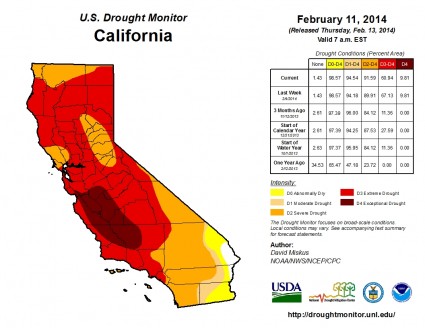
#2 According to the U.S. Drought Monitor, 91.6 percent of the entire state of California is experiencing “severe to exceptional drought” even as you read this article.
#3 According to CNBC, it is being projected that California farmers are going to let half a million acres of farmland sit idle this year because of the crippling drought.
#4 Celeste Cantu, the general manager for the Santa Ana Watershed Project Authority, says that this drought could have a “cataclysmic” impact on food prices…
Given that California is one of the largest agricultural regions in the world, the effects of any drought, never mind one that could last for centuries, are huge. About 80 percent of California’s freshwater supply is used for agriculture. The cost of fruits and vegetables could soar, says Cantu. “There will be cataclysmic impacts.”
#5 Mike Wade, the executive director of the California Farm Water Coalition, recently explained which crops he believes will be hit the hardest…
Hardest hit would be such annual row crops as tomatoes, broccoli, lettuce, cantaloupes, garlic, peppers and corn. Wade said consumers can also expect higher prices and reduced selection at grocery stores, particularly for products such as almonds, raisins, walnuts and olives.
#6 As I discussed in a previous article, the rest of the nation is extremely dependent on the fruits and vegetables grown in California. Just consider the following statistics regarding what percentage of our produce is grown in the state…
–99 percent of the artichokes
–44 percent of asparagus
–two-thirds of carrots
–half of bell peppers
–89 percent of cauliflower
–94 percent of broccoli
–95 percent of celery
–90 percent of the leaf lettuce
–83 percent of Romaine lettuce
–83 percent of fresh spinach
–a third of the fresh tomatoes
–86 percent of lemons
–90 percent of avocados
–84 percent of peaches
–88 percent of fresh strawberries
–97 percent of fresh plums
#7 Of course it isn’t just agriculture which will be affected by this drought. Just consider this chilling statement by Tim Quinn, the executive director of the Association of California Water Agencies…
“There are places in California that if we don’t do something about it, tens of thousands of people could turn on their water faucets and nothing would come out.”
#8 The Sierra Nevada snowpack is only about 15 percent of what it normally is. As the New York Times recently explained, this is going to be absolutely devastating for Californians when the warmer months arrive…
Experts offer dire warnings. The current drought has already eclipsed previous water crises, like the one in 1977, which a meteorologist friend, translating into language we understand as historians, likened to the “Great Depression” of droughts. Most Californians depend on the Sierra Nevada for their water supply, but the snowpack there was just 15 percent of normal in early February.
#9 The underground aquifers that so many California farmers depend upon are being drained at a staggering rate…
Pumping from aquifers is so intense that the ground in parts of the valley is sinking about a foot a year. Once aquifers compress, they can never fill with water again.
It’s no surprise Tom Willey wakes every morning with a lump in his throat. When we ask which farmers will survive the summer, he responds quite simply: those who dig the deepest and pump the hardest.
#10 According to an expert interviewed by National Geographic, the current drought in the state of California could potentially last for 200 years or more as some mega-droughts in the region have done in the past…
California is experiencing its worst drought since record-keeping began in the mid 19th century, and scientists say this may be just the beginning. B. Lynn Ingram, a paleoclimatologist at the University of California at Berkeley, thinks that California needs to brace itself for a megadrought—one that could last for 200 years or more.
#11 Much of the western U.S. has been exceedingly dry for an extended period of time, and this is hurting huge numbers of farmers and ranchers all the way from Texas to the west coast…
The western United States has been in a drought that has been building for more than a decade, according to climatologist Bill Patzert of NASA’s Jet Propulsion Laboratory.
“Ranchers in the West are selling off their livestock,” Patzert said. “Farmers all over the Southwest, from Texas to Oregon, are fallowing in their fields because of a lack of water. For farmers and ranchers, this is a painful drought.”
#12 The size of the U.S. cattle herd has been shrinking for seven years in a row, and it is now the smallest that it has been since 1951. But our population has more than doubled since then.
#13 Extremely unusual weather patterns are playing havoc with crops all over the planet right now. The following is an excerpt from a recent article by Lizzie Bennett…
Peru, Venezuela, and Bolivia have experienced rainfall heavy enough to flood fields and rot crops where they stand. Volcanic eruptions in Ecuador are also creating problems due to cattle ingesting ash with their feed leading to a slow and painful death.
Parts of Australia have been in drought for years affecting cattle and agricultural production.
Rice production in China has been affected by record low temperatures.
Large parts of the UK are underwater, and much of that water is sea water which is poisoning the soil. So wet is the UK that groundwater is so high it is actually coming out of the ground and adding to the water from rivers and the sea. With the official assessment being that groundwater flooding will continue until MAY, and that’s if it doesn’t rain again between now and then. The River Thames is 65 feet higher than normal in some areas, flooding town after town as it heads to the sea.
#14 As food prices rise, our incomes are staying about the same. The following is from a CBS News article entitled “Food prices soar as incomes stand still“…
While the government says prices are up 6.4 percent since 2011, chicken is up 18.4 percent, ground beef is up 16.8 percent and bacon has skyrocketed up 22.8 percent, making it a holiday when it’s on sale.
#15 As I have written about previously, median household income has fallen for five years in a row. So average Americans are going to have to make their food budgets stretch more than they ever have before as this drought drags on.
If the drought does continue to get worse, small agricultural towns all over California are going to die off.
For instance, consider what is already happening to the little town of Mendota…
The farms in and around Mendota are dying of thirst. The signs are everywhere. Orchards with trees lying on their sides, as if shot. Former farm fields given over to tumbleweeds. Land and cattle for sale, cheap.
Large numbers of agricultural workers continue to hang on, hoping that somehow there will be enough work for them. But as Evelyn Nieves recently observed, panic is starting to set in…
Off-season, by mid-February, idled workers are clearly anxious. Farmworkers and everyone else who waits out the winter for work (truckers, diesel providers, packing suppliers and the like) are nearing the end of the savings they squirrel away during the season. The season starts again in March, April at the latest, but no one knows who will get work when the season begins, or how much.
People are scared, panicked even.
I did not write this article so that you would panic.
Yes, incredibly hard times are coming. If you will recall, the 1930s were also a time when the United States experienced extraordinarily dry weather conditions and a tremendous amount of financial turmoil. We could very well be entering a similar time period.
Worrying about this drought is not going to change anything. Instead of worrying, we should all be doing what we can to store some things up while food is still relatively cheap. Our grandparents and our great-grandparents that lived during the days of the Great Depression knew the wisdom of having a well-stocked food pantry, and it would be wise to follow their examples.
Please share this article with as many people as you can. The United States has never faced anything like this during most of our lifetimes. We need to shake people out of their “normalcy bias” and get them to understand that big changes are coming.
30 Comments on "15 Reasons Why Your Food Prices Are About To Start Soaring"
eugene on Tue, 18th Feb 2014 3:00 am
Seems to me we are in the very beginnings of a global climate change that will, permanently, alter the climate making it much harder, if at all, for humans to survive.
And, I know, this has all happened before so it’s a “cyclical” thing and all will return to normal. Course that was millions of yrs ago and lasted, in some cases, millions of yrs. But we Americans are not controlled by such incidents and our wondrous technology will surely save us. Just think, while we’re starving we’ll be able to discuss it on Facebook and Twitter.
farmboy on Tue, 18th Feb 2014 3:56 am
The cons of carrying all our eggs in one basket. Thanks to cheap energy and Latino slaves, it was just so much more tempting to let California raise most of our veggies and fruit.
Was great for efficiency, not so good for resiliency.
DC on Tue, 18th Feb 2014 4:15 am
That ‘california’ place should be the poster child for un-sustainable. The place had a good run for a while, importing raw materials from the nation-and the world and concentrating them to provide the illusion of endless growth and good times forever. While the place is not done for yet-its past wastefulness is beginning to catch up with it, even if it wont happen on the slightly over-the-top ECBs schedule.
Allowing corporate mono-croppers to essentially create a virtually monopoly on a wide of products(in a desert) of course, creates a single-point-of-failure situation. Even in my stores over 800 miles and a country away, ALL the lettuce in our big-box eyesores come from California. Despite no lack of water, land or skill growing a complex product like…head lettuce. Our sole source of it is….yea California. Go figure….
Lets see.
-Drains water from the entire Colorado River system, as well as overdrawing local sources.
-Electricity from surrounding states and as far away from Canada
-Gas from Mexico and around the world(its own supplies long past peak)
-Slave Labor from Mexico. Domestic, Construction-and Industrial AG.
-Hugely bloated legacy infrastructure costs. The result of a century of intense cars only transportation policy. And massive and complex water diversion schemes upkeep as well.
All in a region that is essentially, a desert. The northern part of the state is slightly better, being more temperate. The southern portion, where most of California’s bloat is located-desert. Right now its a tug of war between large portions of the state attempting to revert back to its natural state, and human, well amerikan at any rate, stubbornness on the other.
I am pretty sure I know who is going to win that tug-o-war, but as always, its the timing that interests us most-not the final outcome.
ghung on Tue, 18th Feb 2014 4:37 am
California’s drought will be a boon for local and more distributed agriculture. I’ve been saying that some forcing would be required for some time. How many fields in other parts of the country have lain fallow because of California’s industrial agricultural efficiency? We’re fixin’ to find out.
Spring is less than a month away. Get busy y’all.
p.s. – I didn’t say it would be easy.
Loki on Tue, 18th Feb 2014 5:13 am
DC, how many heads of lettuce have you grown? I’m guessing none. It’s not as easy as it sounds, especially in quantity.
Ghung, I’m hoping you’re right. I’m a organic vegetable farmer in Oregon, we market entirely locally. I’d love it if the price of produce goes up up up 🙂
GregT on Tue, 18th Feb 2014 5:26 am
A large percentage of our produce in British Columbia comes from California. We have already been warned, but most people as usual, continue to keep their heads firmly buried in the sand. There simply is not enough local farmland anymore, to sustain the urban population here.
I wonder what people will prefer in the future, hydro electric power for air-conditioning and electric cars, or food?
Hmmm, tough choice.
Northwest Resident on Tue, 18th Feb 2014 5:44 am
The shock of dramatically rising food prices will make the herd very, very nervous. Smart people are already set up to grow their own “row vegetables” and know how to do it. Semi-smart people such as myself are working hard to get set up to start growing row vegetables and other produce this summer. Dumb people — they don’t have a clue what is coming, and there’s some smart ones who don’t either, they just haven’t figured out what is going on yet.
PapaSmurf on Tue, 18th Feb 2014 6:05 am
I never liked any of those veggies anyway. Although, the strawberries were good.
jedrider on Tue, 18th Feb 2014 6:31 am
Climate Change, then Agricultural Failure, followed by Civilizational Collapse: Where have we seen this before? But, surely NEVER on such a colossal scale.
The Peak Oil scenario was more interesting: Bike-pedaling to read a book in the light. Now, we just get starvation. No fun.
DC on Tue, 18th Feb 2014 6:40 am
Im sure Greg, that both of us have lost count over the years of applications to carve up the ALR all over the province. And who is making these apps? Oh the usual suspects…..
‘Developers’ aka>The A.R.S.E. complex.
Automotive-Retail-Suburban Expansion.
They dont get turned down very often do they? So we have this absurd sitation where ‘farmers’ markets, roadside stands, suburban Faux ‘Organic’ food stores, big-box eyesores, small locally owned grocers(an endangered species) ALL carrying identical produce and veggies, and the bulk of them come from, yea, amerika-California specifically.
It got even more absurd when I advised my mother to stop buying that amerikan chemically treated goop. So what did she do? She humoured me and didn’t go to Wall-mart, and when to a locally-owned store instead, and came home with the exact same produce. Not to annoy me of course, but because thats all there they had.
So the generalized decline of California mono-cropping, will affect the food prices of people living in BC and Alberta and beyond in an entirely different country, and Mexico to the south as well I suspect, despite the fact none of the areas lack the skills, or water or resources to be entirely food self-sufficient. So much for the comparative advantage hypothesis…..
Poordogabone on Tue, 18th Feb 2014 7:17 am
#16 price of natural gas is going up. that will increase the price of fertilizers for one, food processing uses a lot of natural gas. “Chicken factories” need to be heated etc…
Dave Thompson on Tue, 18th Feb 2014 10:29 am
Dandelions are tasty for the spring and free.
Davy, Hermann, MO on Tue, 18th Feb 2014 10:57 am
@ALL – So many good comments on CALLY unable to recognize you all. From my view this drought will force the water issues if the March rains don’t come. Remember this is climate change/instability AGW so historical records my not shake out the future like the past. In any case we may see the push to more sustainable AG and water use. It is not like there are no plan B’s in these areas. Californians tend to be trend setters. It is no surprise the worst of sprawl and unsustainability came to them look at all the heathens that moved in. The place was a paradise before the Europeans. Even after the Spanish and decedents it was pretty good. The Americans are what did the exploitation and of course we know the current story. As far as the produce. I eat it but only because I have to. If you have eaten out of the garden then eating store produce is like being a kid getting medicine. “Plus” all those pesticides. I may being eating healthy but what about the PPM of some nasty shit! I want fresh fruit in the winter while I can. Each time I eat it I know it will not last. We will be seasonal soon enough.
Guys, Cally is a significant economic node in the US and global economy. Don’t think for a minute this will be taken lightly by the world. I am talking if this steadily deteriorates and does not improve. It is not a game ender for the financial system but it is not good. Another “RED FLAG” for growth. We only get so many strikes. Foul balls NP. Foul Balls are good things that go away and there will be many but strikes are systematic disruption to our status quo BAU. It seems most people here want BAU over “BUT” I am saying let’s hope for a gentle ride down the Energy Gradient. We have allot of management ahead. IMHO a quick ride down is a game ender (I hope I am wrong). The systematic risk in this case is poor economic performance stressing the already stressed financial system. The food system is stressed now. We may have deflation of IPAD’s but meat. Veggies, milk products, and et all are in significant inflation. Add to that the mass wealth transfer going on and you get a recipe for social fabric tightening. When middle class people star to suffer the 10% take notice. Even the 1% must consider the consequences. It is not a far cry for lynching in Malibu and The Hamptons! Yes this is all of the above of AGW, water stress, social stress, and political/economic stress, and end of growth. Should play much more a roll in our discussions.
Makati1 on Tue, 18th Feb 2014 1:48 pm
We ate locally and seasonally when I was a kid in PA. The local A&P was the only grocery store in a small town and I remember that it was not much more than 40 feet wide and maybe 100 feet deep. Winter foods were root crops, meat, dairy, canned veggies and fruits, and you never saw asparagus, strawberries, or any out of season stuff in the winter, at any price. I suspect that the old days are coming back sooner than even I thought they would. Maybe obese will go back to being an unknown condition?
action on Tue, 18th Feb 2014 2:37 pm
Simple, switch to Oranges – that’ll keep the scurvy away
ghung on Tue, 18th Feb 2014 3:09 pm
Those of you who have limited space may want to consider container gardening. Even though we have land and a large garden, I’ve been growing peppers, tomatoes, herbs, etc. on our roof in 15 gallon plastic “rope totes”. I built a cheapo drip irrigation system to keep them watered and have produced several hundred pounds of food in a season using this method.
I use wire tomato cages inserted in the buckets (‘totes’) to support plants, and clear plastic bags can be placed over the cages to create a cold frame. The totes, while a bit heavy, can be moved out of bad weather or for safety from pilfering neighbors at night. I use a little cart to move them to be dumped into a compost pile at the end of the year.
Containers can be made from just about anything, but if you get plastic buckets, look for UV stabilized plastic or they won’t last. I’ve found that regular 5 gallon buckets tend to get root-bound towards the end of the season. This method saves soil and water, especially if you compost, add organic matter, and make sure your mixture is well drained. Drill a few holes near the bottom. Some photos:
//i1001 dot photobucket dot com/albums/af140/Ghung/home_sweet_home4_zps75de043a dot jpeg
//i1001 dot photobucket dot com/albums/af140/Ghung/roofgarden1 dot jpg
In the aerial photo, the containers show up as little dots on the roof. I suppose I could put a couple of hundred more up there if I wanted/needed to.
ghung on Tue, 18th Feb 2014 3:14 pm
If you can’t make the above links work:
http://i1001.photobucket.com/albums/af140/Ghung/roofgarden1.jpg
http://i1001.photobucket.com/albums/af140/Ghung/home_sweet_home4_zps75de043a.jpeg
nemteck on Tue, 18th Feb 2014 4:02 pm
“It’s no surprise Tom Willey ……. When we ask which farmers will survive the summer, he responds quite simply: those who dig the deepest and pump the hardest.”
That’s the typical American way to destroy nature. Get everything today or someone else will get it. There is no talk of cooperation and conservation.
And now they want fracking in the California basin. Of course, the SUVs have to be ready to drive to Wall- Mart
Nony on Tue, 18th Feb 2014 4:42 pm
I was in San Diego in the early 90s and remember all the blather about the 7 year drought. It didn’t affect me. Water turned on fine when I wanted a shower. Not like being in the Navy and having to wet, soap, rinse (turning on/off tap). Then in 1992-3, there was a huge winter of rain and the reservoirs filled. These things come and go.
Davy, Hermann, MO on Tue, 18th Feb 2014 5:12 pm
@ghung – nice place!!
Northwest Resident on Tue, 18th Feb 2014 5:24 pm
ghung — That looks more like a fortress than it does a house. Who built that? You? I didn’t see any side-view shots, but I assume you have machine gun turrets built into the walls? Actually, all kidding aside, awesome place! With all that green vegetation, I’m guessing you have a fairly solid water supply too. Nice damn setup — just hope that a group of city slickers hasn’t scoped your place out for an escape hideaway for when TSHTF.
Davy, Hermann, MO on Tue, 18th Feb 2014 5:41 pm
@N/R – rattle snake pits for the scopers from the shitties
John on Tue, 18th Feb 2014 5:55 pm
We’re expecting triple-price increases very soon. I am a major online food seller of storable food. I don’t want to come across as an “advertisement” so I won’t mention my company name.
Grain prices, beef prices and now vegetable prices have increased. The latest news on drought conditions and global harvests is pretty dismal. International competition for available food stocks is also increasing. China has been buying up a large number of farms in order to secure food for their own populations.
Frankly, it only looks to get significantly worse.
Northwest Resident on Tue, 18th Feb 2014 6:12 pm
Davy — Don’t forget the sharpened wood spikes at the bottom of that pit — always a nice touch.
Davy, Hermann, MO on Tue, 18th Feb 2014 6:34 pm
@n/r – with some human waste rubbed on the spikes for good measure
Northwest Resident on Tue, 18th Feb 2014 7:07 pm
Yeah, and if all that doesn’t kill them immediately, ghung has some pet fire ants to finish the job.
GregT on Tue, 18th Feb 2014 8:39 pm
I bought one of these earthboxes a few years back. h ttp://forum.earthbox.com/index.php?topic=7378.0
Absolutely the best container gardening system ever. I now have a half dozen of them. No fuss no muss, I just hook them up to a water supply and let em grow.
They worked so well that two years ago I started making my own out of 20 litre buckets following a plan like this:
h ttp://www.underthechokotree.com/index.php?option=com_content&view=article&id=147:self-watering-container-20-litre-buckets&catid=50:containers&Itemid=37
This guy kinda messed up though. The top couple of inches of soil need to have dolomitic lime mixed in to help keep the soil sweet. Then a trough is made in the soil around the edges of the inside of the container, 7-7-7 non water soluble fertilizer is poured in and covered over with soil. The soil used is peat or coir-based, containing perlite and/or vermiculite.
Instructions for the earth box system can be found here:
h ttps://earthbox.com/earthbox-pdf/EB-WEB-INSTRUCTIONS_NEW-2.pdf
Northwest Resident on Tue, 18th Feb 2014 9:32 pm
John — Being in the business and seeing it coming on hard must be raising the hair on your back a little, if not a lot. Higher food prices and more competition for food is a direct path to hungry people and resulting riots/mayhem. Let’s hope it isn’t as bad as it is portrayed in this article, for now — but we all know that it WILL be that bad and much worse at some point in the near future. Maybe this is a wake-up call. Time to start producing our own food on an individual or small collective basis, not just because it is cool, but because there isn’t any other choice.
Keith_McClary on Wed, 19th Feb 2014 5:52 am
“two-thirds of carrots”
Fortunately you don’t need to be in California to grow carrots and they keep well through the winter. You are missing the vities of spinach, broccoli and peppers, tho.
robertinget on Fri, 21st Feb 2014 4:13 pm
With Hydro drying up even before spring,
California will be needing more natural gas, wind and solar power to generate power.
As alternatives to gas are longer term, initially more expensive, it will be gas pipelines, utilities like PG&E (PCG)
that will be profiting from disasters as is often the case.
My case for NG will be proven as warmer,
spring weather refuses to budge highest gas prices in five years.
For instance:Today’s headlines are reading “Natural gas futures drop for second day on Forecasts of thaw”.
In the first place more cold and snow is not only effecting ‘fly over’ country today but is due ‘Back East’ this weekend.
Secondly, we will be learning the hard way this summer. Many regions will be using more NG (generating power) to cool
homes and businesses than those same cities used for warmth this winter.
Every year summer NG requirements will grow throughout all 50 states until
more storage will be needed for summer
consumption.
New Solar and wind power projects are
lining up for California and Nevada as well.
Any serious alt.energy investor would be wise to get free Google News clipping service on California solar and wind power projects. Long term… solar powered desalination, waste water purification, is California, Nevada
New Mexico, Arizona’s ONLY salvation.
With enough low cost water, GMO salt resistant seeds, plants, we will not starve. Instead of having the cheapest groceries in the world we will simply spend greater percentages of our incomes on food. For rich people this won’t be noticeable. For poor folks climate change is yet another insult added to injury.