
Peak Oil is You
Donate Bitcoins ;-) or Paypal :-)


Page added on May 12, 2014

Why Invest In Farmland?
Everyone has to eat in order to survive and the production of almost all food can be traced back to farmland around the world in some way. Demand is growing for farmland as the world’s population and global needs for food increase. What many don’t realize is that the supply of farmland is not changing, thus creating a severe imbalance in the supply and demand of farmland.
An investment in farmland over the long-term will provide a steady stream of income and capital gains due to the increasing global demand for agricultural commodities, driven by the rising world population, rapid growth in emerging markets, and continued demand for ethanol and biofuels. Demand for agricultural commodities is outpacing supply, positioning farmland for long-term appreciation.
In brief, the following factors are important in driving the fundamental investment rationale for farmland investments:
• Cash Returns – farmland is a performing asset, generating modest cash returns of 4-6%, depending on location and crop.
• Land Scarcity – there are approximately 3.5 billion acres of arable land in the world with the potential for adding a mere 20% over the next 20 years.
• Food Demand – as incomes rise, demand for proteins will increase with corresponding increases in the need for feed grains. Demand is growing in developing countries: The United States Department of Agriculture (USDA) expects exports to rise to as much as $167 billion in 2021 from $82 billion in 2007.
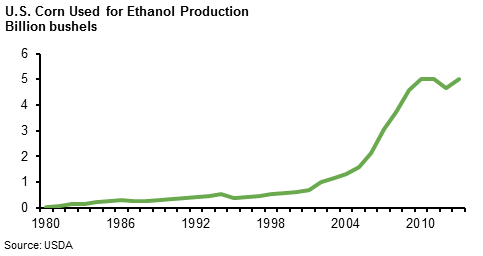
• Bio-fuels – agriculture and energy markets are now bound together by federal mandates for renewable fuels. The USDA estimates that 40.5% of the U.S. corn crop was used for ethanol in 2011 and 43.1% was used in 2013.
• Declining Inventories Worldwide – inventories of grains, as measured by “Stocks to Use” ratios have been trending down in many countries. In the U.S., there is a roughly 35-day supply of corn. In China, declining stocks has created the potential for increasing imports of corn.
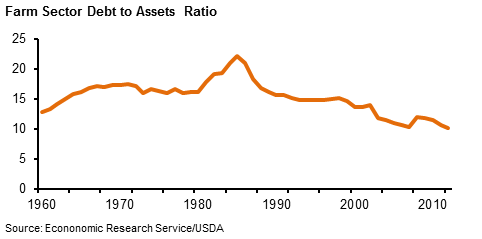
• Low Farm Sector Debt Levels – the U.S. farm sector has a healthy balance sheet. Current debt to assets ratios are at 40-year lows and 78% of Iowa farmland is free of debt.
• U.S. Infrastructure – from transportation and storage networks to the stability of government programs and the know-how at U.S. universities, the U.S. farm sector has the ability to grow and efficiently market large volumes of feed and foodstuffs.
• Inflation Hedge – many economists expect inflation in the longer term as large federal deficits and the Federal Reserves’ easy money policy will create conditions for high inflation. Farmland is highly correlated to inflation and negatively correlated to most other financial asset classes.
• Resource Conservation – agriculture production must be managed as a sustainable resource to feed the world’s growing population. Water is a vital resource and is a limiting factor for irrigated agriculture throughout the world.
• Sustainable Asset – farmland improves in productivity over time when well-managed.
World Population Growth:
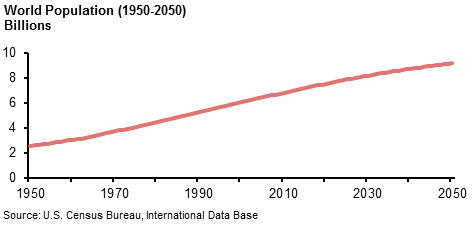
According to the U.S. Census Bureau, approximately 7.0 billion people inhabited the earth in 2012, compared to 1.7 billion in 1900 and 5.8 billion in 1985. The rate of population growth is not expected to temper as the United Nations (U.N.) estimates the world’s population will likely reach 9.2 billion in 2050. The majority of population growth is expected to originate in emerging economies with developed countries remaining stable.
In order to feed the world’s growing and longer-living population, agricultural output will need to double by 2050 according to the U.N.’s Food and Agriculture Organization (FAO). This will be a daunting goal to accomplish as agricultural resources are already strained. In the last decade, agricultural output has grown by 2.4% annually. In order to double agricultural output by 2050, output must increase at 3.4% per year.
Historical grain production statistics suggest reaching this goal will be difficult. In 9 of the last 10 years, the global consumption of grain has outpaced production according to the USDA. To meet future demand, experts are predicting that global agriculture will need to produce more food in the next 50 years than what was produced during the previous 10,000 years, putting more and more pressure on future farmers and the land they use to produce our food.
Agriculture Exports:
The reason food demand is growing faster than population growth is the development of middle classes in emerging markets, due to above average Gross Domestic Product (GDP) growth. The Brookings Institution estimates that by 2021, China’s middle class could grow to over 670 million, compared to only 150 million in 2010. Economists have long shown that as GDP rises, so does the consumption of animal protein as a percentage of diet. As emerging economies continue to develop, there will be a transfer from a grain-based diet to a protein-based diet.
Roughly half the increase in global calorie consumption in the past decade has been a result of higher meat consumption according to the FAO. On average, it takes two pounds of grain to produce one pound of chicken, five pounds of grain to produce one pound of pork, and seven pounds of grain to produce one pound of beef.
The rapid industrialization of developing markets will have serious repercussions on the demand for grain. In China alone, we may have roughly 500 million more people demanding a protein-based diet. As the world’s middle class continues to develop over the next decade, the demand for grains will grow exponentially.
Increasing Use of Biofuels:
Concerns regarding climate change and fossil-fuel dependency have led to a significant focus on renewable fuels, such as ethanol, as a replacement for high polluting carbon-based fuel sources. Ethanol is primarily manufactured from crops such as corn, wheat, and sugar cane. According to the USDA, ethanol production in the U.S. has increased from less than 3 billion gallons in 2003 to over 13 billion gallons in 2013. The Renewable Fuel Standard from the 2007 Energy Act calls for total renewable fuel to reach 36 billion gallons by 2022.
The USDA estimates that more than 40% of the U.S. corn production was used to produce ethanol in 2012. Ethanol demand is expected to stabilize and continue to consume roughly 40% of the total U.S. corn crop per year for the next decade according to the USDA. In January of 2011, the Environmental Protection Authority (EPA) approved the use of E15 gasoline for vehicles manufactured in 2001 or later. Currently, almost all gasoline in the U.S. is E10, or 10% ethanol. The increase to E15 will help the U.S. in its goal of using 36 billion gallons of renewable fuel by 2022. Ethanol exports are also steadily increasing due to growing biofuel demand from the EU and Brazil.
Agricultural Fundamentals:
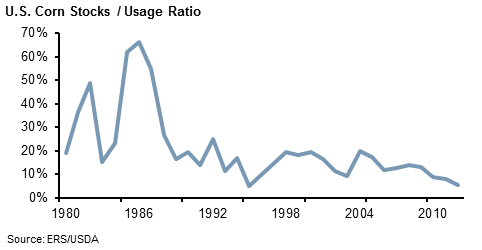
Grain supplies, in the U.S. and globally, are at decade lows, driven by emerging-market demand, disappointing U.S. yields in the last three years, and demand for biofuels. Ending corn stocks to usage ratio (current inventories as a percentage of annual consumption) has declined over the last eight years from roughly 20% in 2004 to 9.9% in 2013. U.S. corn stocks declined to a roughly 35 day supply, meaning that if corn production was halted, the U.S. would run out of corn in a little over a month.
The global demand for food and rising commodities prices have driven agriculture fundamentals to the best in decades. The USDA estimates that farm income rose 29% in 2010, 51%, in 2011, and will rise by 15% in 2013, allowing farmers to reinvest their cash flows back into farmland to expand their operations.
Despite the rapid growth in agriculture over the last few years, farmers’ balance sheets remain very conservative. Strong farm income and minimal use of debt have allowed the U.S. farm sector to maintain conservative balance sheets as current debt to assets ratios are at 40 year lows. According to Iowa State University, 78% of the land in Iowa has no money borrowed against it.
Historical Returns:
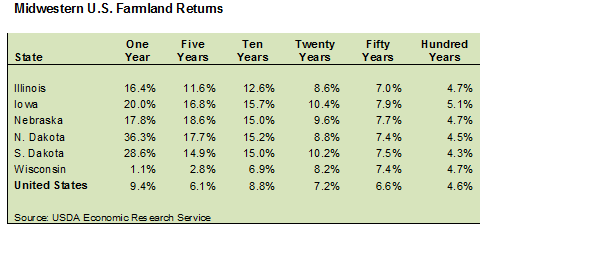
Farmland, through current income and capital appreciation, has been one of the top performing investments over the last century. Over the past 100 years, farmland has only decreased in value three times: during the Great Depression, the inflation crisis of the early 1980s, and most recently during the housing crisis of 2008 and 2009.
Despite three bumps in the road over the last 100 years, historical U.S. farmland returns are one of the most attractive asset classes that compares favorably with more traditional assets such as stocks and bonds. Over the last 20 years, American farmland has provided a total return to investors of 12.4% that is a combination of appreciation and current income from cash rental contracts. Similar long-term appreciation in farmland has been experienced in Europe, South America, and Australia.
One of the most attractive attributes of farmland is the cash rental income. Since 1967, cash rents have yielded roughly 5.7%, although the yield has declined from 6.7% in 1967 to 4.1% in 2008, primarily due to the rise in farmland values. Cash rent yields have increased from the nadir in 2007 and we expect the yield to continue to approach the historical 40-year average of 5.9% as farmland incomes rise.
Conclusion:
An investment in farmland provides investors an opportunity to diversity from traditional asset classes as farmland returns have been negatively correlated with equities and bonds, and with only a modest positive correlation with commercial real estate. These characteristics make it an excellent diversification tool that can balance a portfolio and offset financial and commercial real estate market volatility.
Farmland is frequently compared to investment in gold because of its characteristic as an inflation hedge. However, unlike gold, farmland also produces stable income streams and as a consequence it has been described as “gold with yield.”
Farmland is a long-term investment that will be the key to feeding the world’s growing population. Farmland is the one ingredient in food production that cannot be replaced and is a sustainable asset that will last many generations.
14 Comments on "Why Invest In Farmland?"
Northwest Resident on Mon, 12th May 2014 12:53 pm
“An investment in farmland over the long-term will provide a steady stream of income and capital gains…”
Unless: a) The government confiscates it from you, b) The zombies eat you for dinner and take over management of the farm, c) Roving bands of organized extortionists trade “protection” for most if not all of the food you produce on your farm, d) Climate change disasters render your farm useless.
To name a few.
This article seems to take for granted that the global economy, stock market and your investment portfolio specifically will be intact far into the future — a totally bogus assumption, IMO.
penury on Mon, 12th May 2014 1:11 pm
In the U.S. for many years the ownership of a small farm has been a losing proposition. Major agriculure has destroyed the viability of small farms, however the ownership of food producing land will always allow for survival in the majority of cases.
J-Gav on Mon, 12th May 2014 2:06 pm
Ideally, ‘farmland’ includes a woodlot and a source of water, maybe an orchard too. But its main interest is the soil. If that’s dead and can only be rejuvenated every year by massive inputs of FF-dependent phonylizer, I’m not so sure it’s a great investment. Small farms with real soil need to make a comeback in the U.S. but, as penury says above, they’re still being strangled by Big Ag (pretty much the same in Europe too).
bobinget on Mon, 12th May 2014 2:18 pm
AS a small time farmer i’ll take issue.
#1 it really depends what one grows.
My neighbor makes more in his 100’X50′ greenhouse
than in did in a good year of growing berries and pears on eleven acres. I make more per acre, than the guy with ten, twenty or thirty thousand acres of grain.
The best news ever, we all get the same government tax breaks. All perfectly legal, small. large farmers get to ‘write off’ lots of stuff regular folks cannot. Buy a new pick-up? It’s a business expense, take deprecation for six or eight years. Repairs? Tax deductible. Internet,
phone(s) the same. Oh, I forgot, if that pick-up can deal with 2.5 tons Uncle will give you rebate that too, from your ‘ordinary’ income… You and the wife teach school.. If you can show few hundred dollars in gross income, your real-estate taxes are lower. Buy tools,
rent land, diesel fuel (off road), tax breaks all round.
Apparently, governments want us to grow food.
Several have ‘taken’ land from their farmer class and nearly starved to death. Look at Soviet Union, China,
Zimbabwe, North Korea.. I doubt any army or politicians will try that again any time soon.
Best of all is quality of life.
eugene on Mon, 12th May 2014 4:28 pm
Until climate change renders your land worthless. I read little that doesn’t make the assumption the future will be the same as the past.
J-Gav on Mon, 12th May 2014 4:31 pm
Thanks for some good news there Bob. I wasn’t aware of those tax breaks. But you also say it depends on what you grow … What’s that all about?
Northwest Resident on Mon, 12th May 2014 4:44 pm
J-Gav — Do a google search on “organic certification qualifications” if you haven’t done so already. As a small time farmer/backyard “certified organic” gardener, you can get the certification which allows you to put your “certified organic” label on the produce that you grow. There are wholesalers for organic produce that are looking for more suppliers — or so I have read, in my area at least. Apparently there are a lot of people who ONLY buy certified produce, and restaurants are more and more going with all certified organic products. And as far as getting all those tax breaks — it is true, but you have to sell product — not necessarily a lot — and you can even operate at a loss for a year or two before the IRS starts asking questions. I’m thinking about doing it too.
MKohnen on Mon, 12th May 2014 10:58 pm
I really have no idea of the farming situation in any other part of the world but Canada. As for the Canadian farming situation, that I have observed over the years directly, and here are some things I can tell you about farmland:
1. The health of the soil is noticeably degrading. Look at the tree lines around fields in Alberta or Saskatchewan, and year over year you will see a shocking die-off. Also look at the trees within fields, which is usually an indication of rocks or sloughs. Again, you will notice inexplicable die-off that is quite astonishing. Also note that, even with the use of GMO crops and anhydrous, yields are barely increasing, and in many areas decreasing.
2. Because of government subsidies for broke acres, farmers are encouraged to break land that is less than marginal for cropping. The yield from this land is quite pathetic, but the government will subsidize crop loss based on historic acre yield in the area. Ergo, it pays to break land that can’t produce just to get government money in subsidies. Of course, this is having a major impact on the watershed, since much of this “farmland” is actually marsh that has been drained but is quite alkaline.
3. There is no way that there is 20% more arable land to be recovered, at least not in the Canadian prairie provinces. As stated above, we have already broken huge tracts of sub-marginal land. Even if our growing season extends thanks to AGW, the land won’t support more crops without huge inputs of chemical fertilizers. And AGW is going to require a lot more use of herbicides and pesticides as our winters get milder (I know, if you live in the prairie provinces, after this past winter you probably think I’m nuts for talking about warmer winters.)
Now this should mean that this article is correct, and that farmland will only appreciate in value, as indeed it has. But the big problem is the cost of fuel. There is no way you will ever make a tractor that can pull a 95 foot tiller/seeder that runs on solar power. Fuel is everything, but the farmer’s ability to increase profit due to fuel price increases is extremely limited due to the global agricultural subsidies situation. So, just as it always has been, I’d say that farmland is still a highly speculative investment. Run out of fuel, and your farmland really isn’t worth much.
PrestonSturges on Mon, 12th May 2014 11:16 pm
We have a couple hundred acres of rich bottom land that is immune to drought and will grow anything.
It’ll probably get auctioned off for next to nothing.
There is still huge amounts of farm land available at foreclosure prices.
Davy, Hermann, MO on Tue, 13th May 2014 6:07 am
MK, I farmed 1000 acres of corn and beans around 2000 when the farm market was depressed due to excessive production. I knew then there was a problem but I thought I could blaze a new path of sustainability and balance with the ecosystem. I was sadly wrong. Part of the reason I got in was I saw the coming demand from China and biofuels so I felt the economics would improve. I purchased the land at the right price. I also thought I could reform it in my own special way. I had a full time job as a finance manager with access to heavy equipment from my family’s business. I had partners that were experts in the hands on production efforts. So in a sense I had the abilities, a comparative advantage, and the resources to make it work. I can tell you the production agricultural market and economic segment is broken and a mess. I got my butt kicked mentally and financially. I did not lose money but I worked 4 years for free so in that respect I paid for my education. Production AG is just a reflection of the rest of society and the predicaments it is in. Land may be relatively expensive and prices good now but all the pressures of entropic decay, limits of growth, diminishing returns, and overshoot of carrying capacity are evident in the Ag sector. This sector will break to a lower level of complexity with the break in the financial system and the declining energy gradient. Corporate farming that makes up a significant portion of societies food production cannot survive a significant financial correction. The so called “broad acre farms” with excessive energy intensity in their productive efforts cannot last. The scary aspect of this break to a lower level is the transition that must take place in what will be a relatively quick “system break”. Once the system breaks time will be an element. Those resources of skills, manpower, animal power, new economies, and markets will either not be there in sufficient quantities or severely disrupted. We will have to maintain some production Ag in this process to make a transition without severe collapse. Food is a non-negotiable variable in a decent with a soft enough landing that society can reboot. It will take time to train people, manufacture the tools, and organize an economic system to farm in a less complex, energy intensive, and technical way. If one reads about 19 century Ag which was relatively complexed we see big families, lots of animal power, and relatively smaller populations in rural settings. Small cities could be supported. I might add we had a relatively stable climate. We also had a high death rate comparable to today without the complex medical system to support the population. I firmly believe we will have to go back to 19 century mode of agricultural efforts. This will be a difficult transition and the longer we wait the worse the “receding horizons”. We will have lingering technological benefits follow us in this decent but most will suffer entropic decay and economic abandonment. The complexity and educational system is not there to support these technologies. The current effort of the bottom up are laudable but in no way can scale up to what lies ahead. If anything, hopefully they will be a seed that will allow some kind of transition. My friend on this board Simon is truly an example of what is needed. His hobby is raising and putting horses to work in his wonderful area of France. There are others here I wish I had time to compliment. Many of us that can should play their own little part of being “monasteries of knowledge” for the coming dark ages relative to what we have now.
Northwest Resident on Tue, 13th May 2014 9:42 am
“Many of us that can should play their own little part of being “monasteries of knowledge” for the coming dark ages relative to what we have now.”
Well said, Davy!
Right now is the time to gather together a wealth of knowledge on how to grow your own food — while the internet is still up and easily accessible.
There is no alternative. We are heading into a future where LOCAL food production is the only alternative, where a majority of “jobs” will be in that food production or local distribution.
For every type of crop you want to raise, you have to know a LOT. When do you plant? How deep do you plant the seeds? What spacing should be between plants? What soil/nutritional needs does the plant have? How much water does the plant need? What types of bugs/diseases is the plant susceptible to and how to you organically (no pesticides) manage those? What crops should or should not be planted in a particular area because of the crop that was grown there before (rotation)? When do you harvest the plant, and how do you harvest the plant? How do you preserve the food for long term storage and future use? How do you get your next year’s seed from the crop you’ve grown and still have enough to eat? What crops can be grown in late summer and/or through the winter so that you still have food?
If you’re growing 10 – 20 or so different crops, then knowing all of the above about each crop is a LOT of knowledge. Knowing all this and being prepared by having the seed and the know-how is going to be crucial at some point, and I believe in the near future.
If you haven’t started gathering the information and putting it into a hard-copy book, now is the time to start.
T Allen Dyer on Tue, 13th May 2014 10:55 am
Farmland is undervalued not overvalued!
https://www.prbuzz.com/personal-finance/227533-your-farmland-is-undervalued-not-overvalued.html
Comments?
info@farmlandmarketinggroup.com
Davey on Tue, 13th May 2014 11:01 am
NR, buying up 19 century AG books for my antique book collection. lots of good stuff in those books that’s where we are heading if we are lucky!
MKohnen on Tue, 13th May 2014 1:35 pm
Davy,
Very interesting post, and I couldn’t agree with you more. I have a background in small farming, mechanics, electronics and programming. As such, what I want to develop is the technology that would allow small farmers to do more. As NWR states, the amount of knowledge required for each type of crop is extensive. Additionally, the amount of labour required to grow crops sans pesticides or herbicides is incredible. If we could develop the technology, small scale, to help with these tasks, it would be very beneficial. I also think that most the technology we require already exists, it was just used for gaming and joy-riding rather than being put to a beneficial use. I’m talking about systems that can closely monitor closed-loop crops. Also systems for power generation from multiple sources, water management, waste (let’s never use that term again) management, etc. I know from my background that, in small farming that is as closed-loop as possible, it’s the small repetitive tasks that need to be closely monitored that can be the killers of the process. Now it is true that we may have an over abundance of human labour to do various jobs, but that won’t necessarily help. There are many jobs humans aren’t particularly good at, such as monitoring processes while making small adjustments over long periods of time. Even with things like seeding, you really can’t make seed flow adjustments by hand accurately enough to ensure that you aren’t wasting a lot of seed, or under-seeding areas that could produce better.
Anyway, that’s what I’m working on, and I believe it would work hand-in-hand with more human and animal labour.