
Peak Oil is You

Donate Bitcoins ;-) or Paypal :-)


Page added on February 9, 2016

The Return Of Crisis

Financial markets the world over are increasingly chaotic; either retreating or plunging. Our view remains that there’s a gigantic market crash in the coming future — one that has possibly started now.
Our reason for expecting a market crash is simple: Bubbles always burst.
Bubbles arise when asset prices inflate above what underlying incomes can sustain. Centuries ago, the Dutch woke up one morning and discovered that tulips were simply just flowers after all. But today, the public has yet to wake up to the mathematical reality that over $200 trillion in debt and perhaps another $500 trillion of un(der)funded liabilities really cannot ever be paid back under current terms. However, this fact is dawning within the minds of more and more critical thinkers with each passing day.
In order for these obligations to be reset to a reality-based level, something has to give. The central banks have tried to modify the phrase “under current terms” by debasing the currency these obligations are written in via inflation. Try as they have, though, they’ve been unable to create the sort of “goldilocks” low-level inflation that would slowly sublimate that massive pile of debt into something more manageable.
Wide-spread inflation has not happened. Why not? Because they’ve failed to note that plan of handing all of their newly printed money to a very wealthy elite — while a socially popular thing to do among the cocktail party set — simply has concentrated the inflation to the sorts of assets the monied set buys: private jets, penthouse apartments, fine art, large gemstones, etc. So yes, their efforts produced price inflation; just of the wrong sort.
Even worse, all the central banks have really accomplished is to assure that when the deflation monster finally arrives it will be gigantic, highly damaging and possibly uncontrollable. I’ll admit to being worried about this next crash/crisis because I imagine it will involve record-setting losses, human misery due to lost jobs and dashed dreams, and possibly even the prospect of wars and serious social unrest.
Let me be blunt: this next crash will be far worse and more dramatic than any that has come before. Literally, the world has never seen anything like the situation we collectively find ourselves in today. The so-called Great Depression happened for purely monetary reasons. Before, during and after the Great Depression, abundant resources, spare capacity and willing workers existed in sufficient quantities to get things moving along smartly again once the financial system had been reset.
This time there’s something different in the story line: the absence of abundant and high-net energy oil. Many of you might be thinking “Hey, the price of oil is low!” which is true, but only momentarily. Remember that price is not the same thing as net energy, which is what’s left over after you expend energy to get a fossil fuel like oil out of the ground. As soon as the world economy tries to grow rapidly again, we’ll discover that oil will quickly go through two to possibly three complete doublings in price due to supply issues. And those oil price spikes will collide into that tower of outstanding debt, making the economic growth required to inflate them away a lot more expensive (both cost-wise and energetically) to come by.
With every passing moment, the world has slightly less high-net energy conventional oil and is replacing that with low-net energy oil. Consider how we’re producing less barrels of production in the North Sea while coaxing more out of the tar sands. From a volume or a price standpoint right now, the casual observer would notice nothing. But it takes a lot more energy to get a barrel of oil from tar sands. So there’s less net energy which can be used to grow the world economy after that substitution.
Purely from a price standpoint, our model at Peak Prosperity includes the idea that there’s a price of oil that’s too high for the economy to sustain (the ceiling) and a price that’s too low for the oil companies to remain financially solvent (the floor). That ceiling and that floor are drawing ever closer. When we reach the point at which there’s not enough of a gap between them to sustainably power the growth our economy currently is depending on, there’s nothing left but to adjust our economic hopes and dreams to more realistic — and far lower — levels.
When this happens most folks will undergo a “forced simplification” of their lifestyles (as well as their financial portfolios), which they will experience as disruptive and emotionally difficult. That’s not fear-mongering; it’s just math. (And it’s the reason why we encourage developing a resilient lifestyle today, to insulate yourself from this disruption, as well as be able to enter the future with optimism.)
Too Much Debt
Our diagnosis of the fatal flaw facing the global economy and its financial systems has remained unchanged since before 2008. We can sum it up with these three simple words: Too much debt.
The chart below visualizes our predicament plainly. It has always been mathematically impossible (not to mention intellectually bankrupt) to expect to grow one’s debt at twice the rate of one’s income in perpetuity:

All but the most blinkered can rapidly work out the fallacy captured in the above chart. Sooner or later, borrowing at a faster rate than income growth was going to end because it has to. Again, it’s just math. Math that our central planners seem blind to, by the way — all of whom embrace “More debt!” as a solution, not a problem.
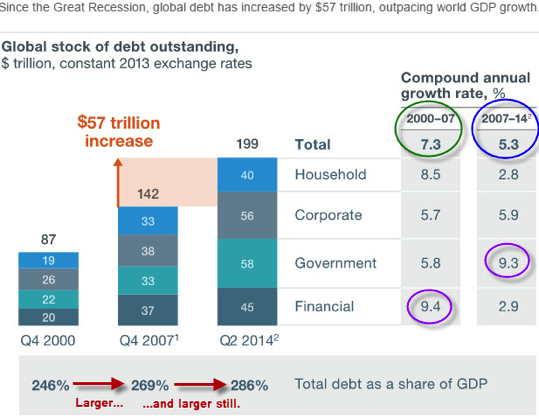
Despite being given the opportunity to re-think their strategy in the wake of the 2008 credit crisis, the world’s central banks instead did everything in their considerable power to create conditions for the most rapid period of credit accumulation in all of history:
Lesson not learned!
The chart’s global debt number is only larger now, somewhere well north of $200 trillion here in Q1 2016. But consider, if you will, that entire world had ‘only’ managed to accumulate $87 trillion in total debt by 2000 (this is just debt, mind you, it does not include the larger amount of unfunded liabilities). Yet governments then managed to pour on an additional $57 trillion just between the end of 2007 and the half way point of 2014, just seven and half short years later.
Was this a good idea? Or monumental stupidity? We’re about to find out.
My vote is on stupidity.
Banks In Trouble
In just the first few weeks of 2016, the prices of many bank stocks have suddenly dropped to deeply distressed territory. And the price of insurance against default on the bonds of those banks is now spiking.
While we don’t know exactly what ails these banks — and, if history is any guide, we probably won’t find out until after this next crisis is well underway — but we can tell from the outside looking in that something is very wrong.
In today’s hyper-interconnected world of global banking, if one domino falls, it will topple any number of others. The points of connectivity are so numerous and tangled that literally no human is able to predict with certainty what will happen. Which is why the action now occurring in the banking sector is beginning to smell like 2008 all over again:
Gundlach Says ‘Frightening’ Seeing Financial Stocks Below Crisis
Feb 5, 2016
DoubleLine Capital’s Jeffrey Gundlach said it’s “frightening” to see major financial stocks trading at prices below their financial crisis levels.
He cited Deutsche Bank AG and Credit Suisse Group AG as examples in a talk outlining bearish views at a conference in Beverly Hills, California, on Friday. Both banks fell this week to their lowest levels since the early 1990s in European trading.
“We see the price of major financial stocks, particularly in Europe, which are truly frightening,” Gundlach said. “Do you know that Credit Suisse, which is a powerhouse bank, their stock price is lower than it was in the depths of the financial crisis in 2009? Do you know that Deutsche Bank is at a lower price today than it was in 2009 when we were talking about the potential implosion of the entire global banking system?”
(Source)
This time it looks like the trouble is likely to begin in Europe, where we’ve been tracking the woes of Deutsche Bank (DB) for a while. But in Italy, banks are carrying 18% non-performing loans and an additional double digit percentage of ‘marginally performing’ or impaired loans. Taken together, these loans represent more than 20% of Italy’s GDP, which is hugely problematic.
The Italian banking sector may have upwards of 25% to 30% bad or impaired loans on the books. That means the entire banking sector is kaput. Finis. Insolvent and ready for the restructuring vultures to take over.
On average, in a fractional reserve banking system operating at a 10% reserve ratio, when a bank’s bad loans approach its reserve ratio, it’s pretty much toast. By 15% that’s pretty much a certainty. By 20% you just need to figure out which resolution specialist to call. At 25% or 30%, you probably should pack a bag and skip town in the dead of night.
This handy chart provides some of the context for Europe more broadly. I’ve highlighted everything from Europe in yellow, showing how the banks there currently top the list of awfulness:

(Source)
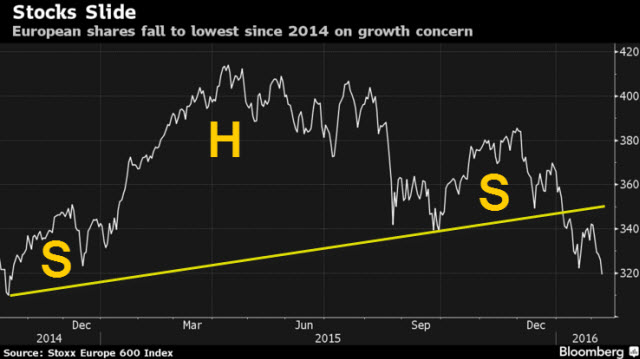
The extreme weakness in European financial shares, combined with other factors, is dragging down Europe’s stock market dramatically. The decline has now wiped out all of 2015’s market gains and has broken convincingly below the neckline (yellow line, below) of a typical “Head & Shoulders” formation:
Since the beginning of the year, the stock prices of these select banks are down (as of COB Friday 2/5/16):
- DB -28.3%
- Credit Swiss -29.9%
- MS -22.6%
- C -22.0%
- Barclays -21.7%
- BAC -21.2%
- UBS -20.3%
- RBS -19.6%
Those are pretty hefty losses over a short period of time, and that’s meaningful. While the headline equity indexes are managing to keep their losses minimized, these bellwether stocks from the critical finance sector are stampeding out the back door.
And when I say ‘critical’, I mean in the sense that a hefty amount of the overall earnings within the S&P 500 and other major stock indexes were fraudulent profits were derived from the banks feeding on central bank thin-air money and front-running central bank policy.
What’s there to worry about? Well, just pick something. It could be a combination of headwinds conspiring to drag down bank earnings from here. Take your pick: reduced trading and M&A revenue, and lower profits from ridiculously flat yield curves and negative interest rates.
However, we have to include the possibility that No more bailouts are coming. Why not? Mainly because it would be politically incendiary at this moment to even try such a thing. Public resentment of the banks is high all over the world, and in the US specifically, there’s an election primary that is hinging for the Democrats on Wall Street coziness. Maybe the markets are pricing that in?
Or it could be that these banks have been playing with fire (again) and got burned (again). We know for sure that a number hold a boatload of junk debt from the energy sector that will need to be written off. And we suspect many are staring at losses from writing too many derivative contracts that have turned against them.
But It Gets Worse; A Lot Worse
If only the greatest near-term risks were limited to the bad actions of the banks. But that’s sadly not the case.
The collapse in the price of oil has been vicious, but it’s likely not done. The oil patch has morphed into a capital-destruction zone for many drillers and as we have been warning all last year, the fallout is going to be worse than we can imagine. And it’s just getting underway.
In Part 2: The Breakdown Has Begun, we lay out our prediction for the terrifying wave of defaults that will swamp the energy sector soon, as well as the many, many related industries that service it. Avoiding losses during this period will be the key priority. And precious metals will regain their role as a preferred save-haven asset class — a victory long-suffering bullion holders should cheer.
We are now in the chaos management phase of this story. Take care to make smart choices now. Your future prosperity depends on it.
40 Comments on "The Return Of Crisis"
Plantagenet on Tue, 9th Feb 2016 7:02 pm
Oh-oh. The oil glut is getting worse, and now the entire economy is faltering.
This is just starting to get good!
shortonoil on Tue, 9th Feb 2016 7:17 pm
Someone with a one word vocabulary probably doesn’t have much to contribute.
ennui2 on Tue, 9th Feb 2016 7:20 pm
shortonoil, you and your shameless continual self-promotion…
Boat on Tue, 9th Feb 2016 8:03 pm
short,
We will have many discussione when demand grows to match production. Without global collapse and a return to higher prices. You will be taken away by the boys in white outfits to the square rubber room and told to sit in the corner. As you wander aimlessly – what could have went wrong.
Apneaman on Tue, 9th Feb 2016 8:10 pm
Boat, when is this going to happen? You’ve been continually predicting greener pastures from the first day you showed up here, all the while everything does the exact opposite. Again, no shame at your stupidity and abysmal failure rate.
How’s the mutual funds doing boaty? I see the S&P 500 fell again and it wasn’t alone – what could have went wrong?
Apneaman on Tue, 9th Feb 2016 8:29 pm
Das Boat, lots of nice charts and graphs here for you. Pay special attention to the “Bank valuations since the start of the year” chart.
Fresh banking crisis fears send FTSE to lowest level since 2012
Health of the financial system and danger of negative central bank interest rates cause bank stocks to fall to lowest level in nearly four years
http://www.telegraph.co.uk/finance/economics/12147540/stock-markets-europe-banks-recession-crisis-crash.html
Apneaman on Tue, 9th Feb 2016 8:31 pm
Lie of the Day: German Finance Minister Says ‘No Concerns’ Over Deutsche Bank
http://mishtalk.com/2016/02/09/no-concerns-says-german-finance-minister/
GregT on Tue, 9th Feb 2016 8:33 pm
“We will have many discussione when demand grows to match production. Without global collapse and a return to higher prices.”
Higher prices were already causing the world’s economies to falter Boat. Despite every financial slight of hand in the book, we have not been able to recover from the last oil price shock.
The gig is almost up.
makati1 on Tue, 9th Feb 2016 8:37 pm
There is blood all over the Market Casino floor. The PPT plug the leak with a band-aid that lasts a day or two and then the hemorrhaging begins anew. Only when the whole vampire capitalist system has bled to death will the insanity in the Empire end. It’d fun for us non-participators to watch the show. Pass the popcorn…
GregT on Tue, 9th Feb 2016 8:47 pm
“shortonoil, you and your shameless continual self-promotion…”
I second that. Thank you Short for your shameless dedication and hard work, and for getting the word out.
Apneaman on Tue, 9th Feb 2016 9:24 pm
Looks like Socialism is not a dirty word for many younger Americans now. Lol
My Generation’s Best Chance Is Socialism
You don’t need a $200,000 college degree to know when you’re getting screwed.
http://www.thenation.com/article/my-generations-best-chance-is-socialism/
JuanP on Tue, 9th Feb 2016 9:44 pm
“The End of Oil” by Charlie Mgee, http://youtu.be/kSKHvQtnlNY
Check out Patterns and Take a Look Around, too!
Boat on Tue, 9th Feb 2016 10:29 pm
You do know when money leaves the market it doesn’t disappear. It just waits for a reentry point in some kind of financial vehicle. Ya’ll just get to excited over any downturn. On the other side of the equation Buffett is investing billions. He is known for going against the herd. He is also one of the most successful investors in history. Like myself he invests for the long term.
GregT on Tue, 9th Feb 2016 10:46 pm
“You do know when money leaves the market it doesn’t disappear. It just waits for a reentry point in some kind of financial vehicle.”
Define ‘financial vehicle’ Boat.
Shit Hits The Fan Plan Man on Tue, 9th Feb 2016 11:13 pm
I buy a lot of guns and ammo and stash them away. They’re likely to be a great investment for the future. As are hunting/fishing supplies and game processing equipment. I predict a Hobbesian world/Malthusian scramble by early to mid 2020’s. As well I figure that finance, insurance, real estate and auto industry will deflate in value while energy and food will increase in value. As long as a barrel of oil contains the energy equivalent of 12 men working 40 hours a week for 52 weeks but remains cheaper than the wages required to employ 12 men working 40 hours a week for 52 weeks then it will retain some market value. The ETP model is from what I can figure really stupid. Maybe short should post the whole deal for peer review and not try to sell it on line. I can’t find anybody who claims to have bought it. Futilitist claims to have gotten a copy of the report for free but he won’t share it or give out any details that are in it. It sounds like total and utter bullshit to me.
Shit Hits The Fan Plan Man on Tue, 9th Feb 2016 11:18 pm
Financial vehicle is just boat trying to sound smart. What he means is transaction. That can be either a good or a service. Both could or could not be considered investments. As far as investments go I recommend guns and ammo. Don’t buy land. You can use guns and ammo to take land once the time comes.
markisha on Wed, 10th Feb 2016 2:19 am
nothing to add . Excellent article , good job
Hello on Wed, 10th Feb 2016 5:07 am
Ape
If you try to be cool, so do it right.
It’s called “das Boot”.
makati1 on Wed, 10th Feb 2016 5:32 am
When money vanishes, like it has been in the Market Casino since at at least last January 1, 2016, it vanishes. It doesn’t just ‘relocate’. A stock worth $200 six weeks ago is now worth $40. No one sold it at $200. Now the offer is $40 for those who might want to buy.
Where did the $160 go?
Same for a house. You bought it for $200,000 last year but next week no one will pay more than $50,000 for it when you have to sell. THAT is the real value. Not the original price YOU paid. A lot of future retirees are going to be shocked when their big house is worth less than they think or maybe totally worthless.
Davy on Wed, 10th Feb 2016 6:14 am
“Investors Have Completely Lost Faith In Deutsche Bank” A Top 10 Shareholder Admits”
http://www.zerohedge.com/news/2016-02-09/investors-have-completely-lost-faith-deutsche-bank-top-10-shareholder-admits
“Investors have completely lost their faith in the bank,” a top 10 shareholder told Reuters, adding that a fast recovery in the share price was unlikely given the magnitude of the problems weighing on the company.
Of course there is always the “government put” but in this case – with Europe’s new bail-in “reforms” DB co-CEO Cryan’s hopes that “the government would intervene,” could well leave everyone from equity to depositors taking and haircut (to zero in the former case).
“Is Deutsche Bank The Next Lehman?”
Davy on Wed, 10th Feb 2016 6:25 am
More systematic risk on top of what we already have with China, oil sector, and a likely equity and bond market route. Deutsche Bank is a too big to fail European bank with huge derivative exposure in trouble. I bring this up because it is these types of financially destructive events that are going to make a demand stabilization unlikely in the near term. This will surely ensure oil will be stuck in a demand/supply destruction cycle.
Longer term as we see results of the oil complex carnage it is a big mystery with oil price. Will a supply shortage raise prices? Will an oil shortage raise prices if the economy continues in secular stagnation? We have seen all the bubbles that have lifted economic activity since 08 begin to deflate. The most serious to deflate has to be China and what was an actual physical demand growth. Commodities and financial assets are now adjusting down. Global trade has cratered. This is the type of economic event that is across the board. Nowhere is there a force to counter this huge deflationary trend from every sector and nation.
The Central banks are left with negative rates which are high problematic. Soon we may see more easing but we should not call it easing at this point we should call it a liquidity drip. Confidence will have all but evaporated and with it liquidity. The central banks will struggle to maintain activity will direct injections of liquidity with all its moral hazard. In the meantime trade continues to drop and firms go bust globally. I see little chance of an economic recovery in this new paradigm of descent. I see little opportunity for oil to find a sustained price recovery.
The next phase is disruptions of vital global supplies of goods and food from cratering activity. Eventually as the economic picture deteriorates enough we have hyperinflation. Not the hyperinflation from too much money printing but the type that comes with loss of confidence and lack of goods. We are going to see a combination of loss of confidence with lack of vital products combine in a global panic. At that point will we see governments step in and try to manage their economies?
Your lights are working. You have food and grocery stores are still full. We have plenty of fuel at the gas pump. The internet is full of products. Things seem normal. This can change very quickly in a just-in-time global world. Adequate food production and reserves are good for no more than 2 years. We can see everything deteriorate in as little as 2 years with financial paralysis and shortages. I am not sure if we are going to have financial paralysis like almost happened in 08. Central banks are too active for that. It will be financial paralysis that comes from cratering confidence, trade, and production that happens more slowly over time.
Davy on Wed, 10th Feb 2016 6:35 am
“What Janet Yellen Could Say Tomorrow To Unleash A Market Surge”
http://www.zerohedge.com/news/2016-02-09/what-yellen-could-say-tomorrow-unleash-market-surge
“The dovish surprise is if she explicitly removes March from the hiking calendar (which would be Draghi-esque in front running the FOMC), broadly hints at a delay or expresses concern on downside risk to long term inflation or structural stagnation. The intention would be to show US households, business and investors that the Fed has their back.”
“Moreover, it is unclear whether the dovishness would be viewed as asset market friendly or as affirming the economic and asset market slump without really offering any policy alternative that would be considered effective. She may even be pressed on what policies the Fed would put in place if these downside risks manifested themselves. So there is a risk that a soothing message will end up as being viewed as an opportunity to sell from better levels.”
“It is unlikely, however, that pointing to negative rates or QE4 would work, as investors are increasingly skeptical that more of the same policy mix would be effective in hitting final goals.”
“In other words, after massive policy errors by Draghi in December and Kuroda in January, Yellen may complete the trifecta by panering to a petulant stock market, and in the process not only not send it higher, but destroy the last shred of cred the Fed may have had, leaving the central bank cabal with just one option, the final one: money paradrops, the kind many serious economists have already called for.”
Davy on Wed, 10th Feb 2016 7:24 am
“JPM’s Striking Forecast: ECB Could Cut Rates To -4.5%; BOJ To -3.45%; Fed To -1.3%”
http://www.zerohedge.com/news/2016-02-10/jpms-striking-forecast-ecb-could-cut-rates-45-boj-345-fed-13
“theoretically, negative interest rates’ lower bound depends partly on the cost of holding cash in the form of physical currency. When people hold cash out of aversion to negative interest rates, they risk losses due to theft and the like. The cost of avoiding this risk could be a key determinant of negative interest rates’ lower bound, but it is hard to directly quantify.”
“While Barr and Kasman still expect policy makers to tread carefully, such analysis may temper the recent fear of investors that after seven years of interest rates around zero and bumper bond-buying, central banks are now out of ammunition. Indeed, a fuller embrace of negative rates could “produce significant reductions in market rates,” said the economists.”
“It appears to us there is a lot of room for central banks to probe how low rates can go,” they said. “While there are substantial constraints on policymakers, we believe it would be a mistake to underestimate their capacity to act and innovate.”
shortonoil on Wed, 10th Feb 2016 7:58 am
“Purely from a price standpoint, our model at Peak Prosperity includes the idea that there’s a price of oil that’s too high for the economy to sustain (the ceiling) and a price that’s too low for the oil companies to remain financially solvent (the floor).”
Well, that is sort of what we have been saying for the last two years:
http://www.thehillsgroup.org/depletion2_022.htm
The price is range bound; if prices go too high demand is destroyed, and they fall back down. If prices go too low the producers go out of business. That range is calculated, and shown in the above graph.
“Our diagnosis of the fatal flaw facing the global economy and its financial systems has remained unchanged since before 2008. We can sum it up with these three simple words: Too much debt.“
Here Chris needs a definition of Too Much Dept. In our view that means that there is so much of it that it can never be paid back. The Etp Model informs us that there is not enough petroleum reserve remaining on the planet to power the economic activity that would be needed to pay back the world’s present debt load. It demonstrates one of the fatal flaws of our present monetary system; it allows for the creation of money (debt, being a debt based currency) without any consideration for the system’s ability to repay that obligation. It is saying that there is a free lunch out there; as engineers we just do not buy it – along with Santa Clause, Kepler Elves, and magic fairy dust.
http://www.thehillsgroup.org/
Davy on Wed, 10th Feb 2016 12:18 pm
“How Systems Break: First They Slow Down”
http://charleshughsmith.blogspot.com/2016/02/how-systems-break-first-they-slow-down.html
“Understanding our current socio-economy as a system of sub-systems enables us to project how and when unsustainable sub-systems will finally unravel.”
“Complex systems like ecological food webs, the brain, and the climate all give off a characteristic signal when disaster is around the corner. “The signal, a phenomenon called “critical slowing down,” is a lengthening of the time that a system takes to recover from small disturbances….. It occurs because a system’s internal stabilizing forces—whatever they might be—become weaker near the point at which they suddenly propel the system toward a different state.”
“The ecosystem example illustrates how critical transitions occur: as the dominant system loses resiliency and slows down, other systems fill the ecosystem spaces that are opened up by the weakness of the dominant arrangement. At some point, the balance or equilibrium of the ecosystem experiences a phase transition and a new balance of other dynamics become dominant.”
“In human systems, this process can be at least partially conscious: we can see the dominant paradigm weakening, and start developing other systems that can compete for the resulting openings in the financial/social ecosystem.”
“Alternatively, we can cling to a state of denial, and the dominant system will be replaced by archetypal systems that are not necessarily positive……The reality that cannot be spoken within the conventional media is that all the primary financial systems we believe are permanent and indestructible are actually on borrowed time.”
twocats on Wed, 10th Feb 2016 12:24 pm
Goodfellas – “way down below the ocean” – that scene is the only analogy i can think of that appropriately describes the current global economic situation.
Davy on Wed, 10th Feb 2016 12:27 pm
“It’s Worse Than 2008”: CEO Of World’s Largest Shipping Company Delivers Dire Assessment Of Global Economy”
http://www.zerohedge.com/news/2016-02-10/its-worse-2008-ceo-worlds-largest-shipping-company-delivers-dire-assessment-global-e
“The demand for transportation of goods was significantly lower than expected, especially in the emerging markets as well as the Group’s key Europe trades, where the impact was further accelerated by de-stocking of the high inventory levels,” the company said, in its annual report.”
“Worse than 2008 according to CEO Nils Andersen who last November warned that “the world’s economy is growing at a slower pace than the International Monetary Fund and other large forecasters are predicting.”
“Imports to Brazil, Europe, Russia, and Africa are all falling, Andersen warned. The company’s business, Andersen says, is suffering from a “massive deterioration.”
steve on Wed, 10th Feb 2016 1:01 pm
I don’t know how we make it to 2020 without this system crashing very fast…hell I think we don’t make it to 2017……the numbers just to make it there don’t add up……a 4 trillion dollar budget for the U.S?
I have been stocking up on dried beans and rice…does anyone know how long you can store rice at about 60 degrees fahrenheit?
shortonoil on Wed, 10th Feb 2016 1:08 pm
“Imports to Brazil, Europe, Russia, and Africa are all falling, Andersen warned. The company’s business, Andersen says, is suffering from a “massive deterioration.”
Yes, almost every indicator out there is screaming depression. From commodities, retail, manufacturing, to shipping. The only question now is how long before store shelves start going bare. One thing for sure, that will not be part of the NBC Nightly News coverage. That will also be when people start to really freak out!
Boat on Wed, 10th Feb 2016 2:31 pm
short,
If you have money there is always food to be bought. Think of all those countries that have high levels of imports. They got plenty of extra cash for food. Both oil and nat gas are very low priced. In all these talks of crash the foundation of growth with the cost of energy being the driver.
shortonoil on Wed, 10th Feb 2016 2:45 pm
“short,
If you have money there is always food to be bought.”
That must be why 20 million starved to death after Chairman Mao’s Great Leap Forward. Just a shortage of funds. Thanks so much for setting the record straight? You’ve got the job that I always wanted; be a pimp for the Anti-Christ.
Boat on Wed, 10th Feb 2016 3:02 pm
short,
That country was just mismanaged. Look at pictures of N Korea and S Korea at night. PS. The one with the lights has more food.
twocats on Wed, 10th Feb 2016 3:32 pm
there’s a lot things being managed right now, but it doesn’t always go according to plan:
http://www.zerohedge.com/news/2016-02-10/credit-craters-not-dovish-enough-yellen-sinks-stocks
billy batts is the world economy in this situation, partying without a care, thinking he’s untouchable, then bam:
https://www.youtube.com/watch?v=DzqZNRVIQpM
Apneaman on Wed, 10th Feb 2016 3:45 pm
Boat, there you go using the “just” word again. More dismissing and downplaying things as a one off or minor triviality. Except you do it with every piece of evidence presented to you – denial boy.
Apneaman on Wed, 10th Feb 2016 3:49 pm
Maersk warns business conditions worse than during 2008 crisis
“Maersk warned that it was facing conditions significantly worse than the financial crisis after it plunged to a large net loss as global trade growth ground to a halt last year.
High quality global journalism requires investment. Please share this article with others using the link below, do not cut & paste the article. See our Ts&Cs and Copyright Policy for more detail. Email ftsales.support@ft.com to buy additional rights. http://www.ft.com/cms/s/2/1d8fd496-cfd1-11e5-986a-62c79fcbcead.html#ixzz3znvFIMtm
The Danish shipping-to-oil conglomerate has been hit by the slump in both petroleum prices and container freight rates in what its chief executive described as a “massive deterioration” in its business.
Nils Andersen told the Financial Times: “It is worse than in 2008. The oil price is as low as its lowest point in 2008-09 and has stayed there for a long time and doesn’t look like going up soon. Freight rates are lower. The external conditions are much worse but we are better prepared.”
Maersk’s shares, which have nearly halved in the past 10 months, fell another 8 per cent on Wednesday morning to DKr7495.”
http://www.ft.com/cms/s/2/1d8fd496-cfd1-11e5-986a-62c79fcbcead.html#axzz3znuajq4N
Apneaman on Wed, 10th Feb 2016 5:13 pm
Not Capitalism
“Regulatory Capture”
https://i.imgur.com/PVpFY.jpg
steve on Wed, 10th Feb 2016 6:10 pm
We know the storm is coming but I am starting to think that when the gun goes off might be the most important measure of all because when it does you have to be ready to move….I mean that as both a metaphor and literally as well…..it will be tough to guess where to go…I have been holding cash now I am second guessing that!
makati1 on Wed, 10th Feb 2016 7:13 pm
Guys, Boat is just scared shitless that we are correct and the world Boat knows is going to disappear soon. Or Boat is really as uneducated/narrow-minded as we think Boat is.
makati1 on Wed, 10th Feb 2016 7:26 pm
A suggestion when storing pastas or grains like rice. If you cannot purchase them in nitrogen sealed containers, or vacuum packed, you can put them in your freezer for 72 hours and kill off all of the possible contaminants like insect eggs, etc. And, yes, I have found little unwanted varmints in packaged pastas from the US and the EU. They are not visible as eggs, but after a few weeks or months of storage, they hatch and grow. Added protein? ^_^
The frozen pasta or grain can then be allowed to warm to room temp and stored for months or years. I use a permanent marker to mark the containers with the month and year I stored them. I suspect that whole grains store better than polished grains and have more vitamins and minerals. Best by dates are a good guide, but that only tells you when they start to lose taste and vitamins, not when they are inedible.
At least, those are my experiences. Food storage is an ongoing effort to cycle and use efficiently. You cannot just buy it and ignore it. If you do, you are just fooling yourself as to your preparedness. And, it is best to buy those things you eat regularly and like. You will find it difficult to switch, both mentally and physically, to things you don’t eat now, when the SHTF.
GregT on Wed, 10th Feb 2016 8:54 pm
“If you have money there is always food to be bought.”
You keep setting your own bar lower and lower Boat. Maybe now would be a good time to stop huffing the glue, before you end up completely brain dead.