
Peak Oil is You

Donate Bitcoins ;-) or Paypal :-)


Page added on November 14, 2013

Recollecting the false messiah of peak oil
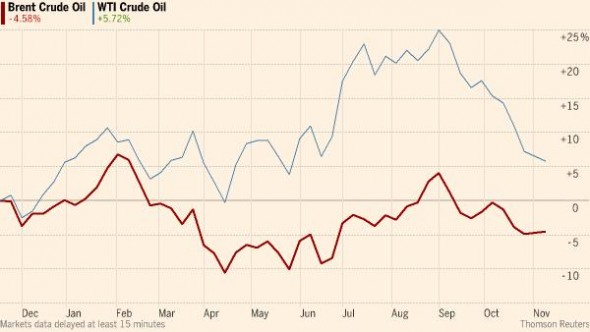
Oil prices continue to decline, with WTI currently leading the charge:

So where are the oil bulls of 2008 now?
Hard to say. But long-standing oil market watcher Stephen Schork, of the Schork Report, offers some colourful views on the topic this Wednesday. They come in the shape of a somewhat self-congratulatory nostalgic yarn, but it is worth the read, in so much as it really takes you back to how things were back in those scary September days.
Here he goes:
Back in September 2008 we were in Vienna giving a presentation to our friends at OPEC. In between copious amounts of Sachetorte and Grüner Veltliner, we had the opportunity to sit down with one of the largest hedge fund managers in Austria. At the time, crude oil on the NYMEX was imploding. That is to say, after peaking at a record $147 that July, the market was in the midst of the correction and was trading around $110 that September.
We told this fund manager the same thing we told Dr. Alipour-Jeddi’s group at OPEC the day before, i.e. we thought oil was heading back to at least $75, which was the spot whence the 2008 bubble began. After we finished our bearish screed, the fund manager stood up, snickered and shot us a look of haughty derision. He then walked over to his bookshelf, took out a book and slid the book across the desk. The book was Matt Simmons’ Twilight in the Desert.
Then, while still maintaining that air of superiority, he told us that this (pointing to Mr. Simmons’ book) was the reason why we would never see oil below $100 a barrel again. We sat there. We took in what he just told us and we contemplated a measured response. After some thought, we told him that we thought he was a fool (that was our exact word).
Needless to say, we didn’t get his business. It can also go without saying that this guy is no longer one of Vienna’s largest fund managers. Our expressed skepticism was (and still is) based on common economic sense that high prices are indeed the cure for high prices. The mirror of this economic axiomatic is… low prices are the cure for low prices, which in the case of our Viennese fund manager, led him to the false messiah of peak oil. The reason why no new significant oil deposits were discovered in the 1980s and 1990s is because… at $20 a barrel it did not make any economic sense to go out and try and discover new oil. In hindsight, you drive oil to $147 barrel and lo and behold, five years hence the world is swimming in oil. It really is that simple.
All of which happens to be a lead up to the following observation about the latest from the IEA’s world energy outlook 2013:
This now brings us to yesterday’s release of the IEA’s World Energy Outlook 2013. Of particular interest were these two bullets:
“Global energy trade is re-oriented from the Atlantic basin to the Asia-Pacific region. China is becoming the largest oil- importing country; India becomes the largest importer of coal by the early 2020s. Improved energy efficiency and a boom in unconventional oil and gas production help the United States to move steadily towards meeting almost all of its energy needs (in energy equivalent terms) from domestic resources by 2035.
Oil supply rises from 89 mb/d in 2012 to 101 mb/d in 2035 in the New Policies Scenario. Key components of the increase are unconventional oil (up 10 mb/d) and natural gas liquids (NGLs) linked to the increase in global gas output (up 5 mb/d). Conventional crude oil’s share in total oil production falls, from 80% in 2012 to two-thirds in 2035. The role of OPEC in quenching the world’s thirst for oil is temporarily reduced over the next ten years, notably as US light tight oil and Brazilian deepwater output step up, but the share of OPEC countries in global output rises again in the 2020s, as they remain the only large source of relatively low-cost oil. Iraq is the largest single source of oil production growth, followed by Brazil, Canada and Kazakhstan. The United States is the world’s largest oil producer for much of the period to 2035.”
Hmm, from Twilight in the Desert to the U.S. being the world’s go-to oil producer for the next two decades. Isn’t it amazing what can happen when you let markets respond to the needs of people? Case in point… weather aside, where would you rather live, Bismarck or Caracas?
A triumph for market adjustability, ingenuity and just holding out for the right incentive.
(He’s not the peak oil messiah, he’s a very naughty boy – Ed.)
11 Comments on "Recollecting the false messiah of peak oil"
eugeni on Thu, 14th Nov 2013 11:05 pm
My answer: you’re fool!
J-Gav on Thu, 14th Nov 2013 11:18 pm
Oh yeah! The market triumphs every time for these nitwits! Euh, except when it doesn’t anymore and shit falls apart …
poaecdotcom on Thu, 14th Nov 2013 11:31 pm
Have faith, the market will over come the Second Law of Thermodynamics….
Or maybe it won’t, we’ll see I guess…
Dave Thompson on Fri, 15th Nov 2013 1:21 am
This is how new investors are duped into the fold. “The United States is the world’s largest oil producer for much of the period to 2035.” The audacity to make such a claim is down right nasty, deceitful and criminal.
BillT on Fri, 15th Nov 2013 1:28 am
Hmmm… is insanity common on Wall Street? Answer: Definitly!
They should step back and look at the WHOLE picture. There is now a bottom to oil prices below which no recovery is possible. Only OPEC and maybe Russia can still recover oil for less than $100 and stay in business.
The stuff the US calls oil is a burp in the scheme of things and will be gone when the middle class can no longer afford it. Ditto for the tar sands and all of the pseudo oil out there. Hype to keep the suckers flowing is all it is.
mo on Fri, 15th Nov 2013 1:46 am
The worlds swimming in oil! Until the drain plug is pulled…..
Jerry L on Fri, 15th Nov 2013 7:50 am
Interesting, I have recently read two opposing scenarios:
One, peak oil is real (but delayed) and society as we know it will crash for lack of energy. But, don’t worry about climate problems because there is not enough available liquid hydrocarbons (with a positive EROI) to cause serious climate change.
Two: (the scenario here) don’t worry we have enough liquid fossil fuels to fry the planet. The free market will solve all problems.
As I see it, if either scenario is correct we are all going to hell in a basket if we don’t start seriously cutting back on the use of fossil fuels.
DC on Fri, 15th Nov 2013 7:57 am
Monty Python. at least were truly funny and very smart.
This guy, is neither.
Luke on Fri, 15th Nov 2013 9:21 am
“swimming in oil”, take care the free market, Wall Street and Helicopter Yelly won’t drown!
Bob Spoley on Fri, 15th Nov 2013 4:02 pm
When the Saudis and the Russians start pulling water out of their aging fields and uping the reservoir energy by injecting CO2 from industry, you will find the relative permeability to oil goes up — not down. This will, in effect, double remaining producable reserves for decades. Offshore East Coast U.S. hasn’t been touched yet either. Wake up!
ghung on Fri, 15th Nov 2013 9:01 pm
Bob said: Wake up!” Yeah, Bob, I figure folks like you must be a pipe dream of some sort. But I’ll humor you for a bit. What will we do with all of this “remaining produc[i]ble” oil? The same stupid shit we do with it now?