
Peak Oil is You

Donate Bitcoins ;-) or Paypal :-)


Page added on November 7, 2015

Oil company defaults are coming
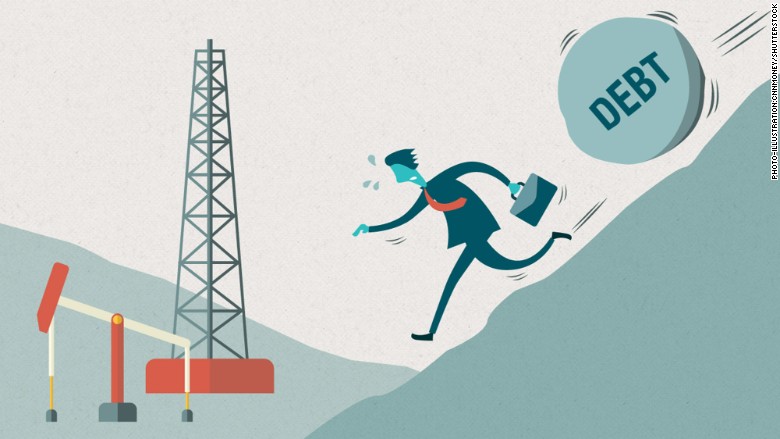
Oil companies of all hues loaded up on massive amounts of debt to fund rigs and fancy new drilling equipment.
The problem is the companies were banking on oil prices closer to $100 oil when they took on the debt. Now oil is around $45 and no one is expecting prices to hit $100 any time soon.
What that means is the likelihood of unpaid debt has gone up for many companies.
“Energy has been really treacherous. There are going to be a lot of defaults,” R. Matthew Freund, chief investment officer of USAA Investments, told CNNMoney.
It’s a dramatic change from just a few years ago. The roaring junk bond market and low interest rates broadly helped fuel the U.S. energy boom. Cheap credit allowed companies to invest in new technologies like hydraulic fracking that makes it easier to drill oil in difficult to reach places.
Back then many companies with “limited operating history” and business models that “made no rational sense” were able to tap the bond markets for funding, said Freund.
But lately, there’s been a spike in credit costs for risky oil companies despite the fact that crude prices have stopped tumbling and have somewhat stabilized in the $40-$50 range.
“That’s a warning signal. Something bad is happening,” billionaire investor Jeffrey Gundlach, founder of elite fixed-income firm DoubleLine Capital, said on Thursday at ETF.com’s Fixed Income Conference.
Related: Wall Street firms that bankrolled oil boom are hurting
Gundlach said that levels of domestic crude oil inventories remain elevated despite a slowdown in U.S. production. It suggests the supply glut that caused prices to crash hasn’t been fixed yet.
Gundlach said he is steering clear of energy junk bonds, a previously-booming area of the fixed-income market. In fact, he’s telling clients to avoid the high-yield bond space altogether.
“Junk bonds should be sold on strength,” he said.
Even those who believe oil prices are going up sound negative about the energy sector.
Oil would go up because “you have crazy people in control of that market,” said Tim Gramatovich, co-founder of Peritus Asset Management. He indicated he was referring to Vladimir Putin and Russia’s role as one of the world’s largest energy producers.
But Gramatovich believes there are “tons of value traps” in shale oil projects right now.
“Stay away from tight oil and some of these Bakken areas where you have distressed prices. You’re going to end up with dry rocks in North Dakota. It’s not a good asset,” he said.
73 Comments on "Oil company defaults are coming"
apneaman on Sat, 7th Nov 2015 5:14 pm
“Energy has been really treacherous. There are going to be a lot of defaults,”
Blame it on energy
“Cheap credit allowed companies to invest in new technologies like hydraulic fracking that makes it easier to drill oil in difficult to reach places.”
Brand spanking new technology
“you have crazy people in control of that market,”
Blame it on Putin
Blame
Lie
Blame
Plantagenet on Sat, 7th Nov 2015 7:07 pm
First comes the oil glut…….Then comes the oil bust……and then comes bankruptcy court.
Cheers!
BC on Sat, 7th Nov 2015 7:57 pm
Plant, again, outside the unprofitable, unsustainable kerogen and tar booms/bubbles, there effectively is no global “glut” of oil.
https://app.box.com/s/ys8ijadj4b57nb95ka0b3ilph38ga7fm
And the differential change rate of the price of oil and oil consumption to final sales is unambiguous proof that the supply of oil is constrained and price of oil as a share of output is not “cheap”, exerting a post-2000 and -Peak Oil constraint on growth of US final sales.
You (and marmico and others) will get it eventually, I’m sure, but it will take time and further evidence to convince you post facto.
makati1 on Sat, 7th Nov 2015 8:18 pm
Ap, Americans are not allowed to own anything shiny that they can look into and see themselves as they really are. They are inoculated at birth with the “Exceptional” vaccine that few are able to overcome because they never leave their country and see the real world. The best thing I ever did was to move from the West to the East and a new challenge and life. I call it my 3rd life. 1st life was youth and learning. 2nd was marriage and family. Now, true freedom.
The sooner Capitalism implodes, the better for the people who will live through the coming bottleneck. Bring it on!
BC on Sat, 7th Nov 2015 8:24 pm
http://money.cnn.com/2015/10/14/investing/oil-crash-wall-street-banks-jpmorgan-bank-of-america/index.html?iid=EL
https://research.stlouisfed.org/fred2/graph/fredgraph.png?g=2iGs
WRT to the CNN article, a reminder of the chart data at the link above. Banks’ C&I loan delinquencies and charge-offs are increasing YoY as of Q2, coincident with US profits after tax and S&P 500 revenues and reported earnings contracting YoY, which is historically recessionary.
The US is in recession, a bear market for the broad equity index, and corporate credit risk spreads are widening.
For the Fed/TBTE banks to raise the reserve rate and thus constrain banking and financial system liquidity under the foregoing conditions is either a colossal blunder or a purposeful attempt to prick the massive asset bubbles after the bear market and recession has already begun. I suspect the latter for reasons I have previously related.
This is akin to the situations in 1937 and 1892-93.
Plantagenet on Sat, 7th Nov 2015 9:02 pm
@BC
1. Kerogen isn’t the same thing as oil. Its not even the same thing as tight oil shale. I’m surprised you don’t know that.
2. The US isn’t in recession. During the second quarter of 2015—the most recent one for which we have data—-US GDP grew by 3.9%. A recession is defined as two consecutive quarters of negative GDP growth. But since we had 3.9% GDP growth last quarter, and the number 3.9 is positive not negative (you can tell by the absence of a minus sign in front of the number) the US definitely isn’t in recession.
http://www.cnbc.com/2015/09/25/us-final-q2-gross-domestic-product-39-vs-37-expected.html
Get it now?
Cheers!
apneaman on Sat, 7th Nov 2015 9:10 pm
Kerogen Glut Kerogen Glut Kerogen Glut Kerogen Glut Kerogen Glut Kerogen Glut
BC on Sat, 7th Nov 2015 9:16 pm
http://www.telegraph.co.uk/finance/economics/11978542/Robots-may-shatter-the-global-economic-order-within-a-decade.html
Pennsyguy on Sat, 7th Nov 2015 10:03 pm
If I was told 20 years ago that oil and coal companies could be going bankrupt in a few years after 2015 while renewables would be getting cheaper (for now)and experiencing exponential growth, I would have been very happy. As they say: be careful what you wish for. It’s a funny universe.
Boat on Sat, 7th Nov 2015 10:05 pm
As the US moves back to conventional oil there will be less Kerogen. As US imports rise the refineries will just will buy more light oil to mix with the tar sands. Nothing to see, move on. Peak oil is the future but not anytime soon. Maybe the wake up call to climate change will cause peak oil, depletion has nothing to do with it.
Energy Investor on Sat, 7th Nov 2015 10:34 pm
Plant, just so you know, GDP is a monetary measure that gets goosed by printing more money and by dropping interest rates to stimulate more debt.
So the monetary measure shows growth for sure, but that doesn’t mean the USA is not in a real recession.
There will come a time to pay the piper on both QE and Zirp. That will be the time when this gets public airing. Until then I hope you find some solice in the published GDP figures 🙂
GregT on Sat, 7th Nov 2015 10:59 pm
planter,
“The US isn’t in recession. During the second quarter of 2015—the most recent one for which we have data—-US GDP grew by 3.9%”
The data was released for Q3 last week. It was reported as 1.5%. Q1 2015 was reported at 0.6%. Even with QE and ZIRP the US economy is still in recession.
http://www.marketwatch.com/story/third-quarter-gdp-lands-with-thud-just-15-growth-2015-10-29
marmico on Sat, 7th Nov 2015 11:08 pm
Banks’ C&I loan delinquencies and charge-offs are increasing YoY as of Q2
OMG, another acorn falling from another Chicken Little.
US is in recession, a bear market for the broad equity index, and corporate credit risk spreads are widening.
Bullshit, bullshit and worth watching.
GregT on Sat, 7th Nov 2015 11:23 pm
“As US imports rise the refineries will just will buy more light oil to mix with the tar sands. Peak oil is the future but not anytime soon.”
Now why would we be mining costly Alberta bitumen, if there was a surplus of cheap conventional crude oil? Depletion has everything to do with it. Those of us that worked in the oil fields in Alberta always considered tar sands to be the dregs. I never thought that I would see the day that the tar sands would be exploited. Alberta was swimming in oil as early as the 1990s. Not any more.
GregT on Sun, 8th Nov 2015 12:15 am
Sorry,
Alberta was swimming in oil as late as the 1990s. Not any more.
Dredd on Sun, 8th Nov 2015 5:18 am
Blame it on psychopaths, not substances (When You Are Governed By Psychopaths – 5).
“The oil made me do it” is a psychotic notion.
Davy on Sun, 8th Nov 2015 6:47 am
Planter said – “The US isn’t in recession”. Planter if you look at numbers without digging deeper sure you can say there is no recession. We have people here who dig deeper. We are not superficial. We connect dots and see underlying conditions the mainstream media ignores. We know this is a globalized world that is increasingly interconnected in many ways that make nation states irrelevant. You can’t just look at US numbers.
The global system has a minimum economic operating level for long term health. There are fundamentals that must be met for long term health. I think we would all agree excessive debt is unhealthy and dangerous. We will all agree the slowdown in China is extremely dangerous for the global system including the US.
Claiming there is a recession or not is missing the point that the whole system is in a compression of what is needed for long term health. I need only point to the Fed’s inability to normalize as proof things are a mess. China is kicking the can of malinvestment and overcapacity down the road with astronomical debt. Europe is a dead man walking of debt and stagnating economies. The rest of the world is tagging along in this financial decline. There is no good long term news. Nothing points to a better world ahead. All you corns can do is pull raw numbers out of your ass and say “Look at this” “All is well”.
“China Exports Drop for Fourth Month, Adding to Signs of Slowing”
http://www.bloomberg.com/news/articles/2015-10-13/china-imports-slump-for-11th-month-export-decline-moderates
“China’s exports declined for a fourth straight month in October, adding to signs of mounting headwinds facing the world’s second-largest economy.”
“Overseas shipments dropped 3.6 percent in October in yuan terms, the customs administration said Sunday, compared with a 1.1 percent decline in September. Imports fell for a 12th straight month, declining 16 percent in yuan terms, after a 17.7 percent decrease the prior month. The trade surplus was 393.2 billion yuan ($61.9 billion).”
“Chinese exports continue to face structural headwinds due to weak demand in key markets” such as the European Union and Japan, said Rajiv Biswas, Asia-Pacific chief economist at IHS Global Insight in Singapore. “Exports have also been impacted by the more recent growth slowdown in emerging markets, which had become fast-growing markets for Chinese exports in recent years.”
Boat on Sun, 8th Nov 2015 6:48 am
GregT,
Canada/Alberta may have been swimming in oil but they started developing the tar sands in 1967. Tar sands is now around 50% of their production. I don’t see any slow down in production according to the latest EIA chart.
http://www.eia.gov/dnav/pet/hist/LeafHandler.ashx?n=PET&s=MTTIMUSCA1&f=M
Kenz300 on Sun, 8th Nov 2015 8:59 am
All Fossil fuel companies need to transition to “ENERGY” companies and embrace safer, cleaner and cheaper alternative energy.
Wind Power Now Cheaper Than Natural Gas for Xcel, CEO Says – Renewable Energy World
http://www.renewableenergyworld.com/articles/2015/10/wind-power-now-cheaper-than-natural-gas-for-xcel-ceo-says.html
shortonoil on Sun, 8th Nov 2015 9:13 am
“Energy has been really treacherous. There are going to be a lot of defaults,” R. Matthew Freund, chief investment officer of USAA Investments, told CNNMoney.”
1979 wasn’t a bad year. The richest oil producing nation on earth wasn’t borrowing money to pay its bills, and Venezuela had toilet paper. The majors hadn’t just canceled $200 billion in projects, and they weren’t laying off 100,000s. The petroleum industry hadn’t doubled its debt over the previous 6 years.
Oil was selling for $12.64/ barrel, which inflation adjusted is $41.46 in 2015 dollars. Less than today’s $44. They were selling oil for less than they are today, and not losing their shirts in the process. At least a third of the world’s producers are now pumping oil for below its full life cycle production cost. World inventories have reached all time highs, and profit per barrel all time lows. Something here just doesn’t add up?
Wall Street wants to figure everything out by dollars, but its not working out very well for them. Someone out there in investor land is going to get smeared although their inflation adjusted barrel is higher priced than it was 36 years ago. Why oil is not making oodles of money in this environment must be somewhat perplexing for today’s computer powered, high speed, binary brained bean counters?
The reason is simple: a barrel of oil just isn’t the same thing that it was in 1979. It still contains 5.6 cubic feet of some of the worse smelling stuff on the planet, but that is were the comparison ends. Oil doesn’t sell because it sinks, it sells because it drives most of the world’s transportation machinery. If stench was the criteria to use, oil would be doing fine at $44. The problem is that a barrel of oil is now only doing 54% of the driving that it was doing in 1979.
We could explain to them what is going wrong, but it probably won’t do any good. Wall Street, like a pig going to swill, would probably just go back to sniffing, and counting barrels?
http://www.thehillsgroup.org/
penury on Sun, 8th Nov 2015 10:06 am
Short’s explanation should explain to everyone why the world is in recession and will not be returning to a growth pattern any time shortly.
peakyeast on Sun, 8th Nov 2015 10:20 am
@Short: If I might elaborate a little. I will probably fuck it up, but here it goes:
Which means that the price of oil today should be at about ~90$ from the oil companies perspective and about ~20$ from the rest of the economys perspective.
GregT on Sun, 8th Nov 2015 10:43 am
@Boat,
Alberta looking at recession as economy falters
“Alberta’s NDP government warned that it expects its biggest-ever deficit this fiscal year, as slumping oil prices send the province into a recession and spending on wildfire and drought relief rises.”
“The news comes as Saskatchewan gave its own warning about vastly increased deficits thanks to the plunge in oil and wildfires.”
“Don Drummond, the Stauffer-Dunning Fellow at the School of Policy Studies at Queen’s University and a former chief economist at TD Bank, said the partisan parsing of economic indicators is ultimately misleading.”
“Whether the economy contracted or grew by a small fraction of a percentage point, or whether the federal budget is in or out of deficit by a few billion dollars simply doesn’t matter in the terms of the bigger economic picture”, he said.
“I think it’s a real travesty because it makes us miss the main point,” Drummond said in an interview Monday.
“The biggest point is: the world, not just Canada, is entering a period of sustained lower growth. Everybody seems to have missed that. You wonder how many times it takes for people to get with that program.”
http://www.thestar.com/news/federal-election/2015/08/31/alberta-looking-at-recession-as-economy-falters.html
BC on Sun, 8th Nov 2015 10:55 am
https://research.stlouisfed.org/fred2/graph/fredgraph.png?g=2t6K
https://research.stlouisfed.org/fred2/graph/fredgraph.png?g=2t6L
https://research.stlouisfed.org/fred2/graph/fredgraph.png?g=2iGs
https://research.stlouisfed.org/fred2/graph/fredgraph.png?g=2t74
https://research.stlouisfed.org/fred2/graph/fredgraph.png?g=2jV7
https://research.stlouisfed.org/fred2/graph/fredgraph.png?g=2rYf
https://research.stlouisfed.org/fred2/graph/fredgraph.png?g=2t7e
https://research.stlouisfed.org/fred2/graph/fredgraph.png?g=2t7w
https://app.box.com/s/ivzn1w3zfqln5p7rmr5c0enar18tbui1
https://app.box.com/s/pke0xewatd7zvhnteefajk6tcoqone9h
https://app.box.com/s/t01wkzn5j1jz9kjmlqv5gwmy92pgvrzd
https://app.box.com/s/rekvofiqj1hptrqv45ipy5crzcfphoky
https://app.box.com/s/et6lp7tn4jl4jyc7eq19nvfvxwnoek85
marmico, the US was in recession for 2-3 quarters in 2008 and 2001 before it was generally perceived.
Your simple-minded BS is showing. You don’t know that you don’t know, which is among the worst kinds of ignorance.
But that I waste my time on your simple-minded ignorance makes me stupid. 🙂
marmico on Sun, 8th Nov 2015 11:13 am
You nutter doomers only get half of the equation. Not only do you adjust the oil price for CPI-U inflation you also adjust for the oil intensity of the economy.
The Real Price of Oil
shortonoil on Sun, 8th Nov 2015 11:16 am
“Which means that the price of oil today should be at about ~90$ from the oil companies perspective and about ~20$ from the rest of the economys perspective.”
Because of Central Bank policies, the Etp Model can’t give a means to calculate what the price for the producer, and consumer sectors of the economy should be to reach equilibrium. What it does tell us is that the consumers ability to purchase petroleum, and its products is going down. It is going down by $470 billion per year against a total value of $35 trillion per year, while the producers cost is going up by an equal amount. The spread between what the economy can afford, and the cost of production is now growing by about $14/ barrel per year. This is resulting in a huge deflationary pressure being applied to the consumer economy, which will drive prices even lower. It is reasonable to expect wide spread cost cutting by producers over the next few years. If the Central Banks respond with NIRP, it will only aggravate the situation.
BC on Sun, 8th Nov 2015 11:33 am
Plant, WRT kerogen and oil shale vs. shale oil and bitumen, I purposefully use “kerogen” and “tar” as a catch-all to imply the gross disimilarity between the cost and quality of these substances vs. light crude.
No doubt virtually everyone here knows the difference between kerogen and shale oil, including yours truly.
From now on, for your satisfaction, I’ll use “shale oil” and “tar”. 🙂
BTW, you’re still repeatedly using the possessive pronoun its for the contraction “it’s”.
https://app.box.com/s/c829ehzpyxep7flfyxw715q8r1r4gyvt
https://research.stlouisfed.org/fred2/graph/fredgraph.png?g=2t8y
https://research.stlouisfed.org/fred2/graph/fredgraph.png?g=2t8C
Also, as to the definition of “recession” you cite, you’re being simple minded as is marmico and falling for the institutional, politically motivated “managing” of the data going into a “selection” year.
For your edification, see the links I shared with marmico as well as the links above showing the per capita real cyclical change rates of state and local tax receipts and self-employment and real wages and salaries that have turned historically recessionary since late 2014 and earlier this year to date.
https://research.stlouisfed.org/fred2/graph/fredgraph.png?g=2t8L
https://app.box.com/s/c8j4stsqoqlwv6uyjl00a9ndvleys9cm
https://app.box.com/s/b3ocl3dzohvkiatcffmy6u2gfqkr937e
Speaking of oil, Texas and most of the rest of the energy states’ economies’ leading and coincident indices are recessionary as of earlier this year.
The current 4-qtr. average of real final sales per capita is at, or near, “stall speed”, whereas the 4-qtr. average of nominal final sales per capita is slightly below 2% (slowest since the 1930s), which historically is recessionary.
http://www.cfosurvey.org/2015q3/Q3-2015-US-KeyNumbers.pdf
Finally, the most recent Duke CFO Survey shows a marked recession-like deceleration of anticipated 12-month growth of revenues, earnings, spending, and employment.
You, marmico, and others are missing the leading indicators of the business cycle. But now you know. 😀
marmico on Sun, 8th Nov 2015 11:38 am
What it does tell us is that the consumers ability to purchase petroleum, and its products is going down
What a crock of shit.
In 1964 Joe Sixpack earned $2.53 per hour, leaded gasoline cost $0.31 per gallon and the average fuel efficiency (AFE) of a car was ~14 miles per gallon (mpg).
Fifty years later in 2014 Joe earned $20.60 per hour, unleaded gasoline cost $3.50 per gallon and the AFE was ~24 mpg.
Gasoline was more affordable in 2014 than in 1964 per 100 miles travelled. Of course, 2015 year to date gasoline is substantially more affordable.
BC on Sun, 8th Nov 2015 12:26 pm
@simple-minded marmico: You nutter doomers only get half of the equation. Not only do you adjust the oil price for CPI-U inflation you also adjust for the oil intensity of the economy.
https://research.stlouisfed.org/fred2/graph/fredgraph.png?g=2t9E
https://research.stlouisfed.org/fred2/graph/fredgraph.png?g=2t9N
https://research.stlouisfed.org/fred2/graph/fredgraph.png?g=2t9P
https://research.stlouisfed.org/fred2/graph/fredgraph.png?g=2t9W
https://research.stlouisfed.org/fred2/graph/fredgraph.png?g=2ta0
https://research.stlouisfed.org/fred2/graph/fredgraph.png?g=2t9Y
https://research.stlouisfed.org/fred2/graph/fredgraph.png?g=2tan
https://research.stlouisfed.org/fred2/graph/fredgraph.png?g=2tap
https://research.stlouisfed.org/fred2/graph/fredgraph.png?g=2taq
marmico, you are yet again demonstrating that you don’t know that you don’t know.
Apart from efficiency, do you know the primary reason why the US uses so much less energy per GDP/final sales since the 1970s-80s?
Have you heard of US peak oil production per capita in 1970?
“Deindustrialization” and wholesale “offshoring” of energy-intensive, value-added production and employment to Mexico and China-Asia?
“Labor arbitrage”?
“Globalization”?
The order-of-exponential increase in debt to wages and GDP since the 1970s-80s?
Do you know that it now requires $5 of private and public debt for every $1 of US private GDP?
Do you know that the acceleration of debt/GDP began contracting in 2009 and has yet to accelerate since?
Do you understand the implications for a debt-based economy, including growth of energy consumption to GDP?
Do you know that private, full-time employment per capita is at the levels of 1997 and 1989?
Probably not.
We’re using less energy to value-added output because we’ve deindustrialized the economy and we’re far more indebted and poorer (bottom 90%+, that is), with low- or no-productivity employment in services growing while value-added goods-producing employment has dramatically fallen.
Now, if you understand that, you’re not so simple minded for your effort. Congratulations! 😀
BC on Sun, 8th Nov 2015 12:31 pm
BTW, to all, I’ve responded to marmico and Plant, but the many links refuting their simple-minded perceptions will be flagged by the site’s moderating settings as spam, so it probably won’t show up for several days or a week. Of course, by then the points will have been lost. Anyone interested can revisit the posts later, FWIW.
BC on Sun, 8th Nov 2015 12:51 pm
https://research.stlouisfed.org/fred2/graph/fredgraph.png?g=2taW
https://research.stlouisfed.org/fred2/graph/fredgraph.png?g=2tb2
https://research.stlouisfed.org/fred2/graph/fredgraph.png?g=2tbk
marmico and Plant probably won’t understand the transformations for the data in the charts above, but for those who are not as simple minded, the data show that the differential rates of growth of health care spending and final sales are recessionary as occurred in 2008 and 2001.
The rate of growth of health care spending at twice the rate of final sales with final sales decelerating is resulting in a large net incremental drag on growth of final sales that was recessionary in 2008 and 2001.
Thus, the US economy likely entered recession as long ago as Q4 2014 or Q1 2015, which similarly occurred in Q4 2007-Q1 2008 and Q4 2000-Q1 2001.
marmico on Sun, 8th Nov 2015 12:59 pm
You are a fucktard, BC. Everyone except nutter doomers is simple-minded.
I believe Boat is the keeper of your doomsday clock which expires on December 31. It will be Y2K all over again. ROTFLFMAO.
Meanwhile reality intrudes for the rest of us.
shortonoil on Sun, 8th Nov 2015 1:17 pm
@BC
https://research.stlouisfed.org/fred2/graph/fredgraph.png?g=2tbk
Do you think it is money coming in from the EMs as a safe haven escape that is delaying the decline in GDP consumption?
BC on Sun, 8th Nov 2015 1:17 pm
GregT: The data was released for Q3 last week. It was reported as 1.5%. Q1 2015 was reported at 0.6%. Even with QE and ZIRP the US economy is still in recession.
https://www.frbatlanta.org/cqer/research/gdpnow.aspx?panel=1
If one takes the 4-qtr. average SAAR including the GDPNow estimate so far for Q4, the rate is ~2%, which puts real GDP per capita since 2007 at ~0.5% (vs. 2.1-2.3% long term at a population rate of 1-1.2%) and nominal GDP per capita below 2% (vs. 5-6.4% long term).
Therefore, it has required $3.8 trillion in Fed reserve printing and $8 trillion in cumulative US gov’t fiscal deficits just to get back to even in 2007 for real GDP per capita and employment.
S&P 500 revenues and reported earnings:
https://app.box.com/s/qpgtgjtag2exy5d9hqk7saipcltlb56k
https://app.box.com/s/ttsdbdi2phrz7fpmijmq18jccr9wvtv9
https://app.box.com/s/uu94vkwgsv5lez0nm0tij3f0f2azl9l8
However, as I have unambiguously demonstrated, we are now up against cyclical/secular demand (cyclical change of the sum of profit, incomes, and gov’t receipts) constraints as indicated by the recession-like contraction in the acceleration of money velocity; a bear market for the broader equity market; an inconspicuously (so far) deflating housing bubble; rising C&I loan delinquencies and defaults YoY; junk bond bear market; no growth of global trade; world real GDP per capita decelerating to stall speed or recessionary; corporate profits contracting YoY; S&P 500 revenues AND earnings contracting as occurred in 2007 and 2001; and real, after-tax wages for the bottom 80-90% contracting YoY.
The myriad leading indicators of a cyclical contraction are evident and accumulating. Whether the BEA/Commerce/BLS data will ever be politically (doesn’t matter which party is in office) permitted to indicate a business cycle contraction is another matter entirely.
GregT on Sun, 8th Nov 2015 1:19 pm
In 1964 Joe Sixpack was the single wage earner of the family. He payed off a mortgage, fed and clothed his wife and children, took them on holidays, put the kids through university, and retired in 2005 with a rather substantial nest egg.
Fifty years later in 2014, Joe’s grandson Joe, can’t afford to buy a home, isn’t married because he still lives in his dad’s basement, and has $50,000 dollars in student loans that he will likely not pay off until he is well into his 40s. He has parked his car because he can’t afford the fuel, insurance, and maintenance costs, while paying off his debt and continuing to put food on the table.
shortonoil on Sun, 8th Nov 2015 1:24 pm
Marmo, you’d better go, your dog is calling you.
marmico on Sun, 8th Nov 2015 1:35 pm
Fifty years later in 2014, Joe’s grandson Joe, can’t afford to buy a home
Wow, in some cities house prices went up more than oil prices since 1964. What a brilliant analyst you are. It must be due to more affordable gasoline prices rather than super-cities with attendant zoning restrictions.
Maybe BC can conjure a chart on why imputed rent makes up about half of the decline in the labor share of national income.
BC on Sun, 8th Nov 2015 1:52 pm
@short: Do you think it is money coming in from the EMs as a safe haven escape that is delaying the decline in GDP consumption?
https://app.box.com/s/feqvg4nch4agcqe8ljesjst50d0jajiw
https://research.stlouisfed.org/fred2/graph/fredgraph.png?g=2tcq
https://research.stlouisfed.org/fred2/graph/fredgraph.png?g=2tct
https://research.stlouisfed.org/fred2/graph/fredgraph.png?g=2tcx
https://research.stlouisfed.org/fred2/graph/fredgraph.png?g=2tcy
https://research.stlouisfed.org/fred2/graph/fredgraph.png?g=2tcE
https://research.stlouisfed.org/fred2/graph/fredgraph.png?g=2tcJ
https://research.stlouisfed.org/fred2/graph/fredgraph.png?g=2tdf
Growth of consumption to date has been held up by growth of spending for “health” care (HC) and autos.
HC spending at a rate of more than TWICE final sales has been supported by the surge in ACA-related Medicaid transfers/spending that reached ~13% YoY in late 2014 and earlier this year.
With HC to GDP of 19% and growth of HC spending at 4-5%, HC is contributing ~1% to final sales at a 4-qtr. average of ~2%.
The incremental growth of auto sales has come from growth of subprime auto loans, the extension of average loan terms from 3-4 years to 5-7 years, and booking 2- to 3-year leases as sales.
Were it not for the surge in subprime auto loans, vehicle sales would be 12-13 million vs. 17-18 million.
Note that the bubble in auto sales during the housing bubble during the 2000s was aided incrementally by mortgage equity withdrawal (MEW), and this time by subprime auto loans.
But the SAAR and YoY comparisons for the growth of HC spending and auto sales are set to become significantly harder, which implies a big deceleration in the SAAR and YoY growth rates going into year end and throughout 2016. Therefore, the sectors of the economy contributing to the majority of growth since 2012-13 will contribute significantly less in 2016.
QEternity and ZIRP have enabled a larger share of future consumption to be brought forward than would have otherwise occurred, implying that growth of future consumption will be that much slower, if any per capita.
BC on Sun, 8th Nov 2015 1:57 pm
short, I just sent a response to your question that, again, has too many charts (required to illustrate the points made) and will be flagged as spam and not seen for perhaps days. 🙁 Bloody nuisance.
Suffice it to say, health care (HC) and autos are holding up spending, with the combined spending at more than TWICE that of final sales and contributing ~1% to SAAR growth vs. overall ~2% SAAR.
HC spending is being aided disproportionately by the ACA-induced 13% YoY growth of Medicaid spending.
Auto sales are be “driven” by subprime auto loans, without which sales would be 12-13M vs. 17-18M.
YoY comparisons are much harder going into the end of the year and throughout most of 2016. Therefore, HC and autos will contribute significantly less to overall growth hereafter.
BC on Sun, 8th Nov 2015 2:03 pm
@marmico: You are a fucktard, BC. Everyone except nutter doomers is simple-minded.
marmico, you have a cretin’s mouth and disposition to go with your simple mind. Congratulations on your many accomplishments.
Wait for the moderator(s) to release my responses, and then go to school and learn something that you don’t know that you don’t know. I’m doing it for your edification, brother/sister. 🙂
BC on Sun, 8th Nov 2015 2:10 pm
Thanks site moderator(s) for quickly clearing my posts. Perhaps Plant and marmico can go to school and learn.
Good karma. 🙂
GregT on Sun, 8th Nov 2015 2:12 pm
“What it does tell us is that the consumers ability to purchase petroleum, and its products is going down”
Short is absolutely correct marmi-noo. You are a clueless moron.
marmico on Sun, 8th Nov 2015 2:23 pm
However, as I have unambiguously demonstrated, we are now up against cyclical/secular demand (cyclical change of the sum of profit, incomes, and gov’t receipts) constraints as indicated by the recession-like contraction in the acceleration of money velocity…
Couldn’t you make it simple for the simple-minds like me? When all the boxes are pink for 3 consecutive months, you have your recession. Now each of the NBER dating committee members has their unique “drama” besides the BIG 4. Frankel from Harvard was partial to aggregate hours.
Now I don’t read anything about acceleration/deceleration of money in NBER deliberations.
You are another nutter doomer fucktard consigned to the dust bin of history in, tick tock, less than 60 days.
peakyeast on Sun, 8th Nov 2015 2:24 pm
@marm: Dont project your own image onto BC – it really doesnt fit seen from anywhere, but your rabies infected mind.
BC on Sun, 8th Nov 2015 2:43 pm
https://research.stlouisfed.org/fred2/graph/fredgraph.png?g=2teO
https://research.stlouisfed.org/fred2/graph/fredgraph.png?g=2teP
https://research.stlouisfed.org/fred2/graph/fredgraph.png?g=2tfo
https://research.stlouisfed.org/fred2/graph/fredgraph.png?g=2tft
More fun charts for the edification of our brothers/sisters, Plant and marmico.
Current growth of profits do not support further growth of investment, production, and employment.
The Duke CFO Survey clearly suggests that corporate managers know this and are adjusting their 2016 budgets and spending plans to reflect it.
marmico on Sun, 8th Nov 2015 2:47 pm
So you peak oil fucktards in the 2015 re-make of the “Chevy-Chase” summer vacation movie, driving the iconic Route 66 from Chicago to LA, went 80% further miles on an hour of work than you did in the original 1964 movie. And the burgers&fries were more affordable to boot.
marmico on Sun, 8th Nov 2015 2:54 pm
More fun charts for the edification
Tick, tock.
BC on Sun, 8th Nov 2015 2:58 pm
@marmico: Now I don’t read anything about acceleration/deceleration of money in NBER deliberations.
Of course you won’t!!! 😀 That you’re looking for it further demonstrates your misperceptions.
The NBER arbitrators date cyclical turns in the economy by as much as a year OR MORE LATER. They will NEVER report in real time a recession or recovery, especially given benchmark revisions by the BEA/Commerce/BLS.
https://research.stlouisfed.org/fred2/graph/fredgraph.png?g=2tfW
Besides, above is a chart of the aggregate of the regression of the indicators (black) with a first-difference R^2 of 0.934 to real final sales (red) decelerating to the rate that the Fed went “all in” in 2012-13, Dec 2007-Jan 2008, and Dec 2000-Jan 2001.
The economy is at, or below, stall speed, dude/dudette, but you just don’t know it because you’re looking backwards at lagging indicators while rolling on the floor laughing your a$$ off. 😀
BC on Sun, 8th Nov 2015 3:03 pm
@marmico: Tick, tock.
Dismissively mocking without presenting anything remotely close to refuting the supporting data I have shared.
Do you do that with one hand tied behind your back, one eyelid closed, standing on one leg, and using 1/50th of your simple mind, marmico? I can’t do that. Impressive.
marmico on Sun, 8th Nov 2015 3:23 pm
Tick tock, tick tock— 53 days until fucktard day when Boat pulls the plug. And BC goes bye, bye.