
Peak Oil is You

Donate Bitcoins ;-) or Paypal :-)


Page added on July 7, 2013

Jon Talton’s Failed Peak Oil Predictions Show Why The Free Market Works

It is a simple reality that you are more careful with your own money than with others’. The latest example comes from Seattle Times business columnist Jon Talton, who has argued repeatedly that the world is about to run out of oil. The theory, called “Peak Oil,” says that since oil is a finite resource, we will run out in the near future, causing massive economic disruption. This is often used as an argument for increased political control of the economy.
The problem with this theory is that it assumes that humans won’t find new ways to do more with less, that they won’t find new sources of oil and natural gas, and will not find ways to use fuel more efficiently.
Peak oil advocates have repeatedly been proven wrong in their timeline for this reason. As a result, peak oil believers like Talton are shy about putting their money where their mouth is.
Two years ago, with U.S. and world production of oil and natural gas increasing, I asked Jon to show me where the peak was in oil production. He responded:
Going by history (peak in the U.S.), one never knows peak until after it’s been hit. We arguably hit peak in conventional oil around 2006-07 worldwide.
Such a claim seemed worthy of testing with a bet. Betting has been called “a tax of bull****.” If you won’t risk your own money then you don’t really have faith in what you are saying.
So I offered this bet:
If we, in fact, hit the peak around 2006-07, then we should see it in the data in 2013. Let’s test that theory. I propose we bet $100 to your favorite charity (if I win, you give the same amount to Kiva). If the Energy Information Administration’s 2013 Energy Outlook shows that production is declining, indicating a peak, you win. If, however, production is still climbing, I win.
Not surprisingly, Talton declined to bet. The certainty in his original statement that claimed we had already hit the peak for U.S. and world production, suddenly vanished.
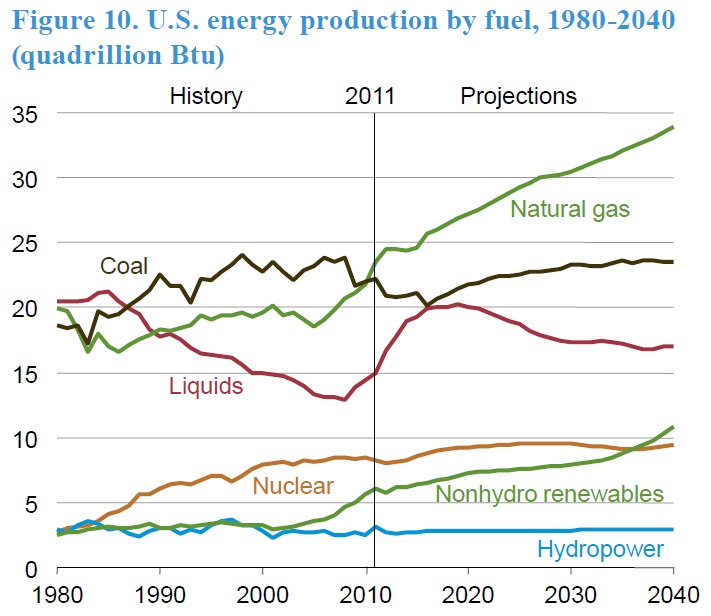 Talton was wise not to have bet. The 2013 Energy Outlook has been released and it finds that U.S. oil production is increasing and is expected to continue to increase.
The graph to the right shows that U.S. energy production is climbing and will continue to climb through the end of the decade. Far from peaking, oil production is climbing and will “peak” later this decade, but will level off for the next two decades. It doesn’t decline as the peak oil theory predicts.
Further, natural gas production continues to climb dramatically. There is no peak in sight.
Talton’s claim that U.S. production peaked years ago turns out to be entirely false. In fact, even with the slight decline after 2020, production will continue to be above the levels of 2011 – the year I offered the bet.
The same is true worldwide. “Proven oil reserves” counts the amount of oil that can be produced from sources that are accessible and known to exist. If reserves are growing, then supply is outstripping demand. We are finding new sources of oil faster than we are using it. Worldwide proven reserves in 2011 (the most recent year available) are 45 percent greater than in 2000. Reserves are 12 percent higher than 2007, the year Talton claimed was the peak, meaning that even as demand has increased, new supply has increased even more rapidly. Far from hitting a peak, oil discovery is increasing rapidly.
There are two key takeaways from Jon Talton’s inaccuracy and refusal to bet.
First, if you are betting that you can predict the future, especially betting against human ingenuity, you are probably wrong. It is hard to know the path of technology and the economy. Believing you can make grand predictions about worldwide economic and natural resource trends is foolish.
Second, Talton is a strong advocate of government intervention in the economy to deal with his peak oil concerns. Ironically, while he is willing to bet the economy on his claims, he isn’t will to bet $100 of his own money. That says it all.
Given a choice between the politically motivated predictions of those who want to guide the economy and the free-market creativity that generates innovation and allows us to do more with less, why would we ever choose a system that fails both to accurately predict the future and provide the ability to solve problems before they occur?
4 Comments on "Jon Talton’s Failed Peak Oil Predictions Show Why The Free Market Works"
DC on Sun, 7th Jul 2013 11:13 pm
/Q The theory, called “Peak Oil,” says that since oil is a finite resource, we will run out in the near future, causing massive economic disruption. This is often used as an argument for increased political control of the economy.
Strawman alert!
Rest of article =nonsense shooting down contrived strawmen by oilco funded ‘think-tank’.
GregT on Mon, 8th Jul 2013 12:02 am
“I asked Jon to show me where the peak was in oil production.”
Why ask Jon? Why not look at a chart of US historical ‘OIL’ production? If you had of taken the 15 seconds necessary to do so, you would know that US oil production peaked in about 1970.
Without doing so destroys any credibility that you may have had, and everything that you have written beyond this point should be taken as utter nonsense.
BillT on Mon, 8th Jul 2013 1:28 am
The site has “Washington” in its name. End of story.
Jerry McManus on Mon, 8th Jul 2013 5:39 pm
Talton: Peak in conventional oil around 2006-07 worldwide.
Industry shill: Look at my pretty graph of quadrillion BTU’s in the USA. Listen to my prattle about “proven reserves”. Watch me smugly pat myself on the back for the artful way in which I paid no attention whatsoever to the peak in conventional oil production around 2006-07 worldwide.