


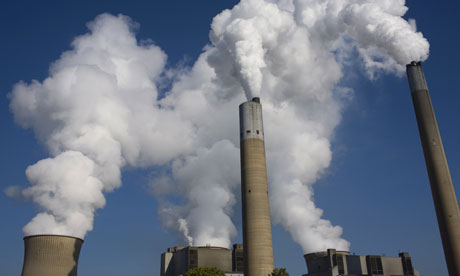
The world could be heading for a major economic crisis as stock markets inflate an investment bubble in fossil fuels to the tune of trillions of dollars, according to leading economists.
“The financial crisis has shown what happens when risks accumulate unnoticed,” said Lord (Nicholas) Stern, a professor at the London School of Economics. He said the risk was “very big indeed” and that almost all investors and regulators were failing to address it.
The so-called “carbon bubble” is the result of an over-valuation of oil, coal and gas reserves held by fossil fuel companies. According to a report published on Friday, at least two-thirds of these reserves will have to remain underground if the world is to meet existing internationally agreed targets to avoid the threshold for “dangerous” climate change. If the agreements hold, these reserves will be in effect unburnable and so worthless – leading to massive market losses. But the stock markets are betting on countries’ inaction on climate change.
The stark report is by Stern and the thinktank Carbon Tracker. Their warning is supported by organisations including HSBC, Citi, Standard and Poor’s and the International Energy Agency. The Bank of England has also recognised that a collapse in the value of oil, gas and coal assets as nations tackle global warming is a potential systemic risk to the economy, with London being particularly at risk owing to its huge listings of coal.
Stern said that far from reducing efforts to develop fossil fuels, the top 200 companies spent $674bn (£441bn) in 2012 to find and exploit even more new resources, a sum equivalent to 1% of global GDP, which could end up as “stranded” or valueless assets. Stern’s landmark 2006 report on the economic impact of climate change – commissioned by the then chancellor, Gordon Brown – concluded that spending 1% of GDP would pay for a transition to a clean and sustainable economy.
The world’s governments have agreed to restrict the global temperature rise to 2C, beyond which the impacts become severe and unpredictable. But Stern said the investors clearly did not believe action to curb climate change was going to be taken. “They can’t believe that and also believe that the markets are sensibly valued now.”
“They only believe environmental regulation when they see it,” said James Leaton, from Carbon Tracker and a former PwC consultant. He said short-termism in financial markets was the other major reason for the carbon bubble. “Analysts say you should ride the train until just before it goes off the cliff. Each thinks they are smart enough to get off in time, but not everyone can get out of the door at the same time. That is why you get bubbles and crashes.”
Paul Spedding, an oil and gas analyst at HSBC, said: “The scale of ‘listed’ unburnable carbon revealed in this report is astonishing. This report makes it clear that ‘business as usual’ is not a viable option for the fossil fuel industry in the long term. [The market] is assuming it will get early warning, but my worry is that things often happen suddenly in the oil and gas sector.”
HSBC warned that 40-60% of the market capitalisation of oil and gas companies was at risk from the carbon bubble, with the top 200 fossil fuel companies alone having a current value of $4tn, along with $1.5tn debt.
Lord McFall, who chaired the Commons Treasury select committee for a decade, said: “Despite its devastating scale, the banking crisis was at its heart an avoidable crisis: the threat of significant carbon writedown has the unmistakable characteristics of the same endemic problems.”
The report calculates that the world’s currently indicated fossil fuel reserves equate to 2,860bn tonnes of carbon dioxide, but that just 31% could be burned for an 80% chance of keeping below a 2C temperature rise. For a 50% chance of 2C or less, just 38% could be burned.
Carbon capture and storage technology, which buries emissions underground, can play a role in the future, but even an optimistic scenario which sees 3,800 commercial projects worldwide would allow only an extra 4% of fossil fuel reserves to be burned. There are currently no commercial projects up and running. The normally conservative International Energy Agency has also concluded that a major part of fossil fuel reserves is unburnable.
Citi bank warned investors in Australia’s vast coal industry that little could be done to avoid the future loss of value in the face of action on climate change. “If the unburnable carbon scenario does occur, it is difficult to see how the value of fossil fuel reserves can be maintained, so we see few options for risk mitigation.”
Ratings agencies have expressed concerns, with Standard and Poor’s concluding that the risk could lead to the downgrading of the credit ratings of oil companies within a few years.
Steven Oman, senior vice-president at Moody’s, said: “It behoves us as investors and as a society to know the true cost of something so that intelligent and constructive policy and investment decisions can be made. Too often the true costs are treated as unquantifiable or even ignored.”
Jens Peers, who manages €4bn (£3bn) for Mirova, part of €300bn asset managers Natixis, said: “It is shocking to see the report’s numbers, as they are worse than people realise. The risk is massive, but a lot of asset managers think they have a lot of time. I think they are wrong.” He said a key moment will come in 2015, the date when the world’s governments have pledged to strike a global deal to limit carbon emissions. But he said that fund managers need to move now. If they wait till 2015, “it will be too late for them to take action.”
Pension funds are also concerned. “Every pension fund manager needs to ask themselves have we incorporated climate change and carbon risk into our investment strategy? If the answer is no, they need to start to now,” said Howard Pearce, head of pension fund management at the Environment Agency, which holds £2bn in assets.
Stern and Leaton both point to China as evidence that carbon cuts are likely to be delivered. China’s leaders have said its coal use will peak in the next five years, said Leaton, but this has not been priced in. “I don’t know why the market does not believe China,” he said. “When it says it is going to do something, it usually does.” He said the US and Australia were banking on selling coal to China but that this “doesn’t add up”.
Jeremy Grantham, a billionaire fund manager who oversees $106bn of assets, said his company was on the verge of pulling out of all coal and unconventional fossil fuels, such as oil from tar sands. “The probability of them running into trouble is too high for me to take that risk as an investor.” He said: “If we mean to burn all the coal and any appreciable percentage of the tar sands, or other unconventional oil and gas then we’re cooked. [There are] terrible consequences that we will lay at the door of our grandchildren.”
Dmyers on Fri, 19th Apr 2013 11:56 pm
“We’d produce all this oil, but they won’t let us! It’s there, I swear, but these environmental wackos…..”
So, that’s going to be their way out, when all the suckers hear their investments in a grand future of US oil in Saudi proportions didn’t quite pan out.
BillT on Sat, 20th Apr 2013 12:56 am
I keep saying the same thing. There is more in the mix than what hydrocarbons are left. Three things have to be considered:
1. Actual recoverable resources.
2. The world economy’s ability to pay.
3. Climate change rate of increase.
Answers:
1. We have nothing but lies and exaggerations to go on.
2. We are contracting and the ability to pay is shrinking the market.
3. Climate change seems to be accelerating and may hit a tripping point where we are all destroyed. Dinosaurs could live in a much hotter world, but we cannot.
poaecdotcom on Sat, 20th Apr 2013 2:41 am
I maintain that the “carbon bubble” has little to do with climate change.
The marginal barrel of oil today has an EROEI that is insufficient to support a complex enough society to enable its extraction.
QED
Ladies and gentlemen, please welcome the 2nd Law of Thermodynamics!!
Norm on Sat, 20th Apr 2013 4:50 am
HEY PEAK OILERS. One of you guys ought to post this article.
http://www.news.com.au/world-news/huge-landslide-shuts-kennecott-utah-coppers-bingham-canyon-mine/story-fndir2ev-1226619124124
I never figured out how to post here. Well…. its not quite oil. Its resources. But its kinda similar aint it? So they keep digging more and more copper outta the ground, finally the whole thing cave in on itself. Why? So that fat lazy butt americans can throw their frayed extension cords into the dump. That aint sustainable! So if its unsustainable, its something for ‘peakoil’ hope somebody will post it.
it is an extraordinary photograph, yes?
AND i know somebody who is a hardcore geologist, he says all that slide, is DIRT its not ORE and all that DIRT must be moved away. Whoops! Ran outta oil, no more oil for the dozer. I thought conservatives should conserve resources? Naah. Just dig the ore until the walls cave in, thats conservative.
GregT on Sat, 20th Apr 2013 8:05 am
History has shown us, that it only takes ONE key resource to end a civilization. Which one will end ours, and how much longer will it take?
mike on Sat, 20th Apr 2013 8:21 am
I forsee a major problem for Oil companies in future. I see a huge drop in oil prices at some point, the companies will become state owned and continue pumping the oil at a huge monetary and energy loss. This is when the collapse will really start to happen, all our taxes will be ploughed into extracting as much as we can whilst climate change problems, water shortages and civil unrest increase. At some point that unrest will become too much and government will collapse, ushering in a neo feudal system. Lets just hope they can dismantle the nuke plants in time (but I doubt it)
Ed on Sat, 20th Apr 2013 9:34 am
The first comment by Dmyers hit it on the head.
They know that oil production won’t increase so they are getting in there first with “peak oilers are wrong, it’s all the fault of climate eco nuts as to why we can’t get more oil out” narrative.
Shame on you Guardian.
bobinget on Sat, 20th Apr 2013 4:56 pm
Is this Guardian article some sort of 4/20 spoof?
http://www.chinadaily.com.cn/cndy/2013-04/20/content_16425271.htm
(China makes and sells more then US @ 20 million p/y
FIVE Million More then domestic US sales.
http://www.autonews.com/section/retail01#axzz2R1QjBarv
While India makes only half of what China sells ((nine million)) sales are picking up’
http://www.ft.com/intl/cms/s/0/efec4640-a1ad-11e2-8971-00144feabdc0.html#axzz2R1PQ5C5S
Leave off locomotive, truck and aircraft sales in EVERY country on the planet. I count for China, US, & India, 45 million vehicles.
I’m still driving a 1982 diesel pick-up. We can expect
the average Chinese farmer to keep his tractor at least that long.
China & India are corralling former US oil and coal resources worldwide by making loans and developing markets for… drum roll… trucks, cars, tractors, aircraft.
In coming decades local conflicts will be fought over water. World wars over those last barrels of liquid fuels
stoners at the Guardian devalued.
rollin on Sat, 20th Apr 2013 6:21 pm
So why don’t the big oil companies start to diversify into solar, wind and gen IV reactors. Go where the money is and get out of that super-destructive stuff before it’s made illegal. Why take all those risks when the society is turning you into villians?
I’ll tell you why, big profits. Drug dealers sell harmful products but the profits are high.
MP on Sat, 20th Apr 2013 6:42 pm
Let’s see, whether now or in 2015, the the powers-that-be face the same choice: The certainty of lowering our material standard of living by reducing oil consumption to save the climate, or (pun intended) keep barreling along with what’s going to be an increasingly desperate attempt to maintain our oil consumption-driven lifestyle and hope for the best when it comes to the climate. I suspect the second will prevail.
Between now and then expect the media to double-down on doling out its oil/climate disinformation campaign lest the sheeple get their faces out of their smartphones, start reading the writing on the wall, and commence panic in the streets.