




From the concrete canyons of Lower Manhattan to the shale basins of West Texas, a new report from Citigroup underscores the degree to which Wall Street has financed the U.S. oil boom, with analysts warning that the slow grind of lower oil prices could spell tough times ahead for shale producers and their creditors.
Cash-hungry shale producers have relied on a mix of bond sales and loans to finance capital-intensive gas explorations, with the interplay between the two types of financings now under the spotlight as oil companies face an intensifying credit crunch.
“The shale sector is now being financially stress-tested by low prices, exposing shale’s dirty secret: many shale producers outspend cash flow and thus depend on capital market injections to fund ongoing activity,” Citi analysts led by Richard Morse wrote in research published on Tuesday.
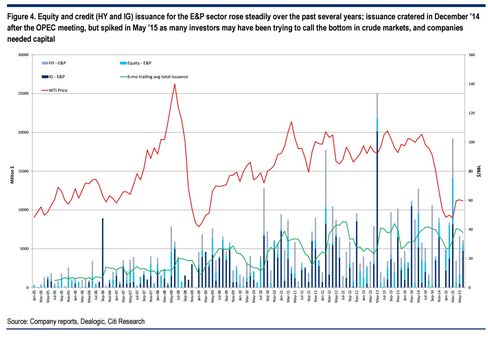
Shale financing has zoomed into focus as U.S. oil companies embark on the latest round of semiannual discussions with lenders, known as the “redetermination of the borrowing base.” The discussions take place twice a year, in April and October, and involve shale producers and banks renegotiating the worth of oil assets securing credit facilities. With the price of crude now down 59 percent from its 2013 peak of $110 a barrel, October redeterminations are likely to crimp the amount of funding available to shale companies.
The Citi analysts expect this year’s redeterminations to result in a 5 percent to 15 percent reduction in the borrowing base, which could in theory help spur the long-awaited shakeout in U.S. shale as producers either have to find fresh capital, merge with competitors, or simply shutter their businesses.
When it comes to the latter option, Citi argues that capital markets now wield unrivaled influence on who lives and who dies as investors choose how and at what price to fund shale producers. The wrinkle, however, is that shale companies may hang on for dear life as long as possible, thanks to perverse incentives in their corporate structure.
“In an additional twist of capital markets’ influence on supply, incentives created by the capital markets may actually slow the supply rationalization for some producers in a classic case of ‘risk shifting,'” said the Citi analysts.
The dynamic has been exacerbated by the large swath of U.S. oil companies that have taken advantage of intense demand for higher-yielding assets by issuing bonds that come with fewer protections, or covenants, for lenders. Such “cov-lite” debt could come back to haunt energy bondholders if shale companies attempt to stay afloat even in the face of negative profitability.
Shale executives may “be willing to produce below break-even prices as long as they have liquidity because producing has value as a real option” on the company’s assets, the analysts wrote. “This would represent a shifting of risk to the creditors, who in many cases have not put in restrictive covenants — in the case of unsecured high-yield debt — that would allow them to easily counteract these incentives.”
Still, there’s no denying that shale will have to grapple with a higher cost of capital that will ultimately give investors extra sway over the future of U.S. shale and, by extension, oil prices.
Where once even the riskiest shale borrowers were able to tap return-hungry financiers at a rate of just 7 percent, the Citi analysts are forecasting that shale’s cost of capital will move closer to 15 percent, shifting the industry’s breakeven price higher by from $5 to $15 a barrel.

“After a period of distress where weaker producers are weaned out and bad investments are written down, shale eventually emerges even stronger,” the analysts concluded. Nevertheless, “investors should re-price what is clearly greater oil-related risk than many had anticipated in the first phase of shale development.”
Makati1 on Tue, 8th Sep 2015 7:14 pm
The contracting world economy controls oil prices. The ability to purchase controls how much oil will be sold at what price. When the numerous CB/Gov. props finally collapse, the Age of Petroleum will end, along with much that we consider ‘normal’.
Davy on Tue, 8th Sep 2015 7:31 pm
The whole commodity super cycle participants and emerging markets are in a rude awakening. Oil is only the tip of the iceberg. When long term debt costs go up in a deflating economy bad debt is going to be realized. In the good times we had extend and pretend but soon it will be the hatchet block. We will see people cutting their loses and getting what they can get while the getting is good. Eventually some kind of de facto debt jubilee will likely occur similar to what happen in the former USSR.
shortonoil on Tue, 8th Sep 2015 8:03 pm
It makes one wonder what these investors would do if they really understood what is happening to oil prices, and why?
http://www.thehillsgroup.org/depletion2_022.htm
There is a very affluent segment of our society that is now bankrupt; and don’t know it!
http://www.thehillsgroup.org/
penury on Tue, 8th Sep 2015 8:36 pm
I think that this has been a recurring theme here for the last couple of years. Always follow the money.
MrNoItAll on Wed, 9th Sep 2015 2:00 am
“shale eventually emerges even stronger”
Numerous articles these days from MSM are recognizing the obvious. This one, for example, is clearly validating the fact that shale on average has been a lousy money losing investment. But then the same articles (this one included) end on a positive note, a concluding burst of hopium.
Articles such as this one are based on tried and true sales tactics. When a salesperson is trying to sell something to somebody and they raise an objection, a good salesman validates the objection, then launches into the counter-point. It is called “handling objections”.
And that’s all these articles like the one posted here are — sales pitches to a bamboozled and hyped up sales prospect — the investing public. They (TPTB) just HAVE to keep the money coming in. There is no lie, no distortion, to underhanded sales tactic that they won’t use to accomplish their goal.
In America, the land of the free, the predators and the snake oil salesmen are FREE to sucker anybody that is stupid enough to fall for it, and “they” exercise their freedom to the full extent.
Never give a sucker an even break. Never miss an opportunity to trick an investor into thinking that shale profitability and big investment payoffs are right around the corner.
It is important to keep in mind that in these last dying days of the Age of Oil, the powers that be have wrested control of your television set just like in the Twilight Zone, and that all you see and all you perceive is being controlled by the unseen powers behind the curtain. The reality experienced by the common citizen and by the regular joe six pack investor is a manufactured, carefully contrived hologram that hides the ugly truth.
Shale will NEVER emerge stronger than what it is now, not without billions if not trillions of dollars additional debt handed over to shale operators to drill into the ground. That is just one tiny aspect of the Ugly Truth that “they” are desperate to hide.
Ralph on Wed, 9th Sep 2015 9:12 am
My employer merged with a City of London organisation five years ago, who sold our physical assets, put the cash in THEIR pension fund and put US in administration. We were bought out by a previous CEO who put her own money in to re-invest in our products and systems. We have struggled through the ongoing consequences, and in the week when we are finally kicked out of our formerly owned premises, our new systems come on line, our new products start shipping and business is taking off, and we go to outsourced production on demand, our main product supplier has gone into administration leaving us with nothing to sell.
The world economy in microcosm.
BC on Thu, 10th Sep 2015 12:23 am
Saudi Arabia’s (SA) per capita oil production/supply is at the level of 1998 and down 15% since Peak Oil in 2005, which is where the US was in the mid-1980s following the peak per capita in 1970.
Any surprise why SA is at war and borrowing for social programs?
Reiterating, Peak Oil is history, i.e., it’s in the rear view mirror a decade behind us.
GregT on Thu, 10th Sep 2015 12:40 am
Thanks for sticking around BC. It would be a complete shame to see you go.
MrNoItAll on Thu, 10th Sep 2015 1:33 am
“Peak Oil is history, i.e., it’s in the rear view mirror a decade behind us.”
Totally agree. That fact is obvious, to me.
But I wonder when we’ll reach “peak barrel count” — keeping in mind that barrel count these days in no way corresponds to actual oil that is capable of providing the good old fashioned energy that the economy needs to run on.
My guess is that peak barrel count is very close or is already behind us. Meaning, we are living right now in the age of “peak everything that matters”.
It is going to be a very rough ride down the backside of the “peak everything that matters” curve!
We should know — we’re on the first mile of that rough ride down right NOW, and now way of knowing how distant the bottom of this ride is!
MrNoItAll on Thu, 10th Sep 2015 1:40 am
Hey GregT — I did my first honey harvest today. Got a little more than six quarts from 8 of a total of 30 already full honey super frames. The honey is dark, rich and I think the best honey I have ever tasted. Not far from where I live there is an 80+ year old man who sells honey from his house — turns out he’s been doing it for over 40 years, and the honey he sells is from his son’s farm. That honey used to be the best I ever tasted, until my honey came along. Wish I could send you a sample!
GregT on Thu, 10th Sep 2015 2:07 am
Very cool NWR!
Any idea as to the predominate flowers in the area? Bees are on my list, but still down on the bottom at this point. Aren’t they the most amazing ‘animals’.
Davy on Thu, 10th Sep 2015 5:23 am
MR, my hive is new so I am going to wait a year to harvest. Bees are doing great. My wife and I are in a bee club. An oldtimer from the club comes around to advise on hives in the area. He says my hive is doing great. My 400 acres is full of wild flowers. It is a bee paradise. I am considering one more hive.
Davy on Thu, 10th Sep 2015 5:27 am
Greg you and I are old timers on this site. I think BC got the doom fatigue. He will be back because it becomes like an addiction. Once one gets a taste of reality it is liberating but it is also depressing. Doom is an admission of decay and death of ourselves and our world. That is very hard for any personality to deal with. I sometimes feel it especially when I think about the world my kids will grow into.
Davy on Thu, 10th Sep 2015 5:41 am
@MR “peak barrel count is very close”. I think it will surprise many how quickly decay will set in. Our global society has a minimum operating level of complexity and energy intensity. Just like everything else in this world from a small motor to a very large system operating levels matter for efficiency and maintenance.
The cornucopians have become habituated to the results of years of complexity and energy intensity. All our lives the lights have gone on and the frig has been full. We can hop in the car fuel up 24/7/365 and get on a highway with other cars in a familiar feeling of activity. It is surreal really because this complexity and energy intensity it is delicate and fragile.
I imagine we are going to have some kind of disruption soon that will bring the system to its knees again much like 08 when the global economy almost froze up. Many people here don’t understand food. One bad harvest we can squeak by. Two bad harvest will bring society to its knees. We are likely in the beginnings of abrupt climate change which is surely not good for global agriculture.
We are likely in the end of growth. The economy is showing every sign of demand and supply destruction which will introduce decay and dysfunction into the global system. How long can a just in time system hum along efficiently when in decay. Eventually these factors are going to affect confidence and liquidity both of which contribute to cooperation on a global scale. All locals have been delocalized by the comparative advantage of efficiency of trade. Relocalizing will not come quick nor easy. We are in for a rough ride for sure.