
Peak Oil is You
Donate Bitcoins ;-) or Paypal :-)


Page added on August 14, 2012

BP Selling Gulf of Mexico Fields
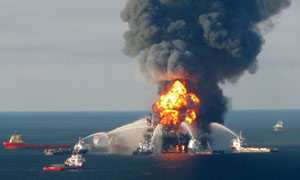
BP Plc (BP/) is seeking as much as $7.9 billion before tax payments for a group of Gulf of Mexico oilfields as it unloads assets following its 2010 spill in the region, two people with knowledge of the matter said.
The oil producer, Europe’s biggest after Royal Dutch Shell Plc (RDSA), has prepared preliminary information for prospective buyers of assets including the Horn Mountain, Holstein, Diana Hoover and Ram Powell fields, said the people, who asked not to be identified because the sale process is confidential.
Because of taxes payable by the eventual buyer, the maximum proceeds BP can expect from the fields will probably be $5 billion to $6 billion, one of the people said. The fields, which hold proven reserves of about 120 million barrels of oil, produced about 58,000 barrels a day in the first quarter, the person said.
BP rose 0.9 percent to 450.9 pence in London.
Chief Executive Officer Bob Dudley plans to sell $38 billion of assets by the end of next year, shrinking BP after the accident at its Macondo well, the worst offshore spill in U.S. history, wiped out a third of its market value. The London- based company said in May that it plans to sell some “non- strategic” assets in the Gulf.
“We’re progressing the planned divestments” in the region “to really focus our Gulf of Mexico footprint,” Dudley said on a July 31 conference call.
Robert Wine, a BP spokesman, declined to comment on details of the sale today.
Profitable Production
BP’s output in the Gulf of Mexico is some of the most profitable in its portfolio, and Dudley has said he wants to focus more on the production hubs of the Thunder Horse, Atlantis, Mad Dog and Na Kika fields. The company has six rigs working in the region and plans to have eight by the end of the year, the most ever.
Competitors including Norway’s Statoil ASA (STL) are also looking to expand in the region, which offers relatively low taxes and easy access to the U.S. energy market.
Two of the fields being sold by BP, Holstein and Horn Mountain, are already operating, and two are still in development, the people said. Bidders are likely to include U.S. companies such as Chevron Corp. (CVX) and Exxon Mobil Corp. (XOM), and it’s unlikely that all the fields will go to one buyer, one of the people said.
Yesterday, BP announced an agreement to sell its Carson oil refinery in California and 800 gasoline stations to Tesoro Corp. (TSO) for about $2.5 billion, bringing its total divestitures to about $26.5 billion since the beginning of 2010.
6 Comments on "BP Selling Gulf of Mexico Fields"
DC on Tue, 14th Aug 2012 7:19 pm
There is something wrong with our system, when outfits like BP can ‘buy and sell’ large tracts of the ocean like there trailer park pads. And as if BPs rep isnt had enough, isnt that Tesoro one of Californias worst polluters and probably amoung the worst nationally as well in the US of Oil?
SOS on Tue, 14th Aug 2012 9:34 pm
They didnt sell any part of the ocean at all. What they sold was the right to extract oil and gas from a certain area. The ocean ownership is not affected.
BillT on Wed, 15th Aug 2012 1:50 am
SOS…they own the Gulf. After all, they polluted it and no one went to jail did they? They also own the Us government, the Federal Reserve, and Wall Street. You think you are electing your representative in November, but you are only voting for the Package Obama or the Package Romney that they present to distract the sheeple and to keep you believing you live in a Democracy. You don’t and have not for at least 30 years.
SOS on Wed, 15th Aug 2012 2:53 am
I disagree about the mineral ownership. That is a legal interest in the minerals under the gulf with, of course, a responsibility to the the gulf itself. Their spill should have consequences but it shouldnt stop the maximization of those vast resources.
DC on Wed, 15th Aug 2012 5:34 am
Yes, BP showed there responsibility to the Gulf by dumping untold millions of gallons of corexent into the ocean. And all to make the oil slick less visible so citizens and other groups would have a harder time suing them for wilful negligence. Harder for the media to show the world endless oil slicks when BPs toxic ‘dispersent’ simply moved them underwater, where its a lot harder to get film.
SOS on Wed, 15th Aug 2012 12:46 pm
Actually, sinister speculation about the unseen aside, the oil dissipated. because it contained no organics. You may not be aware, but the first settlers around San Fransico bay reported it was covered with oil slicks from natural seeps.