
Peak Oil is You

Donate Bitcoins ;-) or Paypal :-)


Page added on April 15, 2014

1 Chart Showing the Stunning Reversal of America’s Energy Future
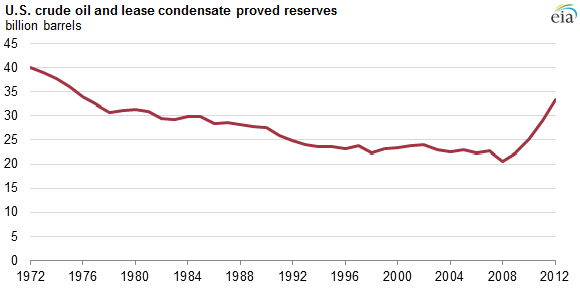
It wasn’t all that long ago that we were worried about peak oil. Those fears have largely vanished thanks to booming American oil production. It’s a stunning reversal that’s perfectly captured in the following chart detailing the change in America’s proved oil reserves over the past 30 years.
Source: U.S. Energy Information Agency
America began turning around its reserve picture about five years ago. This is when energy companies like EOG Resources (NYSE: EOG ) and Continental Resources (NYSE: CLR ) discovered that we actually could economically produce oil out of the Eagle Ford and Bakken Shale plays. The ensuing boom now has America’s proved oil reserves at the highest level since 1976.
Drilling down into our proved reserves
Last week the U.S. Energy Information Agency released its latest proved reserve data for 2012. Proved reserves are the energy resources that the industry is reasonably certain can be produced with current technology and economics. While the data is a bit behind, it still shows the remarkable growth experienced by America’s energy industry over the past few years. What it shows is that 2012 was simply a remarkable year for the energy industry. Overall, energy companies boosted in proved oil reserves by 4.5 billion barrels to a total of 33 billion barrels of oil. It was the largest reserve boost since 1970 and represented a 15% surge in proved oil reserves.
Texas led the way with nearly 3 billion barrels of reserve additions as companies like EOG Resources and Pioneer Natural Resources (NYSE: PXD ) fueled capital into developing and exploring the oil-rich Eagle Ford Shale and Permian Basin. Texas was followed by North Dakota, which added more than a billion barrels of oil thanks to the hard work of companies like Continental Resources. As the following map shows, those two states really stood alone in driving oil reserve growth in America.

Source: U.S. Energy Information Agency
New data is actually pretty dated
As remarkable as these numbers are it still represents the very beginning of the oil boom. Last year saw energy companies focus on spacing wells closer together, testing new hydrocarbon producing zones and improving overall efficiencies. That suggests that there’s a lot more reserve additions to come as the industry becomes more certain that it can produce the energy found in the rocks underneath our nation. In fact, most energy producers believe that shale plays like the Bakken, Eagle Ford, and Permian Basin each hold more oil potential than our nation’s total current proved reserves.
For example, Continental Resources CEO Harold Hamm believes that new technology will ultimately enable producers to unlock more than 45 billion barrels of oil from the Bakken Shale. That’s still a small fraction of the estimated 900 billion barrels of oil trapped within the rocks below North Dakota. Meanwhile, we’re seeing companies like EOG Resources continue to revise Eagle Ford Shale oil recovery estimates higher. EOG Resources has revised its Eagle Ford estimate upward by 250% over the past few years and now believes it will ultimately recovery 3.2 billion barrels of oil equivalent from this Texas shale play.
Meanwhile, producers are using the combination of horizontal drilling and hydraulic fracturing that was the key to these two shale plays in new areas all across the country. In the Permian Basin, for example, Pioneer Natural Resources sees this combination being the key to unlocking upward of 75 billion barrels of oil equivalent, which is 25 billion barrels of oil equivalent more than the company thought the industry would recover just last year. As the following slide shows, Pioneer Natural Resources believes that it’s sitting atop the second largest oilfield in the world.

Source: Pioneer Natural Resources Investor Presentation (Link opens a PDF)
Needless to say, as big as 2012’s proved reserve additions were, it’s likely only the beginning of surging reserve additions in America.
Investor takeaway
We’re still in the very early innings of America’s energy boom. The energy industry is just beginning to hit its stride, while continuing to find additional qualities of oil resources. Not only is that changing the game for our nation but it is opening the door for investors to enjoy potentially game-changing returns.
5 Comments on "1 Chart Showing the Stunning Reversal of America’s Energy Future"
DC on Wed, 16th Apr 2014 6:12 am
I feel a lot better now knowing that fools.com is on top of the energy crisis-problem averted! Thanks guys….
Arthur on Wed, 16th Apr 2014 10:29 am
Here is another stunning reversal of a somewhat different, more sustainable kind:
http://www.triplepundit.com/2014/04/electricity-prices-fall-europe-german-renewable-energy-increases/
Total installed renewable energy base in Germany: 70 GW (that’s the equivalent of 70 standard big power stations).
Annual growth rate 2013-2014:
Wind: 31%
Solar: 74%
Share renewable energy: 25%
Target 2025: 40-45%
Target 2035: 55-60%
Target 2050: 80%
Yes we can.
rockman on Wed, 16th Apr 2014 12:11 pm
First, while the reserves in the TREND are truly world class the chart is very misleading. The “Spraberry/Wolfcamp” is not a “FIELD”…it is a collections of fields, some very large, in a geologic TREND that includes a number of different formations like the Spraberry, Wolfcamp, Cline et al. If the chart were truly representative it would also lump all the fields in the same trend as Ghawar Field. That TREND of fields would be many times greater than the depiction of the Spraberry/Wolfcamp”field”.
The second misleading implication is that the development of the remaining reserves in the S/W trend will mimic those of Ghawar Fld et al. It will not for the obvious reason: the vast majority of those reserves remaining in the S/W trend are in unconventional reservoirs that have a development cost and production profile vastly different than Ghawar Fld which had a much smaller number of wells drilled which each produced many thousands of bopd for decades. The very best wells drilled in the S/W trend will pale in comparison. The S/W will produce a huge amount of oil/NG in coming years (as long as prices stay high) but it will require hundreds if not thousands of wells for each one drilled at Ghawar Fld.
And they still love to slip in that little “e” behind the oil reserve number hoping folks don’t notice they are counting NG reserves as bbls of oil. The current estimate is 2 trillion cubic feet of NG will be produced with that oil. Not sure how Pioneer (a public company out there promoting their stock) did the conversion. But the latest numbers I see from the US Dept of Energy: the Spraberry Trend is itself part of a larger oil-producing region known as the Spraberry-Dean Play, within the Midland Basin. Estimated reserves for the entire Spraberry-Dean unit exceed 10 billion barrels. But I’m not sure how up to date their number is. But a good bit less than the 75 billion bbls of oil EQUIVALENT Pioneer presents.
Also good to bear in mind that these reserves don’t represent new discoveries but are producing areas that were discover more than half a century ago. The increase in oil prices have made going after the residual oil (that we’ve known was there) profitable. A year ago I looked at just one field that had 700 million bbls of residual oil at just 2,400’. The field had been completely drilled up decades ago and had an 11% recovery of the original 820 million bbls in place. Two offset fields have been undergoing CO2 floods and had increased recovery to over 20%. But this field sits there doing only 60 bopd because there is now CO2 available. And it will sit there making 60 bopd until CO2 becomes available…maybe in 15+ years.
Lots of oil/NG left in the S/W trend for sure. And it cost to develop and production rate profile will be nothing like the other world class fields it’s being compared to IMHO. I always sense that such stories are presented with an underlying hope of lower oil prices/increased energy security in the future. Obviously if oil prices were to drop significantly most of those “new” reserves would disappear overnight.
shortonoil on Wed, 16th Apr 2014 12:41 pm
Nicely written article except they left out a few points. These three majors in the shale game
(PXD, EOG, CLR) spent $1.63 on CAPEX last year for every $1 of product produced. They are finding huge reserves of low quality, very expensive to extract hydrocarbons, that have a very limited market. 70% of what is extracted from the Eagle Ford, and 30% of what comes out of the Bakken won’t produce transportation fuels. Cushing and the Gulf Coast storage facilities are 99% full, and oil prices are going up. Refineries need crude to produce gasoline, kerosene, and diesel, and that is coming out of the Middle East, and Africa. If America had to depend on the shale industry to power the country, the rickshaw business would be booming.
Fool.com is a misnomer; TheGreaterFool.com would be much more appropriate!
http://www.thehillsgroup.org
Pops on Wed, 16th Apr 2014 1:17 pm
It is a stunning chart. The one small problem is it shows the past, not the future.