
Peak Oil is You

Donate Bitcoins ;-) or Paypal :-)


Page added on August 3, 2013

World Solar Power Topped 100,000 Megawatts in 2012
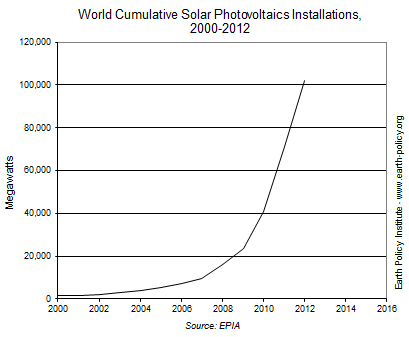
The world installed 31,100 megawatts of solar photovoltaics (PV) in 2012—an all-time annual high that pushed global PV capacity above 100,000 megawatts. There is now enough PV operating to meet the household electricity needs of nearly 70 million people at the European level of use. While PV production has become increasingly concentrated in one country—China—the number of countries installing PV is growing rapidly. In 2006, only a handful of countries could boast solar capacity of 100 megawatts or more. Now 30 countries are on that list, which the International Energy Agency (IEA) projects will more than double by 2018.
PV semiconductor materials convert the sun’s rays directly into clean, carbon-free electricity. Traditional solar cells—made of crystalline silicon—are combined into flat panels or “modules.” While residential rooftop systems are measured in kilowatts, large ground-mounted systems can reach thousands of megawatts of capacity. (One megawatt equals 1,000 kilowatts.)
Today roughly 60 percent of PV is manufactured in China. A decade ago, China produced almost no PV. But in a kind of gold rush spurred by easy bank loans and government tax incentives and subsidies, China hurtled past PV technology pioneers the United States (in 2006) and Japan (in 2008).
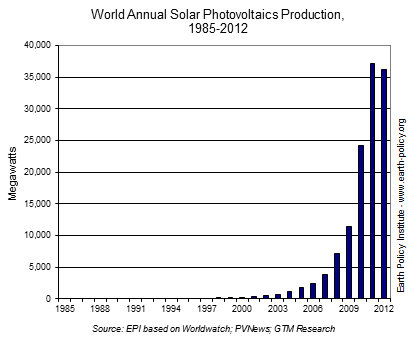
The flood of new companies entering the Chinese PV industry over the last several years created a massive oversupply of panels at the global level and accelerated the already fast-paced drop in world PV prices. Many firms in other countries went bankrupt or shut down factories, and now even some Chinese companies are folding as the industry consolidates. Worldwide, PV production in 2012 declined 2 percent from 2011, the first annual drop on record. But this contraction will be short-lived as demand continues to rise. Solar power installations are growing more than 40 percent annually, and falling PV prices are making solar power more affordable.
China, where PV had previously been too expensive to be widely adopted, may soon lead the world in generating electricity from PV. Each year since 2006 China has at least doubled the amount of new PV installed nationwide. After installing 5,000 megawatts in 2012, China is number three in the world with 8,300 megawatts of total PV capacity, trailing only Germany and Italy. And in July 2013, the government officially set a new national PV capacity goal of 35,000 megawatts by 2015.
Depending on China’s 2013 final tally, Japan could well install the most PV this year, perhaps more than 9,000 megawatts. This would give Japan some 16,000 megawatts of solar capacity—over halfway to its official 2020 target of 28,000 megawatts. Historically, Japan has been the world’s leading market for residential rooftop PV; in 2011, some 85 percent of PV capacity added there was residential. After the March 2011 Fukushima nuclear disaster, though, the government introduced a generous incentive encouraging larger projects, thus spurring huge investment in utility-scale PV capacity.
The other big Asian solar story comes from India, a country of 1.2 billion people where an estimated 290 million still lack electricity. According to the solar energy consultancy Bridge to India, the country had 1,700 megawatts of PV installed by May 2013, with 80 percent of it in the sun-drenched northwestern states of Gujarat and Rajasthan. Bridge to India projects that figure will jump to 12,800 megawatts by 2016. India’s National Solar Mission calls for 22,000 megawatts of solar power nationwide by 2022, including 2,000 megawatts of off-grid PV. Going solar is becoming increasingly attractive in India due to notoriously frequent blackouts and climbing grid power prices—not to mention that solar is now cheaper than diesel for electricity.
Even though Asia’s PV installations are soaring, it will be some years before it can unseat the European Union (EU) in regional PV dominance. The EU boasts 68 percent of world PV capacity. In 2012, for the second year running, the EU added more PV than it did any other electricity-generating technology. EU countries now annually installing hundreds or thousands of megawatts include Austria, Belgium, Bulgaria, Denmark, Germany, France, Greece, Italy, and the United Kingdom.
Germany remains the world’s solar capital, home to nearly one third of global PV capacity. For the third straight year, Germany added more than 7,000 megawatts of PV in 2012, reaching 32,000 megawatts. Accounting for some 5 percent of national power use, the electricity flowing from Germany’s solar panels in 2012 was enough to supply more than 8 million homes.
After adding a world-record 9,400 megawatts of new PV to the grid in 2011, Italy connected 3,400 megawatts in 2012 to keep its second-place spot in installed PV, with 16,300 megawatts total. Italy got 5.6 percent of its electricity from PV in 2012. (See data.)
The main policy driver that has allowed Germany and Italy to amass their world-leading solar capacity is the feed-in tariff (FIT), which guarantees renewable energy generators a long-term purchase price for the electricity they supply to the grid. As these markets mature and solar system costs decline, FIT incentives are being reduced. But worldwide more than 70 countries—the majority of them now in the developing world—use some form of FIT.
Until recently, the United States lagged badly in PV capacity despite its abundant solar resources. (Nearly every state gets more sun than Germany does.) But annual U.S. solar installations doubled in 2011, and nearly did so again in 2012, when 3,300 megawatts of PV came online. As of mid-2013, U.S. PV capacity had passed the 10,000 megawatt mark.
Renewable portfolio standards (RPS)—laws now in 29 states typically requiring that renewables account for a specified share of the electricity that utilities sell—have historically driven U.S. PV development. In California, the U.S. solar leader, utilities must get one third of their electricity from renewable sources by 2020. Federal tax credits and cash grants are also PV catalysts, as are the increasingly popular arrangements allowing homeowners to lease a system from solar developers like Sunrun and SolarCity rather than footing the entire upfront cost. More than half of U.S. residential systems are now leased.
Another solar-rich country finally starting to seriously ramp up its PV capacity is Australia. Residential rooftops host the majority of its 2,400 megawatts, 42 percent of which were installed in 2012. In the state of South Australia, one in five homes is solar-powered.
Large PV projects are announced seemingly every week in countries with little or no previous solar capacity. For example, in mid-2013 construction finished on an 84-megawatt project in Thailand. The 96-megawatt Jasper Solar Project, financed in part by Google, is under way in South Africa. And two projects of over 100 megawatts gained local approval in Chile.
These large projects illustrate another global PV trend: the rise of the mega-project. Only a few years ago, the 10 largest solar farms were between 30 and 60 megawatts. Now PV parks of 100 megawatts or more are becoming commonplace. Arizona’s Agua Caliente PV project became the world’s largest at 250 megawatts when its fourth phase finished construction in 2012. (It will eventually be 290 megawatts.) Developers have announced a 475-megawatt PV farm in Nagasaki, Japan, due in 2016. Several projects between 500 and 3,000 megawatts are under development in California.
Even as PV deployment moves toward larger applications, it is well worth noting the virtues of smaller-scale solar, especially for developing countries. In rural areas with no grid access, installing solar PV at the home level is often cheaper than building a central power plant and electric grid. Bangladesh, working for over a decade with the World Bank, had installed 1.4 million rural solar home systems as of mid-2012, for example. Peru recently announced that the first phase of its national home electrification program will equip a half-million off-grid homes with PV.
Analysts expect a new PV installation record of 35,000 megawatts in 2013. Even with the possibility that Europe’s annual installations will fall below 10,000 megawatts over the next few years, China, Japan, and the United States, along with the growing number of “newcomer” PV countries, will more than pick up the slack. The IEA estimates, perhaps conservatively, that world PV capacity will more than triple by 2018 to 308,000 megawatts—at peak power, the generating equivalent of 300 large nuclear plants.
Earth Policy Institute
14 Comments on "World Solar Power Topped 100,000 Megawatts in 2012"
BillT on Sat, 3rd Aug 2013 6:07 am
“There is now enough PV operating to meet the household electricity needs of nearly 70 million people at the European level of use.” (or 30 Million Americans)
Well, that is 1% of the total needed for the world. And how many years to get there? If this could be added every year … we could be on total ‘renewables’ by 2112! But then, the turnover would require a multiple of that to replace the burned out, worn out units several times over during the build out and they ALL would require hydrocarbon energy to be manufactured, etc. so … dream on!
Andy on Sat, 3rd Aug 2013 10:06 am
Actually the world needs to be installing three times as much (300GW) every year to transition away from FF and also avoid collapse.
One thing is obvious we are not going to ‘transition’ away from FF. As long as there are FF we will burn them.
DC on Sat, 3rd Aug 2013 11:06 am
Two questions this article raise. One, if there is such ‘over-supply’ of PV panels-why is this such a scarcity of them in North American stores and distributors? You can drive(and only drive) hundreds of miles in N.A. and not see a single installed panel-anywhere. Neither on public or private structures. Sure, you might see the odd solar power dog-poo collection can. But…
Two, how much fossil-fuel powered supply was added. Is PV physically displacing coal, FF, oil, NG, whatever, or is solar simply being used to expand the total energy supply right alongside all the usual suspects?
As long as energy consumption continues to grow, alongside population growth AND the continual expansion of FF power, then it really doesn’t matter how many panels are installed. Unless FF power is retired, and completely replaced with solar AND the total energy usage either declines or at worst-is held steady, then these panels are not being near as helpful as this article would suggest.
#2
Arthur on Sat, 3rd Aug 2013 11:28 am
“Well, that is 1% of the total needed for the world. And how many years to get there? If this could be added every year … we could be on total ‘renewables’ by 2112!”
Bill has yet to understand exponential growth. From a recent EU statement:
““EU will reach a 20% share of energy from renewable sources by 2020 and a 10% share of renewable energy specifically in the transport sector… On 31 January 2011, the European Commission (EC) presented its Communication showing that the 2020 renewable energy policy goals are likely to be met.“”
http://deepresource.files.wordpress.com/2013/07/eu-targets.jpg
Germany, Scandinavia, Spain, Italy, Czech republic doing fine, Britain, France, Holland are badly lagging behind (oil, nuclear and gas handicap resp.), but Britain and Holland recently have decided on mega-projects and will reach the targets after all.
Arthur on Sat, 3rd Aug 2013 11:30 am
Addendum to previous post:
http://deepresource.files.wordpress.com/2013/07/solar-installed-2000-2011.png
Forget about 1% per year. This is how renewable exponential growth looks like. By 2050 the transition will be complete, absent of war and financial collapse.
Kenz300 on Sat, 3rd Aug 2013 1:20 pm
Renewables Provide 25% of New U.S. Electrical Generating Capacity in First Half 2013
http://www.renewableenergyworld.com/rea/news/article/2013/07/renewables-provide-25-of-new-electrical-generating-capacity-in-first-half-2013
BillT on Sat, 3rd Aug 2013 3:01 pm
“..absent of war and financial collapse…”
Ah, but BOTH are in our future and in the next decade or less. There is not going to be a significant change to ‘alternatives’ until the ‘alternatives’ are manpower and horse power. Be patient, it’s coming.
GregT on Sat, 3rd Aug 2013 5:27 pm
The only PV panels seen anywhere in the Pacific Northwest, are the ones that supply power to remote roadside telephones, road construction signs, cellular telephone sites, and traffic cameras. Mostly for the convenience of people that are driving automobiles, in areas that are not already serviced by the current electric grid.
While the TALK, of ‘renewable’ electric power generation is all great and wonderful, what exactly are we hoping to generate the electricity for? Televisions? Computers? Refrigerators? Air conditioners? Fluorescent light bulbs? Where do people think that all of these electronic gadgets come from? What good will most of them do for us in a post fossil fuel world? They are merely modern conveniences. They are not necessary for our survival.
All current technologies require fossil fuel energy. Our electronic gadgetry requires a massive input from fossil fuels. Sure, maybe we will be able to scavenge, and repair old appliances and electronics for a while, but what do we do when these items are at the end of their useful lives? What do we do when the grid itself is at the end of it’s useful life?
Fossil fuels have allowed us to create the electric power grid, not the other way around. When the 250 or so personal energy slaves, that we all enjoy in modern industrial society, finally stop working for us, who is going to replace them? Who is going to carry millions of tons of ore from mile deep copper mines, who is going to transport those same ores from the mine to the smelter, and who is going to process those ores?
We are stuck in an energy intensive paradigm. We are focussed on the continuation of BAU, above all else. We have no plans in effect for food production and distribution, water scarcity, ocean acidification, or climate change. Instead we are concerned about the economy, jobs, money, exponential growth, and tablet PCs.
Modern mankind is in for a very huge wake up call, and it is going to be extremely unpleasant.
Concerned on Sat, 3rd Aug 2013 9:26 pm
What is the EROEI on panels.
Has anyone built a math model that end to end might show how PV could self replicate and support other tech at say > 70% power source leaving 30% for FF
PV is also terrible in terms of indeterminacy. Has it ever rained for 3-4 days with out much sunlight?
PV is great for taking the edge of peak demand when business, families and factories are drawing maximum energy during the day of course.
FF depletion, population growth and economy based on growth is a dead end for our species. We could likely be beyond the point of no return.
Additionally if PV is self sustaining this tech should pretty much be able to roll out in impoverished communities and give sufficient energy to start them industrializing (in a tech sense) and on the road to higher quality (energy) lives.
Unfortunately you will find without the FF subsidy going into PV you will have no PV miracle.
Harquebus on Sat, 3rd Aug 2013 9:35 pm
Renewable generators do not return the embodied energy used to make them. The cost of their manufacture will not be going down.
Arthur on Sun, 4th Aug 2013 9:11 am
Concerned and Harquebus would maybe care to take a look at this:
http://deepresource.wordpress.com/2013/06/29/eroei-of-photovoltaics/
Harquebus on Sun, 4th Aug 2013 9:04 pm
Arthur. Improved maybe but, they still can’t do it.
Concerned on Sun, 4th Aug 2013 9:59 pm
Arthur you may want to take a look at Egypt, Cambodia, Haiti, Many countries in Africa with lots of sunshine and many more countries around the world.
In fact take and advanced nation Japan is now the ideal candidate for this new PV given their challenges with Nuclear.
The world bank indeed the nations themselves, could roll out this magic PV along with electric tractors, factories, bicycles and show the rest of the world this miraculous new economy. (end to end) Heck even if it got to 50% renewables and 50% FF it would be incredible.
As of today August 2013, FF is the still the economic energy foundation of advanced civilization. The primary FF input of oil has peaked and is in decline.
We have to deal with this reality.
Kenz300 on Sun, 4th Aug 2013 10:26 pm
EROEI Of Photovoltaics | DeepResource
http://deepresource.wordpress.com/2013/06/29/eroei-of-photovoltaics/