
Peak Oil is You

Donate Bitcoins ;-) or Paypal :-)


Page added on July 18, 2018

Wind Energy Is Getting Cheaper And Cheaper
Who would have thought wind’s transformation from subsidy-supported to self-financing power source would happen so quickly – not this publication, that’s for sure.
Apart from diehard environmentalists, most consumers have been opposed to renewables on the basis they cost significantly more, and turbines are an eyesore on the landscape.
But in the span of less than 10 years, public opposition has declined. Opposition has not gone way entirely, but it has softened as we have become more familiar with the sight of slowly rotating turbine blades on the horizon and with the realization that its costs are falling dramatically.
A recent article in The Telegraph reports on how the cost of power production from onshore wind farms has dropped so far it undercuts conventional coal, natural gas and nuclear options.
The below graph from 2015 shows onshore wind as the cheapest option; costs have come down further since then.

(Click to enlarge)
Source Wikipedia
Calling it the “subsidy-free revolution,” the Telegraph article reflects our own surprise at how quickly the change has taken place.
To be fair, offshore power still requires some subsidy because of the greater cost of installation and maintenance. Even here, costs continue to fall, and subsidy is a route the authorities prefer to entertain because of public opposition to what was seen as the blight of onshore turbines dotting the landscape.
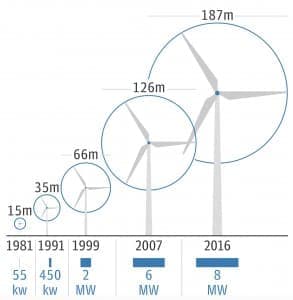
In large part, this is because turbine sizes have increased and, as a result, efficiencies have increased.
(Click to enlarge)
Source: The Telegraph
The industry is seeing it as a major investment opportunity, generating jobs while at the same time reducing the country’s overall carbon emissions.
A figure of £20 billion covering both onshore wind and solar over the next 10 years is mooted, all of which would be subsidy-free.
The latest figures are sounding the death knell for nuclear power in the U.K., but as usual the government hasn’t caught up with the numbers.
Nuclear power is costing a massive £92.50 per megawatt hour and is partly justified on the basis that a base load of power is always required to fill in renewables variability. However, battery parks like Glassenbury in Kent are springing up that can meet gaps in demand, but nothing like a 2 GW nuclear power plant; still, a few MW here and there is slowly adding up.
But, like renewables, costs will need to come down for investment to flow into battery parks. That is, they’ll need to come down to the extent required to negate the need for quick fireup of conventional power sources to fill in gaps during cold snaps or, as renewables rise, as a percentage of the whole to fill in for periods of low wind or at night for solar.
Still, a low-carbon future, at lower power costs and with the benefit of economic growth from investments – what’s not to like?
By Stuart Burns via AG Metal Miner
98 Comments on "Wind Energy Is Getting Cheaper And Cheaper"
dissident on Wed, 18th Jul 2018 8:35 pm
It is cheap because it utterly fails to provide baseload. In other words, it is totally useless without a storage system. This investor pamphlet tries to claim that existing battery technology is up to the task. Yeah, and I have fine bridge in Brooklyn for sale.
BTW, nuclear is only expensive in the OECD where corruption results in plants costing over $10 billion to build. This is the prime reason that western power plants have irrelevant global market share. Nobody in their right mind is going to pay these ludicrous prices.
jawagord on Wed, 18th Jul 2018 8:39 pm
What’s not to like?
https://www.express.co.uk/news/weather/990616/weather-latest-britain-drought-wind-drought-heat-wave-energy-met-office
Cloggie on Wed, 18th Jul 2018 9:08 pm
“It is cheap because it utterly fails to provide baseload.“
You don’t have to worry about that until renewables have reached a share of 30-40% total electricity. It is in 2018 always a good idea to at least aim for that, reduce CO2 emissions, have an independent source of energy and local employment and wait for technology to come up with cheaper storage methods.
Holland and other countries are betting on hydrogen and power-to-gas to provide baseload.
https://deepresource.wordpress.com/2018/07/14/the-netherlands-is-placing-its-bets-on-the-hydrogen-economy/
https://deepresource.wordpress.com/2017/09/16/blueprint-100-renewable-energy-base-for-germany/
https://deepresource.wordpress.com/2017/03/07/power-to-gas/
https://deepresource.wordpress.com/2017/12/28/700-mw-renewable-hydrogen-plant-to-be-built-in-france/
Permavillage on Wed, 18th Jul 2018 9:50 pm
Renewables are supposed to replace oil, right?
Problem is, in order to build a windmill you need oil (as a raw material for plastics, lubricants, etc, and to extract metals and ores from mines), then you need oil to transport it, to install it, to maintain it.
When oil starts depleting, then things will start to look interesting.
Renewables cannot produce the energy that allows them to be manufactured!
MASTERMIND on Wed, 18th Jul 2018 10:08 pm
Renewable’s can’t replace oil because oil is used for 90 percent of the worlds transportation, and renewable s are used to produce electricity..Oil is the lifeblood of our economy and it has peaked or is peaking very soon..
https://imgur.com/a/pYxKa
dave thompson on Wed, 18th Jul 2018 10:10 pm
I am in the process of building a wind mill driven car. I already have a wind turbine strapped to the roof of my electric golf cart for trials. Will keep all of you posted, for the future is wind driven cars.
Go Speed Racer on Thu, 19th Jul 2018 12:12 am
Well good luck with that Dave,
That ride sounds like
a Liberal-Mobile.
Windmills are landscape ruining,
ugly ass abortions. Every last one
of them should be illegal.
Makes the libs swoon with
delirious joy, in-between their
vomit sessions due to Prez Trump.
Hopefully Trump will
Make Windmills Illegal Again.
deadly on Thu, 19th Jul 2018 2:53 am
Wind turbines are a chimera.
Therein lies the problem.
A Problem With Wind
The planners of giant wind installations in Valencia, Spain, mention the dripping and flinging off of motor oil (almost 200 gallons of which may be present in a single 1.5-MW turbine) and cooling and cleaning fluids. The transformer at the base of each turbine contains up to 500 more gallons of oil. The substation transformers where a group of turbines connects to the grid contain over 10,000 gallons of oil each.
The things need oil worse than anything.
Cloggie on Thu, 19th Jul 2018 3:19 am
“The things need oil worse than anything.”
You are unable to grasp the difference in scale between a world that consumes 90 million barrels per day and a few hundred thousand wind turbines that each need a few hundred gallon of oil, replaced every year or so. Anything that “proves” that collapse is inevitable.
/facepalm
/deathwish
simon on Thu, 19th Jul 2018 3:27 am
@Dissident
Wind Energy is cheap because the initial costs are low and the variable costs are low, nothing to do with baseload
Do you have any proof for the corruption claim, please post it, Antius, I am sure would want to see that
@Permavillage
We can re-purpose vegetable oil for this, but I dont think this is necessary for a long while
@MM
You made an assertion of a problem and have said it is insurmountable,
Trains are electric,
Vans and Cars can be electric
Earth moving can be electric
What else do we need ?
deadly on Thu, 19th Jul 2018 4:05 am
Clogmeister, you’re all wet, not a leg to stand on. lol
From Ice Age to Nice Age
Climate change “warming” fears have scared taxpayers and voters in the UK and EU into accepting very expensive renewable energy plans and carbon taxes/trades, that have pushed hard-working people into heat-or-eat poverty. Jobs have been lost. Power prices have gone up 37% (2005-2013). The environment was not helped one bit. We must learn from their experience. Please review our findings with an open mind.
Energy and Man
Not only do FF do physical work for us in the fields but they also provide the feedstock for fertilizer and pesticides that have resulted in enormous gains in crop yields. FF pay for irrigation and for the education of scientists who develop disease resistant high yielding strains of crops. They pay for transportation of crops to processing plants, they pay for the processing plants and their operation, they pay for the operators and ultimately they pay for the transportation of food to market, refrigeration and for our journey to the store to purchase food.
Fossil Fuels will never be replaced by Renewables, Ruinables.
Beer drinking starting soon.
simon on Thu, 19th Jul 2018 4:32 am
@Deadly
I am confused, as, in the wholsale market, renewables are price takers, not proce setters, how are they affecting the cost of energy, except to stop the commissioning of power from more expensive sources, so how are they responsible for the increase in power costs ?
DerHundistLos on Thu, 19th Jul 2018 5:12 am
Simon:
Nothing more to say except nicely done, sir.
Antius on Thu, 19th Jul 2018 5:30 am
Cloggie wrote: “You don’t have to worry about that [intermittency] until renewables have reached a share of 30-40% total electricity.”
Unfortunately, that isn’t true, at least at present. Cloggie’s posts often read like a propaganda exercise. He ignores contrary evidence. He brushes away inconvenient facts. He honestly appears to believe that he can talk away difficult technical problems, like a lawyer arguing in court. The problem is that there is no arguing with the laws of physics. They stubbornly refuse to listen. No matter how eloquent and convincing your arguments are, the problems are the same afterwards as they were before. Propaganda works on people; it doesn’t work on Mother Nature. Trying to pretend that wind intermittency isn’t a problem does not make it any less of a problem. This problem needs to be dealt with, rather than being swept under the carpet whilst pretending we don’t need to worry about it. At this stage the debate about future energy investment needs to be more than a propaganda campaign, because there is no time left for bullshit.
To provide baseload with highly intermittent energy requires two power stations, one intermittent (wind), and the other dispatchable and burning fossil fuels. That means two sets of capital and operational costs. On the plus side, your wind turbine will save fuel in the backup plant, but the cost of the combined system will always be more than using the backup plant on its own, unless fuel becomes very expensive. So trying to use this as any part of baseload will always increase total costs.
As part of the Electron Economy concept, we previously discussed methods by which renewable energy sources could provide energy without the need for electricity storage and minimal use of backup plants. This involves overbuilding renewable energy converters, such as wind and solar, and diverting large parts of their power output into slew loads, that can be switched on and off rapidly. That will include (some) hydrogen production, as an end use chemical feedstock; it will include heat for space and water heating, cooking and industrial processes. In industry, some processes, such as milling and cutting can function intermittently without too much economic dislocation. We can further reduce the impact of intermittency by offering electricity with contracts that include certain amounts of power outage in exchange for reduced power cost. Some customers will have the flexibility to accept that, for others it will be less acceptable and they will choose to pay more for more reliable power. We can further reduce the intermittency problem by prioritising renewables with high capacity factor, like large offshore wind turbines. Finally, a limited number of open cycle gas turbines can function as backup plants.
Cloggie wrote: “It is in 2018 always a good idea to at least aim for that, reduce CO2 emissions, have an independent source of energy and local employment and wait for technology to come up with cheaper storage methods.”
Technology does not change the laws of physics. A storage system is effectively a power station that consumes intermittent electricity as fuel and produces dispatchable power as output. It has capital and operational costs and storage losses will increase the amount of power that needs to be generated in the first place. It will always be expensive and pretending that technology will solve this problem in some sort of magical way is fool hardy.
Cloggie wrote: “Holland and other countries are betting on hydrogen and power-to-gas to provide baseload.”
I have already outlined the follies and enormous cost of doing this, with its huge inefficiencies and high capital costs. I don’t think I need go over it again.
Antius on Thu, 19th Jul 2018 5:54 am
Simon wrote: ” I am confused, as, in the wholsale market, renewables are price takers, not proce setters, how are they affecting the cost of energy, except to stop the commissioning of power from more expensive sources, so how are they responsible for the increase in power costs ?”
In most countries, renewable energy suppliers are paid a pre-agreed strike price for every unit of power that goes onto the grid. They get the same price regardless of demand at that time and the grid is obliged to accept it. This results in distortions in wholesale power prices to the extent that in Germany power prices are often negative – the grid actually pays customers to accept it. Other producers, such as baseload generators and power plants that function as backup, lose market share and without some subsidy, they would be driven out of business, even though they are essential to maintaining whole system stability. For the customer, prices will increase because they are essentially paying for more generating capacity than they would need if the grid were supplied from entirely dispatchable sources. They are paying a price that covers the cost of the renewable energy delivered to the grid and the other (fossil) plants that function as backup, rather than just the fossil plants alone.
alain le gargasson on Thu, 19th Jul 2018 6:01 am
why nobody talks about rare metals and the pollution of the extraction
see in french, may be translate
https://www.youtube.com/watch?v=0anZ0wPVZCY
Davy on Thu, 19th Jul 2018 6:04 am
This is worth reprinting “Antius on Tue, 17th Jul 2018 6:13 pm” (reprinted next comment). Antius points to bigger offshore turbines so we can lower the need for backup and storage. It appears that the future of renewables is pointing to tier use with proper size, dispersion, and connectivity of renewables with the intent of lowering intermittency but also adapting to it thereby lowering backup and storage needs. The cost of storage and backup is likely too high for a macro 100% renewable system to work considering the economic abilities of our global society. That is an educated opinion and one that could be wrong but it should be a point of departure for a different policy. This policy is accepting renewables as extenders not a full blown transition. If we are going to take renewables that step further and away from fossil fuels then we are going to have to include demand management with more sophisticated renewables in size and combination. We will need wind and solar working together over larger geographic areas. This will have to include backup and storage but the goal is to reduce the need for them because of costs. Behavior is the toughest variable and the most important. Conservation and intermittency should be taught in school and made a policy mandate. We need to heat and cool differently to reduce the needs of the grid. We need to live in our space differently by driving less and eating different.
I don’t see the behavior component changing much because there is no real policy for it. In Europe where there is a big policy effort people still are not thinking intermittency with demand management at the degree it must be at. There like most places it is more about technology. Technology is seen with optimism and a win win. It is not because behavior must be a part of its application. What we are talking about is a massive change on how we structure our day and seasons. The sun and wind have to almost be worshipped and our days revolve around them. This includes business. The way we conduct business and the way we produce things needs to change. We need less consumerism and high energy leisure. We don’t need road trips and mindless vacations. Holiday travel just because that is how we have done it should change. We need to relocalize the family instead. You might wonder how road trips relate to wind, solar and the grid but this must be a holistic approach. This is the problem. We do not have consensus on energy and individuals want the government and technology “to take care of it”. The other problem is cost, this will be hugely expensive and we have less money all the time with an economy teetering on failure. Time is speeding up and running out. This is a time based transition because entropic decay does not rest. Depletion and decay now govern our civilization.
I am proposing this partial human revolution not because I think we can save the climate. I think the climate is now changing on its own and feedbacks will be as much or more than human contributions eventually. Longer term climate will probably be our end regardless of wht we do. Climate has been forced too far and it is now the case that our industrial agricultural system that feed so many will eventually be under threat and this will put civilization itself under threat. Systematically I am not sure humans can adapt enough with renewables to make a difference with climate and fossil fuel depletion. In regards to cost and affordability it will be hard to ween ourselves off affluence that fossil fuels and globalism has given us. It is not clear systematically with the economy if we can even do something different without systematic bifurcation to much lower economic activity levels. One need only look at debts, unfunded liabilities, and corruption to see systematic economic decay teetering on failure. We will have to be less affluent with less people and what wealth we have will need to be focused on things that matter.
Market based capitalism and liberal democracies that promote the sacredness of individual liberty to do as the individual wants lawfully needs to be called into question. We now need a system that recognizes the need for control and management in the name of survival. Sustainability and resilience need to take the driver seat over individual liberty. This is if we want some kind of future. That is a decision. Live life large now or make sacrifices is the two doors ahead. The degree we can go in the direction of control and management will buy us time. I don’t see us leaving the world of the affluent individual as the goal of humans. I think this is what people want. People have been habituated to it for too long. We have been told all this is possible by technology for far too long. They want private freedom and more affluence. Governments and business want the same. Rich people want them both and rich people like their freedom and affluence and they run things.
With this recognition then we need to realize it is likely too late for changes that could save civilization in regards to its systematic and behavioral makeup longer term. Maybe a new civilization over time and through a bottleneck can be birthed. It is likely too late with resources and climate issue. Let’s be honest with the science and numbers. It is not too late to change to buy us time to adapt and mitigate better to what is ahead. Maybe we can add a decade or two. Maybe if given enough time we can lower populations and consumption and properly apply good technologies through wisdom. I don’t see us getting there like techno optimist want. The numbers do not add up with energy, food, and water. Diminishing returns is evident everywhere. Behavior and our system of networks and infrastructure is in systematic decline. We can be honest with ourselves and accepting of a coming end to the status quo. We can prepare with adaptation and mitigation strategies. Renewables are part of this but they will not save us without human nature itself changing.
Davy on Thu, 19th Jul 2018 6:05 am
Antius on Tue, 17th Jul 2018 6:13 pm
“Mearns uncovers a linear relationship between offshore wind turbine hub height and capacity factor (see Figure 9). Following the curve would indicate that capacity factor reaches 50% at hub height 220m and 60% at 250m. This is extremely important, because it suggests not only that larger offshore turbines generate for more hours closer to their peak output, but also, that lulls in generation are both less common and probably not as deep. This means that it makes a lot of sense building turbines as large as physically possible. This remains the case even if we hit diseconomies of scale, because improved capacity factor allows us to reduce the number of backup plants needed, which is a huge reduction in capital and operating costs. If we can produce 100MW turbines with hub heights of 600m say, then it may make sense if capacity factors keep improving. Finally, we may build a limited number of backup power plants to reduce the length and frequency of power outages to important customer sets. If wind capacity factors are high enough, then it should be possible to do this using open cycle gas turbines. These are relatively inefficient, but are cheap to build and do not require constant manning. This makes them useful for providing relatively infrequent but high power output. They could use natural gas, liquid fuels or maybe compressed biogas, given that total energy production per year would be modest. In summary, a renewable electron economy could support a high industrial society. The key is carefully balancing the needs for reliability against cost for each consumers set.”
MASTERMIND on Thu, 19th Jul 2018 6:21 am
The Insanity of Endless Growth (Hayden 2018)
Humanity has a key failing – we tend to deny our problems. Humanity denies some things because they force us to ‘confront change’, others because they are just too painful, or make us afraid..
https://www.scribd.com/document/384214485/The-Insanity-of-Endless-Growth-Hayden-2018
That sums up perfectly Davy,Greg,madkat,Clogg..too afraid of collapse..
LmfAO!
Cloggie on Thu, 19th Jul 2018 6:26 am
@Antius – I got that number of 30-40% from an Australian study:
https://deepresource.wordpress.com/2017/08/17/dont-worry-about-intermittency-under-30-40-renewable-energy-share/
Antius on Thu, 19th Jul 2018 6:37 am
“This is worth reprinting “Antius on Tue, 17th Jul 2018 6:13 pm” (reprinted next comment).”
Thanks Davy. Excellent post. Will comment in more detail later on.
MASTERMIND on Thu, 19th Jul 2018 6:42 am
Clogg
Weird ‘wind drought’ means Britain’s turbines are at a standstill
https://www.newscientist.com/article/2174262-weird-wind-drought-means-britains-turbines-are-at-a-standstill/
A total joke..You are a pussy clogg who is afraid of collapse..
MASTERMIND on Thu, 19th Jul 2018 6:52 am
There are powerful people in the US who steer the entire country on the path of confrontation with Russia, President Vladimir Putin warned
https://www.rt.com/news/433683-putin-us-anti-russian-stance/
Your damn right Vlad the bad..Just wait till you are hit with a nuclear first strike..And the Russian public is running around Moscow with their skin melting off..
lmfao!
Cloggie on Thu, 19th Jul 2018 7:13 am
“Your damn right Vlad the bad..Just wait till you are hit with a nuclear first strike..And the Russian public is running around Moscow with their skin melting off..
lmfao!”
Against this satanic vermin, regardless if we are talking about millimind or the US deep state, is only one defense: combined Eurasian war preparation and consultations about how to solve the JQ once and for all.
Antius on Thu, 19th Jul 2018 7:34 am
Cloggie wrote: “@Antius – I got that number of 30-40% from an Australian study:”
OK, his words, not yours. Perhaps a better way of putting it would have been that with the capacity factors currently achievable, we can integrate this much wind power into the grid system without the need for storage or curtailment, hence without disproportionate escalations in the cost of electricity. ‘No problem’ is a poor choice of words, because there have been significant problems in places where this has not been managed properly, i.e. Australia, ironically.
I am not saying that there aren’t solutions. But I really would like us to be honest about the difficulties involved in transitioning to a heavily renewable energy system and how solutions would actually work. Mainly because we really are going to have to do this soon and lives will depend upon getting it right.
Antius on Thu, 19th Jul 2018 7:40 am
“Weird ‘wind drought’ means Britain’s turbines are at a standstill”
The UK has been plagued by a high pressure system (with low wind speeds) since the end of May. Fortunately, solar power output has been high due to plenty of sunshine. A two month long wind energy lull, is exactly the sort of stress test that a renewable electron economy must be designed to cope with. It won’t be easy, but there are options.
MASTERMIND on Thu, 19th Jul 2018 7:41 am
In extremis
As Hannah Arendt argued, there is one common thread which connects individuals drawn to all kinds of extremist ideologies
Totalitarian ideas offer a ‘total explanation’ – a single idea is sufficient to explain everything. Independent thought is rendered irrelevant in the act of joining up to their black-and-white worldview.
It was pointless to argue with them that their logic was flawed, or that the facts of history did not support it. That wasn’t really why they had signed up to it in the first place.
They neglect their capacity for independent thought in favour of total commitment to their chosen movement
https://aeon.co/essays/loneliness-is-the-common-ground-of-terror-and-extremism
Antius on Thu, 19th Jul 2018 8:05 am
Cloggie wrote: “Against this satanic vermin, regardless if we are talking about millimind or the US deep state, is only one defense: combined Eurasian war preparation and consultations about how to solve the JQ once and for all.”
No argument here. Though if Trump is successful in the mid-term elections, he will be in a much stronger position with his own party and in a good position to begin the process of dismantling the J interests within the US government.
A good first step would be to fire Comey and appoint a new CIA director and task him with investigating whether J interference and dominance of media institutions poses a threat to the interests of the broader US public. Since the same thing has already been levelled as the Russians, and actions are taken to limit their influence within the US, a useful precedent has been created that can be exploited. When the investigation exposes the truth, Trump can use ‘executive orders’ and acts of congress, to curtail their influence on national security grounds. This will effectively end the assumption of racial equality in the US, but it had to end sometime.
simon on Thu, 19th Jul 2018 8:20 am
@Antius
The awarded strike price is a daily event, rather than a government mandated, yearly rate
The grants are only for the CRM capacity market, not a major money sink
Finally, the wholesale cost of leccy on average is 40EUR per Mwh this has not varied a lot, and does not
explain a 37% increase, I suspect there are other forces at play there.
@Alain
Bonjour, il y a des conversations dédie à ce sujet sur ce site. Le point de ce site, c’est le
épuisement minereaux et Huile, aussi l’abuse personnelle (Malheureusement), donc le sujet de pollution arrive, mais c’est rare en effet
@Davy
I am afraid you are correct, the future will be hard for people to accept. Mainly the lack of personal mobility
and the need to care about energy, in the EU we are rolling out smart meters as a first step
I suspect this will be a generational thing, god willing we get the time
@MM
Fight the urge, stay on target
john on Thu, 19th Jul 2018 9:38 am
Germany has 58Gw of installed wind power, more than average UK consumption.
Yet often all these turbines produce less than 2Gw
https://www.energy-charts.de/power.htm?source=all-sources&year=2018&week=16
This is not just a small bridge that needs filling. The batteries required to store enough energy for the United Kingdom would cost over £1 trillion. Solar would help much during winter as it is dark from 4pm til 8am.
Even in summer time solar has fallen a fraction of installed capacity by 5pm.
Renewable energy is unfortunately not reliable and storage is very very expensive.
Recycling all those batteries would add even further costs.
deadly on Thu, 19th Jul 2018 9:47 am
The answer as to how the costs have increased to have electricity.
My electricity bill is the most expensive of all of the utilities I use. The utility company that provides natural gas to heat my home and water is usually about half the amount of my electricity costs.
When I first joined an electric cooperative to supply electricity to my new place, ok, a country home, the basic rate to be connected to the grid was at eight dollars per month plus the rate of kwh used.
Because of the production tax credit to fund wind and solar investments, the US gov entered into the energy business, the basic rate for grid connection increased to 32 dollars per month and also an increase of the kwh rate.
The ratepayers pay more, it has to come from somewhere.
The basic rate for grid connection is now at 49.75 usd basic rate per month. An increase of some 600 percent from whence it first began.
It now costs an additional 480 dollars or so each year to be connected to the grid.
All due to the production tax credit.
As President Obama said early into his first term, “Electricity prices will necessarily triple.”
It did at the basic rate and more.
Purdy easy to see how those costs have increased. Wind and solar extract their pound of flesh.
I can’t complain, I am invested in a utility, the shares have increased in value and the dividend has increased enough to offset my increased costs.
I also have a business, those increased costs are going to be passed onto the consumer and every consumer does have an interest in the business I have, so I don’t have to worry about if it will make some money or not, it does.
Everybody wants electricity, an investment in an electric company is a no brainer.
No matter where you go, there you are.
simon on Thu, 19th Jul 2018 9:51 am
Hi John
There are many ways to ensure baseload is met, one is to reduce baseload (this was the point Dave was making)
you will have to do this anyway, as with your spiffy new Nuc. you will be paying 150Eur per Mwh three times the
current rate, for about 30 years.
You do not need, just batteries, there are a variety of ways to store leccy.
You could always integrate yourself more fully with the EU (snickker snickker) and then you can buy leccy
from other sources when needed, its pretty blowy somewhere and france has a large nuk. fleet, and norway a ton of
hydro.
but most of all, forget having a future like it is now, build out more trains, dump the cars. Insulate
be cold in the winter and hot in the summer, toughen up, none of us have a choice.
Sissyfuss on Thu, 19th Jul 2018 10:10 am
Antius, your posts are enlightening and educational. And you give us respite from the Clogmeisters constant prattling about the ease of a renewable transformation of Ind Civ. But enquiring minds want to know if you think Herr Hitler was a misunderstood little love monkey as Da Clog thinks or perhaps even more, a stable genius sent by advanced alien cultures to get us back on path.
BobInget on Thu, 19th Jul 2018 10:34 am
It rains Negativity on these pages.
Here’s part of the skinny.
Texas grid is isolated from other states.
Texas was again the top wind power state with nearly 36 million megawatthours (MWh) of electricity. Iowa was second, with more than 15 million MWh, followed by California, Oklahoma, Illinois, Kansas, Minnesota, Oregon, Colorado, Washington, North Dakota, and Wyoming.Apr 15, 2014
Twelve states produced 80% of U.S. wind power in 2013 – Today in …
https://www.eia.gov/todayinenergy/detail.php?id=15851
As you can see, WP is apolitical.
It’s all about that check.
Antius on Thu, 19th Jul 2018 10:57 am
“But enquiring minds want to know if you think Herr Hitler was a misunderstood little love monkey as Da Clog thinks or perhaps even more, a stable genius sent by advanced alien cultures to get us back on path.”
I don’t know for sure. I am an engineer, not a historian. I read politics, philosophy and history when I get time, which isn’t often. What I have read recently leads me to question the official narrative surrounding WW2.
deadly on Thu, 19th Jul 2018 11:26 am
Let’s hear what T Boone Pickens had to say about them thar wind turbines:
Fast Company: And you’ll do all this on your beautiful 68,000-acre ranch?
Pickens: I’m not going to have the windmills on my ranch. They’re ugly. The hub of each turbine is up 280 feet, and then you have a 120-foot radius on the blade. It’s the size of a 40-story building.
You can’t hide the truth. It speaks for itself.
You can’t make this stuff up.
Cloggie on Thu, 19th Jul 2018 12:01 pm
But enquiring minds want to know if you think Herr Hitler was a misunderstood little love monkey as Da Clog thinks or perhaps even more, a stable genius sent by advanced alien cultures to get us back on path.
Not sure what a love monkey is, other than yet another attempt to satisfy your own insatiable lust for entertainment.
Take-away points (and no, I do not have a picture of Dolfie on my desk):
– WW2 was a planetary power grab by the US, or its deep state rather, planned for since 1933, by the youknowwho, who both owned the US and Soviet governments.
– The idea was to exploit the “Versailles situation” (Britain and France trying to keep Germany down, the latter trying to escape) and set Europe up for war.
– The #1 US tool to get that job done was the world’s first neocon, Winston Churchill, as well as Poland as useful idiot.
– As of 1934 there was an agreement between Roosevelt, Churchill and Stalin for an anti-German alliance:
https://documents1940.wordpress.com/2017/09/27/churchill-stalin-alliance-as-of-1934/
– The Polish campaign was triggered by the Poles who had began to ethnically cleanse Germans from Poland.
– The fact of the “Phoney War”, is a clear indication that neither the British, nor the French, let alone the Germans had any appetite for war.
– The Norwegian campaign was triggered by British and French attempts to interrupt iron ore supply from Narvik to Germany, pushed for by Churchill to finally get the war started on behalf of international jewry.
– The invasion of the Low Countries was triggered by the Dutch government giving in to pressure from Churchill to allow overpass of their troops for a direct assault against the German industrial heartland. The attack was preempted by a couple of hours.
– There was no “Miracle of Dunqerque”. Hitler let the British escape without a massacre, in order to deescalate. But Churchill was not interested because he knew via diplomatic channels with the Americans and Soviets that they were on his side.
– The German invasion of Yugoslavia and Greece was triggered by the invasions of Albania and Greece by the fool and ally from hell, Mussolini. This gave the British the ecuse to “come to the aid of the Greeks” and use Thessaloniki to attack the only source of oil the Germans had, Ploesti, Romania.
– I am willing to believe in the holohoax if someone can give me one name and proof of somebody who was gassed. If not, the holotale was created by the alllies in order to create the justification for their murderous behavior after the fact.
– As of 1933 the aims of the German government were solely to take back all the German lands stolen from them in Versailles and get rid of “reparations”. There was never an ambition for territorial conquest of non-German lands. He had indeed written in the mid-twenties about colonies in the East (“to feed the Germans”), but that was in a time when the USSR was extremely weak and recovering from a civil war.
– Chamberlain was a smart and decent man, acting purely in the interest of the British empire and he was not the coward he was portrayed to be, Churchill was a drunken sadist. He correctly knew that he had nothing to fear from Germany, who had a hobby since 1871 to admire the British. Chamberlain refused to ever meet Roosevelt because Chamberlain knew exactly what the f* was up to. He admitted in private to Joseph Kennedy and James Forrestal who was behind WW2 (not that Joseph needed to be instructed, he knew all too well; after the war he tried to instrumentalize his son to attack the koshers head on, with known results)
https://documents1940.wordpress.com/2017/09/25/chamberlain-and-the-forrestal-diaries/
– Pearl Harbor was provoked, Roosevelt wanted it to happen as he needed a way to circumvent the US public that had no stomach for war. Japan was for 100% dependent on the US for oil and a boycott meant total strangulation. The boycott was imposed one week after Japan joined the Ais, meaning that war with Japan meant war with Germany. Japan was a side-show, Roosevelt wanted Germany and Europe.
Nobody ever challenged me on this interpretation of events, other than with juvenile name calling.
Antius on Thu, 19th Jul 2018 12:46 pm
“– I am willing to believe in the holohoax if someone can give me one name and proof of somebody who was gassed. If not, the holotale was created by the alllies in order to create the justification for their murderous behavior after the fact.”
Zyklon B was basically hydrogen cyanide absorbed into a desiccant like wood shavings and stored in canisters under slight pressure. It was designed to fumigate buildings – the desiccant released the toxin slowly, keeping air concentrations beneath lethal limits (for a while) in a way that made it safer to use. It is entirely possible that some inmates were murdered using this material, many more may have died in buildings that were insufficiently ventilated after fumigation and many more died from malnutrition, cold, disease, etc. a situation that got progressively worse as the war progressed and German resources of all kinds depleted. When your own people aren’t getting enough to eat, how much food would you be prepared to give the shitheads who had been the ‘masterminds’ of the spread of communism in Europe? How many were deliberately murdered and how many died from other effects is difficult to say. Any debate about it in modern Germany will land you in prison.
But consider this: if it was official German policy to mass exterminate these people using poison gas, could they not have come up with something more efficient and purposefully designed? Something that rapidly released lethal concentrations and didn’t require leaving buildings sealed for hours to produce the required effect? Why use a rat and insect killer, and not simply make something purposefully designed that did the job more quickly and efficiently? If it were government policy to carry out such murders, it is difficult to believe that they could not have found a more efficient solution. But I speculate. The camp operators, facing an overcrowding problem, may have simply used what they had to free up room and resources. It is entirely possible that the German leadership did not know what was going on at a local level and with all of the problems that they faced, they probably didn’t care.
rockman on Thu, 19th Jul 2018 1:27 pm
“Renewable’s can’t replace oil because oil is used for 90 percent of the worlds transportation…” And once more the insertion of misleading narrative that wastes space here. No one has ever proposed wind power as replacing oil. It replaces NG and coal burning…at least in Texas. OTOH is electric vehicles ever expand significantly then it might be considered as such.
And the baseload bullshit: Texas has all the baseload it needs, thank you. And ERCOT has no problem integrating our huge wind power into our grid. In fact, as mentioned many times, our wind power expansion prevented an expansion of NG and coal powered plants. Plants that would have been built to meet our surging electricity demand. A demand that surged to a near all-time record high yesterday thanks to AC’s running full out from record high temperatures. ERCOT expects the all-time high record to be broken in a matter of days.
As a result of our wind power expansion Texas abandoned 3 of its largest coal fired plants this year. Say bye-bye baseload. LOL, The numbers aren’t available yet on the current contribution from wind power yet but typically runs about 12%. But there have been times when it produced 40+% of demand for short periods. Times when our wind power SUPPLIMENTED our fossil fuel fired baseload. Oddly enough one of those times was during a polar vortex knocked out part of our baseload (2 NG firepower power plants). A time when the high winds from that cold front generated record high wind power in north Texas. Suck that, baseload. LOL.
Antius on Thu, 19th Jul 2018 1:52 pm
In this post I wish to illustrate why a future renewable energy system will need to be lean on electricity storage and backup.
The link below gives recent wholesale UK electricity prices. They vary considerably across Europe, but for the UK they have bounced between £40-50/MWh (50-60 Euro, 50-60$) for several years.
http://www.energybrokers.co.uk/electricity/historic-price-data-graph.htm
Below, I present two additional links. The first provides Levelised Cost of Energy (LCOE) for different generation options, assessed by Lazard. The second provides Levelised Cost of Storage (LCOS) for different electricity storage media.
https://www.lazard.com/media/450337/lazard-levelized-cost-of-energy-version-110.pdf
https://www.lazard.com/media/450338/lazard-levelized-cost-of-storage-version-30.pdf
There is much to criticise in both reports. The assumptions behind the LCOE calculations are highly questionable. But it is LCOS that I wish to focus on.
The first report gives a LCOE for onshore wind of $30-60/MWh. This is based on a capacity factor that is unrealistically high in my opinion, at least for onshore wind, but I will take it on faith. Utility grade PV comes in at $43-53/MWh. Both calculations are based upon fairly ideal conditions for each source. But it would appear that a 50-50 spilt between wind and solar could generate intermittent power for substantially less than $100/MWh in most places, assuming we take the LCOE assumptions at face value.
The second report calculates LCOS for different media. Here are some extracted figures:
-Commercial scale lithium ion batteries: $891-984/MWh;
-Flow battery: $209-413/MWh;
These costs are based upon the assumption of a full charge-discharge cycle each 24 hours. Longer periods between discharge cycles will lead to higher costs, as effectively, fewer KWh’s are being stored each year and annual capital and operating costs must spread across the number of units stored and discharged each year.
What this tells us is that electricity storage in these media may have some niche applications in short-term grid balancing over a period of hours or to protect very valuable consumers from power outages (i.e. hospitals). But these storage mechanisms are not suitable for bulk power storage on the scale needed to cover long term lulls in renewable energy for an entire national grid. For the same cost as storing 1MWh, we could invest the money in extra wind and solar infrastructure to generate somewhere between 2-20MWh of electric power. The same will ultimately be true of pumped storage plants. At present, they are used to provide grid balancing over a period of hours. To provide several days worth of stored energy, their storage reservoirs must be huge and will necessarily, only be used at full capacity relatively infrequently, significantly increasing LCOS for any power stored in the facility. If hydrogen is used, then between 3-5 units of intermittent electric power will be needed for each MWh stored in this way. When capital costs are factored in as well, the cost of a unit of power from hydrogen will be several times the base cost of intermittent power.
The first report gives a LCOE for gas peaking of $147-218 (capacity factor 10%) and a gas combined cycle cost of $30-85/MWh, assuming a capacity factor of 80%. The variation in costs between the two is partly due to lower efficiency and higher fuel cost in the open cycle peaking turbine, but in almost equal measure the division of capital cost by low capacity factor. The implication is that we must pay almost as much for a facility that we use rarely, compared to one we use constantly. Both figures are based upon relatively low gas prices prevalent today. It can be seen that even if 10% of power is provided by a peaking turbine, it would add something like $20 to the cost of an average MWh. If biogas is used, costs will be greater and fuel supply is fundamentally limited. So backup is something we should aim to use sparingly – dedicated to high value functions that cannot tolerate power supply failure.
To keep a lid on future electricity price in a renewable dominated, fuel constrained electricity based energy system, we must deal with intermittency by reducing demand when wind and solar levels are too low.
Sissyfuss on Thu, 19th Jul 2018 2:17 pm
According to Wikipedia the Nazis starting euthanizing the physically and mentally stunted with bottled carbon monoxide in 1939. They began gassing WW2 prisoners with CM using stationary diesel engines vented into the gas chambers. Eventually they settled on hydrogen sulfide in the form of Zyclon B for the remainder of the war. They were familiar with its properties because they had used it,the Germans, as a chemical weapon in WW1. Sounds a very efficient killing device to me.
Cloggie on Thu, 19th Jul 2018 3:33 pm
“According to Wikipedia the Nazis starting euthanizing the physically and mentally stunted with bottled carbon monoxide in 1939.”
Wikipedia is run by (((Jimmy Wales))).
There was indeed a euthenasia program, we have one in Holland too.
More controversial was the program to put to sleep absolute hopeless cases, people who need intensive care from healthy people who were needed to defend the country. It is no coincidence that that program started after Germany found itself trapped in a unwanted war against Poland, France and the British empire. They knew very well from sorry experience what it meant to be defeated. They could expect the next Versailles to be even worse and thus felt themselves compelled to these extreme measures.
But rest assured Syss, nobody was better at intentionally laying Germans to rest, healthy Germans, than Americans, from relatively safe altitude, for no other intention then to get the America Century started:
https://documents1940.wordpress.com/2017/09/25/time-life-the-american-century/
And your lot is still meddling all over the planet, busy plotting to overthrow regimes not yet vassal of the empire. Iraq: 1 million, 500,000 children (Albright: “worth it”), Syria 500,000, Ukraine: tens of thousands. Libya: “we came, we saw, he died”).
Millimind is the most extreme example here, but he is representative for the cynical mob in Washington, who still have the same intentions they had in 1933.
Expect no criticism from Syss, our exceptionalist friend.
MASTERMIND on Thu, 19th Jul 2018 3:50 pm
Clogg
You just want to be a part of a group that is why you are a Nazi scumbbag..you are just lonely because no woman likes you..Its not really about white supremacy..You just accept that because you have to if you want to be in the group..Just like a Christian has to accept the bible if they want to be welcomed in their church..
I don’t blame you clogg for becoming this way..People are products of their environments..Its our toxic environment manly caused by the economic depression the OECD countries are in that fuels this anti social behavior..And that is something that is out of your control..
Cloggie on Fri, 20th Jul 2018 12:40 am
I agree with Antius that for the foreseeable future (decades) the energy sector needs to be a mix. A rapid transition is perhaps possible for small rich countries, but for most countries the transition needs to be gradual, not in the least to avoid burdening ordinary people with too high energy costs, and as such endanger the energy transition support by “ordinary people”.
From that perspective premature writing off of existing power generating infrastructure, including nuclear, should be avoided.
Nevertheless, a rapid transition for small countries, like Denmark and Scotland, who can use their neighbors as buffers, should be applauded, just to show to the rest of the world that it is possible to have societies run largely on renewable energy and meanwhile pray that cost of storage (battery, hydrogen, methanol, ammonia, pumped hydro, etc.) will come down as it has come down for producing “raw kWh’s” from wind and solar.
Demand management is an absolute must. A lot of gain can be made here, without really lowering comfort levels. Heat pumps need to replace ordinary heating systems, based on burning of fossil fuel. Solar panels should be on every available roof. Cheap batteries should be installed in every household (prices are coming down to $100/kWh) to at least match supply and demand over a 24h cycle for a single household, for certain months of the year.
The car economy can be scaled back by discouraging private car ownership and replacing buses and trams by self-driving vans. You can begin autonomous driving on the high-ways and inter-states (technology is already advanced enough for that, you could do that now) and still have drivers to bring people to high-way stations. With that you can slash the number of vehicles world-wide eventually with a factor 10-20 and with it slash the embedded energy of the global car fleet. Additionally you can organize the system for a much higher occupation rate and as such slash burned fuel per mile per passenger.
Thermal seasonal energy storage should be encouraged…
https://deepresource.wordpress.com/2018/07/03/ecovat-seasonal-storage/
…and used as the “cold side” of a heat-pump system. This is more appropriate for district heating rather than for individual households.
Davy on Fri, 20th Jul 2018 2:56 am
“Nevertheless, a rapid transition for small countries, like Denmark and Scotland, who can use their neighbors as buffers, should be applauded, just to show to the rest of the world that it is possible to have societies run largely on renewable energy and meanwhile pray that cost of storage (battery, hydrogen, methanol, ammonia, pumped hydro, etc.) will come down as it has come down for producing “raw kWh’s” from wind and solar.”
That’s a good point.
“Demand management is an absolute must. A lot of gain can be made here, without really lowering comfort levels. Heat pumps need to replace ordinary heating systems, based on burning of fossil fuel. Solar panels should be on every available roof. Cheap batteries should be installed in every household (prices are coming down to $100/kWh) to at least match supply and demand over a 24h cycle for a single household, for certain months of the year.”
I agree with this point although having a solar system with batteries I wonder how much of the general public can handle a solar system with batteries and fully utilize the system. Maybe if the system can have enough buffers in it and be part of a system where the grid supplies power for larger energy needs. Batteries can be damaged from improper use. It might be better for many to have grid tied panels to lower their energy use. I like my system of a solar system and grid access. I also heat my house and water with a wood boiler. Solar can run the wood boiler system. All my circuits have transfer switches to go between solar or grid. Large draw items like electric oven and backup water heater not have solar access. I maximize my solar gathering during the day. The batteries are used in this process of inverting power but the secondary benefit is a battery backup if the grid ever goes down. I am a doomer and prepper so this is part of my prepping. I am not seeing a raw cost benefit at this point considering how cheap electricity is and how expensive the system is I put in $13K for 1800 watts of panels. I am looking at adding around the same with wind but it is not in the budget at the moment. Where the real value comes in for me is backup power. I am saving power and lowering my electric bill. I gather on average 5KW a day.
“The car economy can be scaled back by discouraging private car ownership and replacing buses and trams by self-driving vans. You can begin autonomous driving on the high-ways and inter-states (technology is already advanced enough for that, you could do that now) and still have drivers to bring people to high-way stations. With that you can slash the number of vehicles world-wide eventually with a factor 10-20 and with it slash the embedded energy of the global car fleet. Additionally you can organize the system for a much higher occupation rate and as such slash burned fuel per mile per passenger.”
Sounds good theoretically until you pencil number to it. The cost are high and the behavioral changes huge. The economic disruption should be considered in the cost figures and this would be very high. We are not geared up for this. For a small country for Holland it may be a wise move but it is unclear whether it would be more than an experiment and could cause lasting economic damage.
“Thermal seasonal energy storage should be encouraged……and used as the “cold side” of a heat-pump system. This is more appropriate for district heating rather than for individual households.”
Yea, this is a good idea for rich urban regions but this does not fit all locations. The cost to retrofit existing systems in relation to benefits of a new system need to be considered. They are high for the best of applications and even worse for a location with a wide variety of heating applications. This would work well for a place like Holland but not many other places with a variety of heating types and suburban sprawl.
All these ideas above are expensive at a time where the economy is already burdened with expenses. It is a pity we can’t convert swords into plow shares. We would likely have the money for all this if we changed some behavior but I am seeing wise behavior decline not improve.
simon on Fri, 20th Jul 2018 3:28 am
I am impressed, we seem to have reached a conclusion with minimal abuse and only a single detour.
@Cloggie/Antius/Dave
One of the interesting developments I have seen is the rise of Demand Side Units, these are large industrial concerns who are paid a small annual fee to be ready to cut electricity consumption at peak times, when they will get another payment.
Antius on Fri, 20th Jul 2018 3:55 am
“Thermal seasonal energy storage should be encouraged…
https://deepresource.wordpress.com/2018/07/03/ecovat-seasonal-storage/
…and used as the “cold side” of a heat-pump system. This is more appropriate for district heating rather than for individual households.”
Agreed.
Hot and cold appear to be the cheapest and easiest ways of storing excess energy. In most developed countries; space and water heating are responsible for about one third of total energy demand. In the UK, people consume about 10MWh per capita for space and water heating each year. As a fossil fuel consumer, that is even more than power production and about the same as total transport fossil fuel consumption.
Underground seasonal storage tanks can store large quantities of heat for months with only minimal losses. The tank itself need be nothing more grand than a hole in the ground with a polymer liner. The surrounding rock and soil will provide insulation after an initial warming up period. The most expensive thing is the distribution pipework. But it is something that only need be built once. Like the sewer systems of large cities, it will be expensive to build but will last for centuries.
One way of reducing the cost of the distribution network would be to site as many heat loads as possible close to the thermal store. Things like swimming pools, laundrettes, community bath houses, old folk’s homes, apartment blocks, etc.
Using stored heat is a very important part of dealing with intermittency. The final graph in the link below shows daily average renewable energy production last year in the UK.
http://gridwatch.co.uk/Renewables
On the whole it looks extremely variable. However, if we cut off the graph halfway up (say at 12.5% on the graph) and use the peaks in energy production to produce stored heat, then what remains beneath the half-way line looks much less variable. If some customers were willing to tolerate occasional power supply disruptions (say, once or twice a month for a few hours at a time) then a limited number of open cycle gas turbines providing perhaps 5% of total power, would be sufficient to fill in the gaps and provide reliable baseload power to customer sets that cannot tolerate intermittency.
Antius on Fri, 20th Jul 2018 4:48 am
“The car economy can be scaled back by discouraging private car ownership and replacing buses and trams by self-driving vans.”
Trams are basically small trains – collectivised transportation that runs on low friction rails and is powered by direct electric, without storage. A very energy efficient means of transportation and certainly not something to be discouraged in a renewable electric energy system. In fact, we should consider replacing buses with trams in my opinion. An upfront capital cost that will pay for itself in the longer term.
“Cheap batteries should be installed in every household (prices are coming down to $100/kWh) to at least match supply and demand over a 24h cycle for a single household, for certain months of the year.”
Individual consumers can make that choice. But large batteries are expensive and often maintenance intensive. I looked into the option of buying a deep cycle battery for a solar powered outhouse I was building. When I worked out the total cost, it came to about £0.5/kWh (0.6E). That is pricey. I decided to use a single 1KWh battery to store 12V to power the lighting and keep heavier loads on variable supply, with a hot water tank as a dump load. Batteries also have an inconvenient tendency to produce hydrogen during charging and Li-ion batteries are prone to catching fire. All batteries are high-current, low voltage devices, and care must be taken to ensure that all connections have low resistance, otherwise strong overheating can result. I’m not sure that they are something the general public could be asked with; they are just too much hassle for most people.
“Nevertheless, a rapid transition for small countries, like Denmark and Scotland, who can use their neighbors as buffers, should be applauded, just to show to the rest of the world that it is possible to have societies run largely on renewable energy and meanwhile pray that cost of storage (battery, hydrogen, methanol, ammonia, pumped hydro, etc.) will come down as it has come down for producing “raw kWh’s” from wind and solar.”
Pushing ahead without a proper plan in the hope that your neighbours pick up the bill is never virtuous. I don’t know Denmark, but I do know Scotland. The local government is run by a bunch of far-left hotheads who are obsessed with virtue signalling and pissing on England whenever they can. Generally they are a pain in the ass to everyone that has to deal with them. They make decisions based on what they feel is fashionable at the time. And people further south pick up the bill for everything they do. People that are struggling to make ends meet and are tired of emotionally immature politicos with a chip on their shoulder.
Technology has been successful at expanding the number of options for energy storage, but it has not been successful at lowering costs. Remember, an electricity store is basically a power station that eats electricity and then spits it out again at a later point in time with losses. Why would anyone expect that ever to be cheap? Thermal storage is relatively cheap because heat can be stored in bulk materials which are very cheap. But it remains so only if we can use the heat as the desired end use.
Generally, the more intensively you use an energy store, the cheaper it is per unit stored. Large energy stores that only get used occasionally are very expensive. That is why battery energy storage is based on the assumption of rapid charge-discharge cycles. The capital cost expands with the total KWh you want to store. That is why we see plenty of hybrid cars on the roads, but Musk’s pure electric Tesla is facing bankruptcy. He did not understand the limitations of the technology that he was getting into.
Antius on Fri, 20th Jul 2018 5:07 am
Cloggie wrote: “Solar panels should be on every available roof”
Davy wrote: “It might be better for many to have grid tied panels to lower their energy use.”
Davy, that is way it is presently being rolled out in most countries. Most are grid connected with a feed-in payment.
In most cases, home level electricity production makes limited economic sense. Take a look at the difference in LCOE between Residential Rooftop and Utility grade:
https://www.lazard.com/media/450337/lazard-levelized-cost-of-energy-version-110.pdf
Utility grade: $43-53/MWh;
Residential Rooftop: $187-319/MWh
That is 4 – 6 times more expensive.
JuanP on Fri, 20th Jul 2018 7:41 am
I essentially agree with Cloggie on what he says about WW2. The world has been sold a pack of lies about it and there are many different versions of what happened. The prevalent Jewish American version is basically a bunch of lies and propaganda.