
Peak Oil is You

Donate Bitcoins ;-) or Paypal :-)


Page added on October 15, 2013

Why Are IEA Renewables Growth Projections So Much Lower Than the Out-Turn?
The IEA has greatly underestimated the growth of renewables for some years now. This illustrates how important it is to allow for unexpected outcomes if policy design is to be robust, as even well informed projections can be very different from the subsequent out-turn.
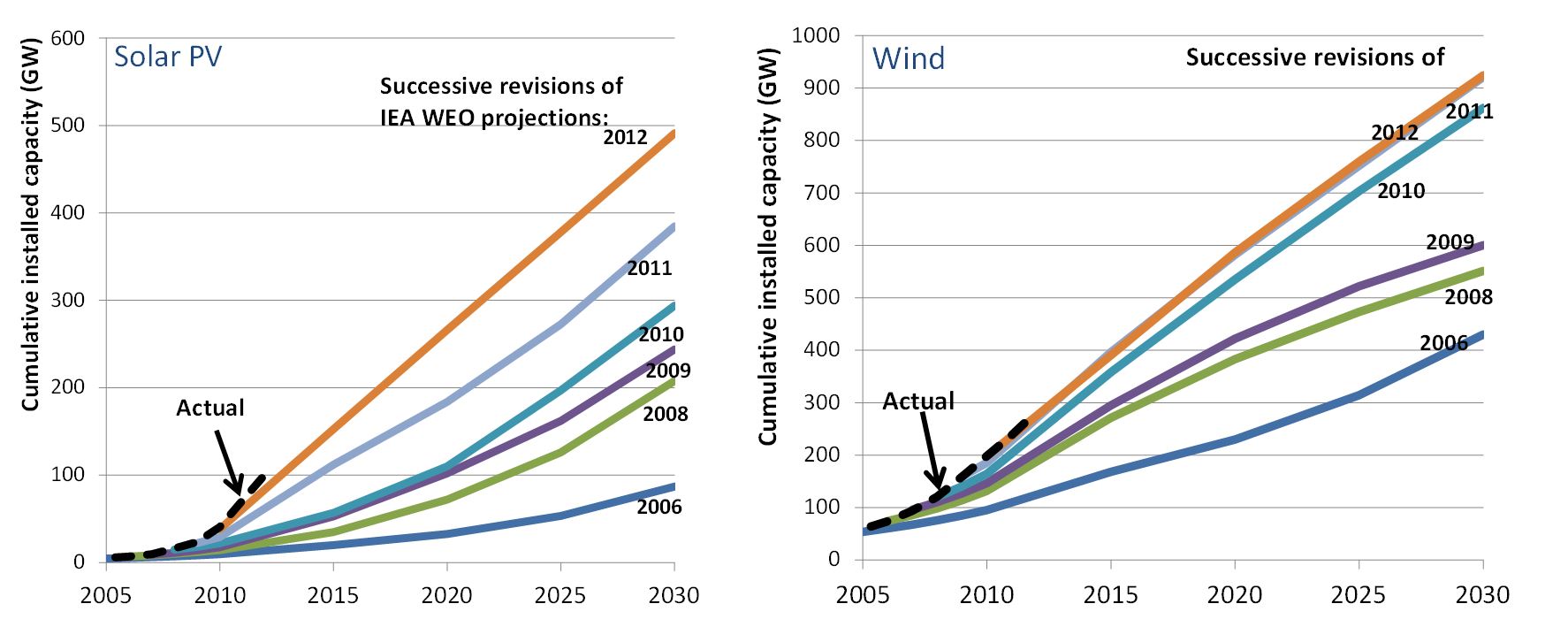
The International Energy Agency’s (IEA’s) annual World Energy Outlook (WEO) is a thorough and well researched analysis of the outlook for the world’s energy systems[1]. Over the years it has become the standard view of the world’s energy use now and in the coming decades. However it has had an extraordinarily poor track record in projecting the growth of solar and wind power in recent years. The charts below compare the IEA’s projections over the last few years with the out-turn for both wind and solar. Projections have been revised upwards each year. But they have still been consistently too low, by a very large amount in most instances, with the pattern persisting over many years for two different groups of technologies, wind and solar PV. As recently as 2006 it was expected to take until the 2020s to reach current levels of wind capacity, and until the 2030s to reach current levels of solar capacity, with current solar PV capacity almost an order of magnitude greater than expected in just seven years ago.
The IEA’s projections have consistently increased over the years, but still fallen short of actual deployment ….
It would, of course, be wrong to suggest that because past projections have been underestimates the current projections will also be too low. However the most recent projections continue to show rates of deployment that appear very cautious. The graphs below show the IEA’s projected rate of installation in the most recent WEO (for 2012) under its central New Policies scenario compared with past and current growth rates. For both wind and solar projected installation rates start below 2012 levels and remain roughly constant or fall over time.
IEA’s projection show declining rates of deployment for both wind and solar …

Decreases in installation rates are of course possible. Wind installation seems likely to be lower this year than last, although the rate of solar deployment continues to grow. However, projecting flat or slowly declining installation rates over the next couple of decades suggests either that current rates are a spike, or that installation is moving towards saturation. Neither of these possibilities seems likely. Costs are continuing to fall, especially for solar, renewables still account for a very small share of total generation, and drivers towards deployment of low carbon technologies seem likely to strengthen rather than weaken over the period. One does not need to be an advocate of renewables to expect that these industries are more likely to grow than shrink over the next couple of decades, even if growth of annual deployment may be much slower than in the past. It would seem more plausible if a central case scenario were projecting some continuing growth in annual installation, with decreases very much a low case. It will be interesting to see how these projections are adjusted in the next edition of the WEO due out in a few weeks.
So what has led to this persistent underestimation of growth? There may have been a reliance on individual jurisdictions’ plans, with more caution than seems with hindsight to have been warranted about the rate at which policy might move. This seems to have led to linear extrapolation of capacities when technologies were in a phase of exponential growth. Projections for wind have improved in recently years as growth has become more linear, and following a large upward revision in the projected rate of addition between the 2009 and 2010 editions of the WEO. It may also be that there is some inherent caution about new technologies. However the IEA – along with many others – has tended, if anything, to be somewhat optimistic about CCS, so this cannot be a complete explanation. There are also specific circumstances that have played a role, notably being somewhat slow to recognise the falling costs of solar PV, with even the costs from the 2012 edition being well above actual values[2].
There may also be a deeper explanation rooted in institutional conservatism. Taking a conservative view of future prospects in the energy sector can be necessary to avoid being swayed by the latest fad. A conservative view recognises the realities of the long time horizons and vast scale of the world’s energy systems. However it can carry the risk of missing the role of genuinely transformative technologies, as appears to be the case here. The IEA’s current caution may still prove justified. But Eurelectric, the European power industry association, noted in a recent report that the European power sector is already undergoing one of the largest transformations in its history[3]. Such changes seem likely to be a global phenomenon. Wind and (especially) solar PV seem likely to form part of the largest transformation of the energy sector at least since the growth of oil consumption in the middle decades of the 20th century, and perhaps since the invention of the steam engine. The IEA seems to be slow to recognise this.
Whichever way the future turns out, the IEA’s past projections show how different actual out-turns can be from even well-informed projections. This provides and important reminder that none of us can be sure about future changes to the energy sector, and policy design must always be robust against things turning out to be different from expectations.
11 Comments on "Why Are IEA Renewables Growth Projections So Much Lower Than the Out-Turn?"
BillT on Tue, 15th Oct 2013 1:09 pm
There are no “transformative technologies’ in the works, only variations on old ideas that will not work for long.
“…If, in fact, we do hit collapse, renewables will not operate the electric grid without fossil fuels, because we need fossil fuels to keep transmission lines repaired, to create and transport replacement parts, and to allow customers to have jobs to pay for the electricity. Thus, without fossil fuels in the future, our investment in renewables is of no long-term value. (And EROI estimates are vastly overstated.)…”
http://ourfiniteworld.com/2013/10/14/two-views-of-our-current-economic-and-energy-crisis/#more-38530
One of many reasons ‘renewables’ are not ‘renewable’ without oil.
rollin on Tue, 15th Oct 2013 1:36 pm
Solar PV and solar concentrating technology have a huge capability of continuing exponential growth. Wind still has room but is more limited to regional growth in high wind areas, so will go linear much earlier than solar.
As both technologies become more efficient and less expensive to build and depoly, they should enjoy an increase in deployment in less favorable regions. I see solar being installed quickly by machines similar to road paving systems, frames assembled and installed with solar panels or films already attached in one step. Crews following behind to make the connections and test continuity. Hundreds of acres covered in a few days.
How about printing solar panels right on house roofs? Installation finished in one day.
By the way, BillT is one hundred percent wrong about needing fossil fuels to keep things repaired, installed, built etc. All we need is energy. Energy can be transformed and where we absolutely need liquid fuels they can be chemically made from CO2 and water, as long as we have energy. I think the oil industry has been quite successful in propagandizing the false myth about fossil fuels being an absolute necessity for high level civilization and transportation. The only thing we may need carbon for a while is in the reduction reactions to separate ores. Even that can be made recyclable given some effort and thought.
mike on Tue, 15th Oct 2013 3:29 pm
The IEA clearly didn’t realise how far governments would go in a failed attempt to subsidise a diffuse energy source with a concentrated one.
And Rollin clearly STILL doesn’t understand the laws of entropy.
If you’re right Rollin then why are energy prices skyrocketing? conspiracy?
GregT on Tue, 15th Oct 2013 3:34 pm
“Solar PV and solar concentrating technology have a huge capability of continuing exponential growth.”
Infinite exponential growth, in a finite environment, is a physical and mathematical impossibility. The longer we promote this flawed ideology, the more devastating the consequences will be, for all of mankind, and the planet Earth.
mike on Tue, 15th Oct 2013 4:02 pm
GregT – It’s amazing how some people are so damn scared of decline (like rollin) for Rollin the only way is exponential growth, up up and up to the stars . He probably uses the term “so we can get off this rock (earth) ” quite a bit.
Which brings me to a pet peeve, and that’s people who want to move to another planet. Wake up call! Earth is the fucking greatest planet in the entire universe for humans, FACT! nowhere will come close to it, you know why? because we evolved to live here, we are symbionts with our planet. Your desire to see it raped so you can have an easy life says a lot about you Rollin 😉
rollin on Tue, 15th Oct 2013 5:39 pm
mike, you are off in the ozone layer making personal claims about me with absolutely no basis for them. Trolling or just stupid? Your conclusions about me are as wrong as what is happening to the environment. Were you born the village idiot or did you have to work at it?
Having worked in the fields of physics and chemistry for decades, I have an idea of what is possible. It is possible to produce lots of energy, metals, products without using fossil fuels or nuclear as an energy source. Whether this is properly pursued is the big question, I doubt it will be.
If you could put two thoughts together, you would realize that collapse scenarios (ones where energy is not replaced) engender the likelihood of environmental devastation, nuclear war and the release of huge amounts of stored nuclear fuels leftover from power plants. There likely will be nothing but a destroyed and radioactive world left if we take no hand in mitigating the loss of fossil fuels.
So take your personal attacks elsewhere, your batting zero here.
Arthur on Tue, 15th Oct 2013 8:49 pm
Every year much more solar energy hits the earth than all accumulated fossil fuel reserves combined. So in principle there is an almost endless energy reservoir that can be tapped and in the long run we have no energy problem. The trouble is that we are probably too late with beginning a serious transition to ensure a smooth transition. And there is huge potential for solar derivative wind as well. Virtually empty and most windy territory on the planet Mongolia can provide all the energy China needs.
mike on Wed, 16th Oct 2013 6:36 am
Yes Arthur we all know that more solar energy hits the earth than all accumulated fossil fuel reserves combined. We know this! This does not mean you can ever use this energy for anything useful and efficient other than warming things up. It is diffuse energy. What with you being a physicist you must recognise the fact that energy is basically the temperature difference between the heat from an energy source and the ambient temperature it is released into. And if you want me to stop trolling you (which I am in an attempt to have to stop reading your utterly moronic posts every day about Solarz powerz is the best thing evar!) then please start using a bit of sense and coming up with solutions which could work rather than solutions which you freely admit haven’t a chance in hell of happening. Get it?
Arthur on Wed, 16th Oct 2013 10:01 am
“This does not mean you can ever use this energy for anything useful and efficient other than warming things up. It is diffuse energy.”
Diffuse? Heating things up? Where have you been the last ten years?
http://tinyurl.com/opv48x8
“What with you being a physicist you must recognise the fact that energy is basically the temperature difference between the heat from an energy source and the ambient temperature it is released into.”
BS, go back to high school and pick up the elementary knowledge that photons can kick electrons out of atomic orbit, resulting in an electric current, that can replace almost everything fossil fuel is used for.
“coming up with solutions which could work rather than solutions which you freely admit haven’t a chance in hell of happening.”
Latest news:
– in Spain since early 2013, wind is the largest source of electricity
– Germany, Thursday October 3, 2013: solar + wind deliver 60% of electricity (around 12:00) and 34% over 24 hours.
Whatdoyamean, ‘no chance in hell’??
mike on Wed, 16th Oct 2013 4:07 pm
Thanks for the pic, made me chortle. Just because someone has spread solar panels over their roof doesn’t mean what they are doing is efficient Arthur. Passive solar is an efficient and great way to heat the home or heat the water but photovoltaics are a joke in the long run. I presume your house is covered in them so I’ll let you find out for yourself next time you have to replace them, when government is no longer subsiding them, the energy used to mine, build and transport them (oil)is through the roof and the Chinese aren’t selling them below cost of production
What you are describing is called electricity Arthur. Electricity last time I checked is a way to transport energy, not an energy source. An energy source is exactly as I described. The energy source in the case of solar power is called the sun. So again useful energy is the temperature difference between the energy source output and the environment it exists in that gives energy its ability to actually do work.
Solar panels are simply ways of conducting the energy from the sun into something else. They don’t produce energy in any way, they conduct it. The same with Wind power in a more roundabout way.
Latest news
German solar industry ends in debacle with 21 billion euros in destroyed capital. large corporations who placed their bets on solar power and solar heat are “pulling out disillusioned“ .
This is thanks to cretinous thinking like yours. Thanks Arthur!
Arthur on Wed, 16th Oct 2013 8:07 pm
“Passive solar is an efficient and great way to heat the home or heat the water”
Excellent, nothing against passive solar.
“but photovoltaics are a joke in the long run. I presume your house is covered in them so I’ll let you find out for yourself next time you have to replace them, when government is no longer subsiding them”
Not yet, intend them to buy them next spring, 12 panels, 3000 peak watt, 6000 euro all in. No subsidies, apart from feed-in compensation, which is no subsidy. After 10 years the investment will be returned and hopefully have another 15-20 years until I drop dead. One of the reasons why I am going to invest is to simply pay the electricity bill for the rest of my life why I still can.
“the energy used to mine, build and transport them (oil)is through the roof and the Chinese aren’t selling them below cost of production”
You forget that prices for solar come down all the time for 40 years now, with no end in sight yet. The expectation if further drop towards 30-40 $ cent per installed peakwatt.
“Electricity last time I checked is a way to transport energy, not an energy source.”
No, it is not. Why don’t you stick your two fingers into the jack to experience the difference between a source and means of transportation. With electricity you can do work, like drive a car, hence it is energy.
“The energy source in the case of solar power is called the sun.”
Very good. And the radiation energy is CONVERTED into USEFUL electrical energy.
“So again useful energy is the temperature difference between the energy source output and the environment it exists in that gives energy its ability to actually do work.”
Huh? Solar panels have nothing to do with ‘temperature’. The sun sends tiny radiation packages called photons through the vacuum (without any temperature) between the sun and the earth, straight onto the panel, where they hopefully kick an electron from a silicon atom out of it’s orbit, through an insulator and abducted via a ultra thin metal layer, and via a detour back to the silicon, underway doing work Americans refuse to do 😉
“Solar panels are simply ways of conducting the energy from the sun into something else.”
No, they CONVERT one form of (radation) energy into another (electricity). Electricity can be used to drive a car, power a computer, lightning, etc., where solar radiation cannot be used for these purposes. A panel is not a conductor, it is a transformer.
No panel, no electricity, no useful work.
“German solar industry ends in debacle with 21 billion euros in destroyed capital. large corporations who placed their bets on solar power and solar heat are “pulling out disillusioned“.”
You probably mean simple production work. That is true, but fortunately we have Chinese to do that, much cheaper that way. Germans do the real hard work of designing and producing turn key solar panel factories…
http://www.youtube.com/watch?v=ihEIaYsB4yg
…carrying the panels from the machines into carton boxes is left to the Chinese. So everybody does what he/she does best and everybody is happy.
“This is thanks to cretinous thinking like yours. Thanks Arthur!”
Questions mike? Just ask, remember I am here to help you.