
Peak Oil is You

Donate Bitcoins ;-) or Paypal :-)


Page added on March 4, 2015

We need food, not ethanol
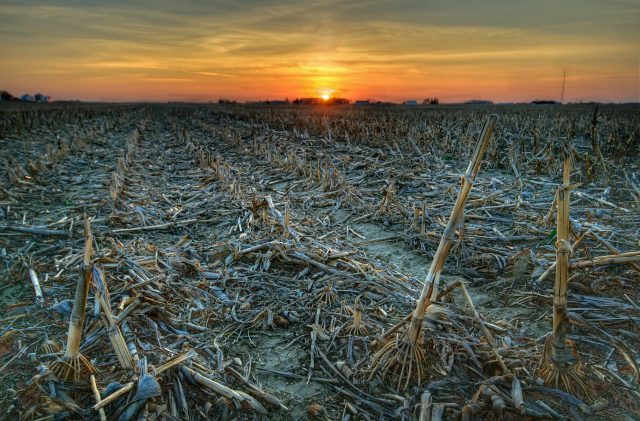
Last winter, I was in the sub-basement of the library at the University of Minnesota, with two state maps stretching 10 feet across spread out on the table in front of me. One was from the 1990s, the other a century older. Growing up on the Wisconsin border, the Minnesota I knew was nothing but farm fields growing food, interrupted only by the Twin Cities and their suburbs. But the map from the state’s early years showed a different landscape. Back then, carbon-storing forests covered most of Minnesota.
Today it’s mostly cornfields with ethanol fuel plants sprouted in between. Farmers used to grow corn and other crops to sell as food for families and livestock, but in the last decade, selling it for ethanol has become too lucrative to refuse. In 2013, thanks largely to surging demand from ethanol plants, U.S. farmers snagged an average of $6.15 per bushel of corn — up from $1.96 in 2005.
The federal government has encouraged ethanol use since 1992, but it really took off as an alternative to gasoline in 2005, spurred by the fines and mandates of the newly adopted Renewable Fuels Standard. The current version of the standard requires 36 billion gallons of renewable fuels to be blended with gasoline by 2022, which the U.S. Environmental Protection Agency predicts will be about 7 percent of the total fuel use.
Though these policies were well intended at the time, research now shows that the land we’re using to grow plants for biofuels would be better used for crops to feed hundreds of millions of undernourished people around the world. The World Resources Institute, a non-partisan environmental policy group, released a report in January calling for an end to biofuel production. Its argument is that we can no longer spare agricultural land for fuel crops that don’t produce enough energy to justify the investment. Government subsidies aimed at propping up the ethanol industry to make it competitive with gasoline cost more than $20 billion, mostly in the form of federal tax cuts. But it still wasn’t enough to make the renewable fuel worth it.
From the time the seeds are planted to the time it burns out of your exhaust pipe, ethanol only converts 0.15 percent of the sun’s radiation into energy. Next generation solar panels, on the other hand, can convert 16 percent of solar radiation into electricity, according to the institute’s report.
The fact that ethanol isn’t worth it highlights other options we already have. The best thing about harnessing energy directly from the sun is that we can put solar panels on land that can’t be used for agriculture — in deserts and on top of buildings, for example. And wind turbines can turn in between fields of crops, as they already do in southwestern Minnesota and many other rural areas. We could even confine biofuel crops like switchgrass to roadsides, or backyards. If people are going to insist on staying in the energy-profligate suburbs, we could at least make their valuable land worth something instead of wasting it on the great American lawn.
A few decades from now, I imagine filling our world with carbon storing and energy generating opportunities in every crevice, like a patchwork quilt of sustainability. In this world, we’ll cover as much of the land with forests and natural habitat as we can. After that, we’ll use the rest of the space for agriculture, which by then will be even more efficient than it is now (and mostly hydroponic, I hope). Then, we’ll tuck ourselves into densely packed, energy efficient cities. Dutifully organizing our land is the best way to protect it, and ourselves in the process. But we have to make these plans now before we ruin the earth with foolish policies.
By 2050, the world population may grow from its current 7.2 billion to 9.5 billion. To keep up, according to the World Resources Institute, we will have to increase crop calories by 70 percent from 2006 levels. That’s a very technical way of putting it, but the way I see it is this: 805 million people go hungry today. If we can’t feed everyone now, how are we going to do it with 2 billion more people at the table? We need land for food, and farmers are willing to cultivate it for us.
When I reported on agriculture stories in Minnesota, the farmers I talked to felt pressured into growing crops for biofuels. They wanted to grow food as their families always had, they told me, but the heavily subsidized prices they were getting from ethanol producers were just too good to resist. Let’s stop promoting biofuels as the solution to our energy future, and use that land to grow food instead
5 Comments on "We need food, not ethanol"
dave thompson on Wed, 4th Mar 2015 8:08 pm
“A few decades from now, I imagine filling our world with carbon storing and energy generating opportunities in every crevice, like a patchwork quilt of sustainability.” This person is certainly optimistic.
Go Speed Racer. on Wed, 4th Mar 2015 8:58 pm
I often wondered if all the lawn clippings and yard waste could be converted to fuels. Dont know. Author forgot to mention, solar is good for toxic poisoned land. Put the solar panels on top of the atomic dump.
Davy on Wed, 4th Mar 2015 10:06 pm
I am sorry Rebecca (article author) but you are perpetuating your lack of knowledge and broad understanding of what is ahead. First thing is the inaccurate statement that the surge in corn was largely from ethanol production. It was from a drought in the Midwest and frothy commodity prices from QE related financial distortions in 2013.
I am dismayed that so many people are malnourished and suffering but there are no easy trade-offs between hunger and food production. We are talking global economic relationships. These relationships are financial with economics underlying the production of food and the distribution. Farming is a high capital cost business with great risk. The poor can afford the food we produce today and there are multiple economic and social reasons for this. There is no silver bullet like stopping ethanol. Ethanol is not economic it is an economic tool to achieve a goal of raising corn prices and diversifying liquid fuel supply mainly for dubious air quality blending practices.
Rebecca again shows a lack of understanding of biofuels when mentioning cellulosic ethanol from switch grass. This alternative to corn based ethanol has not proven economic and probably never will especially how Rebecca mentioned the supply coming from dispersed settings like roadsides and backyards. Ethanol is all about not moving product far which is little different than farming in general. Your best price for your crop comes from moving it the shortest distance. Transport always kills crop prices whether it is for food or ethanol.
Rebeca then goes on to preach the greenie vision of a shiny, ecologically healthy, and technologically advanced society that has moved away from dirty fossil fuels. She preaches we will be doing that by storing carbon, living efficiently in densely packed cities, and run by AltE. She also mentioning hydroponics like that is an energy efficient activity. Folks this is what I am saying when I criticize the greenies. It is this unreality of limits and diminishing returns of technology and complexity. These folks are mesmerized by BAU and they paint it green so it has justification. We can have it all if only we would turn away from the brown and embrace green.
I do like her last point and that is how are we going to feed those 2 more billion projected by the academic goal seeking wonks by 2050? Well there will likely not be 2 more billion Rebecca. We will be lucky to see another 500MIL then the likely 200MIL a year excess deaths begin and lasting a generation. This as BAU unravels and the dense cities you mention Rebecca depopulate.
Population is out of control and that is an issues. Ethanol is an issues of consumption overshoot. Population is in its own overshoot. Then you have global economics that must localize and move away from monocultures because of the coming end of globalism. What I just said is a predicament that has no happy ending. Not producing ethanol is not going to solve those problems.
GregT on Wed, 4th Mar 2015 10:31 pm
Great post Davy!
Kenz300 on Wed, 4th Mar 2015 11:09 pm
Percentage of US corn kernels, by weight, processed into fuel ethanol: 13
Percentage of all food everywhere, that ends up in the garbage pail: 33