



When we started working on producing water from atmospheric humidity, myself and my friend and colleague Toufic El Asmar thought it was a mad idea. Energy is expensive and water condensation requires a lot of it. Yet, as we kept working on the concept, we found that it made sense. Sure, it takes energy, but, with the progress of technology, renewable energy is becoming cheaper and cheaper. And at some moments, renewable energy really costs zero. At those moments, you should store it, but storage is the expensive part of renewable power. So, why not transform solar energy into something that you can store at little or no cost, for instance clean, drinkable water? After all, water is fast becoming a scarce commodity in many regions of the world.
So, the idea was born of a “solar water machine” which uses electric energy from photovoltaic panels to drive a water condenser which collects humidity from the air. The water is then filtered and made drinkable by adding a small amount of natural salts. The machine is more complex than this; it also collects rainfall and it can clean and purify water from almost any source, producing up to two hundred liters of pure water per day. Its solar panels make it completely self-sufficient: you may place it anywhere; it doesn’t need to be connected to the grid (although it may be). So, it is good for remote places, for emergency situations, and for a variety of needs. Here is the “Acqua dal Sole” system, the day of its official presentation in Capannori, Italy. The people involved in the project are lined up in front of the machine (including yours truly).

Now that I told you the essential, let me tell you some more details about this idea. It all started some years ago, when myself and Toufic El Asmar prepared a project about using solar collectors to produce air conditioning for North African and Mid-Eastern Countries. The idea was that these countries enjoy a high solar insulation, which could be collected using parabolic mirrors to heat up an absorption air conditioning system. The project was approved by the European Commission with the name of “REACT” and it led to the manufacturing of two prototypes, one in Morocco, the other in Jordan.
As time went by, however, the rapid fall of the price of photovoltaic panels made parabolic solar collectors obsolete. But while working on the React project, we noticed how solar refrigeration could produce a lot of water by condensation from the air. That led us to study the subject more in detail and the European Commission sponsored a project called “Aqua Solis“. Our idea was to study an approach completely different than the large scale desalination plants which are commonly used nowadays to produce water for dry countries. The idea was to develop “village scale” systems; improved versions of the old “solar still” idea. Cheap, simple, and with no need of the expensive pipeline systems needed for the conventional desalination plants. The basic idea was to create versatile systems which could use photovoltaic energy for water production, but also for any use needed at a particular moment
We are looking at practical applications and markets for this device. Of course, that depends on the cost but, as the prices of PV keep falling, it is likely that water from the air could be a revolution in the way water is produced in the world, especially in areas where it is badly needed. And also on the way renewable energy is stored.
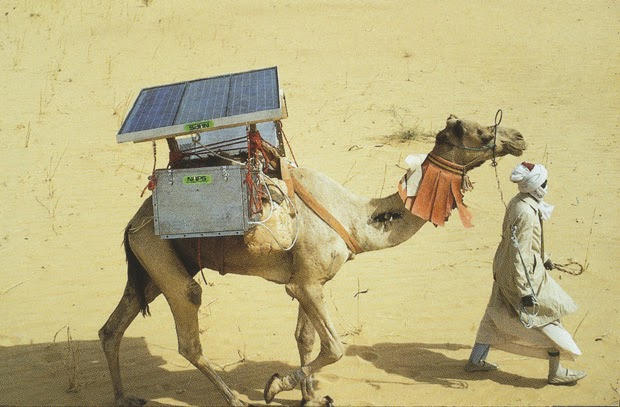
Once you have seen the “photovoltaic camel” you can understand how fast the range of applications of PV panels is growing. Photovoltaics is an emergent technology which has the possibility of reshaping the world in ways which, at present, we can’t even imagine.
Acknowledgement: the people who worked on the “Acqua dal Sole” project
Ugo Bardi (University of Florence)
Eugenio Baronti (Zefiro s.r.l.)
Lorenzo Cardarella (Sinapsi s.r.l.)
Toufic El Asmar (Food and Agriculture Organization, FAO)
Filippo Niccolai (Sinerlab s.r.l.)
Francesco Niccolai (Sinerlab s.r.l.)
Michele Tosti (Sinapsi s.r.l.)
J-Gav on Mon, 23rd Jun 2014 4:09 pm
There’s an edgy side to Ugo which I’ve always liked – the “Seneca Effect” etc.
Then there’s this techno-fix side to him (remember he very nearly fell for Andrea Rossi’s cold-fusion E-Cat scam).
Photovoltaic camels to the rescue? Good Lord, Ugo, take some time out! A quiet vacation in the Bahamas or something to think things over …
J-Gav on Mon, 23rd Jun 2014 4:13 pm
I mean, this is the same guy who recently published a report about how mining is depleting world resources at a completely unsustainable rate – so where are the materials to come from to build out this camel-revolution? Bardi seems like a nice fellow, but somehow conflicted over what he knows and what he would ideally prefer …
Davey on Mon, 23rd Jun 2014 4:29 pm
Gav, give him a break he is Italian.
BC on Mon, 23rd Jun 2014 7:08 pm
I enjoyed the article and think some of these set up in barren, unforgiving locations makes sense.Well done Ugo.
Roman on Mon, 23rd Jun 2014 7:47 pm
It’s called an air well. It’s an ancient technology.
Makati1 on Mon, 23rd Jun 2014 10:44 pm
No mention of efficiency. cost per gallon of water produced, etc. Another techie start-up wanting suckers to waste … or … invest money in their dreams.
Saudi desert humidity is high and averages about 80% along the coasts and less inland. Maybe cost efficient here.
Sahara desert humidity is in the low teens. Again, a high energy use area for this product. Maybe two camels to carry the panels? LOL
Arizona desert humidity is in the 10% to 15% range. Sorry Guy! You need a lot of panels.
Makati1 on Mon, 23rd Jun 2014 10:45 pm
By the way, they used ‘wind traps’ in the Dune series to collect water. That method should work well also, but is not portable.
Juan Pueblo on Tue, 24th Jun 2014 10:04 am
There are a few residential off the shelf models of water condensers available for sale. Just plug in and drink, totally self contained. They are expensive, but reliable and useful in some extreme desert environments and such. There are bigger units, too. The military uses some of them. The tech is less energy efficient than desalination.
I have been reading Ugo’s post and usually enjoy them.
Kenz300 on Tue, 24th Jun 2014 12:22 pm
Quote — “Sure, it takes energy, but, with the progress of technology, renewable energy is becoming cheaper and cheaper. And at some moments, renewable energy really costs zero.”
——————————–
Solar Industry Uniquely Poised to Help Fight Climate Change
http://www.renewableenergyworld.com/rea/blog/post/2014/05/solar-industry-uniquely-poised-to-help-fight-climate-change
J-Gav on Tue, 24th Jun 2014 1:18 pm
BC – I agree that “some of these” would be fine and much appreciated by the recipients. By all means, let’s do that to the extent possible. But that “extent” will not make more than a tiny dent in the overall energy/water/electricity picture due to financial and resource constraints IMHO.