



The “Wind and Solar Will Save Us” story is based on a long list of misunderstandings and apples to oranges comparisons. Somehow, people seem to believe that our economy of 7.5 billion people can get along with a very short list of energy supplies. This short list will not include fossil fuels. Some would exclude nuclear, as well. Without these energy types, we find ourselves with a short list of types of energy — what BP calls Hydroelectric, Geobiomass (geothermal, wood, wood waste, and other miscellaneous types; also liquid fuels from plants), Wind, and Solar.
Unfortunately, a transition to such a short list of fuels can’t really work. These are a few of the problems we encounter:
[1] Wind and solar are making extremely slow progress in helping the world move away from fossil fuel dependence.
In 2015, fossil fuels accounted for 86% of the world’s energy consumption, and nuclear added another 4%, based on data from BP Statistical Review of World Energy. Thus, the world’s “preferred fuels” made up only 10% of the total. Wind and solar together accounted for a little less than 2% of world energy consumption.

Figure 1. World energy consumption based on data from BP 2016 Statistical Review of World Energy.
Our progress in getting away from fossil fuels has not been very fast, either. Going back to 1985, fossil fuels made up 89% of the total, and wind and solar were both insignificant. As indicated above, fossil fuels today comprise 86% of total energy consumption. Thus, in 30 years, we have managed to reduce fossil fuel consumption by 3% (=89% – 86%). Growth in wind and solar contributed 2% of this 3% reduction. At the rate of a 3% reduction every 30 years (or 1% reduction every ten years), it will take 860 years, or until the year 2877 to completely eliminate the use of fossil fuels. And the “improvement” made to date was made with huge subsidies for wind and solar.
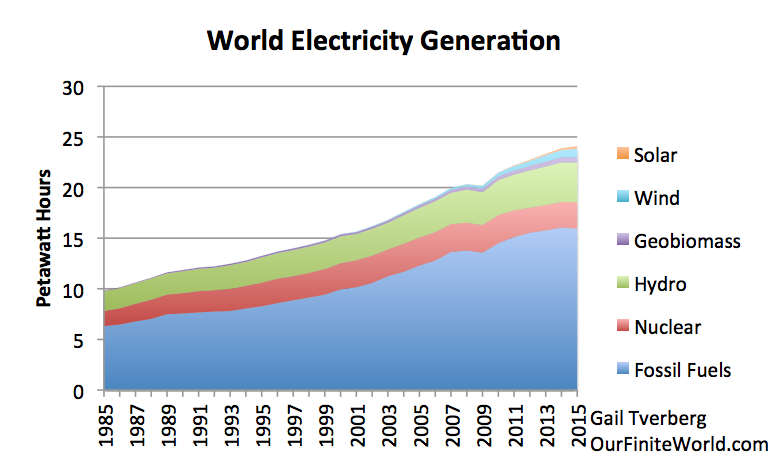
Figure 2. World electricity generation by source based on BP 2016 Statistical Review of World Energy.
The situation is a little less bad when looking at the electricity portion alone (Figure 2). In this case, wind amounts to 3.5% of electricity generated in 2015, and solar amounts to 1.1%, making a total of 4.6%. Fossil fuels account for “only” 66% of the total, so this portion seems to be the place where changes can be made. But replacing all fossil fuels, or all fossil fuels plus nuclear, with preferred fuels seems impossible.
[2] Grid electricity is probably the least sustainable form of energy we have.
If we are to transition to a renewables-based economy, we will need to transition to an electricity-based economy, since most of today’s renewables use electricity. Such an economy will need to depend on the electric grid.
The US electric grid is often called the “World’s Largest Machine.” The American Society of Civil Engineers gives a grade of D+ to America’s energy system. It says,
America relies on an aging electrical grid and pipeline distribution systems, some of which originated in the 1880s. Investment in power transmission has increased since 2005, but ongoing permitting issues, weather events, and limited maintenance have contributed to an increasing number of failures and power interruptions.
Simply maintaining the electric grid is difficult. One author writes about the challenges of replacing aging steel structures holding up power lines. Another writes about the need to replace transformers, before they fail catastrophically and interrupt services. The technology to maintain and repair the transmission lines demands that fossil fuels remain available. For one thing, helicopters are sometimes needed to install or repair transmission lines. Even if repairs are done by truck, oil products are needed to operate the trucks, and to keep the roads in good repair.
Electricity and, in fact, electricity dispensed by an electric grid, is in some sense the high point in our ability to create an energy product that “does more” than fossil fuels. Grid electricity allows electric machines of all types to work. It allows industrial users to create very high temperatures, and to hold them as needed. It allows computerization of processes. It is not surprising that people who are concerned about energy consumption in the future would want to keep heading in the same direction as we have been heading in the past. Unfortunately, this is the expensive, hard-to-maintain direction. Storms often cause electrical outages. We have a never-ending battle trying to keep the system operating.
[3] Our big need for energy is in the winter, when the sun doesn’t shine as much, and we can’t count on the wind blowing.
Clearly, we use a lot of electricity for air conditioning. It is difficult to imagine that air conditioning will be a major energy use for the long-term, however, if we are headed for an energy bottleneck. There is always the possibility of using fans instead, and living with higher indoor temperatures.
In parts of the world where it gets cold, it seems likely that a large share of future energy use will be to heat homes and businesses in winter. To illustrate the kind of seasonality that can result from the use of fuels for heating, Figure 3 shows a chart of US natural gas consumption by month. US natural gas is used for some (but not all) home heating. Natural gas is also used for electricity and industrial uses.

Figure 3. US natural gas consumption by month, based on US Energy Information Administration.
Clearly, natural gas consumption shows great variability, with peaks in usage during the winter. The challenge is to provide electrical supply that varies in a similar fashion, without using a lot of fossil fuels.
[4] If a family burns coal or natural gas directly for winter heat, but then switches to electric heat that is produced using the same fuel, the cost is likely to be higher. If there is a second change to a higher-cost type of electricity, the cost of heat will be even greater.
There is a loss of energy when fossil fuels or biomass are burned and transformed into electricity. BP tries to correct for this in its data, by showing the amount of fuel that would need to be burned to produce this amount of electricity, assuming a conversion efficiency of 38%. Thus, the energy amounts shown by BP for nuclear, hydro, wind and solar don’t represent the amount of heat that they could make, if used to heat apartments or to cook food. Instead, they reflect an amount 2.6 times as much (=1/38%), which is the amount of fossil fuels that would need to be burned in order to produce this electricity.
As a result, if a household changes from heat based on burning coal directly, to heat from coal-based electricity, the change tends to be very expensive. The Wall Street Journal reports, Beijing’s Plan for Cleaner Heat Leaves Villagers Cold:
Despite electricity subsidies for residential consumers, villagers interviewed about their state-supplied heaters said their overall costs had risen substantially. Several said it costs around $300 to heat their homes for the winter, compared with about $200 with coal.
The underlying problem is that burning coal in a power plant produces a better, but more expensive, product. If this electricity is used for a process that coal cannot perform directly, such as allowing a new automobile production plant, then this higher cost is easily absorbed by the economy. But if this higher-cost product simply provides a previously available service (heating) in a more expensive manner, it becomes a difficult cost for the economy to “digest.” It becomes a very expensive fix for China’s smog problem. It should be noted that this change works in the wrong direction from a CO2 perspective, because ultimately, more coal must be burned for heating because of the inefficiency of converting coal to electricity, and then using that electricity for heating.
How about later substituting wind electricity for coal-based electricity? China has a large number of wind turbines in the north of China standing idle. One problem is the high cost of erecting transmission lines that would transport this electricity to urban centers such as Beijing. Also, if these wind turbines were put in place, existing coal plants would operate fewer hours, causing financial difficulties for these coal generating units. If these companies need subsidies in order to continue paying their ongoing expenses (including payroll and debt repayment), this would create a second additional cost. Electricity prices would need to be higher, to cover these costs as well. A family who had difficulty affording heat with coal-based electricity would have an even greater problem affording wind-based electricity.
Heat for cooking and heat for creating hot water are similar to heat for keeping an apartment warm. It is less expensive (both in energy terms and in cost to the consumer) if coal or natural gas is burned directly to produce the heat, than if electricity is used instead. This again, has to do with the conversion efficiency of turning fossil fuels to electricity.
[5] Low energy prices for the consumer are very important. Unfortunately, many analyses of the benefit of wind or of solar give a misleading impression of their true cost, when added to the electric grid.
How should the cost of wind and solar be valued? It is simply the cost of installing the wind turbines or solar panels? Or does it include the all of the additional costs that an electricity delivery system must incur, if it is actually to incorporate this intermittent electricity into the electric grid system, and deliver it to customers where it is needed?
The standard answer, probably because it is easiest to compute, is that the cost is simply the cost (or energy cost) of the wind turbines or the solar panels themselves, plus perhaps an inverter. On this basis, wind and solar appear to be quite inexpensive. Many people have come to the conclusion that a transition to wind and solar might be helpful, based on this type of limited analysis.
Unfortunately, the situation is more complicated. Perhaps, the first few wind turbines and solar panels will not disturb the existing electrical grid system very much. But as more and more wind turbines or solar panels are added, there get to be additional costs. These include long distance transmission, electricity storage, and subsidies needed to keep backup electricity-generation in operation. When these costs are included, the actual total installed cost of delivering electricity gets to be far higher than the cost of the solar panels or wind turbines alone would suggest.
Energy researchers talk about the evaluation problem as being a “boundary issue.” What costs really need to be considered, when a decision is made as to whether it makes sense to add wind turbines or solar panels? Several other researchers and I feel that much broader boundaries are needed than are currently being used in most published analyses. We are making plans to write an academic article, explaining that current Energy Return on Energy Invested (EROEI) calculations cannot really be compared to fossil fuel EROEIs, because of boundary issues. Instead, “Point of Use” EROEIs are needed. For wind and solar, Point of Use EROEIs will vary with the particular application, depending on the extent of the changes required to accommodate wind or solar electricity. In general, they are likely to be far lower than currently published wind and solar EROEIs. In fact, for some applications, they may be less than 1:1.
A related topic is return on human labor. Return on human labor is equivalent to how much a typical worker can afford to buy with his wages. In [4], we saw a situation where the cost of heating a home seems to increase, as a transition is made from (a) burning coal for direct use in heating, to (b) using electricity created by burning coal, to (c) using electricity created by wind turbines. This pattern is eroding the buying power of workers. This direction ultimately leads to collapse; it is not the direction that an economy would generally intentionally follow. If wind and solar are truly to be helpful, they need to be inexpensive enough that they allow workers to buy more, rather than less, with their wages.
[6] If we want heat in the winter, and we are trying to use solar and wind, we need to somehow figure out a way to store electricity from summer to winter. Otherwise, we need to operate a double system at high cost.
Energy storage for electricity is often discussed, but this is generally with the idea of storing relatively small amounts of electricity, for relatively short periods, such as a few hours or few days. If our real need is to store electricity from summer to winter, this will not be nearly long enough.
In theory, it would be possible to greatly overbuild the wind and solar system relative to summer electricity needs, and then build a huge amount of batteries in order to store electricity created during the summer for use in the winter. This approach would no doubt be very expensive. There would likely be considerable energy loss in the stored batteries, besides the cost of the batteries themselves. We would also run the risk of exhausting resources needed for solar panels, wind turbines, and/or batteries.
A much more workable approach would be to burn fossil fuels for heat during the winter, because they can easily be stored. Biomass, such as wood, can also be stored until needed. But it is hard to find enough biomass for the whole world to burn for heating homes and for cooking, without cutting down an excessively large share of the world’s trees. This is a major reason why moving away from fossil fuels is likely to be very difficult.
[7] There are a few countries that use an unusually large share of electricity in their energy mixes today. These countries seem to be special cases that would be hard for other countries to emulate.
Data from BP Statistical Review of World Energy indicates that the following countries have the highest proportion of electricity in their energy mixes.
- Sweden – 72.7%
- Norway – 69.5%
- Finland – 59.9%
- Switzerland – 57.5%
These are all countries that have low population and a significant hydroelectric supply. I would expect that the hydroelectric power is very inexpensive to produce, especially if the dams were built years ago, and are now fully paid for. Sweden, Finland, and Switzerland also have electricity from nuclear providing about a third of each of their electricity supplies. This nuclear electricity was built long ago, and thus is now paid for as well. The geography of countries may also reduce the use of traffic by cars, thus reducing the portion of gasoline in their energy mixes. It would be difficult for other countries to create equivalently inexpensive large supplies of electricity.
In general, rich countries have higher electricity shares than poorer countries:
- OECD Total – (Rich countries) – 2015 – 44.5%
- Non- OECD (Less rich countries) – 2015 – 39.3%
China is an interesting example. Its share of energy use from electricity changed as follows from 1985 to 2015:
- China – 1985 – 17.5%
- China – 2015 – 43.6%
In 1985, China seems to have used most of its coal directly, rather than converting it for use as electricity. This was likely not difficult to do, because coal is easy to transport, and it can be used for many heating needs simply by burning it. Later, industrialization allowed for much more use of electricity. This explains the rise in its electricity ratio to 43.6% in 2015, which is almost as high as the rich country ratio of 44.5%. If the electricity ratio rises further, it will likely be because electricity is being put to use in ways where it has less of a cost advantage, or even has a cost disadvantage, such as for heating and cooking.
[8] Hydroelectric power is great for balancing wind and solar, but it is available in limited quantities. It too has intermittency problems, limiting how much it can be counted on.
If we look at month-to-month hydroelectric generation in the US, we see that it too has intermittency problems. Its high month is May or June, when snow melts and sends hydroelectric output higher. It tends to be low in the fall and winter, so is not very helpful for filling the large gap in needed electricity in the winter.

Figure 4. US hydroelectric power by month, based on data of the US Energy Information Administration.
It also has a problem with not being very large relative to our energy needs. Figure 5 shows how US hydro, or the combination of hydro plus solar plus wind (hydro+S+W), matches up with current natural gas consumption.

Figure 5. US consumption of natural gas compared to hydroelectric power and compared to hydro plus wind plus solar (hydro+W+S), based on US Energy Information Administration data.
Of course, the electricity amounts (hydro and hydro+S+W) are “grossed up” amounts, showing how much fossil fuel energy would be required to make those quantities of electricity. If we want to use the electricity for heating homes and offices, or for cooking, then we should compare the heat energy of natural gas with that of hydro and hydro+S+W. In that case, the hydro and hydro+S+W amounts would be lower, amounting to only 38% of the amounts shown.
This example shows how limited our consumption of hydro, solar, and wind is compared to our current consumption of natural gas. If we also want to replace oil and coal, we have an even bigger problem.
[9] If we need to get along without fossil fuels for electricity generation, we would have to depend greatly on hydroelectric power. Hydro tends to have considerable variability from year to year, making it hard to depend on.
Nature varies not just a little, but a lot, from year to year. Hydro looks like a big stable piece of the total in Figures 1 and 2 that might be used for balancing wind and solar’s intermittency, but when a person looks at the year by year data, it is clear that the hydro amounts are quite variable at the country level.

Figure 6. Electricity generated by hydroelectric for six large European countries based on BP 2016 Statistical Review of World Energy.
In fact, hydroelectric power is even variable for larger groupings, such as the six countries in Figure 6 combined, and some larger countries with higher total hydroelectric generation.

Figure 7. Hydroelectricity generated by some larger countries, and by the six European countries in Figure 6 combined, based on BP 2016 Statistical Review of World Energy.
What we learn from Figures 6 and 7 is that even if a great deal of long distance transmission is used, hydro will be variable from year to year. In fact, the variability will be greater than shown on these charts, because the quantity of hydro available tends to be highest in the spring, and is often much lower during the rest of the year. (See Figure 4 for US hydro.) So, if a country wants to depend on hydro as its primary source of electricity, that country must set its expectations quite low in terms of what it can really count on.
And, of course, Saudi Arabia and several other Middle Eastern countries don’t have any hydroelectric power at all. Middle Eastern countries tend not to have biomass, either. So if these countries choose to use wind and solar to assist in electrical generation, and want to balance their intermittency with something else, they pretty much need to use something that is locally available, such as natural gas. Other countries with very low amounts of hydro (or none at all) include Algeria, Australia, Bangladesh, Denmark, Netherlands, and South Africa.
These issues provide further reasons why countries will want to continue using fossil fuels, and perhaps nuclear, if they can.
[10] There has been a misunderstanding regarding the nature of our energy problem. Many people believe that we will “run out” of fossil fuels, or that the price of oil and other fuels will rise very high. In fact, our problem seems to be one of affordability: energy prices don’t rise high enough to cover the rising cost of producing electricity and other energy products. Adding wind and solar tends to make the problem of low commodity prices worse.
Ultimately, consumers can purchase only what their wages will allow them to purchase. Rising debt can help as well, for a while, but this has limits. As a result, lack of wage growth translates to a lack of growth in commodity prices, even if the cost of producing these commodities is rising. This is the opposite of what most people expect; most people have never considered the possibility that peak energy will come from low prices for all types of energy products, including uranium. Thus, we seem to be facing peak energy demand (represented as low prices), arising from a lack of affordability.
We can see the problem in the example of the Beijing family with a rising cost of heating its apartment. Economists would like to think that rising costs translate to rising wages, but this is not the case. If rising costs are the result of diminishing returns (for example, coal is from deeper, thinner coal seams), the impact is similar to growing inefficiency. The inefficient sector needs more workers and more resources, leaving fewer resources and workers for other more efficient sectors. The result is an economy that tends to contract because of growing inefficiency.
If we want to operate a double system, using wind and solar when it is available, and using fossil fuels at other times, the cost will be very high. The problem arises because the fossil fuel system has many fixed costs. For example, coal mines and natural gas companies need to continue to pay interest on their loans, or they will default. Pipelines need to operate 365 days per year, regardless of whether they are actually full. The question is how to get enough funding for this double system.
One pricing system for electricity that doesn’t work well is the “market pricing system” based on each producer’s marginal costs of production. Wind and solar are subsidized, so they tend to have negative marginal costs of production. It is impossible for any other type of electricity producer to compete in this system. It is well known that this system does not produce enough revenue to maintain the whole system.
Sometimes, additional “capacity payments” are auctioned off, to try to fix the problem of inadequate total wholesale electricity prices. If we believe the World Nuclear Organization, even these charges are not enough. Several US nuclear power plants are scheduled for closing, indirectly because this pricing methodology is making older nuclear power plants unprofitable. Natural gas prices have also been too low for producers in recent years. This electricity pricing methodology is one of the reasons for this problem as well, in my opinion.
A different pricing system that works much better in our current situation is the utility pricing system, or “cost plus” pricing. In this system, prices are determined by regulators, based on a review of all necessary costs, including appropriate profit margins for producers. In the case of a double system, it allows prices to be high enough to cover all the needed costs, including the extra long distance transmission lines, plus all of the high fixed costs of fossil fuel and nuclear power plants, operating for fewer hours per year.
Of course, these much higher electricity rates eventually will become unaffordable for the consumer, leading to a cutback in purchases. If enough of these cutbacks in purchases occur, the result will be recession. But at least the electricity system doesn’t fail at an early date because of inadequate profits for its producers.
Conclusion
The possibility of making a transition to an all-renewables system seems virtually impossible, for the reasons I have outlined above. I have outlined many other issues in previous posts:
- Intermittent Renewables Can’t Favorably Transform Grid Electricity
- Ten Reasons Intermittent Renewables (Wind and Solar PV) are a Problem
- EROEI Calculations for Solar PV Are Misleading
- Obstacles Facing US Wind Energy
- Eight Pitfalls in Evaluating Green Energy Solutions
- Eight Energy Myths Explained
- Scientific American’s Path to Sustainability: Let’s Think about the Details
- The real oil limits story; what other researchers missed
The topic doesn’t seem to go away, because it is appealing to have a “solution” to what seems to be a predicament with no solution. In a way, wind and solar are like a high-cost placebo. If we give these to the economy, at least people will think we are treating the problem, and maybe our climate problem will get a little better.
Meanwhile, we find more and more real life problems with intermittent renewables. Australia has had a series of blackouts. A several-hour blackout in South Australia was tied partly to the high level of intermittent energy on the grid. The ways of reducing future recurrences appear to be very expensive.
Antonio Turiel has written about the problems that Spain is encountering. Spain added large amounts of wind and solar, but these have not been available during a recent cold spell. It added gas by pipeline from Algeria, but now Algeria has cut back on the amount it is supplying. It has added transmission lines north to France. Now, Turiel is concerned that Spain’s electricity prices will be persistently higher, because he believes that France has not taken sufficient preparations to meet its own electricity needs. If there were little interconnectivity between countries, France’s electricity problems would stay in France, rather than adversely affecting its neighbors. A person begins to wonder: Can transmission lines have an adverse impact on new electricity supply? If a country can hope that “the market” will supply electricity from elsewhere, does that country take adequate steps to provide its own electricity?
In my opinion, the time has come to move away from believing that everything that is called “renewable” is helpful to the system. We now have real information on how expensive wind and solar are, when indirect costs are included. Unfortunately, in the real world, high-cost is ultimately a deal killer, because wages don’t rise at the same time. We need to understand where we really are, not live in a fairy tale world produced by politicians who would like us to believe that the situation is under control.
penury on Tue, 31st Jan 2017 3:35 pm
The time has come to move from hope and dreams into reality. If you were to take the U.S. as a surrogate for the world it becomes apparent that there is no money to change the system, there is no source of energy to replace fossil fuels, and apparently governments do not want the people to understand, our infra-structure is failing, Our easy life of 1000 slaves is coming to an end, It will be a different life style shortly. (relative term)
Cloggie on Tue, 31st Jan 2017 4:28 pm
Maybe Gail would care to study the example of Denmark for a while before she disses renewable energy.
https://www.theguardian.com/environment/2016/jan/18/denmark-broke-world-record-for-wind-power-in-2015
Wind energy is meanwhile the cheapest energy:
https://www.theguardian.com/environment/2014/oct/13/wind-power-is-cheapest-energy-unpublished-eu-analysis-finds
Denmark is still one of the wealthiest country.
Please Gail, go back to accounting. One Heinberg layperson is more than enough.
makati1 on Tue, 31st Jan 2017 4:44 pm
Cloggie, buy a clue…or a brain. When Denmark is TOTALLY independent, meaning it needs ZERO imports to survive, THEN you can brag.
I would not want to live there when the Gulf Stream drops farther south or quits altogether. A definite possibility if Greenland keeps increasing the non-salty water flow into the Atlantic.
Of course, you could not pay me to live there even today. Europe is dying. It has nothing left to brag about. It is reverting to a bunch of tribal groups and going back to warring for a hobby. Be patient.
BTW: http://www.tradingeconomics.com/denmark/imports
“Denmark imports mainly machinery* (22 percent of total imports), live animals, food, beverages and tobacco (14 percent), chemicals and related products (13 percent) and transport equipment** (11 percent).
Main import partners are: Germany (21 percent of total exports), Sweden (12 percent), the Netherlands and China (8 percent each), and Norway and the UK (5 percent each). This page was last updated on January of 2017.”
*Machinery? Could that be windmill parts?
** Transport equipment: Could that be those huge cranes for installing windmills? LMAO
makati1 on Tue, 31st Jan 2017 4:46 pm
“wind and solar are like a high-cost placebo. If we give these to the economy, at least people will think we are treating the problem,”
BINGO!!!
penury on Tue, 31st Jan 2017 5:05 pm
Cloggie, studying Denmark would be interesting however, to compare the effort needed for Denmark as opposed to say California is not realistic. Perhaps if San Francisco did it maybe close but not quite the same. Area and population has some effect on cost and time.
makati1 on Tue, 31st Jan 2017 5:15 pm
Penury, I think you are trying to educate someone who doesn’t want to be educated. He is probably scared shitless with what is happening all around him and is in denial. He brags about the few seeming pluses and ignores the other end of the scales because they are too frightening and he is impotent to change them.
Cloggie on Tue, 31st Jan 2017 5:23 pm
California has a lot of desert with (thus) a lot of sunshine.
California: 96/km2, days with sun 290
Denmark: 133/km2
Cloggie on Tue, 31st Jan 2017 5:24 pm
Penury, I think you are trying to educate someone who doesn’t want to be educated.
The only vision you have on offer is roll over and die.
Davy on Tue, 31st Jan 2017 5:47 pm
makati, Clog is more rational than you are and has some valid points that are useful. All you do is diss with lame references on how many EBT cards are in America. Who cares makati it gets redundant and boring. We are likely going to see an energy transformation but unfortunately probably no energy transition. Clog is keeping us up to date on what is happening in this exciting field. Too bad Clog is lost in a techno fantasy but at least he is pleasant unlike you and your boyfriend.
rockman on Tue, 31st Jan 2017 7:18 pm
Cloggie – “Maybe Gail would care to study the example of Denmark for a while before she disses renewable energy.” And to expand on that point: the article does do a good job of explaining what truly looks like an impossible goal: the planet transioning to renewables. And not just to 100% but even to a much smaller but significant level.
But there is good news in this analysis: no one really thinks the entire planet going big time renewables is very important. Oh yeah, lots of lip service by some. But folks are primarily concerned just about their little part of the world.
And that applies not just to energy…it’s true across the board. Be it medical services, housing, food, true democracy, fresh water, etc: there is no possibility for the ENTURE WORLD to fully transition to such happy places. So why should anyone be surprised that there’s no chance for the ENTIRE WORLD to transition to renewables to a significant degree. IMHO I don’t understand why so much time was spent in this article arguing the obvious.
And since the Rockman is being brutally blunt let’s go all in: I don’t really care if CA or KY transitions to renewables to a significant degree. There are 2 levels of interest as I see it: personal and regional. We have cohorts here that have reduced their PERSONAL fossil fuel footprint that no US state (let alone the ENTIRE WORLD) has any chance of achieving.
And the Rockman interest in the transition to renewables is pretty much restricted to a REGION…Texas. Pretty much the way folks in CA aren’t really interested in the transition in Texas or any other state…or Kenya for that matter. Not trying to be flip but nothing going on with renewables outside one’s sphere of influence has much impact on that person.
So to repeat: the ENTIRE WORLD cannot transition to renewables to any significant degree. And I’m sure folks have heard more then enough about the transition effort in Texas…and probably CA…and maybe even Denmark (sorry Cloggie). So let’s here what is or isn’t happening in your state. The only national transition to renewables will happen via the cumulative effect of what happens in multiple states/regions.
And yes: framing such matters in generalities is easy. Hitting the more important details is a lot more work. Imagine how much more effort this article would have required if it had dug into each of the 50 states and not just the ENTIRE WORLD. LOL.
Survivalist on Tue, 31st Jan 2017 10:08 pm
http://energyskeptic.com/2017/tilting-at-windmills-spains-disastrous-attempt-to-replace-fossil-fuels-with-solar-pv-part-2/
Simon on Wed, 1st Feb 2017 1:08 am
Mak. the news you get about the collapse of the EU is …. little exaggerated.
The UK has no constitution and a very simplistic voting system, in the rest of the EU most countries (correct me if I am wrong Cloggie) have a quite complex system for Referenda and elections, this means from the outside that the rest of the world gasps at Marine le Pen, whilst the French Yawn, she is going to get past round one, she is our protest vote. Wilders in Holland also will garner loads of votes, however with STV he will be unable to form a Gov. and even if he does to pass a referendum you need 60% (correct if I am wrong Clog) so, not gonna happen.
As for renewables, we are making some serious inroads in the EU (and let us not forget Texazs 😉 ) The Achilles heel is always storage, however I was recently told that there are experiments with a 100Mwh battery bank due to be trialled, so we are getting there.
However, with 900watt per Hp and 100hp per car this is 90Kwh per Hour for each car, the sums don’t add up to BAU but a more Train Centric kinda life. Either way its going to be interesting to see what happens.
In short Mak. Chill out, you got more doom than Dave !!
Simon
GregT on Wed, 1st Feb 2017 1:46 am
“As for renewables, we are making some serious inroads in the EU (and let us not forget Texazs ) The Achilles heel is always storage, however I was recently told that there are experiments with a 100Mwh battery bank due to be trialled, so we are getting there.”
There are no such thing as renewables Simon. You’re in the same state of denial that cloggie is. Could of, should of, might of, will be, getting there. All a complete load of nonsense. The EU, just like everywhere else on this planet, is heading towards a 3rd world standard of living. Electricity is the last thing that you should be focussing your attention on. It isn’t going to help your predicament in the least.
Simon on Wed, 1st Feb 2017 1:53 am
Greg
We are arguing semantics here, as by definition there is nothing renewable, all ends in entropy.
However for the next 10 years Alt. Energy (happy now) will continue to make inroads.
I do not, deny that there will be a load of adjustments coming, however I suspect the descent to 3rd world status (if it occurs) will be caused by more geo-political/physical events than energy depletion.
I forsee us returning to the 1700’s lifestyle, but with Lycra and iPhones
Simon
GregT on Wed, 1st Feb 2017 2:32 am
“We are arguing semantics here, as by definition there is nothing renewable, all ends in entropy.”
Semantics? Right Simon. They aren’t renewable, so why continue to call them something that they clearly are not? Semantics? Give me a break.
Lycra and iPhones? Hilarious. 🙂
GregT on Wed, 1st Feb 2017 2:48 am
“However, with 900watt per Hp and 100hp per car this is 90Kwh per Hour for each car, the sums don’t add up to BAU but a more Train Centric kinda life.”
‘Kinda’ like the 1700’s, with 6.8 billion more people.
GregT on Wed, 1st Feb 2017 3:00 am
Don’t fret too much Simon. When cloggie returns in the morning, I’m sure he’ll be able to explain to everyone how all of our problems will be solved with more discrimination, racism, violence, bloodshed, and war.
joe on Wed, 1st Feb 2017 3:07 am
It makes sense that reality denialists will hope that the EU will be saved by constitutional sophistry. Wilders and Le Pen, are but the begining of whats coming. Whole regions of Europe answer the call to prayer 5 times a day and Cloggie et al can’t comprehend the danger.
Liberals like Cloggie always forget those who hate freedom the most. Christians and Jews cannot buy a house and live in Mecca. Thats not Trumps fault. Islam is a prejudicial cult. Be warned.
Simon on Wed, 1st Feb 2017 4:48 am
Hi Greg
Cloggie, does have some strongly held beliefs but to be fair to him, he is only letting them roam free in the appropriate discussion, just ‘don’t poke the bear’
Joe, that is a kind of mishmash of arguments, are you saying that the EU will be brought down by islam ?
makati1 on Wed, 1st Feb 2017 4:49 am
Simon, I see what is happening all over the EU. It is descending into chaos, never to recover. Get back to me in a few years … if you still have an internet or even electric. LOL
joe on Wed, 1st Feb 2017 5:02 am
Simon, its very obvious what I wrote. Please address the issue with Mecca. Otherwise I won’t debate you.
Cloggie on Wed, 1st Feb 2017 5:11 am
I do not, deny that there will be a load of adjustments coming, however I suspect the descent to 3rd world status (if it occurs) will be caused by more geo-political/physical events than energy depletion.
Exactly right.
Don’t fret too much Simon. When cloggie returns in the morning, I’m sure he’ll be able to explain to everyone how all of our problems will be solved with more discrimination, racism, violence, bloodshed, and war.
You are right Greg, this planet can be at times a brutal place, but most of the time not much happens. War is the (usually brief) transformation of the old order into the next, that can peacefully last for decades.
Fight or go under. Good luck in your no doubt hyper-white climate and peak oil refugee enclave (racist, much?) in the Canadian forests, hand-wringing waiting for the end of the world (that is not going to happen). Your pious and defenseless anti-racism will make you (or worse your kids) a tasty prey for those who couldn’t care less about your One World ideals and your unrealistic “we are going to love each other” Christian attitudes and correctly see it for what it is: Anglo moral weakness.
https://www.youtube.com/watch?v=HqiWFLsgVi4
Everybody on this planet is a “racist”, with “nations of immigrants” Anglo-Sphere per definition having the weakest sense of ethnic identity. Sorry pall, but the rest of the world is not like you. We are all members of a club and don’t want to see it go under.
[part 1]
Cloggie on Wed, 1st Feb 2017 5:11 am
You are a smart and cultured guy Greg and understand like no other here who is running the show in America and the world. But in the end of the day you do not oppose the intentions of the US deep state. You are like an early Christian in Rome, hating the emperor but still willing to give (the this time kosher) Caesar what Caesar is due.
Your attitude means the end of white Canada and probably Canada itself. You personify the coming demise of Anglo-sphere. No pride in your own people, too much trouble, too much nihilism and complete unwillingness to fight.
Fine, prouder people than you will take you over, that’s the law of nature.
You better pray that your “racist” cousins from Europe will motivate themselves to come to your aid and keep you out of the Soros-BLM-SJW Gulags on North-American soil, if the “racist” Trump-Alex Jones types would lose the confrontation with the Left.
Wilders and Le Pen, are but the begining of whats coming. Whole regions of Europe answer the call to prayer 5 times a day and Cloggie et al can’t comprehend the danger.
You are such a liar. I have been warning for years against Islam. I have spent an aggregate two years full time, obviously uncompensated, on Dutch nationalist forums since 2002 to defend my country against the take-over by 7th century archaists, who got here in the first place because of the One World aspirations of the deep state of our American overlords.
Liberals like Cloggie
Liberal, me? You are such an idiot, please don’t take it personal. I am indeed firmly rooted in the Dutch tradition of liberty (that was transported to America in the 17th century; America 1783-1900 was in mentality basically Greater Holland or Holland as proto-America), but I know that liberalism and freedom of religion isn’t going to save us anymore. So the only vehicle that can save us is hardcore (armed) nationalism. The difference between the hard-core nationalism of the thirties (fascism and national-socialism) and what is required now is that my “nationalism” has a strong European component, with global reach, including those Americans with the fashy haircut, who no longer have any problem calling themselves “European”, but at the same time want to remain loyal to North-America:
[part 2]
Davy on Wed, 1st Feb 2017 5:12 am
“EU, just like everywhere else on this planet, is heading towards a 3rd world standard of living. Electricity is the last thing that you should be focussing your attention on. It isn’t going to help your predicament in the least.”
Yea, but, how quickly do we want to get there? I am preaching an energy transformation for those places that can manage it but there will be no energy transition anywhere. This is both related to the physics of human energy systems and systematic decay of our modern civilization combined with planetary destruction.
Europe will fail and fail badly. They are located in a sandwich with hell the two pieces of bread. Yet, Europe will likely be one of the last men standing. Europe is doing the right stuff on many levels and they have a population who is adaptable. They have lots of strong points but still too little too late. Modern man’s Achilles heel is scale and time frame for what can be done with the unsustainable.
Davy on Wed, 1st Feb 2017 5:13 am
The only place worse than makatiland is the Middle East. You are in hell makati just don’t know it yet. Scary!
Cloggie on Wed, 1st Feb 2017 5:13 am
https://www.youtube.com/watch?v=Xq-LnO2DOGE
But the American empire is walking on its last feet, thank God. And yes, war is inevitable, in Europe and certainly in America. You don’t want war? Tough luck, war wants you. And you can’t hide. If North-America descends into chaos, as it will, reality in the Philippines for instance will drastically change. And not to the advantage of whitey there. It will be 1942 all over again when the Japanese invaded, with Americans trying to flee. China will immediately fill up the power vacuum in the South China Sea and the Ps will be Chinese sphere of influence. Bye-bye Uncle Sam.
For an American, the best place to be is deep in the interior of the US, as far away from the big cities as possible. And have your gun ready, lying under your bed. The very gun that Washington failed to confiscate, but will attempt to confiscate if they manage to waste Trump. That will be the 1776 2.0 moment and Americans can show what they are made of, for the first time in history (probably will need help again from Europe.lol).
[part 3]
Davy on Wed, 1st Feb 2017 5:19 am
Clog, Canadians are closet racist. You know how bad it will get by reading their anti-American rants with no references to their own part played in the rape and pillage. The rest of the Anglosphere is close. They come across so high and mighty because they have this closed little culture that was only possible by blood sucking off the US. They have reasons for their standard of living that is among the highest in the world. Definitely higher than the US if you consider abstracts of value not included in normal numbers. They are a hypocritical nation of whiners who think they are somehow special. They are going to be overrun and consumed by a self-destructing US and then let’s see the talk.
Simon on Wed, 1st Feb 2017 5:34 am
Joe
Not at all clear, are you saying the EU will collapse because of
a) Islam becoming the dominant force in EU
b) Populist uprisings against Islam
c) Populist uprisings against Immigrants
Davy, I guess I would take issue with the use of the word fail. I believe that the mighty ones in Brussels know what is coming, and are edging us into a mode to accept much reduced horizons, so I would see the EU as one of the last places to slip back, but I would hope it will be managed.
Davy on Wed, 1st Feb 2017 5:58 am
Clog, Trump and Putin destroyed the American Empire. It is gone in the dust heap of history. No use discussing it. The neoliberal and neocon compromise that was Obama was a disaster. The end was in the works for years but Obama succeeded in allowing both sides to gut the country one final time in an unholy compromise of corruption and wealth transfer. The once lofty values of the left have been destroyed in closet politically incorrect, victimization, and elitism. Conservative have always been science deniers and cultural assholes from day one. There was never any hope with them. The left was a dim light shining for a time and now it is the problem. This all has been epitomized by global American freedom leadership as the Americans wreck nations and destroy people with military hardware of the most grotesque nature. Our big military is useless today except as a bargaining chip in a zero sum gain world. The big economy has been coopted and gutted by globalism. The US is still a strong power in a multipolar world of Russia, China and Europe. The rest of the world is just tagging along. Too bad asshole anti-Americans we are not going away.
Your Europe is at least as likely to descend into chaos. Both places are geographically huge so like the US this is not going to be armies against armies but pockets of chaos in a generalized malaise of economic and social suicide that comes with decay and decline. We should be happy we are not in China and India who are likely going to be the first. I can only imagine decline and decay on steroids in overpopulated Asia. Russia is the best place to be as long as Putin survives and he is just a man. Anything is possible out of Russian leadership post Putin. They are a brutal mafia culture on drugs and alcohol with WMD’s.
The US is going to have a civil war but likely not how you think. It is not going to be armies fighting armies. It is going to be cultural polarization in an increasing cultural and economic malaise. The same thing that is coming to Europe as soon as your people wake up to the fact you are different nations and basically despise each other in hyper nationalistic jealousy. When your economies crash, as they are setting up to do, all this will spill out on to the streets with the added dimension of Muslims who hate you. It is coming and all your high and mighty lofty Euro ideas will melt like frost on a warm spring morning. I am honest but you are delusional and in cognitive dissonance. Why else would you be on a doomer site trumpeting the glory of your pathetic Europe and unrenewable renewables.
Davy on Wed, 1st Feb 2017 6:03 am
Simon, I am glad you are in this discussion because you add a degree of moderation to the extremes here. If I am extreme it is because I battle extremist daily. It is the nature of war. War is better than a bad peace when it comes to the truth. Agendas have to be dismantled so what is left is closer to the truth.
makati1 on Wed, 1st Feb 2017 6:29 am
Davy, you have no idea of “truth”, just U$M$M Propaganda. You are the most elitist redneck wannabee I know. Arrogant to the extreme.
Only “farmer” I know that has hours to write long rants and bullshit everyday. I know I will have the last laugh, and soon. Denial does not change fact. Nor will it save you.
The U$ is being torn apart. Getting some of its own medicine from the same people who are causing it all over the world, the insane elite. Its ALL about money and power.
Davy on Wed, 1st Feb 2017 6:37 am
China is the den of “malinvestment” and people bitch about the environmental effects of trumps wall. LOL.
“This Won’t End Well – China Skyscraper Edition”
http://www.zerohedge.com/news/2017-01-31/wont-end-well-china-skyscraper-edition
“China has been on a skyscraper-building boom for years, but, we suspect, 2016 may have seen the mal-investment boom jump the shark. As Goldman Sachs illustrates in the following chart, China was head, shoulders, knees, and toes above the aggregate of the rest of the world in terms of skyscraper completions in 2016…Could record-setting skyscrapers signal economic over-expansion and a misallocation of capital?”
“EWN Interactive, a subscription service focused on technical analysis, thinks so. The following infographic follows the “Skyscraper Curse” through six different market tops and subsequent crashes over the past century. In the market, extreme optimism results in price bubbles. One of the real-life manifestations of extremely positive social mood is the construction of enormous buildings. Market tops and skyscrapers often seem to emerge simultaneously, because both phenomena are the result of the illusion of infinite prosperity.”
“And just this week, another illustration of Keynesian perfection as China created, then destroyed 19 massive structures, to make room for an even bigger skyscraper. The epic explosion that took place in Wuhan, the capital city of Hubei province, leveled 19 seven to 12-story structures in a controlled demolition, the South China Morning Post newspaper reported, citing local media. The city authorities are planning to demolish at least 32 buildings to make way for a new business center that will reportedly feature a 707-meter tall skyscraper, which is to be one of the tallest buildings in the world.”
Davy on Wed, 1st Feb 2017 6:40 am
What’s a matter makati? Is makatiland getting you nervous? The killing of foreigners for ransom should be a concern. I know you are an old man on a small stipend but you act like hot shit. You best maintain a low pro so you won’t be a body deposited on the street corner heading to an unmarked grave.
Davy on Wed, 1st Feb 2017 6:52 am
Now it is getting messy in makatiland. Duterte is going after cops. We know how this plays out. Remember the revolutionary tribunals in France!
“Philippine Defense Ministry asks Duterte for nod to deploy army in drug war”
https://www.rt.com/news/375884-duterte-drugs-philippines-military/
“The Philippine Defense Ministry has asked President Rodrigo Duterte for the green light to deploy troops in his war on drugs, as well as the power to hunt down rogue cops. The Defense Ministry confirmed that it wished to join Duterte’s war on drugs and apprehend corrupt police officers. In a statement, it asked for “an official order regarding this presidential directive to serve as a legal basis for our troops to follow.” The request comes after the president gave an address on Tuesday asking his generals to take part in his war on drugs and aid in capturing and bringing “scalawag cops” to justice.”
joe on Wed, 1st Feb 2017 10:52 am
Cloggie, Hitler got his backing from banksters (aka the liberal establishment) in Germany. You and the Nazis and Islam are on the same side, against the Jews. God will punish your stupidity. The world of crapitalism is ending, your precious EU will die in a list of Mohammadean tax farms just like the old sick man of Europe and soon to be newest dictatorship led by an Islamist. UMM Merkel the childless former commie lover joined the liberals when they forced the nation’s of Europe to rip out their industry and pass it to China and worship the ECB you are a liberal and your so called hard line nationalism and claim to spend your life posting armchair opinions shows how pathetic you are. You keep sagging off Britain and you claim to want to create a great European army. THOSE ARE NATO WISHES. The great General Patton loved killing you guys in 1945. Lets Make America Great Again.
joe on Wed, 1st Feb 2017 10:54 am
Those are nazi wishes. Damn autocorrect!
Davy on Wed, 1st Feb 2017 11:02 am
Joe, more intellectually lazy comparisons to Hitler and a true lack of understanding of modern global economics. The bankers are terrified of Trump because he is not in their pocket. They were completely in the democrat’s pocket. Trump is not going to diss them unfairly. He knows he needs them but they don’t own him either.
GregT on Wed, 1st Feb 2017 11:35 am
“Your pious and defenseless anti-racism will make you (or worse your kids) a tasty prey for those who couldn’t care less about your One World ideals and your unrealistic “we are going to love each other” Christian attitudes and correctly see it for what it is: Anglo moral weakness.”
I moved away from Hongcouver for very good reasons cloggie. I have no doubt that as this shit show progresses there will be more violence and division along ethnic lines, I also have no doubt that it isn’t going to end at ethnicity. Even in the white only enclave that I have chosen to call my new home, people will still form groups in opposition to one another. Just because I am aware of the potential, does not mean that I condone violence, discrimination, or hatred. That being said, if they come for me or mine, I am more than ready, willing, and able.
Cloggie on Wed, 1st Feb 2017 11:38 am
Cloggie, Hitler got his backing from banksters (aka the liberal establishment) in Germany. You and the Nazis and Islam are on the same side, against the Jews. God will punish your stupidity.
Which God, there are so many of them? I’m losing count.
Islam is my enemy if they venture to take over my country; the very fact that we share the same skepticism regarding a third group, doesn’t make us buddies. I know that for the British your pets are demi-Gods, but for continental Europeans and certainly for Russians far less so (communism and stuff).
https://www.theguardian.com/theguardian/2002/nov/28/features11.g21
(Writing on ‘Zionism versus Bolshevism’ in the Illustrated Sunday Herald, February 1920)
About Hitler… he got indeed a bad press, which is not that strange if you realize who owns the press. I do not have a picture of him on my desk, never will, but I do know meanwhile that most stories about him and Germany 1933-1945 are stinking lies.
And now that Anglosphere will go flat on its face and the Great White World is going to be refactored, with Europe, America and Russia becoming contract partners rather than vassals, the time has arrived for an audit of the entire 20th century.
Spoiler: you don’t want to be British in that exercise.
your precious EU will die in a list of Mohammadean tax farms just like the old sick man of Europe
Yeah, you British with your Island mentality have been dreaming about destroying Europe for 500 years. Dream on. London is the worst capital in Europe in losing its original character. Expect the Houses of Parliament to become the Great Mosque of London by 2030. But remember fellow idiots: we must fight racism!! Very important, mr Soros said so himself.
you claim to want to create a great European army. THOSE ARE NATO WISHES.
You are completely misinformed, NATO does NOT want an independent European army. F* NATO.
The great General Patton loved killing you guys in 1945.
Originally yes, but once he was in Berlin and was forced to celebrate victory with these Mongols from Siberia, he got second thoughts and began to regret his efforts and wanted to keep fighting and drive the Soviets out of Europe, which he could have done. But his deep state superiors like Eisenhower (West-Point nickname: “the Swedish kike”) had different plans and had long decided to give Eastern Europe to the Soviets. Patton protested and that was what got him killed.
Patton/1945: “we defeated the wrong enemy.” he wrote his wife on July 21, 1945: “Berlin gave me the blues. We have destroyed what could have been a good race, and we are about to replace them with Mongolian savages. And all Europe will be communist…. On August 31 he wrote: “Actually, the Germans are the only decent people left in Europe. it’s a choice between them and the Russians. I prefer the Germans.”
Eisenhower (deep state) giving Patton a last warning:
https://www.youtube.com/watch?v=XJaxlHk3xkA
Patton didn’t listen and was killed in an “accident”. He liked the Germans a little too much.
P.S. the idea that Hitler was in the pocket of Wall Street bankers is ridiculous.
pointer on Wed, 1st Feb 2017 12:31 pm
“We need to understand where we really are, not live in a fairy tale world produced by politicians [or greenies] who would like us to believe that the situation is under control.”
Amen, Gail.
Davy on Wed, 1st Feb 2017 12:39 pm
Yea, pointer that reality then points to hospice and lifeboat mentality and that is why the status quo narrative does not go there. Besides humans have short term horizons of action with long term horizons of hopium. It works to live in denial. Society functions becuase of denial. The only problem is it results in inconsistencies that are dysfunctional systematically and responsible for mental illness of individuals maladapted to alternative reality.
Apneaman on Wed, 1st Feb 2017 12:42 pm
Clogtard a new one world rule will be in effect by 2100 – Microbes will once again rule this planet and the humans short visit will be over. It’s a physical impossibility for a cancer trapped on a finite planet to infect and consume the healthy tissue forever. Time’s almost up.
Deforestation rises with incomes in developing economies
A new study examining the changes in forest cover along national borders finds that as incomes increase, so does deforestation.
https://news.mongabay.com/2017/01/deforestation-rises-with-incomes-in-developing-economies/
When the energy crunches start the humans will strip mine and clear cut forests like locust. After that it will be the furniture then the vinyl siding.
You simply can’t miss all the signs. Here is big Cheeto and his cancer crew getting ready to piss on Teddy Roosevelt’s grave. I predicted this years ago and it happened in Brazil last year (officially). In addition, look for the so called regulator to look the other way even more(unofficially). What other choice does a hungry cancer have? It’s the race to the bottom and last man standing.
US Republicans launch effort to abolish Environmental Protection Agency with new bill
Today, the American people are drowning in rules and regulations promulgated by unelected bureaucrats’
“A bill to “completely abolish” the Environmental Protection Agency has been drafted that would close the main arm of the US Government responsible for fighting climate change by the end of next year.”
http://www.independent.co.uk/news/world/americas/environmental-protection-agency-bill-drafted-abolish-matt-gaetz-congress-a7556596.html
Almost all accessible battery juice for the humans has been drained and recharging takes centuries (biomass) to millions of years (fossil fuels). All these little monkey people and their petty monkey politics are a meaningless sideshow. The humans are just thermodynamic puppets in the last act.
Human domination of the biosphere: Rapid discharge of the earth-space battery foretells the future of humankind
“Abstract
Earth is a chemical battery where, over evolutionary time with a trickle-charge of photosynthesis using solar energy, billions of tons of living biomass were stored in forests and other ecosystems and in vast reserves of fossil fuels. In just the last few hundred years, humans extracted exploitable energy from these living and fossilized biomass fuels to build the modern industrial-technological-informational economy, to grow our population to more than 7 billion, and to transform the biogeochemical cycles and biodiversity of the earth.”
http://www.pnas.org/content/112/31/9511.full
Apneaman on Wed, 1st Feb 2017 12:48 pm
Go ask Alice…………when she’s ten feet tall….
Book review of Failing states, collapsing systems biophysical triggers of political violence by Nafeez Ahmed
“In this post I summarize the sections of Nafeez’s book about the biophysical factors that bring nations down (i.e. climate change drought & water scarcity, declining revenues after peak oil, etc.) The Media tend to focus exclusively on economic and political factors.
My book review is divided into 3 parts:
-Why states collapse for reasons other than economic and political
-How BioPhysical factors contribute to systemic collapse in Syria, Yemen, Iraq, Saudi Arabia Egypt, Nigeria
-Predictions of when collapse will begin in Middle East, India, China, Europe, Russia, North America”
http://energyskeptic.com/2017/book-review-of-failing-states-collapsing-systems-biophysical-triggers-of-political-violence-by-nafeez-ahmed/
rockman on Wed, 1st Feb 2017 1:36 pm
Greg – “They aren’t renewable, so why continue to call them something that they clearly are not?” I get Simon’s point but I also didn’t fall in love with the term “renewable” either. Don’t hate it but I would rather go with something like NFFE…Non Fossil Fuel Energy. Which essentially focuses on the reason this site exists: depleting fossil fuel reserves. Maybe try to make it slick sounding like Neoenergy. Yeah, I know, wind power ain’t exactly new. LOL.
So you come up with something cool sounding. LOL. The focus is on finding alternative power sources to allow the economies to carry on as best as possible. Hmm…how about that: APS?
Sissyfuss on Wed, 1st Feb 2017 1:49 pm
Rock, how bout ” Peak Oil Negation by Zero Insolation” or P.O.N.Z.I.?
Apneaman on Wed, 1st Feb 2017 2:06 pm
Driverless Cars: Their Time Will Never Come
“Can we just get real here for a minute? Our streets and highways are never going to be populated by a significant number of driverless cars. Any more than our lives are going to be enriched by attentive robots exhibiting artificial intelligence. We are no closer to deploying fleets of driverless cars now than we were to having a flying car in every garage, as the illustrated predictions in Popular Mechanics and the like insisted through the 50s and 60s. And 70s and 80s. (I should have warned you about the disorientation a sudden dose of realism can have; sit down and breath into a paper bag, it will pass.)”
http://www.dailyimpact.net/2017/01/30/driverless-cars-their-time-will-never-come/
Nony on Wed, 1st Feb 2017 2:12 pm
No need for wind/solar to “save us”. The world has several decades left of readily minable coal, natural gas, oil and uranium.
Prices for all of these substances are reasonable. Would like oil a little lower, darned OPEC driving it to 52 from 42, but still it’s fine. I pay low $2s/gallon at the pump.
What’s the concern? Things are fine. The Oil Drum shut down because peak oil hysteria is over. ASPO stopped having conferences. Staniford, Hamilton, etc. are all quiet on the peak oil front.
Don’t ya know? It’s gonna be alright. Well, you know we’d all like to change the world…
Play some good tunes, get a workout in. Relax and have a frosty.
https://www.youtube.com/watch?v=uwsMqO4t8l8
GregT on Wed, 1st Feb 2017 2:16 pm
“The focus is on finding alternative power sources to allow the economies to carry on as best as possible.”
Our economies are already on life support, and we still have access to plenty of fossil fuel reserves. Expecting our economies to carry on with a fraction of the energy that we enjoy today, is simply unrealistic. I still maintain that the term ‘renewable energy’ is misleading, and is giving people a false sense of security. Besides, there are much more pressing issues facing humanity than our economies, which BTW, are the root causes of those same said much more pressing issues.
GregT on Wed, 1st Feb 2017 2:20 pm
“The world has several decades left of readily minable coal, natural gas, oil and uranium.”
The very same stuff that is killing us, and our one and only ever planet Nony. There’s no need for wind and solar to save us, because we can’t be saved from ourselves.
Smart like yeast.
Davy on Wed, 1st Feb 2017 3:06 pm
Nony, are you a denier? I expected more out of you. Someone so smart and then he dismisses the science of climate change. Most often that is the case of lying to oneself or not giving a damn. IMA we have enough hydrocarbons but none of us know if we have the economy to get at them. Yet, I like your attitude of having a frosty. It is friendly and inviting.