
Peak Oil is You

Donate Bitcoins ;-) or Paypal :-)


Page added on May 12, 2014

Tech Talk – without Cellulosic Ethanol where will transportation fuel come from?

There are some ominous signs that we are beginning to reach a point where it is less economic to look for and develop new supplies of oil, as costs rise, return on investment becomes less certain, and alternate opportunities exist for the funds that promise a better return with a lower initial investment. The problem, of course, that this generates is that as existing fields decline, so the fields that remain are likely to be smaller and more difficult (and thus expensive) to develop. To meet the need, therefore, exploration investment needs to increase, rather than decline, since the need is to find an increasing number of the smaller fields. Without those searches, then future supply will increasingly be unable to meet the growth in demand.
Further, given the time that is required to find new fields, develop them and then connect into a distribution network that carries the oil to refineries and the customer, without the knowledge of what is going to be needed, the crisis of under supply will approach not only more rapidly but also with less flexibility in being able to remediate the shortages when they start developing.
A large part of the problem lies in the way that oil is used. With much of it being refined into transportation fuels – in the USA some 70% – there is little in the short run that can be used to replace it.

Figure 1. Percentage uses of petroleum products in different sectors of the USA (Institute for Energy Research )
Since we are unlikely to see much change in power sources for vehicles in the next couple of years, as the oil shortage begins to bite there is insufficient flexibility in the system to offer an immediate alternative that will be viable. While corn ethanol has provided (at some cost) less than a million barrels a day it has reached an apparent plateau of production that is unlikely to change, given the alternate demand for the corn.

Figure 2. Ethanol Production in the United States (EIA) (Note: A billion gallons a year is roughly 65 kbd).
Cellulosic ethanol remains an unfulfilled promise, back in 2010 there was already some concern that it would meet even the initial targets, as time has worn on these seem increasingly out of touch.
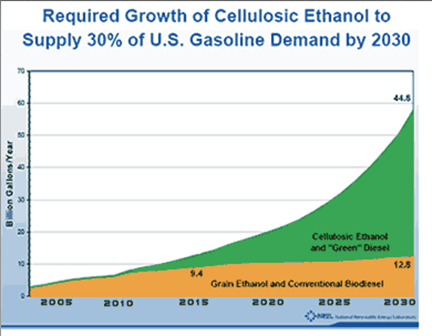
Figure 3. Projected needs for cellulosic ethanol to meet projected national needs by 2030. (Bloomberg Biomass Magazine )
More recently Robert Rapier has noted that KiOR, one of the companies that Vinod Khosla founded and then took public as a promised source for this ethanol, is failing to live up to its promises, and may likely soon be bankrupt. It began shipments in 2013 from its Columbus, MS plant but of only nominal quantities of fuel relative to the future need. Shortly thereafter the plant shut down through the first quarter of this year, needing additional funds to improve operational efficiency.
Share prices that started at $15 have now dropped to $0.64, having recently visited $0.59 a share. Investments to make those changes may only come for a limited time, perhaps only through August, from Mr. Khosla. But the company has to pay back the $75 million it borrowed from Mississippi – with the next $1.8 million payment due June 30th, and there don’t appear to be other investors waiting in the wings. The state will get the assets should the company fold.
Sadly this is another exemplary case of a number of firms who promised much in this field, but have so far delivered relatively little, although there are several new plants coming on stream this year. The EPA has suggested that the production target for this year be lowered from 6 billion liters to 64 million liters – a significant cut, and one indicative of the likely difficulties in finding alternate sources to petroleum based products needed for the transportation industry when oil becomes less available.
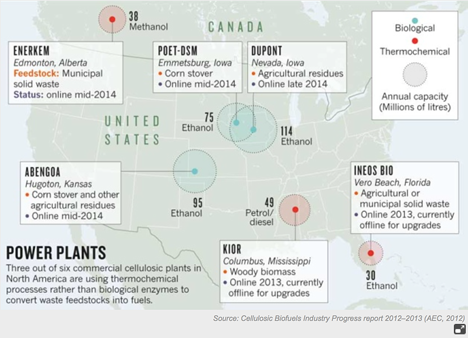
Figure 4. Status of the Cellulosic ethanol production plants planned to be in operation by the end of this year (Nature )
The INEOS plant in Florida began production last July but then shut down and is looking to achieve stable production this year, after upgrading the facility, which will have a capacity of 8 million gallons a year. Not much against the millions of barrels a day that may be needed, but the company has the advantage that it is using local municipal waste and also providing power to the community – which provide other gains to their operations.
The Hirsch Report was published in February 2005. In that report the authors noted that it would likely take up to 20-years of concerted effort to produce an alternate source to petroleum based fuels. We are now nearly ten years through this potential period of grace, and the major candidate to provide that alternate resource is so far being found wanting.
The writing on the wall is increasingly discernable, oil companies are cutting back on exploration investment ensuring that future discoveries will likely be smaller in number as well as in size. This will reduce the amount available, requiring an alternate source. Cellulosic ethanol, which has been held up as one answer to the problem, is falling significantly short of the mark needed to make up for possible conventional shortfalls within the next decade.
The question then becomes – what is the alternative? We could look to making oil from coal, peat and other alternate sources as was done in Germany in World War 2 and in South Africa, where SASOL continues to operate. But planning, permitting, building and operating a facility to convert coal is something that will take at least seven years, and require initiatives to make commitments that are currently lacking.
What else is there? Bear in mind that solar and wind energy production largely goes to address the electricity market – which is largely separate from that of the transportation fuels. Thus their development will largely not impact the problem, since electric cars cannot be produced in the quantities that will likely be needed in the time that remains. Bedazzled by the promise of cellulosic ethanol we have failed to properly pursue the alternatives that now look as though they will prove to be needed.
Time is running short, but awareness of the problem is as yet, even less evident. Basking in the transient benefits of increased domestic production, even as turmoil has cut global oil production by an estimated 2.3 mbd, production that won’t soon return, there is less inclination to face the issue than there has been in previous Administrations, even though it is now becoming possible that it will be this Administration that first sees the impact.
Bit Tooth Energy by Heading Out
11 Comments on "Tech Talk – without Cellulosic Ethanol where will transportation fuel come from?"
Makati1 on Mon, 12th May 2014 6:36 am
There simply is NO substitute for oil. Dreams of any ‘alternate’ is just that, a dream. We are going back to muscle power fueled by consuming plants internally, not processed into some ‘fuel’.
Mike2 on Mon, 12th May 2014 7:53 am
@Makati1:
Amen! 😉
bobinget on Mon, 12th May 2014 9:35 am
“Ethanol is the oxygenate most widely used in reformulated gasoline”.
By cutting gasoline’s ethanol percentage to 5% we could up octane, save diesel fuel, natural gas and farmland needed to grow beans.
Thanks the Lord, E 85 is no longer the darling of Lefty
enviros and Righty farm state lawmakers too busy making marriage safe for homophobes.
Plantagenet on Mon, 12th May 2014 10:34 am
technology already exists to convert natural gas to liquid fuel.
Problem solved.
GregT on Mon, 12th May 2014 11:25 am
Climate instability will continue to grow in both scope, and magnitude for another 40 years, at least.
Converting natural gas to liquid fuels, will only add further to man’s greatest threat, and will only make matters much, much worse.
Problem NOT solved, only exacerbated.
J-Gav on Mon, 12th May 2014 2:20 pm
The author is correct, anyone who thinks cellulosic ethanol will make a significant contribution as a transportation substitute for oil, needs their head examined.
Joe Clarkson on Mon, 12th May 2014 7:18 pm
Liquid fuels can be made from biomass, natural gas, coal and just about anything else that has carbon in it. But those liquid fuels cannot, even now, compete in price with oil derived fuel (coal-to-liquids is only about 0.4% of all liquids output).
This may be a ‘receding horizons’ situation. As oil goes up in price, so does the cost of everything that would be required to build and operate a coal-to-liquids facility or similar facilities for other feedstocks.
But even if these other sources of liquid fuel become economically competitive, it would take a huge amount of time and money to build out the production facilities needed to replace a majority of the oil now being produced. I doubt that we have enough of either.
Boat on Mon, 12th May 2014 8:15 pm
Joe,
I like the term “receding horizons”
Your paragraph
But even if these other sources of liquid fuel become economically competitive, it would take a huge amount of time and money to build out the production facilities needed to replace a majority of the oil now being produced. I doubt that we have enough of either.
I agree with that also except the time factor. There are so many variables it is simply to hard to predict not only the loss of liquid fuels but all the possible events that could dramatically change the time horizon. Most of them bad.
On the other hand I spend much time on this site trying to show areas where we are changing the calculus for the good at a fast at least here in the states despite political gridlock that slows the changes down.
Davy, Hermann, MO on Tue, 13th May 2014 5:35 am
“Strategy is the art of making use of time and space.
I am less concerned about the latter than the former.
Space we can recover, lost time never.”
– Napoleon Bonaparte
I feel Napoleon’s quote is an important topic in regards to Joe’s comment on “receding horizons”. We really are in a war with entropic decay and one of the most pressing of entropic decay variables is the human energy gradient. PO is related to space and time in regards to productive flows. I and others here believe we have lost the battle with time in the battle against declining production. The time wasted since the all-important 70’s when we had the resources to pursue resilience and sustainability is gone. We had a population, although too large then, it was still a significant degree more manageable. We are now in a situation of diminishing returns due to wasted time. Cheap oil is depleting rapidly and the new expensive oil cannot come on board fast enough. AltE is only a booster or temporary bridge energy source. AltE is itself reaching diminishing returns due to its reliance on fossil fuels which are in diminishing returns. AltE is “very” price sensitive due to its capex structure. The financial system also at probably the furthest into diminishing returns territory will not support much more AltE. The current very short AltE renaissance will end as soon as it begun. Again time was lost for AltE. Gas, coal, biofuels, and Nuk again by extension and association with oil which are in diminishing returns are themselves facing all the difficult problems of a parent resources supporting it becoming more expensive. Any of the “exotics” energy possibilities like hydrates are off the board of diminishing returns. By extension society has reached limits of growth and diminishing returns in a population in overshoot to its carrying capacity. We basically have a global societal human system that is brittle and extended well beyond its natural state of equilibrium. “All” aspects of society within this system are in the predicament of being beyond a natural stable state. Couple that with a deteriorating climate. Further we are at this very moment reaching food instability. All roads lead back to food and food will be the “straw that breaks the camel’s back”. The financial system is a mirror of the above described predicaments. Confidence is liquidity and the financial system is being bandaged together with a series of financial actions in a wide range of areas most notably wealth transfer, market manipulation, legalized corruption, and parasitic growth of the financial sector. This has allowed capital to flow but unnaturally and unsustainably. This cannot last and will not last. All systems by nature fluctuate and cycle in a finite world. We have the indications in every sector of the human ecosystem of a coming break. As always I come back to “time” and the million dollar question “when”. Humans have tendency to be impatient in these regards. In earth time this will be a short phenomenon but human time we could see years with some luck. Luck can be considered feedbacks that are inclusive and supporting reaching their tipping points of bifurcation relatively slower than could be the case. This equates to a few years in my mind. With no plan B anywhere but the very bottom coupled with a brittle system unable to change this can inch on for some time but it will break and break relatively soon. There will be no replacement for the current status quo BAU with a “Brics new world order” or the like. I see no way this process can go beyond 10 years. When the breakage occurs so will the level of economic activity and complexity. This will render any hope of technology, innovation, or substitution saving the day null and void. You just can’t produce those level productive activity to support the highly technical without continuous growth and energy intensity. Once that is gone again time is up. So there are no roads other than collapse to a lower level of complexity. How low is anyone’s guess but low enough that we will never see complexity and energy intensity on par with what we see today. Time is up folks! “Gather the rose buds why the may” and prepare the lifeboat for the harshness ahead.
energyskeptic on Tue, 13th May 2014 5:33 pm
When I first published “Peak Soil” about biofuels back in 2006, it was obvious already from peer-reviewed papers by Patzek, Pimentel, and others that any kind of fuel from plants was not going to replace oil for too many reasons to list
http://energyskeptic.com/2014/peaksoil/
Also, we’re at Peak Coal
http://energyskeptic.com/?s=peak+coal
There are no solutions, which no one wants to hear, except for one-child-per-woman and a hell of a lot more farmers, and it may be too late to do that and stay under the net energy cliff decline rate….
Northwest Resident on Tue, 13th May 2014 9:07 pm
energyskeptic — Those are very informative articles. BTW, I stop by your site at least once each day and absorb the knowledge found there. Very interesting and relevant reading to be sure. Thanks for your contributions!!