
Peak Oil is You

Donate Bitcoins ;-) or Paypal :-)


Page added on November 4, 2012

Tech Talk – The Quiet Steps of a Geothermal Movement

As I write this, the election is now less than a week away, with two entirely different paths possible for our future as we move toward 2013. These two approaches to energy are particularly different, but it is pointless to do any further comparison, since the airwaves have, on the rare occasion these differences are explored, discussed these from all points on the spectrum. Nevertheless, it gives an occasion to step aside from Iran, for a week, and to draw attention to something you may have missed in this debate, yet is starting to happen on university campuses scrambling to meet that ever-rising fuel bill.
In the current debate, both sides seem to anticipate that the energy future is rosy. As an illustration, I was struck by a comment just this last week:
“Peak oilers have become almost extinct, destroyed by the arrival of new technologies with the U.S. leading the oil supply change,” said David Hufton of oil brokerage PVM.
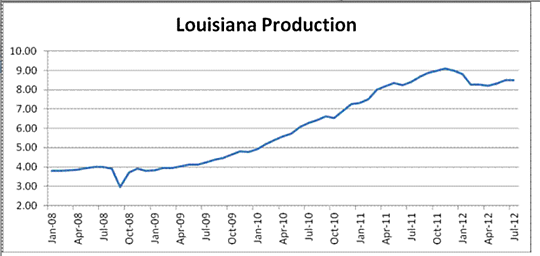
Yet the very same week I received another newsletter from Go Haynesville Shale predicting (from Seeking Alpha) that 2013 will see the decline in Hanesville production.
I live in Missouri, and a number of years ago some of my colleagues evaluated the potential benefits of renewable energy and were left severely unimpressed with the potential for wind and solar in this state. At the time I was not sure what the answer was for our state.
The campus where I worked until I retired, (Missouri University of Science and Technology – the new UMR) was quite revolutionary some decades ago in starting to burn wood with coal, as a way of controlling both emissions and costs. Now those benefits were disappearing, and the campus faced the prospect of finding about $25 million for a new boiler, at a time when state funds are not likely available, and what philanthropist wants to fund a boiler? So the campus had to be creative. And it was!
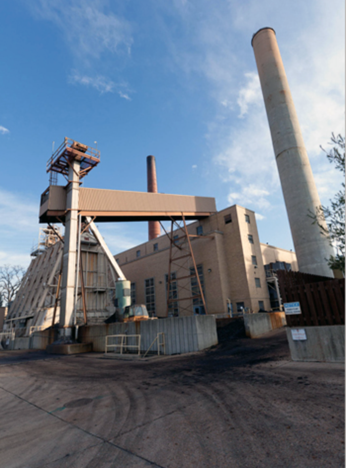
The initial proposal was approved in remarkable time and over the past summer drilling crews moved in for the initial drilling of the wells. Unfortunately (but realistically) the greatest amount of open space around campus that can be used are the parking lots. And so a number of drilling rigs appeared as the students left for the summer, and proceeded to drill a series of roughly 600 wells, each around 400 ft deep. The last was completed last month, and the wells were then lined with piping and are currently being connected into a triad of networks.
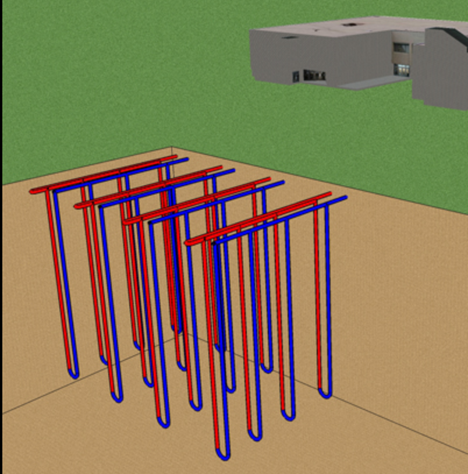
In the summer the flow is reversed. The hot water from the heat exchanger/chiller is returned to the wells through the red lines, releasing the heat into the ground and cooling before it returns back to the surface through the blue line, and into the chiller/heat exchanger to provide a cooling source for the campus.
Current estimates are that the initial costs (paid for with a bond issue) will be no more than the cost of that boiler (which wasn’t going to be funded though needed), and that the campus will save, in the beginning, some $1 million in energy costs (the remaining energy will be supplied with natural gas and the boilers will be retired in 2014) and this will service the bond. The funds only allow some 60% of the campus to be initially served, through three separate plants that are set around the campus. In time, as savings mount, it is likely that other buildings will be brought into the loop (though some have sufficiently antiquated heating and cooling systems such that the entire building will need renovation first.
Over the lifetime of the system (and there is not a lot of fragile equipment in the loop, so this may be more than fifty years) energy savings are likely to rise to more than $3 million a year, as the energy crisis that we are currently pretending isn’t happening finally comes to pass.
Given the benefits that the system will develop, it is not surprising that MS&T are not alone in this approach. In fact, they learned of the concept at the time that Ball State was beginning their project. That project has just been dedicated and anticipates, being larger than ours, that it will save that campus around $2 million a year. It also includes some 3,600 wells by the time that the second phase of the program is completed.
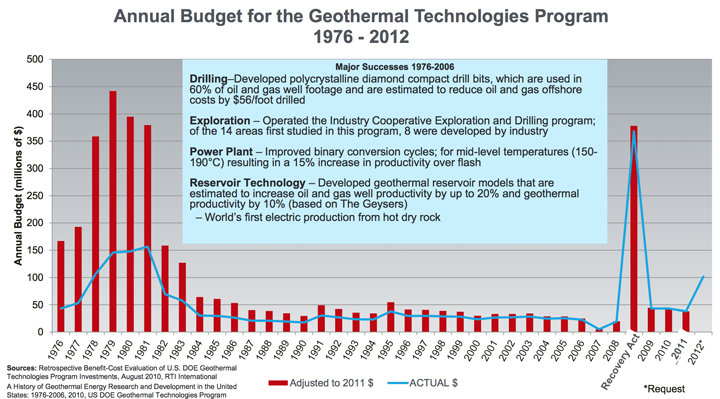
The idea is beginning to catch on, and there are a small but growing number of campuses now that are in the throes of the same type of effort, though in each case tailored to the individual needs of the different campuses. Hampton University in Virginia is heating their Multi-Purpose Building, Indiana Tech has restored and powered a Civil War era building, Montana Tech will use the heat from mine waters underneath the campus. In Boise, ID, the ground water temperature is a little higher (around 170 degrees) and the city has used geothermal energy since 1983, and now Boise State is joining in with its own plant. As with the Montana project, so the program at New Mexico Tech has also been funded as part of the Recovery Act. Some of the potential benefits of that program have been described by the Department of Energy. However that presentation also illustrates the transience of the funding opportunity.
3 Comments on "Tech Talk – The Quiet Steps of a Geothermal Movement"
BillT on Mon, 5th Nov 2012 12:37 am
Seems the EROEI is small on this type of system. The initial cost for 600, 400 feet deep wells, pumps, heat exchangers,piping, etc is high. Then you have to supply electric to the pumps forever to get the heat out of the ground and into the exchangers. Again relying on some far away carbon based power plant to produce the energy.
It seems that a lot of assumptions were made when deciding to go with a ground source heat pump. While it may be a bit more efficient than the old boiler, it will still depend on the price and supply of oil/NG/coal for the foreseeable future. Any savings may disappear as all of those get more and more expensive and unreliable.
There are more ramifications to peak energy than are obvious.
deedl on Mon, 5th Nov 2012 9:07 am
Of course there were many assumptions made. You have to actually build this stuff and try it on large scale to see how well it works. So even if it may turn out not to be the best solution it is worth trying.
In general heat pump systems are more efficient than the direct use of electricity for heating, because you only need to compensate entropy losses. If you couple that with pv to run the heat pump you can build houses that need no additional energy for heating. Couple that with some thermal mass then even the pv-intermittency is no problem. This concept has already been proven.
On shouldn’t do the mistake to judge technologies isolated or in todays context, but their ability to fit into renewable energyschemes.
BillT on Mon, 5th Nov 2012 10:45 am
deedl, that’s all ‘renewables’ are, schemes, usually to get taxpayer money. That they could find $25 million for a ‘maybe’ system (that still uses energy from other sources to make it possible) only exposes the gullibility of the people who ok’d it. Then there is constant maintenance of the pumps, underground lines, etc.
These systems have been around for many decades and are not replacing other systems for a good reason. They are not more efficient or less expensive over the life of the system. It is all that ‘green-washing’ used to push schemes as conserving energy and being good for the ecology…lol. This one will need huge amounts of energy from,(probably), coal burning plants somewhere. Then when it fails…