
Peak Oil is You

Donate Bitcoins ;-) or Paypal :-)


Page added on August 27, 2018

Sun 24×7: Calculation of EROEI

Over the past 10 years, solar energy has rapidly moved from “toys” to the most serious projects, and the continuation of the curve of this takeoff promises in the future total domination of this type of generation. Or not? In the attempts to predict here, a lot of copies and major claims have been broken: two: the sun through the clouds and at night does not shine (ie, the source variability) and the high energy intensity of solar cell production, and this energy does not return during the work of the latter. (3r3r3? EROEI ? <1)
Technically, the first problem with the variability solved – you just need to build more solar cells and a battery of sufficient capacity. However, this approach clearly aggravates the problem with EROEI and the cost of electricity. The cost can be found in the reviews
Lazard , but I have not seen any attempts to calculate EROEI for a solar power station with a battery. So I decided to count it myself, and got a rather unexpected result, about which in the end.
To evaluate, let’s calculate a power plant with a lithium-ion battery located in Yuma, Arizona, USA. Why in Arizona? This is a very good place for solar energy (one of the best in the world) and there is a lot of information on it. If EROEI turns out to be less than one, it will mean big problems with the sun as a basic source of electricity (for today). If EROEI turns out to be higher, then taking into account the analysis that we are going to make, it will be easy to apply the calculation to any place in the world.
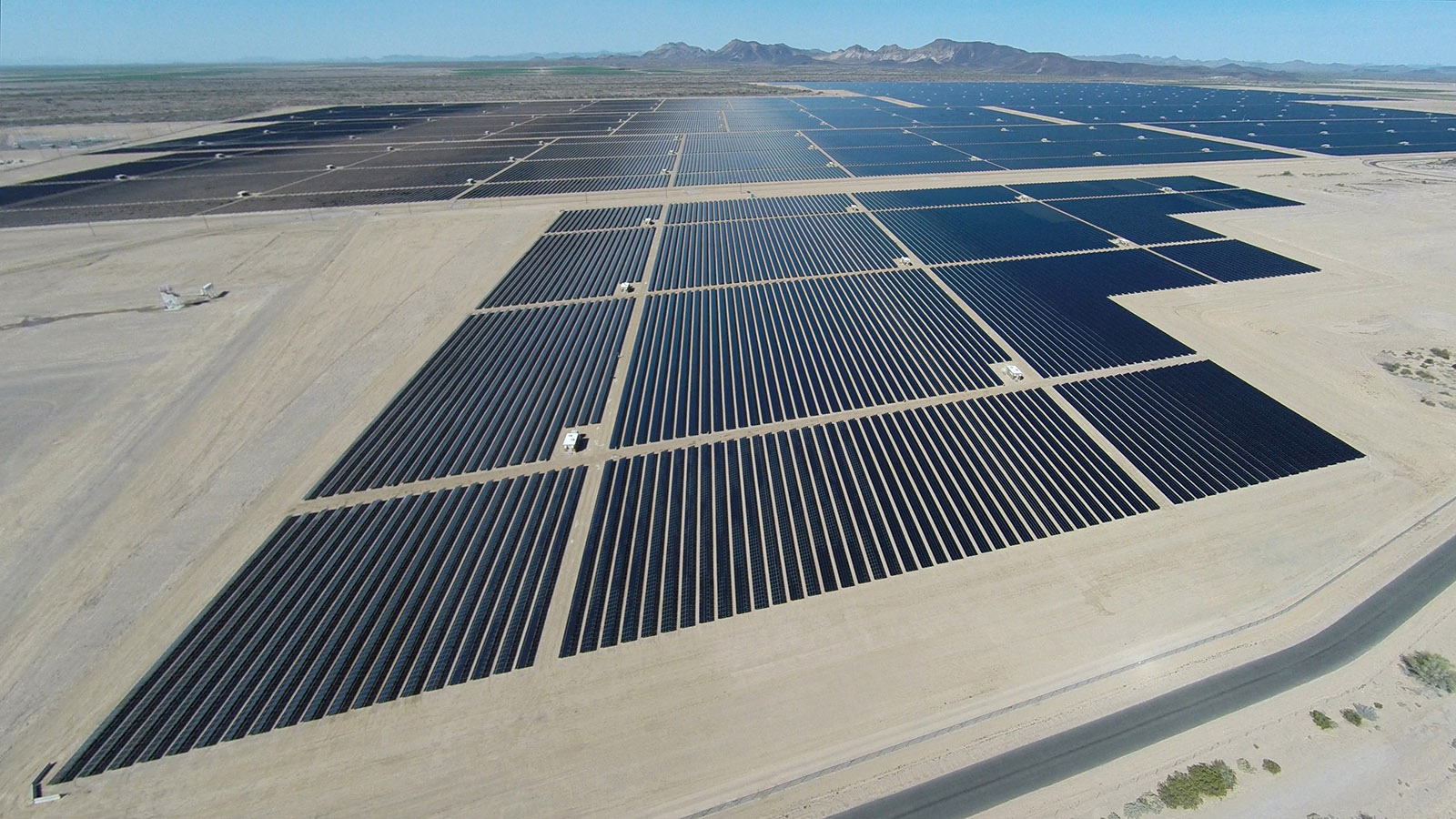
In Yuma, by the way, there is a fairly large Sia Agua Caliente Solar Project with a capacity of 250 megawatts, but not 24×7. The solar panels of this station are made of thin-film technology from the CdTe semiconductor, which differs from silicon by much better energy costs per kilowatt of battery power, but loses value.
NREL Pwatts calculator. It is based on the table of the sun’s insolation value for our point, taken from ” standard meteorological year “- a database of meteorological parameters for the US territory with harmonized values. With the help of this calculator you can get hourly values of power generation taking into account the angles of the sun’s fall, scattered light, panel temperature and conversion losses, which was done as a basis for further calculations.
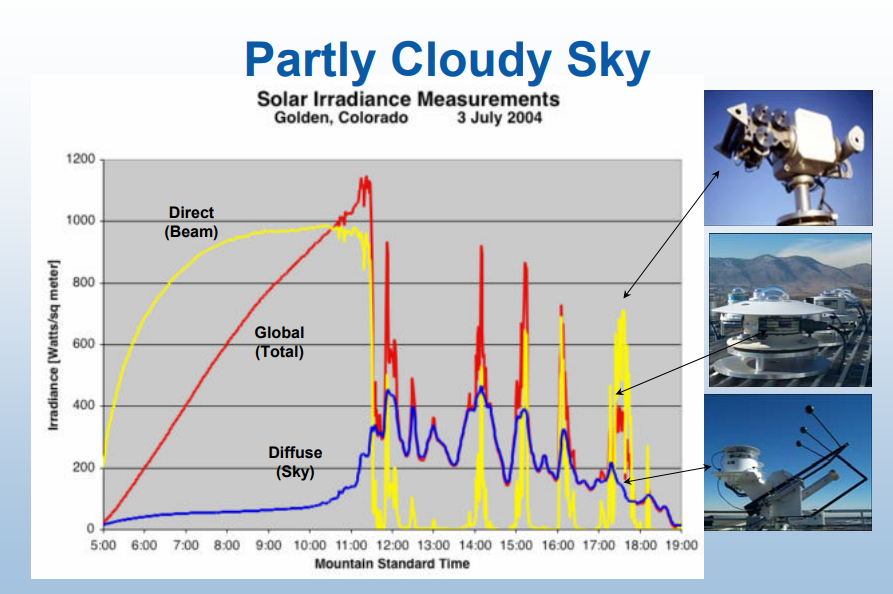
“Standard meteorological year” is a very powerful database, measuring such subtleties as the solar line (yellow curve on the graph) and indirect (blue) illumination, which allows to accurately estimate the simulation of the simulated satellites on cloudy days.
Now the obtained data for one-kilowatt SES should at least somehow be optimized. You can change the ratio between the volume of solar cells and batteries (the more solar cells, the less we need to store energy to survive the dark days without turning off) and also the angle of installation of solar batteries.
For our solar power station, the defining EROEI moments will be cloudy winter days, for example on December 27-28 in the standard meteorological year – for these two days the plant’s CIUM will be catastrophic 3.4% and completely determine its redistribution, which will lead to the generation of excess electricity 95% of the remaining days.
In principle, it would be more correct to take and change the TK to a more optimal one – for example, “300 megawatts 90% of the time of the year”, then the station could be several times smaller, but this option will be counted next time, but for now – hardcore.
So, the angle of installation of solar panels needs to be optimized not for the maximum power output during the year, but for maximum productivity during the pair of the worst periods – it turns out 41 degrees, and not the most optimal 32 (difference, however, only 5% for annual output).
The ratio of the volume of the battery and solar cells is calculated a little more difficult – as an optimum for energy. Taking into account the fact that 1 electric kilowatt of a solar power plant costs ~ 14 GJ ( , A 2016 study of ), And one electric kilowatt-hour of lithium-ion batteries is about 1.6 GJ ( , 2012 study ).
Hence the optimization rule – we increase the battery until we reach a situation where an increase of ??? kWh no longer leads to a drop in the power of solar panels by at least 1 kilowatt.
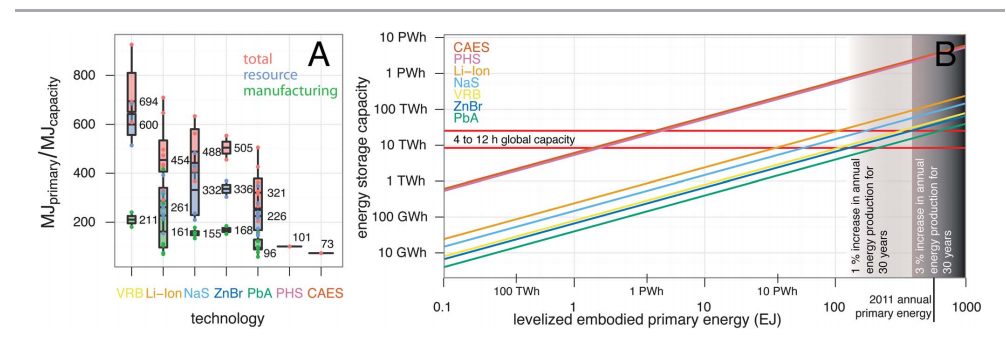
An interesting graph of the article on the energy cost of batteries. In particular, the most “energy-saving” are the accumulator (PHS) and compressed air (CAES) – the latter, in the aftermath, everything is very difficult. there is used the burning of natural gas to restore energy. The right panel shows the “energy cost” of a 4-12 hour global repository.
The search of various combinations of SB and battery size in the issue of Pwatts gave me such optimal values - ??? gigawatts of SB and 20 GW of battery life. In this case, the station will issue 300 megawatts of all 8760 hours of the year, and the battery charge will only fall once to 2% of the total, and basically will fluctuate between 50 and 100%. The factor of using the installed capacity (generating unit) of the generating part is poor – about ??? and its significant improvement would be the reception by the network of daytime peaks at least at the level of 2 gigawatts, then the total CIUM would be about 0.? which is much closer to the real SES of the type , from the picture above.
It would be even better to limit the work of the station 330 to the sunniest days of the year – then the size of the SB part could be reduced to 1.4 gigawatts, and the battery to 7 GWh. Yes, changeable RES has problems with the latest percentages in the power system – the difference between 80% of the shares and 100% is colossal in terms of investments.
Well, we think EROEI. At ??? GW of the sun and 20 GWh of lithium, we need 64.1 petajoules (14 * 10 .9 * ??? * 10 .6 .kw + ??? * 10 .9 J * 20 * 10 6 kWh) or ??? TWh, and [b] EROEI is equal to ???r3r3141. . People who are aware of the discourse around the sun and EROEI this number is surprised – much more than expectations. Yes, the result is ambiguous – on the one hand it is easy to increase several times by taking peaks of solar generation and reducing the station’s operation time by year to at least 90%; on the other hand, it is Arizona, one of the best points on the planet for solar power stations.
Well, most importantly, such a project is not yet feasible from a financial point of view. Even the optimized 1.4 GW + 7 GWh will cost no less than $ 4 billion, which will give the cost of electricity from this facility at $ 140 per MWh – too expensive. Appeared in reality, “Solar & Storage” while trying to limit the battery to a much smaller size, providing mainly the passage of the evening peak + replacing the pickers, i.e. gas turbine power plants, quickly launched in the event of unplanned consumption peaks: it is clear that the cost of electricity from the pickers is very high and this can be earned.
To summarize, I want to note that the calculation shows that at least physics does not prohibit the distribution of solar power stations, at least until the places with good insolation. However, there are a lot of such places on the planet, so in the next 10 years, apparently, such power plants will be massively built.
14 Comments on "Sun 24×7: Calculation of EROEI"
Ghung on Mon, 27th Aug 2018 9:30 am
“….and also the angle of installation of solar batteries.” ????
Uhhh,, I’m having trouble making any sense of most of this article. Translation problems, perhaps.
Antius on Mon, 27th Aug 2018 11:10 am
An almost unintelligible article that doesn’t really answer the question that it presents.
Large scale renewable energy projects generally have acceptable EROI and competitive costs at the bus bar. But both performance measures fall to pieces when large scale electricity storage is put in place in attempt to build up some kind of steady-state, baseload supply.
I have looked into this from many different angles for many years. It is very difficult to devise a mass storage solution for electric power that does not push costs through the roof and EROI through the floor. I have tried to work around this for both grid level power plants and for distributed systems. I have reached some general conclusions:
(1) Storing energy produced from electricity with the intention of turning it back into electricity, is very expensive and should be used very sparingly. It magnifies total energy requirements because of storage losses and generally has high capital and embodied energy costs. Pumped storage and compressed air energy storage come out ahead of any battery energy storage. Hydrogen may have niche applications, but has poor whole system efficiency as an electricity-electricity storage mechanism. Stored heat and cryogenic storage have relatively good energy density and tolerable capital costs, but efficiency is mediocre.
(2) Back-up power is generally cheaper than storage, because nature has already paid the price for storage when she made the fossil fuel or biomass. But you still have to pay for the backup plant’s capital, operation and fuel costs. You save a little on fuel, but the other costs are just as high. Biomass could provide some fuel for this function, but is seasonal in its availability.
(3) Storing energy as hot or cold is generally much cheaper, but only where these applications are end uses.
(4) The cost of primary energy from a renewable plant can be kept low if we can adapt the way we use it, i.e. by adapting demand to fit supply.
If we are destined to rely on intermittent renewable energy as a large-scale alternative to fossil fuels, we will need to combine all of these approaches intelligently. Demand management is the most important, as it reduces the requirement for expensive storage. But it will necessitate different ways of living and working.
A practical example: I recently investigated the possibility of directly coupling a homemade wind turbine to a rotary compressor to produce compressed air to drive tools in my workshop. The turbine itself was cheap and I could build it largely from recycled materials. But to store 3KWh of compressed air at 10bar, requires a storage tank with volume 5000 litres. That would cost me about £6000 or about $8000 or euros. If I use a full tank of air each day and amortize that cost over 10 years, it adds £0.55 ($0.7 or euro) to each kWh of stored energy. That is quite expensive.
The total cost can be reduced considerably by using a smaller storage tank, using excess air to drive the heat pump on a chest freezer (a slew load that is switched off when I start using air for other discretionary loads) and by timing my use of air with the weather. This is easier as well if I can stockpile raw materials and finished products in a store room.
A renewable future is possible, but is not compatible with a 9 till 5 work ethic or with just-in-time manufacturing philosophy. Those things are relics of the fossil fuel era.
Cloggie on Mon, 27th Aug 2018 11:39 am
At ??? GW of the sun and 20 GWh of lithium, we need 64.1 petajoules (14 * 10 .9 * ??? * 10 .6 .kw + ??? * 10 .9 J * 20 * 10 6 kWh) or ??? TWh, and [b] EROEI is equal to ???r3r3141. . People who are aware of the discourse around the sun and EROEI this number is surprised
Glad we sorted that one out once and for all.lol
habrahabr(abra) to me.
Davy on Mon, 27th Aug 2018 12:36 pm
great comment antius.
Antius on Mon, 27th Aug 2018 1:46 pm
Thanks Davy. I continue to be impressed by how many useful applications could be powered using low pressure compressed air. Basically anything that requires mechanical power in a more or less static application, is just as well powered by compressed air as electricity.
The downside is that compressed air is a little less efficient. But compressed air tools are cheaper, lighter, simpler and more powerful.
In a real SHTF scenario, any country with a reasonable supply of wind energy can power entire cities this way. Compared to electricity, the systems are much simpler to build. The compressors have as little as one moving part and can be directly coupled to the rotating shaft. The distribution system is pipes and hydraulic accumulators. No transformers, no high voltage lines, circuit breakers, etc. Very simple systems.
Cloggie on Mon, 27th Aug 2018 2:12 pm
“Hydrogen may have niche applications, but has poor whole system efficiency as an electricity-electricity storage mechanism.”
The Fraunhofer Institute claims it is possible to have a 100% renewable energy system, without demand management necessary, where power-to-gas is the largest storage component:
https://deepresource.wordpress.com/2017/09/16/blueprint-100-renewable-energy-base-for-germany/
They admit that initialy transition cost will be high, but eventually will asymptotically approach current energy cost.
dave thompson on Mon, 27th Aug 2018 2:51 pm
The whole idea of transition is silly. Without FF inputs the transition grinds to a halt.
Cloggie on Mon, 27th Aug 2018 3:28 pm
With electricity and hydrogen you can do everything you can do with fossil fuel.
MASTERMIND on Mon, 27th Aug 2018 3:34 pm
Clogg
You are putting the cart in front of the horse again..you live in a fantasy land because you know you are dead fucking meat soon when the oil starts to run out..
You can run you fat ugly slob, but you can’t hide..
LMFAO!
Antius on Mon, 27th Aug 2018 4:54 pm
I have always wanted one of these.
http://www.lowtechmagazine.com/2012/10/electric-velomobiles.html
The thing that prevents me from getting one is the thought of a wanker in a huge American style truck running me over. But the fact is that even on battery power alone, it can get me to work at the same speed as driving in the town where I live. The range is more than adequate to get me there and back home again. The battery is 0.2588kWh and gives a range of 60km. That is 17.3KJ/km.
In a SHTF scenario, small vehicles like this have a small enough energy consumption that they can be charged from home solar panels at a reasonable cost. In London, even in the winter months (dec & jan) daily insolation is ~0.5kWh/m2 per day. With 15% efficient solar panels, some some 4m2 of panels would provide the 288Wh needed for the battery.
If we could build velomobiles that run on low pressure compressed air at 10bar say, then a 60km range can be provided by about 500 litres of air. This is doable, but would make the vehicle slightly longer and heavier. The benefit of compressed air is that I can build a wind turbine that can make it out of old junk in a reasonably well equipped workshop. I would struggle to make a PV panel.
Antius on Mon, 27th Aug 2018 5:48 pm
A potential substitute vehicle fuel is producer gas.
https://en.m.wikipedia.org/wiki/Producer_gas
This is easily manufactured by blowing a mixture of air and steam through burning carbonaceous materials. It could therefore be produced from coal, biomass or even refuse, in a producer that could be built locally by anyone with reasonably good machining skills. It is a mixture of CO, CH4, H2 and nitrogen.
Typical calorific value is 5MJ/m3 at standard conditions and 50MJ/m3 @ 10bar. That is equivalent to about 1.3litres of diesel. Again, it is relatively easy to build small cars that can burn fuels like this efficiently, provided that people do not expect them to drive like formula one racing cars. A single seat car with twice the energy consumption of the velomobile and a 30% efficient engine, would consume 100KJ of producer gas per km. So a 50km range could be provided by a tank containing 100 litres of gas at 10bar. That is enough to get most people to work and back.
This is the sort of thing that could be done at a community level by like minded people with reasonably good skills.
peakyeast on Tue, 28th Aug 2018 9:09 am
@Antius: I came to the same conclusion and posted it here some years ago. A fossil free society is fully possible, but not with rigid 8 to 4 jobs and JIT.
We are going to a far more flexible work future and possibly more local – if any future that is.
Sissyfuss on Tue, 28th Aug 2018 9:27 am
Antius, my Amish neighbors had a rustic furniture building operation in their pole barn for years and all tools were pneumatic and run off propane powered air compressors. Something about electricity is the devils handiwork. Worked very well for them until the big box stores they were supplying switched to foreign suppliers utilizing slave labor. Wonder if I should tell them that Trumps MAGA could return their business to them? Nah.
Antius on Wed, 29th Aug 2018 6:40 am
“Antius, my Amish neighbors had a rustic furniture building operation in their pole barn for years and all tools were pneumatic and run off propane powered air compressors. Something about electricity is the devils handiwork. Worked very well for them until the big box stores they were supplying switched to foreign suppliers utilizing slave labor. Wonder if I should tell them that Trumps MAGA could return their business to them? Nah.”
Sis, the Amish may have been ahead of their time. Maybe one day they can use biogas to power their compressors or a purely mechanical compressor on a wind turbine.
For many applications, electricity adds more complexity to our systems than is strictly necessary and it adds significant specialist materials requirements. So long as we live in large scale economies where things can be made in large factories with unlimited technical input and shipped everywhere, that isn’t a killer problem. But if we ever arrive at the point where we need to build things at a more local level, then attempting local manufacture of electrical systems would be difficult. To build electric motors requires fine copper wire and electromagnets. The permanent magnets in wind turbine generators rely on rare earths. The distribution system requires transformers. At all stages, from generation to end-use, the equipment involved is complex.
With a compressed air system, all components can be made from carbon steel and rubber. End use tools are simple enough that they could be made in local machine shops. The generation side could involve compressors mounted on wind turbine shafts with few moving parts.
The only really difficult part of the system is pressure vessels, which are needed to store air and dampen and fluctuations in compressor output. A pressure vessel failure is basically a bomb and there are a lot of laws and regulations surrounding the safe construction, testing and maintenance of pressure vessels. That is why I have opted for the smallest vessel possible and to use air as it is generated, rather than store it in any large volume.
In theory, in a SHTF scenario, it may be possible to build a low pressure vessel using rammed earth and adobe, and by buttressing the vessel walls against the surrounding compressed soil. The top end of the vessel would be counter weighted by a mass of earth, rock or rubble. Such a thing would require a lot of digging and very careful control of damp levels in the adobe or rammed earth restraining walls. It would never get approved by ASME of course.