


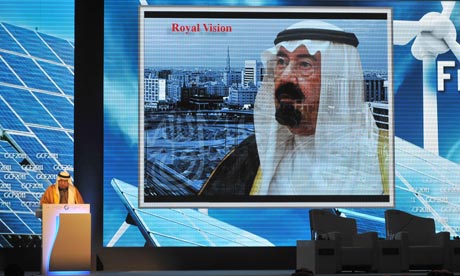
Saudi Arabia, the world’s biggest oil producer, has plans to become 100% powered by renewable and low-carbon forms of energy, according to an influential member of the royal family.
But the process is likely to take decades, and some observers are sceptical as to whether it is any more than window-dressing.
Prince Turki Al Faisal Al Saud, founder of the King Faisal Foundation and one of the state’s top spokesmen, told the Global Economic Symposium in Brazil that he hoped the kingdom might be powered entirely by low-carbon energy within his lifetime – he is 67 – but that he thought it was likely to take longer.
However, he insisted Saudi was moving ahead with investment in renewable energy, nuclear power and other alternatives to fossil fuels and that it could use its vast oil reserves for other goods, such as plastics and polymers.
“Oil is more precious for us underground than as a fuel source,” he said. “If we can get to the point where we can replace fossil fuels and use oil to produce other products that are useful, that would be very good for the world. I wish that may be in my lifetime, but I don’t think it will be.”
Joss Garman, political director of Greenpeace, said: “It speaks volumes that a Saudi prince can see the benefits of switching to clean energy sources when [UK chancellor] George Osborne seemingly cannot, but Saudi Arabia will only truly be a green economy when it leaves its fossil fuels in the ground.”
Saudi Arabia’s energy use is almost entirely from fossil fuels at present, with about two-thirds coming from oil and the remainder from gas. The state produces close to 12m barrels of oil a day, representing more than 12% of world crude production, and has about one-fifth of the world’s oil reserves, according to the US government’s Energy Information Administration. Energy use per person within the kingdom is also high by world standards, because energy prices are kept so low.
As Prince Turki noted, however, the kingdom has vast potential for using solar power. “The cost of solar energy is now 15% of what it was 20 years ago,” he noted. Saudi Arabia has also signed memoranda of understanding – though no final deal as yet – with Argentina over nuclear energy.
But despite his commitment to advancing renewable energy in the Middle East, Prince Turki – who served as director of Saudi Arabia’s intelligence services for more than 20 years and has also been an ambassador to the UK and the US – was also clear that the rest of the world was likely to continue to rely on fossil fuels for many years to come. “No country can ban itself from any one form of energy,” he said.
One of the other potentially important technologies for Saudi Arabia is carbon capture and storage, as depleted oil fields could be used as storage for compressed carbon dioxide, but it has so far made little progress. The prince said the development of carbon capture and storage (CCS) technology should be seen as an international effort rather than the responsibility of single countries.
Nebjsa Nakicenovic, deputy chief of the International Institute for Applied Systems Analysis, said CCS was likely to be a vital technology around the world. Though he acknowledged there could be problems, as the technology is still unproven, he warned: “Do not discount CCS.”
On renewables, Nakicenovic said the world should aim to generate 30% of energy from sustainable renewable sources by 2030. That would represent more than a doubling of current renewable energy usage, because although on paper about 15% of energy now comes from renewable sources, this includes a large amount of biomass – mostly wood, dung and other waste – burned in developing countries. Much of this is unsustainable, and requires a significant use of resources in foraging for firewood. “So [the target] is very ambitious, but doable,” he said.
MrEnergyCzar on Fri, 19th Oct 2012 10:55 pm
In other words, we’re hitting peak oil….
MrEnergyCzar
Arthur on Fri, 19th Oct 2012 10:58 pm
SA and its oil are going down, make room for rising gas stars Russia, Iran and Qatar.
BillT on Sat, 20th Oct 2012 12:57 am
What is the saying? “My grandfather rode a camel. My father drove a car. I fly a jet. My son will ride a camel”.
GregT on Sat, 20th Oct 2012 7:58 am
Maybe if they breed enough camels, they can use the dung as a form of renewable energy.
Kenz300 on Sat, 20th Oct 2012 3:46 pm
As the price of fossil fuels continue to rise we will all use energy more wisely and be looking to alternative energy sources. The rising cost of fossil fuels driven by finite supplies and expanding population growth is a motivating factor and will cause individuals, families, businesses and countries to change their behaviors. Every country needs to develop a plan to balance its population with its resources, food, water, energy and jobs. The Saudi’s have not addressed their population growth or their subsidies of energy.
SOS on Sat, 20th Oct 2012 4:42 pm
The Saudis can profit from Renewables for a couple of reasons. The main one is their extraction cost. It is under $10. This is a large profit margin.
When they consume a barrel of oil domestically it could have been sold at full market price. The necessary subsidy for solar can easily be absorbed by that huge profit margin and they can profit from the build-out and operation of the solar investment. The oil, displaced by the solar investment is sold at full market price. Very good plan.
The second reason is of course their abundance of solar power and its reliability. As with alternatives storage is still a huge problem.
GregT on Sat, 20th Oct 2012 7:39 pm
Kenz300,
Last time I checked, the Saudis appeared to have a larger energy subsidy than most countries of the world, and they are positioning themselves for some degree of an energy independent future.
The prices of fossil fuels have risen dramatically over the past several years. Where I live, there are more single occupant SUVs and full sized pickups than ever before. Most people have less disposable income and are going further into debt. It should not be too difficult to see the direction that we are heading.
Behaviours will change, but not by choice, at least not at first. People will lose their jobs, their homes, their retirement funds and their life savings. Most will have no idea as to why. The system will implode in on itself, slowly at first, gradually gaining momentum. It is already happening, and it will get much more chaotic.
Natural resource extraction and refinement, food production, water distribution, and jobs, all rely on exponentially expanding supplies of cheap oil. It should be obvious by now that we have reached a plateau and are perilously close to the edge of the downward slope.
Alternate energy sources might supply us with a different energy future, a future that will look nothing like our present, but they will not replace fossil fuels. It is a simple matter of a combination of EROEI, energy density, and portability. Not to mention the fact that every alternate source of energy requires cheap fossil fuel energy to extract and refine resources, and to construct and maintain infrastructure.
I used to be in denial, which given the circumstances, was perfectly normal. I have now come to the conclusion that our future is in great jeopardy. I have taken positive steps to position myself and my family for a sustainable and survivable future.
You still have the opportunity to do the same.
Tom on Sun, 21st Oct 2012 8:36 pm
I wonder how much electricity generated from oil the Saudis are using to pump and process their oil. Solar seems like a natural fit, given their situation, plenty of sunshine and the high price of oil.
Kenz300 on Mon, 22nd Oct 2012 2:03 pm
Price can be a substantial motivator to change peoples behavior.
With rising oil prices many people around the world will be priced out of the market and will walk, bicycle or use mass transit for their daily commutes. There are over a billion people living on less than $2 a day. That does not leave much money for transportation costs. The high price of oil is already having an impact and changing behaviors. Auto companies are producing and selling MORE 40 MPG vehicles and FEWER 15 MPG vehicles. Bicycles are wonderful for transportation but need communities that are connected by safe walking and bicycle paths that connect work, schools and homes. For longer distances mass transit needs to be more plentiful and convenient.
The Saudi’s have an ever increasing internal demand for oil caused by their growing population and their subsidies of oil to the public. Both are not sustainable in the long run.
The Saudi’s have indicated their willingness to move to solar power and other forms of alternative energy. We shall see how quickly they can ramp up their production of alternative energy and reduce their internal consumption of their precious oil resource. They need to address both issues if they want to reduce internal demand.
Renewable Ray on Tue, 23rd Oct 2012 1:37 pm
It’s about grid management, they can build in solar plants into remote regions for the same price they can connect the area to the grid. Same reason you put solar in that small work shop on the back of your property. No electrician, permits etc. Just install solar and your done.