
Peak Oil is You

Donate Bitcoins ;-) or Paypal :-)


Page added on July 21, 2017

Richard Heinberg: Controversy Explodes over Renewable Energy

A heated debate in the pages of one of the country’s most renowned scientific journals has gained national attention. The debate is over whether a combination of wind, solar, and hydroelectricity could fully power the U.S. But both sides of the debate are completely missing half of the equation.
In a series of papers published over the last few years, Mark Jacobson of Stanford University (along with co-authors) has offered a series of transition plans for achieving a 100 percent wind-solar-hydro energy economy. These include comprehensive blueprints for the United States, for each individual state, and for the world as a whole. His message is clear: such a transition is not only possible, it’s affordable—cheaper, in fact, than maintaining the current fossil fueled system. There is no technical or economic barrier to an all-renewable future—only a political one, resulting from the enormous influence of fossil fuel companies on Congress and the White House. Jacobson’s plans have been touted by celebrities (Leonardo DiCaprio and Mark Ruffalo) and at least one prominent politician (Bernie Sanders).
However, during the past two years a group of scientists unconvinced by Jacobson’s arguments has labored to craft a critical review of his plans, and to get it published in the same journal that printed Jacobson’s own most-cited paper. They voice a concern that the growing popularity of Jacobson’s plans could lead to critical mistakes in policy making and investment choices. The lead author, Christopher Clack, and his 20 co-authors, attack Jacobson’s assumptions and highlight what they call serious modeling errors. Much of their criticism has to do with Jacobson’s ways of getting around solar and wind power’s most notorious drawback—its intermittency. Jacobson says we can deal with cloudy and windless days by storing energy in the forms of underground heat and hydrogen. Clack et al. point out that doing so on the scale Jacobson is proposing is unprecedented (therefore, we really don’t know if it can be done), and also argue that Jacobson made crucial errors in estimating how much storage would be needed and how much it would cost.
The stakes in this controversy are high enough that the New York Times and other mainstream media have reported on it. One pro-renewables scientist friend of mine despairs not just because of bad press about solar and wind power, but also because the reputation of science itself is taking a beating. If these renowned energy experts can’t agree on whether solar and wind power are capable of powering the future, then what are the implications for the credibility of climate science?
Jacobson and colleagues have published what can only be called a take-no-prisoners rebuttal to Clack et al. In it, they declare that, “The premise and all error claims by Clack et al. . . . about Jacobson et al. . . . are demonstrably false.” In a separate article, Jacobson has dismissed Clack and his co-authors as “nuclear and fossil fuel supporters,” though it’s clear that neither side in this debate is anti-renewables.
However, Clack et al. have issued their own line-by-line response to Jacobson’s line-by-line rebuttal, and it’s fairly devastating.
This is probably a good place to point out that David Fridley, staff scientist in the energy analysis program at Lawrence Berkeley National Laboratories, and I recently published a book, Our Renewable Future, exploring a hypothetical transition to a 100 percent wind-and-solar energy economy. While we don’t say so in the book, we were compelled to write it partly because of our misgivings about Mark Jacobson’s widely publicized plans. We did not attack those plans directly, as Clack et al. have done, but sought instead to provide a more nuanced and realistic view of what a transition to all-renewable energy would involve.
Our exploration of the subject revealed that source intermittency is indeed a serious problem, and solving it becomes more expensive and technically challenging as solar-wind generation approaches 100 percent of all electricity produced. A further challenge is that solar and wind yield electricity, but 80 percent of final energy is currently used in other forms—mostly as liquid and gaseous fuels. Therefore the energy transition will entail enormous changes in the ways we use energy, and some of those changes will be technically difficult and expensive.
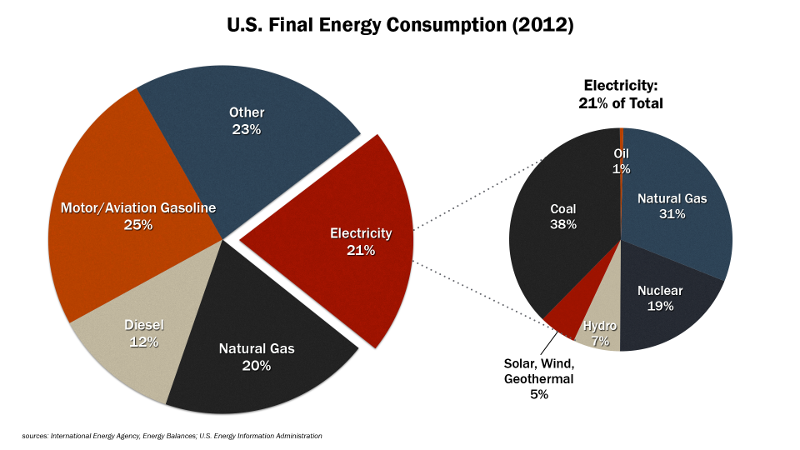
Our core realization was that scale is the biggest transition hurdle. This has implications that both Jacobson et al., and Clack et al. largely ignore. Jacobson’s plan, for example, envisions building 100,000 times more hydrogen production capacity than exists today. And the plan’s assumed hydro expansion would require 100 times the flow of the Mississippi River. If, instead, the United States were to aim for an energy system, say, a tenth the size of its current one, then the transition would be far easier to fund and design.
When we start our transition planning by assuming that future Americans will use as much energy as we do now (or even more of it in the case of economic growth), then we have set up conditions that are nearly impossible to design for. And crucially, that conclusion still holds if we add nuclear power (which is expensive and risky) or fossil fuels (which are rapidly depleting) to the mix. The only realistic energy future that David Fridley and I were able to envision is one in which people in currently industrialized countries use far less energy per capita, use it much more efficiently, and use it when it’s available rather than demanding 24/7/365 energy services. That would mean not doing a lot of things we are currently doing (e.g., traveling in commercial aircraft), doing them on a much smaller scale (e.g., getting used to living in smaller spaces and buying fewer consumer products—and ones built to be endlessly repaired), or doing them very differently (e.g., constructing buildings and roads with local natural materials).
If powerdown—that is, focusing at least as much on the demand side of the energy equation as on the supply side—were combined with a deliberate and humanely guided policy of population decline, there would be abundant beneficial side effects. The climate change crisis would be far easier to tackle, as would ongoing loss of biodiversity and the depletion of resources such as fresh water, topsoil, and minerals.
Jacobson has not embraced a powerdown pathway, possibly because he assumes it would not appeal to film stars and politicians. Clack et al. do not discuss it either, mostly because their task at hand is simply to demolish Jacobson. But powerdown, the pathway about which it is seemingly not permissible for serious people to speak, is what we should all be talking about. That’s because it is the most realistic way to get to a sustainable, happy future.
75 Comments on "Richard Heinberg: Controversy Explodes over Renewable Energy"
Lucifer on Fri, 21st Jul 2017 4:13 pm
Nothing is sustainable on the earth until someone or something brings the human population down to below 1 billion, that is my expert opinion.
MASTERMIND on Fri, 21st Jul 2017 4:20 pm
The Oil Age may come to an end for a shortage of oil.
-Saudi Oil Minister Sheikh Yamani
Twocats on Fri, 21st Jul 2017 4:51 pm
What’s sad is we could have a living situation far more enjoyable with using much less energy. Except not as enjoyable for the wealthiest on the planet. Lots lots to lose.
Davy on Fri, 21st Jul 2017 5:35 pm
“Powerdown” is not really an option if we are honest about our economic situation. Powerdown means less economic activity and that implies debt defaults and unemployment. This means economic abandonment, dysfunctional networks, and physical decay. This is what less means let’s be honest about that. We are already underfunded almost everywhere with significant amounts of bad debt and nonperforming debt. We have huge market bubbles that if deflated would magnify the current bad debt many times. How are we going to ramp up so much economic activity to transition and at the same time decline economically? This part of the fake green equation never adds up.
“Deliberate and humanely guided policy of population decline” is nothing more than a notional wish. There is no real chance of this working in a world that is so uncontrollable as ours is now. Even in those nations most organized I doubt this can be achieved. Dropping population means economic impact and disruption. It implies growth disruption. If other countries do not follow with population reduction then we have contrasting economic systems because dropping population and expanding population entail very different economic efforts. They won’t mix and we will have to have border restrictions. Globalism does not do border restrictions well.
“Abundant beneficial side effects”?? There will be nothing beneficial about any of this. It may be a better alternative for bad side effects. Nothing but the status quo can be considered beneficial in today’s understanding of what beneficial means. Tell me what can be implied as beneficial about decline, decay, and dysfunction? Maybe a crash powerdown with enforced population decline is a better option to a blind walk into collapse eventually but it will not be a happy and optimistic one.
This is the problem with the fake green establishment. They are not rationally honest. They are emotionally wanting and dreaming. The series of transition plans for achieving a 100 percent wind-solar-hydro energy economy this article refers to is unachievable hopium. There is far more to what we are facing than energy. The energy issues is much more than electricity which this article references well. The timing and scale are enormous and the means of transition far from achievable in today’s economic realities. This transition might occur in some smaller locations in a Byzantium type arrangement with walls and restriction on entry. Such a place will have to wall out all those things that will conspire to destroy their effort. Their effort will likely face resource constraints from a global world in decline.
Climate change is likely lost. Economic activity is on a knife edge of decline. Human population is set to continue to grow further beyond what is already an order of magnitude too many people. When are we going to acknowledge defeat of the traditional fake green agenda and start making other arrangements? Those other arrangements are far from defined because it is unclear society can handle the truth. Maybe the fake green narrative is what we need. We need to lie to ourselves to find hope so the system keeps on keeping on. If we were truly honest about our situation than most people would be in a panic. So what the hell, Heinberg have at it and tell your story with just enough doom to keep people uneasy but not enough to frighten them into a stampeding herd of crazed apes.
Shortend on Fri, 21st Jul 2017 5:40 pm
Think we should all sit down and write poetry.
Go Speed Racer on Fri, 21st Jul 2017 6:25 pm
If we incinerated old La-Z-Boy recliners in
waste-to-energy, it would meet the entire
electric grid needs of the United States.
The resource is perpetually renewable and
sufficient, because we will never run out
of old La-Z-Boy recliners.
Apneaman on Fri, 21st Jul 2017 6:42 pm
Heated debate over energy and complete silence (except for the usual empty campaign promises) on a national infrastructure that is now second and third rate in many locals.
Decaying infrastructure taking a toll on America
“America’s infrastructure is in a state of crisis. Roads and train lines are old, dangerous and cost the country billions of dollars in economic growth.”
“We are now beginning to see what happens when mass transit systems break down. We have a painful precursor, a series of breakdowns with Amtrak and Pennsylvania Station,” said New York state Governor Andrew Cuomo, “When you close down the tracks there is a series of dominoes that fall, that puts the entire system near collapse.”
“The report card for America’s entire infrastructure system was even worse. The US scored a lowly D+.”
http://www.dw.com/en/decaying-infrastructure-taking-a-toll-on-america/a-39715851
Might as well be arguing over who gets to colonize mars first, team left or team right.
Makati1 on Fri, 21st Jul 2017 7:36 pm
America as we have known it is over. The decline is on its way to the bottom. Not only is the infrastructure crumbling, but also the ability to plunder the world for the extra 20% of resources that are now consumed by Americans. They have a lot of pain in their future as they learn to live on the 4-5% (or less) that is their share.
Renewables will never scale up to even 1/4th of the electric consumed today in the U$. Probably not even 1/5th. BTW: EIA says it is about 10% today and the EIA tends to exaggerate.
https://www.eia.gov/todayinenergy/detail.php?id=31892
“Slip sliding away, slip sliding away
You know the nearer your destination
The more you’re slip sliding away”
https://video.search.yahoo.com/search/video?fr=mcafee&p=%22slip+sliding…%22+song#id=1&vid=10c598cb5fb3b08f4c1d95b25d85962c&action=click
energy investor on Fri, 21st Jul 2017 7:51 pm
Heinberg et al seem right.
Powering down at some point seems inevitable but we will not go in that direction voluntarily.
Meantime well-meaning idiots like Leonardo di Caprio will go on talking nonsense and believing in the tooth fairy….and scientists will continue to get funding for talking well phrased rubbish that has immaculate theory and no real-world applicability.
Kevin Cobley on Fri, 21st Jul 2017 8:13 pm
All of commentators on the subject of “Renewable” and “Fossil” generators miss the bleeding obvious, the best and cheapest form of energy is energy you don’t have to use.
It’s time conservation of energy was brought to the front and centre of all energy policy.
Apneaman on Fri, 21st Jul 2017 9:49 pm
energy investor, here is some more AGW jacked record rain fall (Rain Bombs) in NZ. You know the very thing you say is not happening.
State of emergency in Dunedin, army in Timaru to assist Civil Defence as wild weather hits
“Towns across Otago and Canterbury remain cut off by floodwaters tonight as record rain plunges southern regions in chaos.”
http://www.nzherald.co.nz/nz/news/article.cfm?c_id=1&objectid=11893369
State of emergency declared in Christchurch, rain still falling over the city
https://www.weatherwatch.co.nz/content/rain-eases-slowly-today-around-nz-sunday-low-will-have-fallen-apart
“We had rain in Dunedin through the last several hours – between 7-8mm per hour,” he said.
He said some places had experienced between 60 and 200mm of rain in the last 24 hours – with the mountains south of Dunedin’s Swampy Summit on the more extreme end of the scale.
Oamaru had 161mm of rain in 24 hours, while Dunedin city saw 107mm. The average rainfall for an entire year in the region is 812mm.”
http://www.newshub.co.nz/home/new-zealand/2017/07/dunedin-locals-rescued-as-torrential-rain-flooding-slips-continue.html
Tell yourself.
Hubert on Fri, 21st Jul 2017 10:46 pm
This country is run by idiots. We are headed for a major collapse.
anon on Sat, 22nd Jul 2017 1:43 am
‘powerdown’ is the _only_ option, and it is the one which will be taken for you without asking whether you like it or not. It’s simply the laws of physics.
How we transition from the present situation to a powerdown situation is a _little_ bit in our control, and we can try to make some intelligent choices. None of the intelligent choices will care much about wind or PV or keeping the shiny toys of industrial civilization functioning. That’s all going to be the stuff of fairy tales for future generations. Learn to garden and learn to live with less, and learn to stick together in _small_ communities and preserve the parts of human knowledge and civilization which _can_ be preserved through the power-down. Your iphone and SUV and air conditioning and macdonalds will not be making it through that transition regardless of what cargo-cult wind farms and PV fields you build in the last days of oil.Those will at best be a source of scrap metal for the future.
Cloggie on Sat, 22nd Jul 2017 2:07 am
At least Heinberg has meanwhile accepted that a renewable energy base is possible, it’s a start, where many here are still stuck at the naive stage of thinking that “renewable energy is an extension of fossil fuel”, which may be true in 2017, where most energy is generated by fossil fuel, but it is not fundamentally true. The decisive concept is EROEI. But to paraphrase Albert Bartlett: “The greatest shortcoming of the human race is our inability to understand EROEI”.
Strange that Heinberg ignores geothermal energy and biomass and concentrates on solar and wind only.
Geothermal energy will probably be the major source of space heating, in combination with heat pumps.
Currently biomass constitutes 10% share in EU energy generation and this number will not decline:
http://biomassmagazine.com/uploads/posts/web/2016/10/AEBIOM16-4_14773468525158.JPG
I don’t know the details of Mark Jacobson’s study.
What I do know is that several studies have shown that with a renewable energy share of below 40%, you do not really need to worry about storage. Conclusion: shall we first ensure that we have 40% of our energy generated in a renewable fashion, be fore we begin to worry about storage?
Solar and wind are largely technologically developed. Progress can still be made in price decay thanks to economy of scale. The industry expects prices for solar panels to halve by 2020-2022. Prices for offshore wind could further decline with an additional 30%. From that point on, renewable energy sources outperform conventional fossil sources on a price/kWh basis.
But there still is the issue of storage. Heinberg refers to “100 times the debit of the Mississippi”. That’s not possible indeed. The real solution will consist of a combination of many techniques, of which pumped hydro will be only one, but an important one. Other solutions are batteries, compressed air, hydrogen, NH3, just to name a few.
We will still have time to work on those before we have crossed the 40% renewable share threshold.
But the discussion is obsolete. There is no alternative for… em alternatives. If we agree that easy fossil is running out and that unconventional fossil like sub-sea coal is unacceptable for climate and environmental reasons, we have to move into renewable energy. It is only America where these kind of discussions are still raging, where the EU, China and even India have long decided that renewable energy is THE way forward. Fossil fuel is old American glory and is associated with times that won’t return, no matter how much people dream of MAGA.
Makati1 on Sat, 22nd Jul 2017 2:27 am
Dream on Cloggie. ALL renewables are an extension of FF and, when FF end, all renewables will no longer be “renewable”. You can deny that assertion all you want but facts are facts and dreams are just that.
you see the trunk of an elephant and believe it is a snake…
Cloggie on Sat, 22nd Jul 2017 2:33 am
Dream on Cloggie. ALL renewables are an extension of FF and, when FF end, all renewables will no longer be “renewable”. You can deny that assertion all you want but facts are facts and dreams are just that.
Go tell that to Richard Heinberg and every university educated energy consultant.
You were wrong with peak oil, you will be wrong with renewable energy.
Cloggie on Sat, 22nd Jul 2017 3:34 am
Perhaps Richard Heinberg wants to spend two minutes to follow the calculation I made below the third picture in this post:
https://deepresource.wordpress.com/2017/07/21/opel-ampera-e-chevrolet-bolt/
The journalists of der Spiegel gave a very good review of the US made Opel Amera E, in the US aka Chevrolet Bolt.
The Americans don’t want the car, but the Europeans in contrast are lining to order one, but no such luck. Norwegians get preferential treatment.
This car is so good that if a country like Holland with a car fleet of 8 million would switch to 8 million Chevy Bolts/Opel Ampera, the Dutch merely need 222 large 6 MW offshore turbines to power the entire fleet.
The recently completed and now operational Gemini offshore wind park has 150 turbines and 600 MW name plate power and would cover 50% of said electricity need.
These are the Dutch offshore wind plans for 2023, total 4.5 GW wind power:
https://deepresource.wordpress.com/?s=borssele
4.5 GW is almost four times the energy amount necessary to power 8 million e-vehicles.
Longer term offshore wind plans are 17 GW.
There is no fundamental energy problem. The remaining challenge is storage, but several potential solution concepts do exist. In fact, since an average e-vehicle needs to be recharged once in two weeks, the batteries of the e-vehicle fleet become an important storage facility for renewable energy itself.
Antius on Sat, 22nd Jul 2017 3:56 am
The future economy will be powered by a mixture of energy sources. An idealistic transition to 100% intermittent renewable energy is unlikely in the near term, because storage technology is expensive, technically immature and geographically constrained.
Wind and solar modules are artificially cheap at present because the Chinese are producing them in subsidized state owned companies using cheap coal energy and are then dumping them onto global markets. We then buy them at unsustainably low interest rates.
People that advocate renewable energy for ideological reasons, like our very own Cloggie, are all too happy to look this gift horse in the mouth.
Cloggie on Sat, 22nd Jul 2017 4:09 am
An idealistic transition to 100% intermittent renewable energy is unlikely in the near term, because storage technology is expensive, technically immature and geographically constrained.
The EU has set a time frame for 2050 largely fossil free. That’s 33 years from now and seems realistic. Nobody expects this to happen in the “near term”.
Wind and solar modules are artificially cheap at present because the Chinese are producing them in subsidized state owned companies using cheap coal energy and are then dumping them onto global markets.
The only thing China produces for wind is steel, which indeed is cheap.
We then buy them at unsustainably low interest rates.
Low interest rates apply to everything, not just solar and wind devices.
People that advocate renewable energy for ideological reasons, like our very own Cloggie, are all too happy to look this gift horse in the mouth.
Not sure what my “ideology” would look like.
I favor renewable energy because of:
– renewable aspect of the infinite energy source in contrast to depleting conventional fossil fuel and uranium
– largely clean energy generation, without CO2 and fine particle emissions
– electricity energy base, leading to silent and low-maintenance cars
– local energy generation, eliminating geopolitical conflicts over energy resources
– in contrast to fusion we have an energy source that works for a change
– oh and renewable energy is now the cheapest energy around.
Advantages as far as the eye can see.
Renewable energy has world-wide the best green image, which can’t be said of that uranium/plutonium of yours, with which you try to make a living. I earn my living with IT, not with energy.
Davy on Sat, 22nd Jul 2017 4:52 am
Cloggie get your facts straight. China is talking with forked tongue and you are buying it: “It is only America where these kind of discussions are still raging, where the EU, China and even India have long decided that renewable energy is THE way forward. Fossil fuel is old American glory”
“China and India Will Continue to Increase Oil and Coal Consumption, Paris Agreement Notwithstanding”
http://tinyurl.com/y6woldxv
“According to the BP Statistical Review of World Energy, the United States had the greatest share of wind and solar electricity (5.4 percent) among the 3 countries in 2015—the year of the most recent data available. China had a 3.9 percent share and India had a 3.7 percent share of wind and solar power to total electricity generation. Both China and India are building coal-fired power plants (the United States is not) and both countries are increasing their demand for petroleum. According to the Energy Information Administration, they are even importing oil and petroleum products from the United States.”
“According to Bloomberg, China’s coal-fired generation capacity may increase by as much as 19 percent over the next five years. While the country has canceled some coal-fired capacity due to lack of demand growth, China still plans to increase its coal-fired power plants to almost 1,100 gigawatts, which is three times the coal-fired capacity of the United States. Further, China is also building coal-fired plants in other countries such as Kenya and Pakistan. In Lamu, Kenya, a $2 billion, 1050 megawatt, coal-fired power plant—the first of its kind in East Africa—will be financed with Chinese, South African, and Kenyan capital, and be built by the state-owned Power Construction Corporation of China. Excluding projects in South Africa, over 100 coal-generating units are in various stages of planning or development in 11 African countries and China is financing about half of them. The combined capacity of the units is 42.5 gigawatts—over eight times the region’s existing coal capacity. Pakistan is committed to building as many as 12 new coal-fired power plants over the next 15 years as part of a large infrastructure investment project that China and its partners are funding. About $33 billion will be spent on 19 energy projects that include coal-fired power plants, transmission lines, and other infrastructure as part of the China-Pakistan Economic Corridor. The majority of the new generating capacity (roughly 75 percent) will come from the new coal plants.[iii]”
“While it is true that China is building wind and solar units domestically, many of these units are being curtailed due to lack of infrastructure and a preference for coal. Many of China’s wind turbines have been erected in the northwest part of the country, which is sparsely populated and far from China’s big cities. The construction of transmission lines to move the wind power has not kept up with the demand nor the construction of the wind units.[iv] According to Greenpeace, an average of 19 percent of Chinese wind power was curtailed in the first three quarters of 2016. And, in the Gansu province, 46 percent was curtailed. The Gansu and Xinjiang provinces also saw solar curtailment rates of 39 percent and 52 percent respectively during the first quarter of 2016.[v]”
“China has established a goal that 40 percent of the vehicles bought within the country will be electric cars or plug-in hybrids by 2030, but its appetite for gas-guzzling SUVs makes achieving that goal unlikely. China’s preference for gasoline-fueled SUVs over electric vehicles is due to their safety and the lack of charging stations for electric vehicles. It is estimated that China will have 150 million SUVs by 2025 (45 percent of its passenger vehicle fleet), up from just four million SUVs in 2010. The surging SUV demand will increase oil consumption in China for at least the next decade, according to estimates from state-owned China National Petroleum Corp., and will more than offset the impact of increasing electric vehicles and hybrids.[vi] China’s transportation sector required 2.5 million barrels of gasoline per day last year, and it is expected to increase until it hits 3.6 million barrels per day in 2024.”
JuanP on Sat, 22nd Jul 2017 6:01 am
“If powerdown—that is, focusing at least as much on the demand side of the energy equation as on the supply side—were combined with a deliberate and humanely guided policy of population decline”
Like that is going to happen! The human population will be reduced as will our energy consumption, but it won’t be done deliberately or humanely. I know because I had a Vasectomy and no children and more than 99.99% of people look at me like I am crazy and say all kinds of stupid, ignorant things when I tell them that. This year the global human population is headed towards an increase of more than 85,000,000 people, more than ever before.
The coming powerdown and population reduction will be the most painful, brutal, unforgiving experience in human existence. If you are not preparing now then you will not be ready. You should seek an adequate location, defensible shelter, learn how to grow and store food and collect and store water. Good luck! We are all going to need it!
Cloggie on Sat, 22nd Jul 2017 6:05 am
Combating intermittent supply latest:
Hydrogen economy gets a new lease on life.
Hydrogen-fueled garbage truck in Eindhoven/Netherlands successfully operational since 2013:
https://deepresource.wordpress.com/2017/07/22/garbage-truck-on-hydrogen-in-eindhoven-the-netherlands/
Hydrogen generated by wind turbines will be used for eventually at least 100 trucks next year:
https://deepresource.wordpress.com/2017/07/22/trucks-on-h2-generated-by-wind-turbines-in-the-netherlands/
Dredd on Sat, 22nd Jul 2017 6:11 am
Nature imposes accountability whether or not civilizations can (When Accountability Is A Plague – 4).
Cloggie on Sat, 22nd Jul 2017 6:19 am
@Davy – I am aware that China is building a larger number of new fossil fuel power stations. But they also have a clear and positive renewable energy vision.
According to the BP Statistical Review of World Energy, the United States had the greatest share of wind and solar electricity (5.4 percent) among the 3 countries in 2015—the year of the most recent data available. China had a 3.9 percent share and India had a 3.7 percent share of wind and solar power to total electricity generation.
These numbers are plain wrong. Here a source WITH link:
https://en.wikipedia.org/wiki/Electricity_sector_in_China
https://en.wikipedia.org/wiki/Electricity_sector_of_the_United_States
2016:
China 9.0%
USA 5.5%
And since Trump no further impulses for wind will come from the federal level.
China produces currently twice as much wind energy as the US (145 GW vs 74 GW) and the difference will likely increase.
https://en.wikipedia.org/wiki/Wind_power_by_country
China will invest $400 billion in renewable energy until 2020.
https://www.theguardian.com/business/2017/jan/05/china-invest-renewable-fuel-2020-energy
Cloggie on Sat, 22nd Jul 2017 6:23 am
The Chinese plan a global electricity grid for renewable energy and want to invest $50 trillion until 2050.
https://futurism.com/building-big-forget-great-wall-china-wants-build-50-trillion-global-power-grid-2050/
Jimmydanger on Sat, 22nd Jul 2017 6:43 am
Davy cites the BP Statistical Review of World Energy, Cloggie says BP is wrong and counters by providing links to Wikipedia and The Guardian.
Who to believe?
Davy on Sat, 22nd Jul 2017 6:44 am
clog futurism does not fly with me
Davy on Sat, 22nd Jul 2017 6:50 am
Clog, you act like the US is doing nothing and this is not true. The US does investments according to economic parameters because much is done through the corporate sector. The corporate sector has far more economic constraints then government subsidized efforts. Europe and China care less about ROI and more about mandates. Top down economics is often wasteful. You being an IT guy I would expect a lack of business savvy. Have you ever owned or run a business? When Alt’s are truly cost effective they will be embraced more in the US. The US may “turn and burn” on the tail end when the economics are more beneficial.
deadlykillerbeaz on Sat, 22nd Jul 2017 6:51 am
2000 BC – Chinese First to Use Coal as an Energy Source
200 BC – Chinese Develop Natural Gas as an Energy Source
1st Century – Chinese First to Refine Petroleum (Oil) for Use as an Energy Source
http://alternativeenergy.procon.org/view.timeline.php?timelineID=000015
I doubt the Chinese are going to halt the use of fossil fuels anytime soon since they have been using them for over 2500 years.
End of story.
Go Speed Racer on Sat, 22nd Jul 2017 6:51 am
Well Mr Clogster, if the windmill has a nameplate rating of 4.5GW, don’t forget to divide that by a factor of 10.
It’s because the wind seldom blows enough to keep the windmill anywhere near nameplate rating.
4.5GW / 10 = 450 MW.
Cloggie on Sat, 22nd Jul 2017 7:26 am
if the windmill has a nameplate rating of 4.5GW, don’t forget to divide that by a factor of 10.
Make that 44%:
http://energynumbers.info/capacity-factors-at-danish-offshore-wind-farms
But in the calculations of my post about the Chevy Bolt of “22nd Jul 2017 3:34 am” I use real power, not name plate.
Cloggie on Sat, 22nd Jul 2017 7:36 am
Clog, you act like the US is doing nothing and this is not true.
Nowhere do I say that. I know that on state level, like in Texas and California a lot is happening. My point was that in the US there are still a lot of people who need to be convinced that a) renewable energy can work and b) that it should be implemented.
Trump and his fossil fuel policies have a lot of support from his electorate in a measure unthinkable in Europe.
China has a middle position. The Chinese government recognizes climate change, supports Paris and sees renewable energy as a valuable tool to combat CC. But it also wants to lift the income level of its gigantic population.
boat on Sat, 22nd Jul 2017 8:08 am
In 2016 the US invested around 40 billion in renewables while the Chinese invested around 100 bil. Around the globe over 1/2 of energy dollars went to renewables. Sign of the times.
boat on Sat, 22nd Jul 2017 8:26 am
Clog,
It has been just the last few years solar and wind dropped enough to compete with nat gas. Were used to cheap electricty, not Russian fuel. Look for US renewables to continue to grow rapidly in sunny and windy areas. Achieving the benifits of scale and countinued tech gains will be the driver.
Cloggie on Sat, 22nd Jul 2017 9:01 am
Boat, I trust that eventually the US will run itself on renewable energy as well, like the rest of the developed world.
Cloggie on Sat, 22nd Jul 2017 9:12 am
The 2016 figures are in for Germany:
https://en.wikipedia.org/wiki/Renewable_energy_in_Germany
Nuclear: 80 TWh (14.7%)
Brown Coal: 134.8 TWh (24.7%)
Hard Coal: 100 TWh (18.3%)
Natural Gas: 45.2 TWh (8.3%)
Wind: 77.8 TWh (14.3%)
Solar: 37.5 TWh (6.9%)
Biomass: 49.3 TWh (9.0%)
Hydro: 20.8 TWh (3.8%)
Renewable = 14.3 + 6.9 + 9.0 + 3.8 = 34%
It could have much been more, but offshore wind is stagnating because of the political inability to build new high-voltage North-South lines, because of “activists”.
boat on Sat, 22nd Jul 2017 10:13 am
clog,
If those turbines get big enough and cheap enough maybe they can bury those lines.
Kenz300 on Sat, 22nd Jul 2017 10:23 am
The future is powered by wind and solar.
The past is powered by fossil fuels.
GregT on Sat, 22nd Jul 2017 10:59 am
Boat,
Considering the fact that those wind turbines are manufactured, transported, installed, and maintained with fossil fuels, oil prices would need to drop substantially before wind becomes cheaper. If oil prices dropped back to levels seen before The Oil Glut, there wouldn’t be near as much interest in alternate sources of energy production.
John Norris on Sat, 22nd Jul 2017 11:12 am
Cloggie, good numbers for Germany. UK in Q2 was 29.5% renewables.
http://www.enappsys.com/news_and_rep/summary_reports.jsp
John Norris on Sat, 22nd Jul 2017 11:20 am
For a different take on the 100% story, check out:
https://cleantechnica.com/2017/07/22/100-clean-renewable-energy-possible-setting-record-straight/
Apneaman on Sat, 22nd Jul 2017 11:36 am
boat, perhaps you can get yourself a Tesla pickup truck someday?
It looks like the state of California is bailing out Tesla
“This is how the taxpayer-funded rebates in the “California Electric Vehicle Initiative” (AB1184) would work, according to the Mercury News:
The [California Air Resources Board] would determine the size of a rebate based on equalizing the cost of an EV and a comparable gas-powered car. For example, a new, $40,000 electric vehicle might have the same features as a $25,000 gas-powered car. The EV buyer would receive a $7,500 federal rebate, and the state would kick in an additional $7,500 to even out the bottom line.
And for instance, a $100,000 Tesla might be deemed to have the same features as a $65,000 gas-powered car. The rebate would cover the difference, minus the federal rebate (so $27,500). Because rebates for Teslas will soon be gone, the program would cover the entire difference – $35,000. This is where Senator Vidak got his “$30,000 to $40,000.”
The Tesla Model 3 would be tough to sell without the federal $7,500. But this new bill would push Californian taxpayers into filling the void. It would be a godsend for Tesla.”
http://www.businessinsider.com/tesla-stock-price-california-state-government-bailing-out-2017-7?IR=T
More of that ‘free’market magic and technology.
dave thompson on Sat, 22nd Jul 2017 12:09 pm
@Cloggie the quote you got wrong attributed to Albert Bartlett is; “The greatest shortcoming of the human race is our inability to understand the exponential function.”. AND read this http://sunweber.blogspot.com/2017/07/furnaces-of-industry_14.html
BigMind on Sat, 22nd Jul 2017 12:19 pm
“an average e-vehicle needs to be recharged once in two weeks”
Cloggie, what are you smoking? I have an EV, and I can tell you I recharge it more than once every two weeks.
Heinberg is on the right track. In fact, we don’t need to make any deliberate policy decisions. They will be made for us, and will centrally feature power-down as Heinberg describes, and also a population decrease (albeit not necessarily “humane”).
GregT on Sat, 22nd Jul 2017 12:19 pm
Two caveats from Cloggie’s last link above:
“As of the end of 2015, renewable energy sources, such as biomass, biogas, biofuels, hydro, wind and solar, accounted for 12.4% of the country’s primary energy consumption”
“Although the terms “energy” and “electricity” are often used interchangeably, they should not be confused with one another, as electricity is only one form of energy and does not account for the energy consumed by combustion engines and heat boilers, used in transportation by vehicles and for the heating of buildings.”
That niggling little forest again, hiding in plain sight behind the saplings.
Cloggie on Sat, 22nd Jul 2017 2:06 pm
@Cloggie the quote you got wrong attributed to Albert Bartlett is; “The greatest shortcoming of the human race is our inability to understand the exponential function.”
If you would bother to carefully reread my post you would note that I was paraphrasing, not quoting Bartlett.
It is impossible to not know that quote if you are a senior poster here. My post was a little tease aimed at Gregorius.
That niggling little forest again, hiding in plain sight behind the saplings.
You are right about the distinction, or lack thereof, between electricity and energy, although from the context it should be clear I was referring to electricity here (hint: “high voltage lines”).
Cloggie, what are you smoking? I have an EV, and I can tell you I recharge it more than once every two weeks.
Well, it depends a little on how many miles you actually drive. My numbers were based on a modest Dutch average of 34 km/day. The Opel Ampera was tested to have a range of 520 km.
520/34 makes… 15 days.
antaris on Sat, 22nd Jul 2017 2:44 pm
Clog “an average e-vehicle” is not an Opel Ampera. I have been driving a Mitsu Imiev for 5 1/2 years and for the 42 km return to work I charge every day in the winter and every second day in the summer. I drive on highways, cross bridges and climb hills here outside of Hongcouver. In the winter lights and heat are required. Though we have a lot of hydro power here in BC, at night I believe they shut the flood gates and purchase US Coal and NG generated electricity. So my EV is Coal powered some of the time.
Cloggie on Sat, 22nd Jul 2017 2:55 pm
Clog “an average e-vehicle” is not an Opel Ampera.
I know, never claimed it was. But you have to admit that with e-vehicles things develop with break-neck speed.
5.5 years you say?
That’s like touching an iPhone-3GS.
https://static.bigspark.com/shrine/865/original-0b43ac7d23.jpeg
Cloggie on Sat, 22nd Jul 2017 3:07 pm
Mark Jacobson/Stanford says that 100% renewable energy base is possible by 2050, based on hydrogen and electricity only.
His “opponent” Christopher Clack, the CEO of Vibrant Clean Energy, LLC & The University of Sheffield, claims that only 80% decarbonization is economically feasible, although he admits that Jacobson’s scenario can be done theoretically, but at too high a price.
(big deal).
Heinberg wants to think small and will be satisfied with 10% of what he has now (gonna be a hard sell to all these rednecks).
Cloggie on Sat, 22nd Jul 2017 3:10 pm
And please note that none of these high caliber figures tries to peddle the idiocy that you can’t have a “stand-alone” renewable energy base, without fossil fuel. Please drop that nonsense and maintain some standards here.