
Peak Oil is You
Donate Bitcoins ;-) or Paypal :-)


Page added on August 18, 2014

Reality Check: Germany Does Not Get Half of its Energy from Solar Panels
The rise of the Internet means that simple factual issues can be checked quicker than would have been believed possible a generation ago. The rise of social media means that facts are not checked, they are retweeted.
Such is the case with renewable energy in Germany, where it appears almost anything is to be believed.
Here is the most popular meme: “Germany now gets half of its energy from solar panels.” This does the rounds of Twitter and Facebook almost every day. In fact, it has now spread to more reputable outlets such as Popular Mechanics, and has even appeared on the website of Richard Dawkins, the inventor of the term meme, under the headline “Germany Now Produces Half Of Its Energy Using Solar.” The problem, of course, is that Germany does not get half of its energy from solar panels, and will not do so any time soon.
As with any myth there are multiple versions. In this case it is either that Germany gets half of its electricity or half its energy from solar panels. The latter version is easily refuted by pointing out that the majority of German energy consumption is not in the form of electricity. BMWs, Mercedes and Volkswagens run on petrol and diesel, not electricity.
The more common version of the myth is debunked with simple reference to Germany’s official statistics for electricity generation. And what they tell us is quite simple. Germany does not get half of its electricity from solar panels, instead the figure is around ten times lower. Last year only 4.5% of Germany’s gross electricity generation came from solar panels, far short of 50%.
And if you want to think that half of Germany’s electricity comes from something green you will be disappointed. 46% of generation comes from coal. And just over half of coal powered electricity in Germany comes from burning lignite, perhaps the most polluting way to generate electricity on the planet.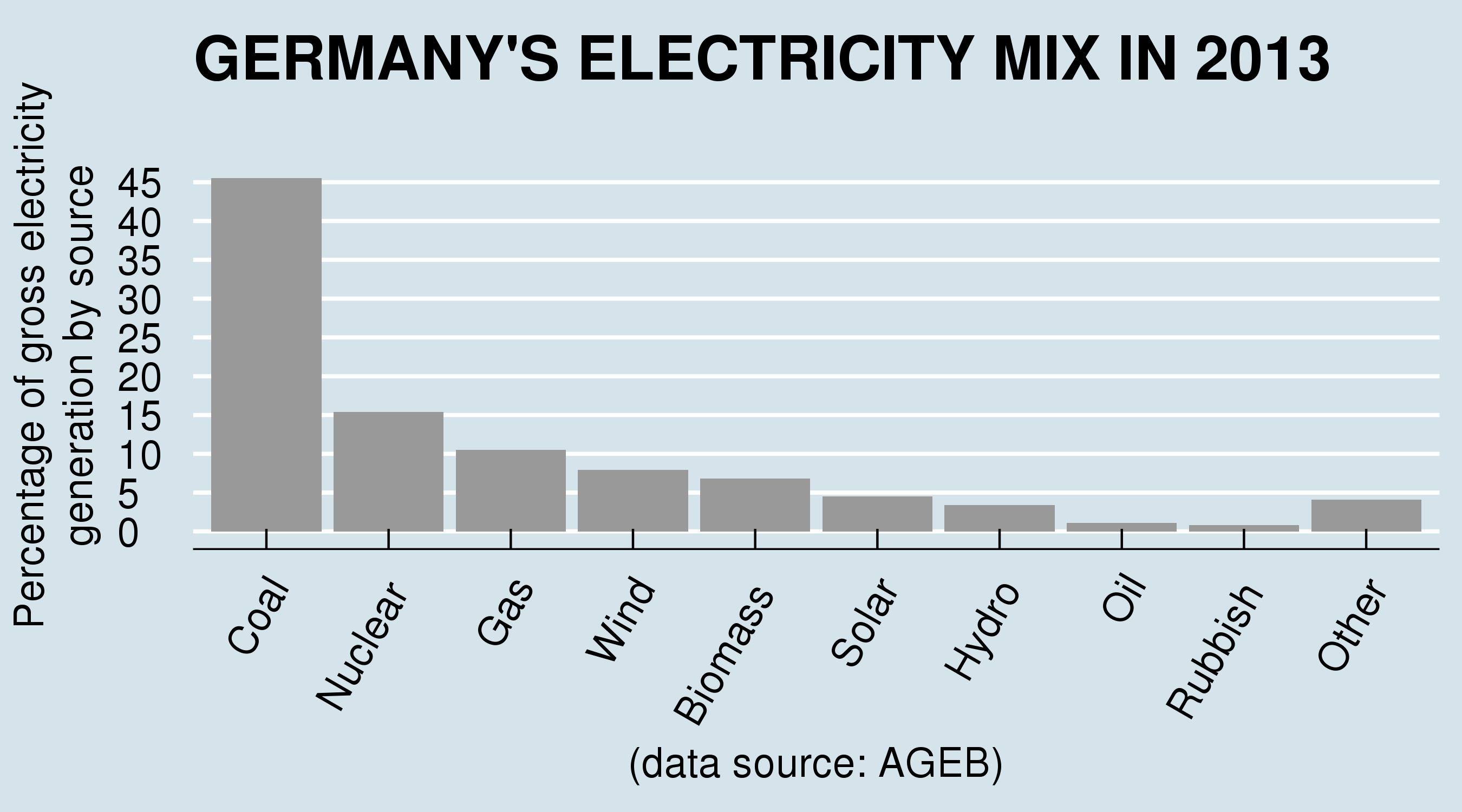
These statistics, then, make it clear that the “solar revolution” that has supposedly occurred in Germany is not worth the name, and is mostly just a combination of hype and wishful thinking. I can make this even clearer by comparing the growth of solar in Germany with that of more old fashioned forms of electricity generation.
Germany’s solar output varies massively during the year, and these variations can be made clear by a simple comparison. Daily output of Germany’s solar panels peaked last year on 21st of July, when panels produced 20.9% of daily electricity demand. In contrast, the worst day of the year was 18th January when solar panels produced just over 0.1% of Germany’s electricity demand. This second statistic has, unsurprisingly, failed to elicit any headlines.

During large stretches of winter Germany’s solar panels generate almost no electricity, with output from solar panels being fifteen times higher in July than in January last year. In addition, Germany’s annual consumption of electricity peaks in Winter evenings, when solar panels reliably generate no power. These simple realities mean that Germany, or any other cloudy and high latitude country, will struggle to generate truly revolutionary amounts of electricity from solar panels.
I will end with a simple calculation of how long it will take Germany to reach 50% solar electricity given current build rates.
The new German government has put in place a long-term target of having between 2.5 and 3.5 gigawatts of solar panels installed each year. If we take the higher figure, and assume that 3.5 gigawatts is installed each year, it will take Germany almost ninety years to reach 50% solar electricity. This however is an underestimate. Solar panels must be replaced every twenty or twenty fives years, and 50% solar energy in Germany would require massive advances in energy storage techniques. Germany, then, is around a century away from getting half of its electricity from solar panels.
Does this look like a revolution?
10 Comments on "Reality Check: Germany Does Not Get Half of its Energy from Solar Panels"
Plantagenet on Mon, 18th Aug 2014 11:47 am
Not only is Germany not 50% solar–Germany continues to build new coal-fired power plants. Germany’s CO2 output is still going up, at a time when more enlightened countries around the world are closing coal-fired power plants and reducing their CO2 production.
Dredd on Mon, 18th Aug 2014 12:19 pm
“Does this look like a revolution?”
No, it looks like propaganda against renewable energy by focusing on one element of the generation of renewable energy when there are many elements (solar thermal, wind, hydro, tidal, etc.).
Bragging about the use of dirty oil, dirty coal, or dirty gas is bragging about Civilization committing suicide.
sunweb on Mon, 18th Aug 2014 12:53 pm
Dredd – you sure read into that article what you want to read. The title is about solar panels, not renewables. It is about Germany which has very low, very low tidal component. I missed the bragging, I only read the information. You cheer leaders are so much fun.
And there are so many ways we are committing suicide including using devices of all kinds that require a fossil fuel supply system and a heavy industry infrastructure. Or do you have a magic wand to create solar panels out of thin air?
Westexasfanclub on Mon, 18th Aug 2014 1:45 pm
It’s not fair to look at photovoltaic generation only. It’s all about the mix. Quoting Wikipedia: “During the first six months of 2014, almost 31% of German electric power came from renewable sources.
On sunday may 11th renewables generated 74% of electricity at their peak. Of course this is easier to achieve on sunday when most of the industry is powered down. But anyway, all in all the numbers of renewables in Germany are looking increasingly good.
dissident on Mon, 18th Aug 2014 2:20 pm
Please, every source needs to be accurately analyzed and presented and not hidden in a lump of obfuscation. This reminds me of the so-called global “oil” production which is continuously revised to include things like biodiesel and presented as actual crude oil.
The wintertime solar output figures are truly pathetic. It means Germany and many other countries will have to use other energy sources to fill the gap for half the year. An article on Germany’s wind energy capacity and expansion plans would be interesting.
rockman on Mon, 18th Aug 2014 2:28 pm
Here’s a novel idea to end the arguments: First, how much electricity was produced in Germany over the last 12 months. Of that total how much came from each source: coal, oil, NG, solar, biofuels, etc. Next level: how many Btu’s were generated in the last 12 months in Germany along with the various sources such as solar thermal et al.
Can’t argue with the facts.
surf on Mon, 18th Aug 2014 3:33 pm
The claim that germany gets 50% from solar may come from an event earlier this year:
http://www.the9billion.com/2013/10/30/germany-59-percent-renewable-energy-peak/
On a windy sunny day with low demand they got a peak of 59% of their electricity from wind. Overall for the entire day they got 34.6%. The market price for electricity dropped to 2.75 cents per KWH. If people just look at the headline and forget about wind they would think that they got half the power from wind.
As to the new coal plants most were started over 10 to 15 years ago when the utilities doubted that wind and solar would have any substantual impact. Also laws at the time required stricter polution controls. At the time it made sense to build new ones to replace the older dirty ones.
When the utilities realised the mistake some were canceled or the construction was stopped.
http://www.sourcewatch.org/index.php/Germany_and_coal
The end result of the overbuilding of coal. With all the new wind and solar most coal plnats are struggling to stay solvent. The only way coal plants can pay the blls is by exporting power to other countries which is what is happening.
As to the claim
“In 1990, Britain got no electricity whatsoever from gas power plants. Yet, within one decade this went from zero to forty percent. This is a much more rapid growth than has been in German solar wind, or anything else. In fact, no country has grown any source of renewable electricity at such a speed.”
Today every year 40GW of wind GW is installed worldwide. Britton has a peak demand of about 59GW. So if someone had enough money the could beuild enough wind power is less than 10 years.
The above article debunked one Myth and then made it’s own errors.
Makati1 on Mon, 18th Aug 2014 8:02 pm
All of the ‘renewable’ junkies are out today. LOL
Too bad their idea of reality varies so far from the real thing.
andya on Tue, 19th Aug 2014 3:01 am
Big difference between capacity and output smurf.
Honestly if people were smrt enough to understand reality, we wouldn’t be where we are today. That fact that we are in the type of situation we are in, is enough evidence for me to judge humans as instinctive animals, not rational at all.
rockman on Tue, 19th Aug 2014 6:27 am
“So if someone had enough money they could build enough wind power is less than 10 years.” There’s no lack of money. What’s missing is a significant financial incentive to do. It does exist in some areas like Texas. But not everywhere.