
Peak Oil is You

Donate Bitcoins ;-) or Paypal :-)


Page added on January 5, 2018

In 2017, The Myth of Powering the World with 100% Renewables Has Started to Crack

When thinking about 2017, it is easy to see the bankruptcy of Westinghouse and the subsequent cancellation of its Summer project in South Carolina as this year’s big issue. But as the year has drawn to a close, the continuation of its AP1000 project at Plant Vogtle in Georgia has been approved by the regulator and there is every expectation that Westinghouse will emerge from bankruptcy in 2018.
So while important, to us there is a much more important defining issue for 2017. It is the very real start of a movement that recognizes that powering the world with 100% renewables is a myth – and that chasing a myth will not get us to our global goal of meeting the world’s increasing energy needs while reducing carbon emissions and successfully combating climate change.
There were a number of defining moments in 2017 that highlight this change in attitude.
First there was the paper published in the Proceedings of the National Academy of Sciences, “Evaluation of a proposal for reliable low-cost grid power with 100% wind, water, and solar”, by 21 prominent scientists taking issue with Mark Jacobson’s earlier study claiming that 100% renewables is feasible in the USA by 2050. In a nutshell, the paper found many poor assumptions in the Marc Jacobson paper and ultimately finds that its conclusion that 100% renewables in the United States by 2050 is false. And how does Marc Jacobson respond to this criticism? Does he review his work, make changes and then show that his conclusion remains valid? No, he does what some would do when their beliefs are under attack, he sues. This is one of the most shameful episodes of the year. A scientist suing when others disagree with him is just not the way things are done. Science is about skepticism and continuous questioning. A peer reviewed paper that is critical of another one is to be applauded and responded to, to continue the discussion. Suing those who disagree is simply not one of the options.
Second, we saw Germany called out for its lack of progress on decarbonization in recent years while holding COP23 in Bonn late this year. While massively investing in new renewables, these are unable to take the place of its closing nuclear plants, thereby making coal king in Europe’s most polluting nation. This story shows how a 12-thousand-year-old forest that has been almost completely consumed by the country’s ravenous addiction to coal power.
Other countries have seen the light as well. The UK is strongly committed to new build nuclear and Sweden and France have realized that removing nuclear from the mix will do nothing to achieve their climate goals. In Korea, the public decided to continue with a new build going against its new government’s policy.
And finally, we saw something this past year, we have not seen before – the rise of the pro-nuclear environmental NGO – as those who care about the environment and climate change are starting to realize that renewables alone is a path to nowhere. This includes such organizations as Environmental Progress, Energy for Humanity and Mothers for Nuclear.
A look at the 2017 edition of the World Energy Outlook tells an interesting story.
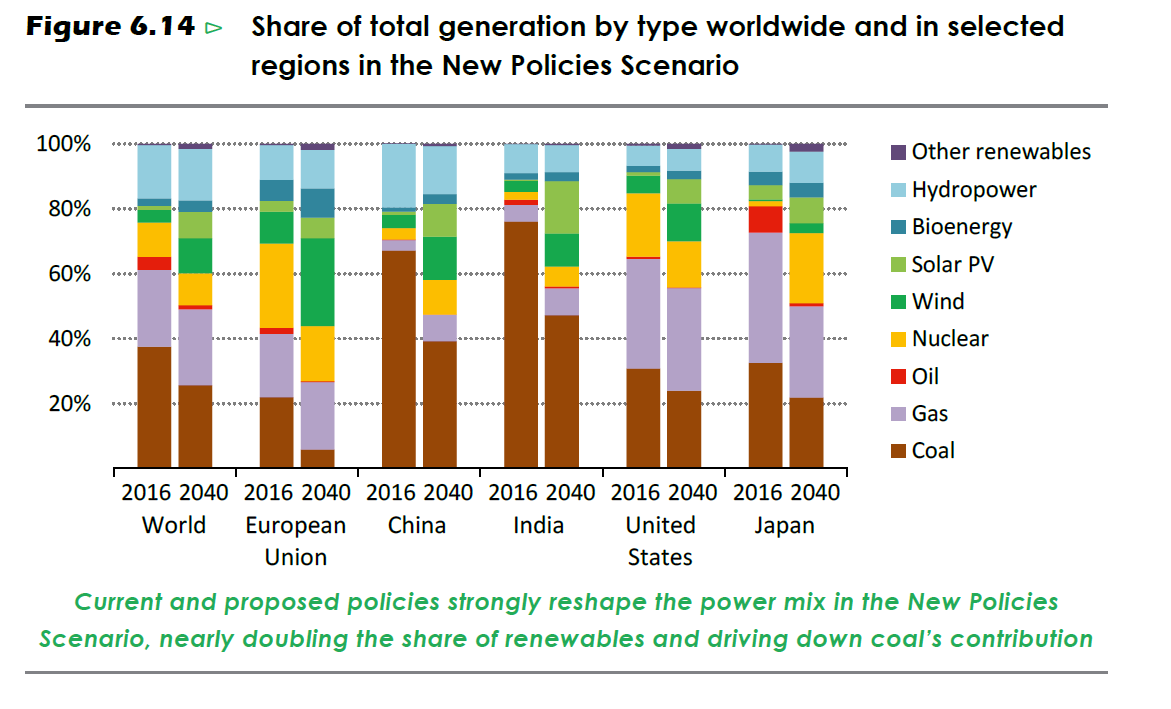
Source: World Energy Outlook 2017
Even with massive investment in renewable technology, fossil fuels remain king in electricity generation by 2040 still producing about half of all global electricity. Wind and solar increase to anywhere from 20% in the New Policy scenario to about a third of electricity generation in the Sustainable Development Scenario (the scenario that shows what can be done to meet Paris objectives). This is even though wind and solar make up about 45% of the total investment in new capacity and global subsidy for renewables grows from about $140 billion per year to $200 billion.
Looking deeper at the numbers, it can be seen that this investment results in a huge increase in wind and solar capacity of 5000 GW in the Sustainable Development Scenario. All other things being equal, this same amount of energy would only have required about 1500 GW of nuclear to be built since a nuclear plant produces about 3 times more energy than an equivalent size of solar plant and more than 4.5 times as much energy as wind capacity. And this is before any consideration of the intermittency of wind and solar and the needed improvements to systems to accommodate that – and of course the predominantly fossil backup needed for when the wind doesn’t blow, and the sun doesn’t shine.
What this shows is that wind and solar are good ways to reduce fossil use, probably by about 30% or so. But they are not good ways to REPLACE fossil fuels in their entirety. This must be done by more robust alternatives such as hydro and nuclear. These are the only large-scale base load options that are both reliable and low carbon available today.
And what about storage? Often, we hear that once storage technology improves, this will be what is needed for renewables to break free of their intermittency. Of course, this sounds better than it actually is. In reality, storage would be ideal for base load plants like nuclear where it can help store energy generated during times of low demand reducing the need to build new peaking generating plant. On the other hand, storing enough energy from wind and solar would require massive overbuilding of capacity to collect extra energy during the 20% of the time the sun is shining and the 30%, the wind is blowing.
Changing beliefs is hard. We live in a time when all opinions are considered valid, whether from experts or lay people. And most of all, people are challenging expert views as never before. Yes, it is a romantic view of the future to believe that all of our energy will come from energy sources such as the wind and the sun. But beliefs don’t change physics and if we really want to change the world, we need more nuclear power to replace a large portion of today’s fossil generation. Only then will we be on our way to a truly low carbon economy. We are under no illusion that this change is coming quickly, but 2017 saw the start. There are now cracks in the 100% renewable myth. It will take hard work and ongoing support from the new generation of pro-nuclear NGOs to keep broadening the crack in 2018 – and who knows? Maybe the tide will shift, and we will be on our way to a truly sustainable future.
Wishing you all a very happy and healthy new year!
56 Comments on "In 2017, The Myth of Powering the World with 100% Renewables Has Started to Crack"
MASTERMIND on Fri, 5th Jan 2018 6:21 pm
UC Davis Study: It Will Take 131 Years to Replace Oil with Alternatives (Malyshkina, 2010)
http://pubs.acs.org/doi/abs/10.1021/es100730q
University of Chicago Study: predicts world economy unlikely to stop relying on fossil fuels (Covert, 2016)
https://www.aeaweb.org/articles?id=10.1257/jep.30.1.117
Kevin Cobley on Fri, 5th Jan 2018 7:30 pm
It’s quite clear that the wasteful consumption of energy will have to end.
The US will need to have a much-reduced lifestyle, Public transit, Walking and Wearing Sweaters.
Ending of the disposable goods system.
coffeeguyzz on Fri, 5th Jan 2018 8:33 pm
I absolutely love when the totalitarians unabashedly show their true colors.
The derangement displayed above by Mr. Cobley is almost exceeded by the barely concealed coercion he and his comrades are all to eager to ram down the throats of the wider mass of ‘unwashed’.
You Menshoviks, who are the majority of posters who frequent this site, may be unfamiliar with the sadistic Bolsheviks who lurk in the shadows, and their sordid history, but many of us DO know … and are prepared to respond.
Makati1 on Fri, 5th Jan 2018 9:56 pm
Kevin, and that lifestyle is getting closer and closer for the US every day. Most are oblivious to the coming changes. Many see it but are in denial. A few are adjusting and prepping for it. And a few thousand are leaving the US every year for better places to live.
I wonder how many Americans would like to be here today? Sunny and 88F. About typical for the Ps year round. The only ice is in the cold drinks. My sister just said she has a wind chill of -18F in PA. A 106F difference.
MASTERMIND on Fri, 5th Jan 2018 11:17 pm
Madkat
When the global economy collapses your country will crush like a paper bag!
Makati1 on Fri, 5th Jan 2018 11:55 pm
MM, “My country” is the US and you are correct about the US bursting like a popped balloon. It is already happening in slow motion. Real wages are shrinking. Real unemployment is growing, along with suicides and a shrinking life expectancy. The US is devolving.
Whereas, the Ps are, and will be, aligned more with Russia and China and their money system. They already are in the banks here and the ATMs are connected to Russia’s new finance system.
The Ps will not be as affected as the US. Some changes are going to happen here, but the US has much, much farther to fall and it will happen faster there than anywhere else in the world. You live in a corporate police state, MM. Not a democracy.
Cloggie on Sat, 6th Jan 2018 12:02 am
http://www.spiegel.de/spiegel/millionen-amerikaner-aus-der-mittelschicht-sind-abhaengig-von-heroin-a-1162602.html
“Heroin is destroying the American middle class”
Says US vassal media der Spiegel.
Makati1 on Sat, 6th Jan 2018 12:17 am
“Millennial Deaths Surge As Opioid Crisis Deepens” (US)
“…many young millennials who are trapped in the real economy with high debts and wage stagnation are dying at an alarming clip. …
The figures are so concerning that millennials deaths have shifted the overall life expectancy rate for the United States lower for the second consecutive year. …
According to the latest data from the Centers for Disease Control and prevention (CDC), 129 out of every 100,000 25-34-year-old US adults died in 2016. The last time these levels were seen it was 1995, at the height of the HIV/AIDS epidemic….
Unfortunately, the opioid crisis will only get worse as it consumes the millennial generation,…”
https://www.zerohedge.com/news/2018-01-05/millennial-deaths-surge-opioid-crisis-deepens
Slip slidin’ to the 3rd world…
Cloggie on Sat, 6th Jan 2018 12:25 am
http://mzconsultinginc.com
“Expert and Independent Nuclear Energy Advisory Services”
MASTERMIND on Sat, 6th Jan 2018 12:42 am
Madkat and Clogg
Global Economic Growth GDP Per Capita (1.3%)
https://data.worldbank.org/indicator/NY.GDP.PCAP.KD.ZG
The whole world is in another depression! Wake up you two are so brainwashed! Anti America scum!
MASTERMIND on Sat, 6th Jan 2018 12:45 am
Collapsing ceilings and no working toilets: Sears workers describe decay in failing stores
http://www.businessinsider.com/sears-stores-are-falling-apart-employees-say-2017-6
Go Speed Racer on Sat, 6th Jan 2018 1:37 am
Of course we can power the world with
100% renewables.
There is an unlimited supply of old sofa’s
and old tires, easy to set on fire.
It is a 100% renewable energy source
because sofa’s get old, and have to be
replaced. Especially after Mick spills
beer down the cushions.
Makati1 on Sat, 6th Jan 2018 1:50 am
Funny MM. GDP growth in most Asian countries is above 6%/year. It is the Western countries that are declining with less than 1%/year. Real numbers would show that the West is actually contracting GDP.
BTW: The demise of US corporations that have existed and been profitable for over 100 years, like Sears, should be a wake-up call that the US is already collapsing.
Asia is building new infrastructure. The US infrastructure is collapsing faster and faster.
Cloggie on Sat, 6th Jan 2018 2:04 am
The whole world is in another depression!
Dream on, Europe is booming. Holland #1 in western Europe, Germany good second. Even Spain, Portugal and Greece are doing fine:
http://www.spiegel.de/wirtschaft/soziales/wieso-deutschland-den-euro-suedstaaten-eine-entschuldigung-schuldet-a-1186297.html
But the highest growth rates are in Eastern Europe. Romania 5%.
This gives Europe unprecedented means to push through the renewable energy revolution and prepare ourselves for a future where all the “fuel” will come for free, where the rest of the world will be stuck with ever higher fossil fuel prices for a fuel that is ever more difficult to mine, even though the fossil fuel reserves (coal!) are virtually endless and Britain (for starters) has the potential to become the Saudi-Arabia of underground gasified coal.
90% of new energy capacity in Europe is renewable, which means that renewables have one, for the simple reason that renewables are the cheapest.
Now I know what Antius is going to say (correctly): the first 0-30% share renewables are easy because you do not need to take storage into consideration.
True.
But this will be offset by rapidly declining cost for renewable infrastructure (wind turbines, panels) and storage facilities: H2, methanol, NH3, pumped hydro, biomass, to the name the most important ones.
Zero fuel cost will outweigh extra cost for storage. Don’t believe me, it has been calculated already in an simulated/optimized integral energy model:
https://www.ise.fraunhofer.de/content/dam/ise/en/documents/publications/studies/What-will-the-energy-transformation-cost.pdf
In Europe all the mart money goes into renewables, because they are the cheapest. The latest North Sea offshore wind tenders are given to the developers who do it for free. No subsidy required for turbines or produced kwh’s. Society only needs to worry about distributing these renewable kwh’s and storage, which is gradually becoming more important. Here a very promising example in France where 700 MW hydrogen storage is being developed with Norwegian technology:
https://deepresource.wordpress.com/2017/12/28/700-mw-renewable-hydrogen-plant-to-be-built-in-france/
Renewable produced hydrogen (electrolysis of steam) will be mixed with natural gas and transported in a conventional network and as such reduce CO2-emission. In Holland a power station is refactored to burn (Norwegian) hydrogen:
https://deepresource.wordpress.com/2017/08/09/first-climate-neutral-power-station-in-the-netherlands/
And remember:
Denmark = wind (Vestas, DONG/Orsted)
Norway = hydrogen (Norsk Hydro –> heavy water)
Cloggie on Sat, 6th Jan 2018 3:25 am
The article originates from a nuclear energy consultancy and unsurprisingly promotes nuclear energy, which is OK, as long as you are aware of it. The whole point of the article is to defend the interests of the nuclear industry and to (falsely) claim that it is impossible to have a 100% renewable energy in the long term. The nuclear industry wants a slice of the energy pie as well. MZ is with the back against the wall and fighting for its economic survival.
What is of real interest is of course their arguments. The main claim to fame for nuclear is of course the absence of CO2-emissions. The do not lose any word about the cost if things go wrong. And if nuclear goes wrong, it goes terribly wrong.
They do not exclude renewable energy but instead promote a mix. To return the favor, I do not advocate a too rapid closure of nuclear power stations either. In the best case old nuclear and fossil power stations need to be written off gradually during their economic life time in order to avoid unnecessary high costs for society.
The uncertain factor is climate. In a situation of runaway climate change at least the fossil fuel power plants need to be written off faster than economy would dictate.
First of all they make fun of a lonely American voice Marc Jacobson, who in the midst of fossil fuel champ USA makes the case of US 100% renewable energy by 2050, thereby mimicking the EU, that has that ambition for Europe for much longer already [*].
Details about the Jacobson lawsuit:
https://www.greentechmedia.com/articles/read/mark-jacobson-files-lawsuit-over-critique-of-100-percent-renewables#gs.mDl1z8k
For the record, I believe in 100% renewable energy base (2050 or even earlier if necessary), but I also believe in free speech. So, unless there is personal libel against Jacobson involved, I’m against law suits on academic matters. The issue seems to be false citations from Jacobson’s work, who places all his bets on pumped hydro storage, where this is premature and other promising options do exist, first and foremost good old hydrogen.
Next they note that Germany is not too successful lately in curtailing emissions, which is purely the result of the economic boom in continental Europe lately (#GoldenDecade).
I’m absolutely unaware of any significant public pro-nuke movement like “Mothers for Nuclear”.lol
Even with massive investment in renewable technology, fossil fuels remain king in electricity generation by 2040 still producing about half of all global electricity.
That may be true for “the world”, but absolutely not for the #1 scientific/technological power house on this planet, I mean Europe. And if you want to know the future of the world, look at Europe first, now that the US is slowly descending into third world status.
All other things being equal, this same amount of energy would only have required about 1500 GW of nuclear to be built since a nuclear plant produces about 3 times more energy than an equivalent size of solar plant and more than 4.5 times as much energy as wind capacity.
Absolutely BS. Currently modern North Sea wind parks have a capacity factor of 50% name plate power. And nuclear power stations do not have 100% either. The factor is less than 2, not 4.5.
What this shows is that wind and solar are good ways to reduce fossil use, probably by about 30% or so. But they are not good ways to REPLACE fossil fuels in their entirety. This must be done by more robust alternatives such as hydro and nuclear.
More BS. We agree about the need to get rid of fossil (emissions, climate). Hydro can’t step in as there is not enough, although there is more than enough capacity to use pumped hydro as storage facility. A single massive bassin in Scotland alone should suffice to provide the entire EU with all the storage it needs or as Jacobson proposes for the US. But hydro energy, no. That leaves nuclear. But that won’t work either as the world is running out of uranium. If the world would hypothetically switch to 100% nuclear, uranium would run out in 14 years. Duh. Of course there is a work-around: the world one giant Sellafield.
https://en.wikipedia.org/wiki/Sellafield
That means operating an energy economy on the basis of plutonium. This might perhaps function for a century or so without major accidents in a top-of-the-bill country like Britain, but absolutely not for the third world. Africans, Muslims, Indians and plutonium: A complete nightmare. Obviously MZ doesn’t mention this necessity.
Article –> garbage bin.
[*] – actually it is 90%, so the remaining 10% can still be reserved for fossil and as such alleviate storage problems. I absolutely cannot see why storage in the form of H2/NH3/methanol cannot replace fossil for 100% eventually.
Davy on Sat, 6th Jan 2018 5:11 am
“Whereas, the Ps are, and will be, aligned more with Russia and China and their money system. They already are in the banks here and the ATMs are connected to Russia’s new finance system.”
Wow, mad kat, have any references to how many ruble ATM’s there are in the P’s? Do you even know any details on what this money system is and does? What does that ATM spit out roubles? Somehow I think the Russian version of the SWIFT system is not going to be too interested in a few Filipino ATM’s. More dumbass out of the board wingnut.
Davy on Sat, 6th Jan 2018 5:15 am
“The Ps will not be as affected as the US. Some changes are going to happen here, but the US has much, much farther to fall and it will happen faster there than anywhere else in the world.”
You have starvation awaiting you mad kat when the fall comes. YOU, personally don’t have much of a chance being 75 without health insurance. You are already past your life expectancy because you now live in a 3rd world without access to quality health care. One bad sickness and you are gone.
Davy on Sat, 6th Jan 2018 5:29 am
“Heroin is destroying the American middle class”
“Number of people in the U.S. who used selected illicit drugs in the past year as of 2016 (in 1,000)”
https://tinyurl.com/yc4qwscl
Nedernazi and mad kat peddling anti-American hype as usual. Drug abuse has increased and the opioid crisis is worsening but nothing like these wingnuts want you to believe. They love the MSM hype when it benefits their agenda.
Davy on Sat, 6th Jan 2018 5:33 am
“Funny MM. GDP growth in most Asian countries is above 6%/year. It is the Western countries that are declining with less than 1%/year. Real numbers would show that the West is actually contracting GDP.”
Funny, mad kat, that is what overpopulation does it creates growth. Take for example the P’s, you have a similar GDP to my state of Missouri with 16 times the population and your population is still growing fast.
“Real numbers would show that the West is actually contracting GDP”
Real numbers show Asia’s growth is mostly bad debt type malinvestment and overcapacity in heavy industry with no future.
Davy on Sat, 6th Jan 2018 5:41 am
“Dream on, Europe is booming. Holland #1 in western Europe, Germany good second. Even Spain, Portugal and Greece are doing fine:”
BS, Europe is cranked up on quantitative easing and negative rates. What a joke.
“This gives Europe unprecedented means to push through the renewable energy revolution and prepare ourselves for a future where all the “fuel” will come for free”
LMFAO, free fuel folks. What a complete dumbass!
“90% of new energy capacity in Europe is renewable, which means that renewables have one, for the simple reason that renewables are the cheapest.”
Nedernazi, what percent of this new capacity represents total primary energy?
“But this will be offset by rapidly declining cost for renewable infrastructure (wind turbines, panels) and storage facilities: H2, methanol, NH3, pumped hydro, biomass, to the name the most important ones.”
Do you have any numbers on the rapidly declining cost of storage? Nope, because you have almost none to talk about you cheerleading clown.
TheNationalist on Sat, 6th Jan 2018 5:46 am
Meanwhile here in Australia we move to renewables at a faster rate. We know have the best from Europe and America helping us and we can lead from the front.
Happy New Year Everybody and 88F is nothing MadcattyMcKatti it is 118F here!
Good for solar mind you!
http://www.abc.net.au/news/2018-01-05/sa-cities-could-become-australian-renewable-energy-centre/9306318?section=business
http://www.abc.net.au/news/2017-02-22/which-companies-are-vying-for-renewable-energy-funding-in-sa/8290736
TheNationalist on Sat, 6th Jan 2018 5:47 am
*now
joe on Sat, 6th Jan 2018 5:54 am
Davy, stop pointing out the obvious. It doesn’t work on some people here. I’ve been saying for years here that low rates and QE has been paying the tab since 07. Nobody wants to know. It’s paid for tight oil and social stability. But not forever.
Davy on Sat, 6th Jan 2018 6:44 am
“Davy, stop pointing out the obvious.”
Yea, the nedernazi and mad kat are intellectually juvenile is pretty obvious.
Cloggie on Sat, 6th Jan 2018 6:51 am
BS, Europe is cranked up on quantitative easing and negative rates.
Mwao, it is more like 0% en what is so bad about QE if inflation remains low.
https://www.ecb.europa.eu/stats/policy_and_exchange_rates/key_ecb_interest_rates/html/index.en.html
https://www.ecb.europa.eu/explainers/show-me/html/app_infographic.en.html
The ECB started buying assets from commercial banks in March 2015 as part of its non-standard monetary policy measures. These asset purchases, also known as quantitative easing or QE, support economic growth across the euro area and help us return to inflation levels below, but close to, 2%.
But I’m sure that the forum collapsenik manages to sense an impending collapse somewhere.
Shrug.
LMFAO, free fuel folks. What a complete dumbass!
I hope that Davy pretends to be that stupid, but somehow I fear he actually IS that stupid. Don’t know bout Christ invoicing for his Missouri deplorables for his beneficial solar rays, but in Holland they come for free. I got my 1500 solar kWh last year without having to pay a tired dime to the Good Lawd. Wind same story. That’s what I mean with saying that with wind and solar, the “fuel” comes for free.
what percent of this new capacity represents total primary energy?
I have given them to you and millimind often enough. Having memory problems? Dementia slowly creeping in?
Do you have any numbers on the rapidly declining cost of storage?
Everybody in Europe and to a lesser extent in the US is working on storage as everybody understands that storage is currently THE bottleneck in the renewable energy designs of the EU, now that solar and wind have largely matured. Great progress is achieved in many fields, hence cost reductions:
https://deepresource.wordpress.com/2017/12/11/high-temperature-electrolysis/
https://deepresource.wordpress.com/2017/08/21/amadeus-1414-degrees-energy-storage/
https://deepresource.wordpress.com/2017/09/18/liquid-air-energy-storage/
In the US a lot of progress materialized in the field of batteries, important for cars, planes and short term domestic storage:
https://deepresource.wordpress.com/2016/01/05/breakthrough-battery-technology-65kwh/
https://deepresource.wordpress.com/2017/03/17/storage-breakthrough-100kwh-has-been-achieved/
https://deepresource.wordpress.com/2017/04/15/cheap-electricity-storage-for-households-underway/
https://deepresource.wordpress.com/2017/10/12/aqueous-sulfur-flow-battery-for-ultralow-cost-long-duration-electrical-storage/
I think that most storage will come from a combination of hydrogen and pumped hydro, with a minor role for batteries.
MASTERMIND on Sat, 6th Jan 2018 7:10 am
The Great Depression 1929-1940 US Economic Growth GDP (1%)
https://en.wikipedia.org/wiki/Great_Depression
The Great Recession 2006-2017 US Economic Growth GDP (1.5%)
https://www.statista.com/statistics/188165/annual-gdp-growth-of-the-united-states-since-1990/
The Great Recession 2006-2017 US Economic Growth GDP Per Capita (0.4%)
https://data.worldbank.org/indicator/NY.GDP.PCAP.KD.ZG?locations=US
OCED Economic Growth GDP Per Capita 1970-2015 (0.5%)
https://imgur.com/a/HXBkr#Bv4I4AF
Global Economic Growth GDP Per Capita (1.3%)
https://data.worldbank.org/indicator/NY.GDP.PCAP.KD.ZG
World Governments Gross Debt to GDP (330%)
https://imgur.com/a/3usX7
Non Partisan CBO Office Forecast Less Than 2% US Economic Growth GDP Through 2027
https://www.cbo.gov/publication/52801
*Note: 20% GDP Includes (FIRE) finance, insurance and real estate
tahoe1780 on Sat, 6th Jan 2018 9:29 am
https://www.youtube.com/watch?v=SIP0O1NJVZA
Too little, too late. The carbon (and methane) is already up there.
https://www.youtube.com/watch?v=UQuv8fETfME
Peak Oil won’t help.
Davy on Sat, 6th Jan 2018 11:46 am
“Mwao, it is more like 0% en what is so bad about QE if inflation remains low.”
You realize there is not one rate, right. There are various rates depending on the country bonds, business bonds, and other official rates. The biggest distortion are with bonds in Europe where real rates do not reflect real economic reality. This all hinges on the ECB buying spree. The ECB is running out of bonds to buy which is a sign the program is running into limits, what then?
“Shrug.”
Right, nedernazi, shrug is all you can do because real economic strength is suspect. Inflation is very low indicating low potential. Structural unemployment is very high in places. Exceptional European economic strength is a nothing burger.
“In Holland they come for free. I got my 1500 solar kWh last year without having to pay a tired dime to the Good Lawd. Wind same story. That’s what I mean with saying that with wind and solar, the “fuel” comes for free.”
Nothing is free nedernazi, alternative energy systems must be depreciated and they have an initial cost that must be amortized. Saying fuel is free is more of your nedernazi subterfuge of deception.
“I have given them to you and millimind often enough. Having memory problems? Dementia slowly creeping in?”
The reason you don’t post those numbers is it makes your agenda you peddle look less than the fantastic. You are cheerleading something that isn’t reality yet. IOW, you are a FRAUD.
(earlier comment)“But this will be offset by rapidly declining cost for renewable infrastructure (wind turbines, panels) and storage facilities: H2, methanol, NH3, pumped hydro, biomass, to the name the most important ones.”
“Everybody in Europe and to a lesser extent in the US is working on storage as everybody understands that storage is currently THE bottleneck in the renewable energy designs of the EU, now that solar and wind have largely matured. Great progress is achieved in many fields, hence cost reductions”
If you refer to your comments you are already claiming rapidly declining storage facilities???? Sorry you don’t have them yet at a quantitative level you can make that claim. Where is the progress on the ground with working systems? There are very few and even fewer of the exotic storage systems being paraded around by you. You can’t claim something that is not reality yet. The rapidly rising systematic cost once renewables cross the 30%-50% threshold are about to confront you. Just claiming panels and turbines are rapidly falling is a hollow claim.
Kenz300 on Sat, 6th Jan 2018 12:07 pm
Two-thirds of world’s new energy capacity in 2016 was renewable: IEA
http://www.greencarreports.com/news/1113115_two-thirds-of-worlds-new-energy-capacity-in-2016-was-renewable-iea
Battery storage is a game changer making wind and solar base line power.
Clean energy production with solar panels / tiles and battery storage.
Clean energy consumption with electric vehicles. No emissions.
Sign me up. A new solar roof, battery storage, an electric car charger and an electric vehicle.
Solar panels are now being projected to have a much longer life than just a few years ago.
Dredd on Sat, 6th Jan 2018 3:47 pm
“The Myth of Powering the World”
The world was never powered before Oil-Qaeda eh MZZZZZZZZZZZZZZZZZZZZZZZZZ ConBsing?
(The Authoritarianism of Climate Change)
Antius on Sat, 6th Jan 2018 4:57 pm
Cloggie, one new Danish offshore wind farm has demonstrated 48.9% capacity factor in the first 4.7 years of its life. But the average for all Danish offshore wind is 41.6%.
http://energynumbers.info/capacity-factors-at-danish-offshore-wind-farms
It remains to be seen if average capacity factor for this single, relatively new wind farm can eventually be made typical for the all North Sea wind. Maybe it can. In time we will see. UK offshore wind farms have average capacity factor of 37.2. Better than it has been in the past, but not anything like 50%.
http://energynumbers.info/uk-offshore-wind-capacity-factors
There is a lot more to say on this thread, but I will save it for tomorrow.
Dooma on Sat, 6th Jan 2018 5:48 pm
Davy, your comments about Asia having a terminally ill economical outlook is simply untrue.
Vietnam is going through a very solid patch of growth. Figures that both of our countries would love to have.
May I suggest that you do some research before you make sweeping accusations? In fact, why not get out of your fish bowl and actually visit some of these countries as I have and see it with your own eyes?
This would be far more credible than regurgitating “stories” you read on the net. I sense that the growth of Asia is a really difficult concept for you to get used to.
Davy on Sat, 6th Jan 2018 6:05 pm
“Davy, your comments about Asia having a terminally ill economical outlook is simply untrue.”
Where did I say it was terminally ill? That’s because I didn’t. That is a typical intellectually lame accusation by someone looking to attack not debate. I said the rate of growth is likely clouded with bad debt, malinvestment, and overcapacity or do you deny these things? Do you know what health growth is or are you like your buddy mad kat and believe big numbers = good and small numbers = bad?
“Vietnam is going through a very solid patch of growth. Figures that both of our countries would love to have.”
Vietnam is a 3rd world country and not a good comparison to the US or Australia.
“May I suggest that you do some research before you make sweeping accusations? In fact, why not get out of your fish bowl and actually visit some of these countries as I have and see it with your own eyes?”
Zero interest in going to Asia. I am into localization and not into contributing more CO2 to a global problem. I know you could give a shit about CO2 levels because you are always bragging about your travels. I live what I preach. What fish bowl dooma? I doubt you being in these countries will be a enlightenment for you on whether they have growth or not. You are not at all an expert and would have no clue what to look for.
“This would be far more credible than regurgitating “stories” you read on the net. I sense that the growth of Asia is a really difficult concept for you to get used to.”
Do you have any references for the stories in question? I sense you just want to fuck with an American because you hate Americans. Is that fish bowl enough for you dooma.
Makati1 on Sat, 6th Jan 2018 6:06 pm
Dooma, he just cannot admit that there are places in the world that are not suffering the decline that the US is. I doubt he will ever admit that there are places in the world that are better than living in the US. Most Asian countries are experiencing significant growth and improvement in many areas.
Those who never get out of the US, or even the state they live in, are reliant on the propaganda the US MSM spews out all of the time. The real world doesn’t exist for them.
Davy on Sat, 6th Jan 2018 6:13 pm
“Dooma, he just cannot admit that there are places in the world that are not suffering the decline that the US is. I doubt he will ever admit that there are places in the world that are better than living in the US. Most Asian countries are experiencing significant growth and improvement in many areas.”
Well one thing is obvious mad kat and dooma are no economic experts but they are anti-American experts specializing in comments that focus on any bad they can find in regards to the country they hate. As for finance or economic understanding I would put both of them at the bottom of the list of people that comment here. They are strictly looking to cherry pick numbers for negative effect. FRAUD
Cloggie on Sun, 7th Jan 2018 3:56 am
Autonomous 1p E-taxi beginning test rides in Tokyo. Passengers report “scary experiences”, comparable to those of the first rail passengers in Britain, 1830:
https://www.youtube.com/watch?v=GjnbTcI8oCc
http://www.spiegel.de/auto/fahrberichte/smart-vision-eq-gib-dir-die-kugel-a-1185268.html
Go Speed Racer on Sun, 7th Jan 2018 3:58 am
Greetings to Clogster and Ants on us,
those windmill statistics are completely
bogus. The capacity factor is usually
about 5% … proving that windmills produce
very little energy.
And they are ugly, vandalizing the pretty
landscape views.
The only thing that keeps the blades turning
is they are net energy negative, actually
drawing power from the grid to spin the
blades around.
The world should immediately switch over
to garbage incineration fires, as a proper
renewable energy source.
dave thompson on Sun, 7th Jan 2018 4:14 am
What are ocean wind towers made of? How long before the rust away into nothing?
Cloggie on Sun, 7th Jan 2018 4:17 am
Cloggie, one new Danish offshore wind farm has demonstrated 48.9% capacity factor in the first 4.7 years of its life. But the average for all Danish offshore wind is 41.6%.
From your own link, Anholt-1 has 53% (commission date September 2013). Expect this number to rise slightly more as offshore technology matures.
https://en.wikipedia.org/wiki/Anholt_Offshore_Wind_Farm
https://cleantechnica.com/2012/07/27/wind-turbine-net-capacity-factor-50-the-new-normal/
“Wind Turbine Net Capacity Factor — 50% the New Normal?”
http://euanmearns.com/uk-offshore-wind-capacity-factors-a-semi-statistical-analysis/
“UK offshore wind farm coming on line in 2017 can be assumed to have a capacity factor of around 41%, although projections indicate that the turbines planned for the Hornsea II farm discussed in previous posts could have capacity factors exceeding 60%.”
Cloggie on Sun, 7th Jan 2018 4:28 am
What are ocean wind towers made of? How long before the rust away into nothing?
Steel.
http://geminiwindpark.nl/e_hwh.html
Corrosion protection
When steel structures are submerged in seawater, corrosion occurs. To prevent this, Gemini will employ an advanced impressed current cathodic protection system. Four electrical anodes will be premounted equidistant around the exterior circumference of the transition piece, and four more will be mounted to the interior. The combination of seawater, steel and the direct electrical current passing through the anodes will create a neutral, non-corrosive environment on the TP and the MP to the mudline.
Oldest steel ship in the world:
https://en.wikipedia.org/wiki/HMS_Warrior_(1860)
10 years ago I visited the ship from 1860 in Portsmouth to verify that the ship is still doing fine as a museum ship, lying for 150 years in salt water, with no end in sight.
Sea water corrosion is NOT a problem in offshore wind, provided precautions are taken.
Davy on Sun, 7th Jan 2018 5:47 am
“Sea water corrosion is NOT a problem in offshore wind, provided precautions are taken.”
That is a pretty cavalier attitude. Anyone who thinks they can developed the ocean as Europe is doing with all these wind farms is quite naive to how powerful and dangerous the ocean is. This is especially true of the coming age of climate instability. I am sure technology will make these towers very resistant but I am sure the ocean will present challenges that one day when the world is no longer prosperous, that will leave them vulnerable because the fix will not be available or the maintenance not affordable. HUBRIS
dave thompson on Sun, 7th Jan 2018 6:24 am
Ok Cloggie you win. But please come back in the future and tell me how wonderful wind and solar are replacing the burning of FF. So far world wide the burning of FF year over year only gets higher.
Cloggie on Sun, 7th Jan 2018 6:53 am
But please come back in the future and tell me how wonderful wind and solar are replacing the burning of FF. So far world wide the burning of FF year over year only gets higher.
That’s a luxury problem. Unlike the ASPO2000 peak oil crowd predicted, Mother Earth is still willing to cough up far more fossil fuel than ASPO predicted. The conventional peak oil story millimind is still pushing may be true, but is irrelevant at the same time, as there are near limitless fossil alternatives for conventional oil:
– shale oil
– massive amounts of sub-sea coal ready to be gasified
– methane hydrates
There is more than enough fossil fuel available to enable the renewable energy transition world-wide in this century. That is the new insight that emerged after 2012. Do not worry about energy. Instead worry about climate (but don’t exaggerate). Just carry out the Paris Accords and we will probably be fine, more or less.
And if not, it was nice to have known you all.lol
Antius on Mon, 8th Jan 2018 5:46 am
“From your own link, Anholt-1 has 53% (commission date September 2013). Expect this number to rise slightly more as offshore technology matures.”
No. Anholt-1 has 48.9% capacity factor (so far). And it does not appear to be typical. We do not know how much of it’s relatively high capacity factor is due to local effects at it’s specific location. The average for all Danish projects is 41.6%. Impressive, but not quite what you are claiming.
“Oldest steel ship in the world:
https://en.wikipedia.org/wiki/HMS_Warrior_(1860)
10 years ago I visited the ship from 1860 in Portsmouth to verify that the ship is still doing fine as a museum ship, lying for 150 years in salt water, with no end in sight.
Sea water corrosion is NOT a problem in offshore wind, provided precautions are taken.”
False. Historically, both North Sea oil platforms and the global tanker fleet have average hull life of 20 years. Do you have any reason to suppose that your wind turbines will buck this long established average?
You seem to suffer from best case fallacy. You take an example of something that has done unusually well or lasted an unusually long time and then present that as what can be expected as typical. It’s kind of like assuming you are going to live 120 years because someone somewhere did.
Antius on Mon, 8th Jan 2018 5:58 am
“– shale oil
– massive amounts of sub-sea coal ready to be gasified
– methane hydrates
There is more than enough fossil fuel available to enable the renewable energy transition world-wide in this century. That is the new insight that emerged after 2012. Do not worry about energy. Instead worry about climate (but don’t exaggerate). Just carry out the Paris Accords and we will probably be fine, more or less.”
All of it low EROI and therefore not useful for sustaining the way of life to which we have grown accustomed, using the systems we have built.
In a way you are correct about European countries being in a better position, though it has little to do with renewable energy and more to do with efficiency.
Your native Netherlands has high population density and has long pursued a policy of compact living arrangements. Most of the population live in apartments and cities are navigable on foot. Public transport focuses heavily on rail based solutions that are electrically powered. Whilst the lack of personal space isn’t ideal from a quality of life perspective, this does make for a relatively energy efficient way of living. What little land you do have is productive arable farmland.
Contrast that to the US, where the population is much more dispersed and would find it very difficult to carry out every day travel and heat their large living spaces without using fossil fuels. The future favours those that are efficient.
Davy on Mon, 8th Jan 2018 6:10 am
“You seem to suffer from best case fallacy.”
If this agenda peddling was not bad enough add to that a hyper nationalism combined with highly critical expose of anything non-European. If all that was not annoying enough he also floods the board with this polarizing message.
Antius on Mon, 8th Jan 2018 6:17 am
“90% of new energy capacity in Europe is renewable, which means that renewables have one, for the simple reason that renewables are the cheapest.
Now I know what Antius is going to say (correctly): the first 0-30% share renewables are easy because you do not need to take storage into consideration.
True.
But this will be offset by rapidly declining cost for renewable infrastructure (wind turbines, panels) and storage facilities: H2, methanol, NH3, pumped hydro, biomass, to the name the most important ones.”
Not likely, at least in the next few decades. The embodied energy of available storage technologies would appear to be too high.
https://www.researchgate.net/publication/255770835_On_the_importance_of_reducing_the_energetic_and_material_demands_of_electrical_energy_storage
This is a tough nut to crack. You need a storage mechanism with high energy density, low embodied energy, high efficiency and preferably long life. This is why I was interested in fossil fuel upgrading (coal to methanol).
Davy on Mon, 8th Jan 2018 6:44 am
I would expand and clarify the broad idea of efficiency. Efficiency for the sake of increased performance and or cost reductions suffers diminishing returns leading to less efficiency. Poor economic decisions in the name of efficiency can result in an overall macro decline in efficiency, IOW, malinvestment. Economic efficiency without mandates promotes unstable carrying capacities and or unstable complexities. Increased efficiency in a free choice environment also promotes more consumption at a time when demand management is critical because of overconsumption (sprawl).
We need to consider beneficial alternatives to efficiency. Resilience and sustainability are likewise vital and in many cases this means less economic efficiency and performance. Resilience and sustainability related to localism, seasonality and intermittency are a few of these alternatives to traditional modern efficiency strategies. The most important addition to efficiency is a starting point of a proper population and consumption levels. To get to a proper mentality of quality of life balanced with ecological needs we need education focused on these issues. The results ideally would be a wisdom based demand management for a new paradigm of human overshoot. Until we accept we are in overshoot we will likely not have a focus on education. The focus will be economic performance based efficiency that are market driven.
Antius on Mon, 8th Jan 2018 6:46 am
The improving capacity factor of new offshore wind farms appears to be due to increasing hub height. Presumably, this is due to more constant wind speeds at greater height.
http://euanmearns.com/uk-offshore-wind-capacity-factors-a-semi-statistical-analysis/
A 50% capacity factor would be useful if it can be rolled out across all new wind projects. At the very least, it would reduce the amount of fuel burned in back-up power plants. But this would be only a modest cost saving. It would be more useful if we could meaningfully reduce the number of back-up plants or storage facilities needed to maintain a baseload supply. If the variability of the power source is lower and say, the power output never drops below 30%, it would mean that back-up plants only need to cover 70% load. If on the other hand, output still drops close to zero occasionally and we still have lull periods lasting a week, the benefit would be modest.
Antius on Mon, 8th Jan 2018 7:03 am
Davy, I don’t think it’s that complicated. It is basically a question of GDP per unit energy.
The US population is more spread-out and very much suburbanised. In one sense, it has more resources in terms of land on which its population could grow biofuels and food. The downside is, the added distance is something you have to traverse every day in order to get to work, to buy food, to visit relatives, etc. Transportation distances are much greater in the US and much more of it has to go over land than sea. Likewise, US living spaces are larger, which in one sense means a better quality of life. But they are then more energy intensive to heat.
Western Europe (especially Netherlands) has excellent access to the sea. Any goods produced in the Netherlands have only a short distance to travel to the enormous container port in Rotterdam. Likewise, any goods imported. Much of that transport is rail, which draws power from the electrical grid.
There are pros and cons in both cases. But in a world of more limited energy a more energy efficient way of life is likely to be better. It would appear to be more difficult for Americans to adjust to that without radically changing the way they live.