


Government policies were a big help here. The federal government offers generous incentives for the purchase of solar panels and electric vehicles. The District of Columbia, where we live, offers additional incentives for both. Not only did these directly reduce our out-of-pocket costs, they have also helped manufacturers achieve economies of scale that made these technologies affordable in the first place.
So I thought walking through the experience might inform—and perhaps inspire—others who might be considering taking a similar leap.
Rooftop solar
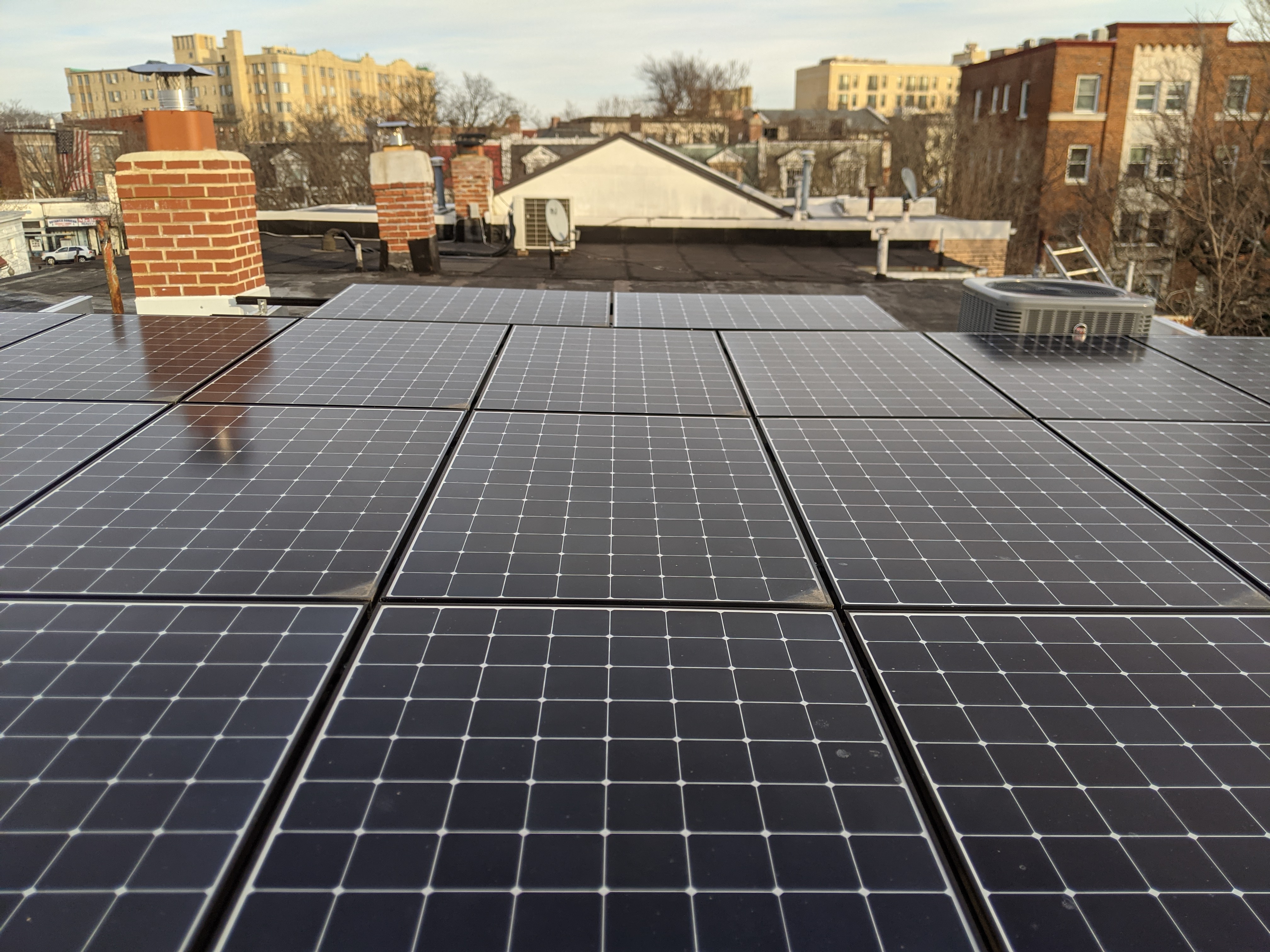
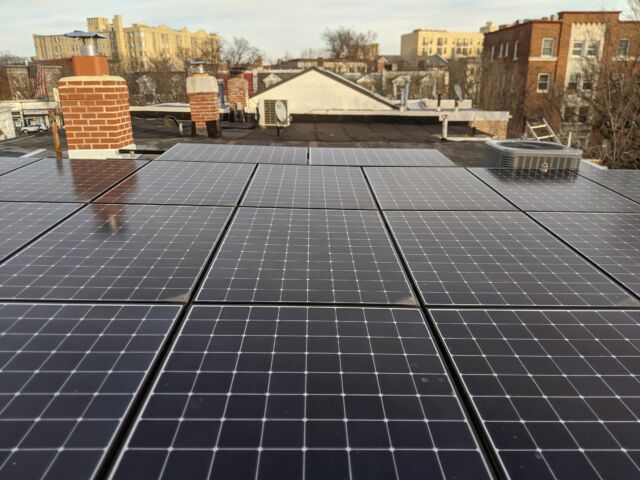
My green energy odyssey started with solar panels. My wife and I live in a Washington DC row house with a gently-sloping, south-facing roof. With no tall trees behind the house, it’s ideal for generating power all day long.
In the spring of 2019, I got quotes from two solar companies. One company wanted $35,538 for a 8.5 kW system with 26 panels. The other firm quoted us $33,372 for a 8.64 kW system with 24 panels. In either case, we’d get a 30 percent federal tax credit worth more than $10,000, bringing the net cost below $25,000.
We decided to go with the more expensive vendor. The cheaper bidder wanted to anchor the solar panels directly to the roof, while the more expensive proposal would suspend the panels from beams mounted on the parapet walls on either side. The first firm assured me that they could seal the roof up good as new, but the idea of cutting into the roof made me nervous.
Later, the winning contractor told us that our roof was nearing the end of its life and would cost more to replace after solar panels had been installed. So we decided to have them replace our roof. Our chimney was also in bad shape, so we had a different company rebuild that. This added $17,482 to the cost of the project. We financed all of this—and the HVAC upgrades I’ll discuss shortly—with a home equity loan.
The roof was installed in early August. The solar panels arrived in October. Then there was a month’s wait for Pepco to hook up the system to the electric grid. Our system was finally active in November 2019.
Solar panels only generate power in the daytime. So if we wanted to build a self-contained system, we would have needed to buy batteries to store excess power in the day and for use at night. But luckily for us, DC law requires our electric utility, Pepco, to do what’s known as net metering. When we have excess power, Pepco credits us at retail rates, effectively providing us with free energy storage.
Our solar panels will pay for themselves in five years
In 13 months of operation, our system has generated more than 11 MWh of power, which our solar system’s website estimates saved us $1,250. Our electric bills reflect that. In the year before the solar panels were installed, our electric bills totaled $1,254. Over the following year, we paid only $72.
Still it would have taken more than 20 years for the solar panels to pay for themselves based only on these electricity savings. Luckily, free electricity wasn’t the primary benefit for us.
Under DC law, Pepco must acquire a rising share of its electricity from renewable sources. Pepco can either generate renewable power itself or buy solar renewable energy credits (SRECs) from third parties like us.
Thanks to DC’s stringent green energy requirements, SRECs in the district sell for more than $400. Each SREC represents 1 MWh of electric power, so our solar panels generate about 10 SRECs per year. Hence we can expect as much as $4,000 per year in SREC income. So far we’ve gotten three quarterly payments totaling $3,647.
When you combine SREC revenues with our electricity savings, the solar panels are likely to pay for themselves in about five years.
Americans outside of DC probably won’t get such a good deal. Many states don’t have an SREC program, and the ones that do have lower SREC prices.
When we installed our solar panels in 2019, they were eligible for a 30 percent federal credit. That figure dropped to 26 percent for 2020. It was scheduled to drop to 22 percent in 2021 and to zero in 2022. However, Congress just passed legislation to extend these deadlines by two years. So the 26 percent credit will now be available through the end of 2022. Then it’ll fall to 22 percent in 2023 and to zero after that.
On the other hand, the cost of solar panels keeps dropping. And some parts of the country get more sun than Washington DC. So if you live in one of America’s sunnier states, you may find that solar panels are a good investment even with little or no state help. And regardless, it’s good for the environment.
HVAC overhaul
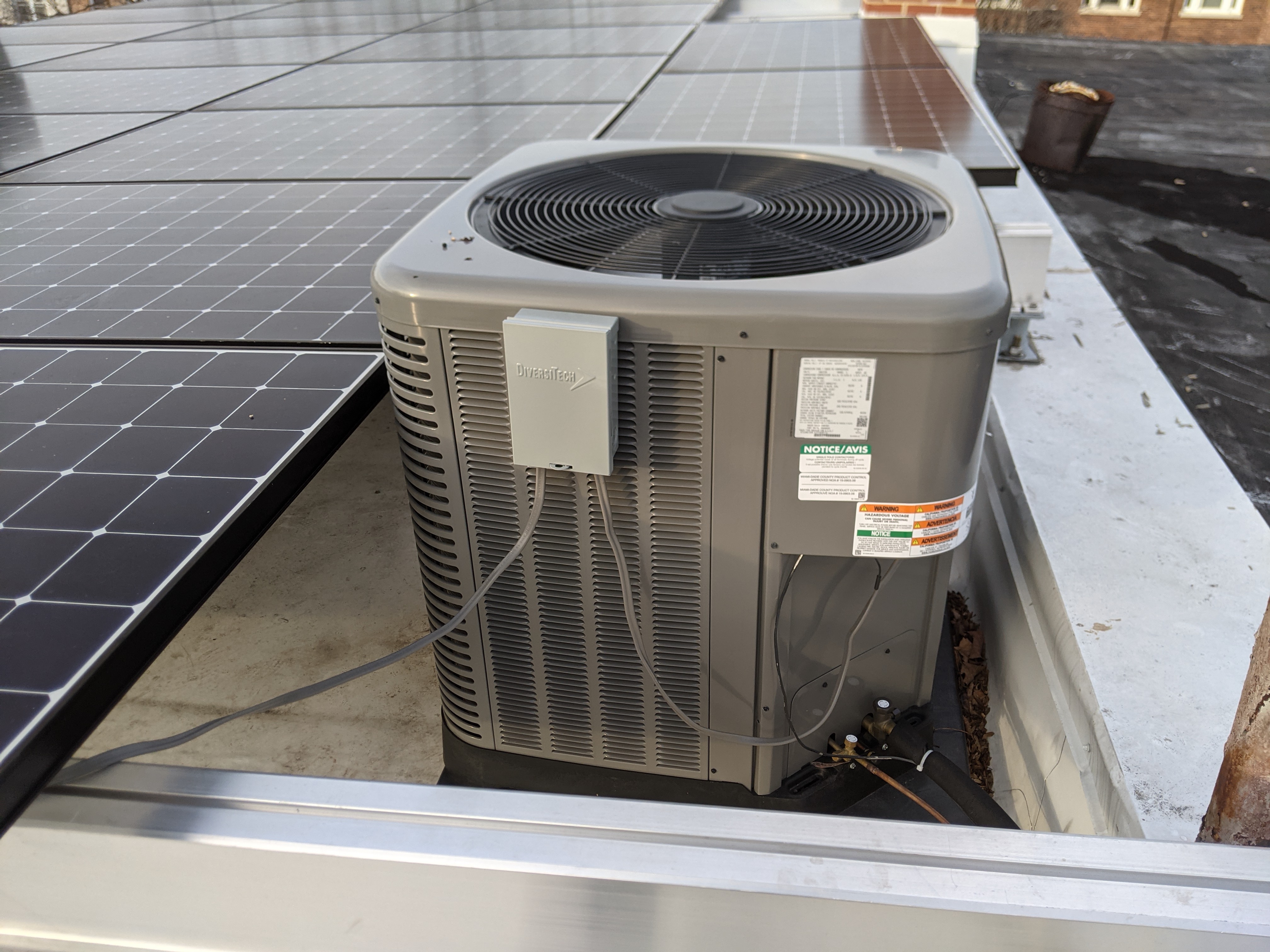
When we decided to replace our air conditioner in early 2020, we weren’t thinking about reducing our carbon footprint. The condenser for our old air conditioning system was noisy and took up space in our tiny backyard. As we made plans to put solar panels on our roof, we wondered if we could put the condenser on the roof as well.
Our initial plan to do both at the same time didn’t work out. But a few months after the solar panels were installed, I hired a company to install a new system on the roof, since the old one was nearing the end of its life.
We decided to pay an extra $1,000 or so for a version that doubled as a heat pump that could heat our house as well as cooling it. In total, the air conditioning system—including heat pump capability and crane rental—cost $12,666. Buying the heat pump likely makes us eligible for a $300 federal tax credit as well as a rebate from the District of Columbia.
Weeks after the new air conditioner was installed, the oil-fired boiler that feeds our radiators sprang a leak, creating a puddle of water on the basement floor. I’d been wanting to get rid of that old boiler—and the enormous oil tank in our basement—for years. The leak accelerated our timetable. Rather than trying to salvage our aging boiler, we decided to replace it. It was July, so we had plenty of time to get a new one.
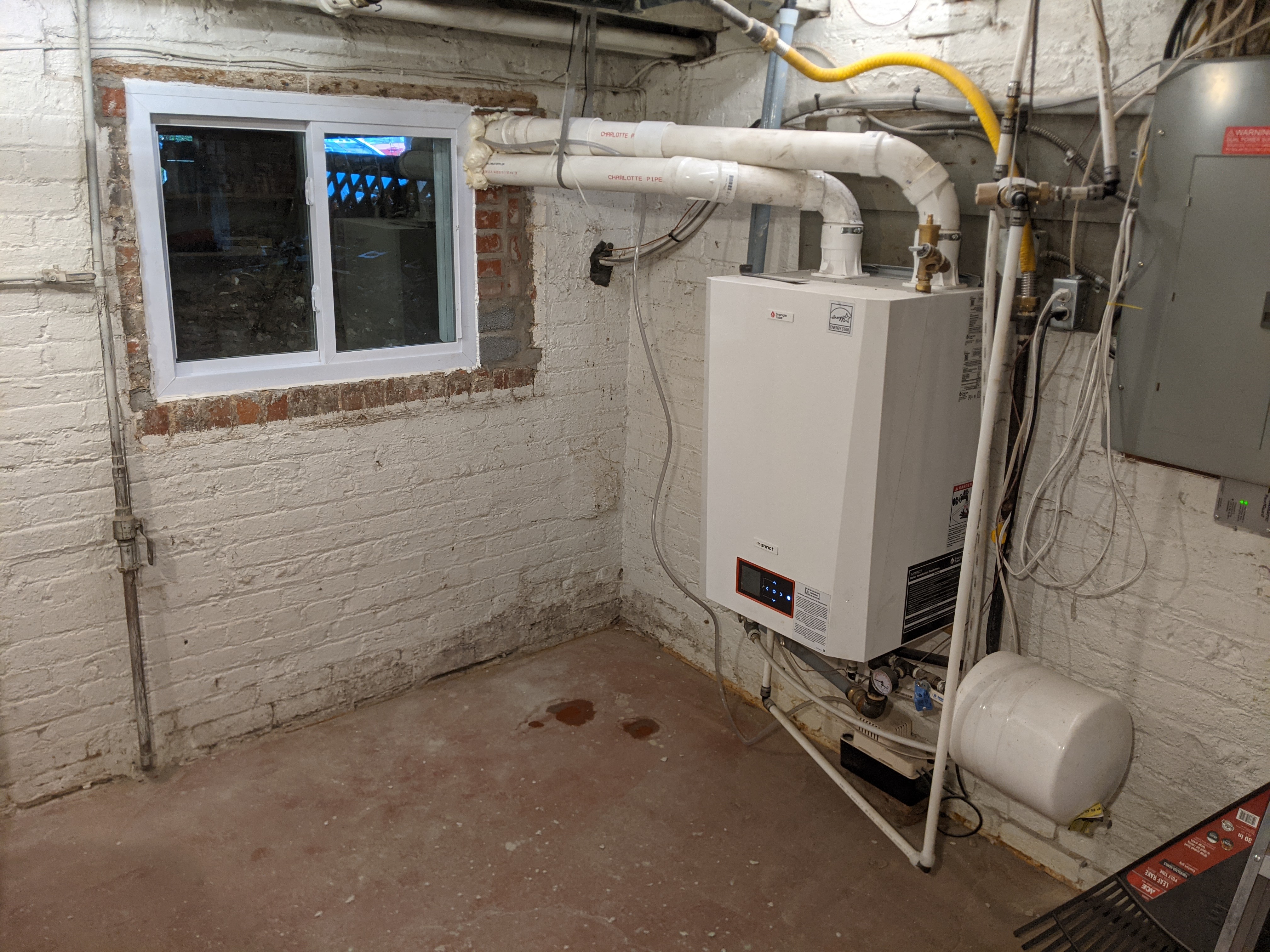
After researching the options, we decided to get a high-efficiency condensing model. We got a “combi” unit that doubles as a tankless water heater. It hangs on the wall and takes up dramatically less space than our separate boiler and water heater had before. It cost $10,500. I got an $825 rebate from the District of Columbia and may be eligible for a $150 federal tax credit.
Conventional boilers waste heat by sending a lot of steam up the chimney. A condensing boiler, in contrast, cools down exhaust gases to turn most of that steam back into water, extracting a few extra percentage points of heat in the process. These cooler, moister exhaust gases can’t go up a conventional chimney. Instead, condensing boilers use a plastic exhaust pipe that sticks out of the side of the house—angled slightly downward so the condensing water runs outside.
FamousDrScanlon on Sun, 3rd Jan 2021 6:21 pm
‘Sustainability is wishful thinking’: get ready for the energy downshift
“The problem with “sustainability” is its implication that economic growth can still continue on blithely in a world of zero carbon and a green energy transition. But expect a rude shock.”
https://www.stuff.co.nz/environment/climate-news/122689734/sustainability-is-wishful-thinking-get-ready-for-the-energy-downshift
I expect to laugh at them.
makati1 on Sun, 3rd Jan 2021 6:31 pm
Amerikans are so self centered sand stupid about the real world that they deserve the huge pain in their near future. Less than 1% are prepared and even they will likely be surprised at what they have not prepared for. 2020 was just the beginning.
Outcast_Searcher on Sun, 3rd Jan 2021 8:39 pm
makatai1: Sez the clown who predicts doom every month year after year, endlessly.
So of course, I believe every single doomish thing you predict. LOL
makati1 on Sun, 3rd Jan 2021 11:21 pm
Outcast, but I am always correct, unless you are deaf, dumb and blind, or in deep denial of reality. But, deny all you want, the pain is already happening to millions of your neighbors and friends. Be patient, you will get that same “enjoyment” soon.
The US unemployment numbers are multiples of the lies the government posts and the actual CV19 CAUSED deaths are a small fraction of the same government lies. They have shown who the sheeple are in Amerika and the world (face diapers) and they are celebrating their success…so far. 2021 could be the turn-around…or…the final submital to the chains. We shall see.
Zeke Putnam on Mon, 4th Jan 2021 9:23 am
My read is: those that are wealthy enough to afford a $90,000 investment get a $20,000 tax break which is paid for by those of us who are not wealthy enough to spend 90K. I understand all the BS about the need for subsidies but this is really just welfare for the upper classes.
DT on Mon, 4th Jan 2021 7:03 pm
I got as far as “We haven’t yet achieved a carbon-free lifestyle.” and quit reading. The entire article is all about How industrial civilization is going to save us all by way of the clean green, energy transition, built on the back of 250 years of FF technology.
DT on Mon, 4th Jan 2021 11:39 pm
I just love the old tried and true go to term, phrase, (insult?) “Oh you must be a doom and gloomer.” I must admit, it is handy to use when you don’t have a legit argument to counter with in an intellectual discussion.
FamousDrScanlon on Wed, 6th Jan 2021 10:22 pm
We Must Preserve The Earth’s Dwindling Resources For My Five Children
“As we move into the 21st century, it is our responsibility to think of the future of the earth—not for ourselves, but for those who will inherit what my husband and I leave behind when we’re gone. If we do not join together and do what’s best for this, our only planet, there may not be an environment left in which my five children, and their 25 children’s 125 children, can grow up and raise large upper-middle-class families of their own.
Nothing less than the preservation of my descendents’ lifestyle itself is at stake.
Imagine a world devoid of pristine wilderness for my progeny to explore on the weekends in the sport-utility-vehicles of the future, leaving my youngest son, Dylan, with nowhere to blow off steam on off-road adventures. Imagine a world in which my beautiful middle son, Connor, is denied his twice-daily half-hour hot showers because of water shortages. Picture what it would be like for my oldest boy Asher, preparing to start his first semester at Stanford, to have to go without basic amenities such as cable television, satellite radio, central air, or massage chairs, all because of the shortsighted squandering by his parents’ generation of our non-renewable energy sources today.
Though it seems like a far-off nightmare, this terrible vision is all too possible. Would you want to live in a world where my five children had to endure such horrible deprivations? I know I wouldn’t.
If we don’t take action now, my daughters Kimmy and Jenna may not be able to blow-dry their hair for 45 minutes to an hour each morning, nor may my future sons-in-law cut their grass atop enormous, diesel-powered riding mowers. In fact, they may not even have lawns—at least not the lush, verdant kind that requires constant watering and pesticide treatment. It’s conceivable that one day my five children’s spacious yards may be entirely composed of synthetic Astroturf, or—God forbid—those tacky wood chips my sister in Arizona uses.
In a cruel irony, those wood chippings will get more expensive as the world’s timber supply continues to shrink.
Encroaching urban sprawl has already begun to spoil the view from the porch of our beautiful new summer home on Lake Wakenaka. Sadly, the view from the bay windows of our first summer home, the one we built at our Woodland Acres property six years earlier, has already been ruined by such unchecked development. Must my children grow up in a world where only one of their parents’ summer homes is surrounded by the beauty of nature? It’s unthinkable, I know, but we must face facts.
This is to say nothing of the deleterious impact the destruction of our global ecosystems will have on the wildlife my family enjoys hunting. Biodiversity is crucial to another 100 years of deer-, quail-, duck-, bear-, moose-, bobcat-, and bison-shooting summer recreation for my descendents.
We must take steps immediately to devise safe, alternative energy sources that my future offspring can safely consume. If we don’t develop new fuels now, there will be none left for those who issue from my loins to burn and continue to burn for all time. I don’t want my 625-odd great-grandchildren to have to wait 20 or 30 precious seconds for their toilets to flush. I don’t want their 3,125 children to live in a hellish society where they cannot own their own snowmobiles. And I shudder to think that my 15,625 great-great-great-grandchildren may not be able to have TVs in every room that they can leave on all day and all night. Is it our right to deny my progeny of their gargantuan RVs and motorboats, as well? Of course not.
We cannot, in good conscience, lay such a burden on tomorrow’s generations of Melfords. My children are the future. And at the end of the day, isn’t it family—my family—that truly matters?”
https://www.theonion.com/we-must-preserve-the-earths-dwindling-resources-for-my-1819584296
Kevin Ronald Cobley on Fri, 8th Jan 2021 10:18 pm
If this guy has to spend so much money to allegedly be “green”, he clearly has a excessive lifestyle problem.