
Peak Oil is You
Donate Bitcoins ;-) or Paypal :-)


Page added on March 13, 2014

Liquefied Air to Store Energy on U.K. Grid
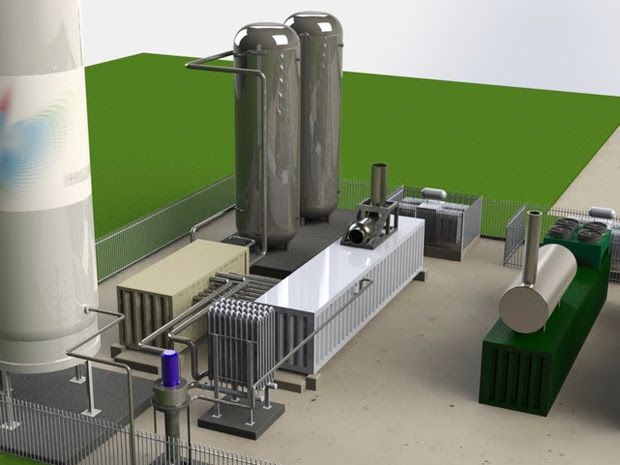
IEEE Spectrum has an article on a variant of compressd air energy storage being trialled in the UK – Liquefied Air to Store Energy on U.K. Grid. U.K.-based Highview Power Storage last week said that it has been awarded an £8 million grant from the U.K. Department of Energy and Climate Change to build a commercial-scale facility that uses liquified air to store energy. Highview is already running a smaller pilot plant, but the full-scale version will be able to store enough energy to deliver five megawatts of power for three hours. That puts it on a scale that would entice utilities to use the technology, says company CEO Gareth Brett. …
Liquid air energy storage is similar to compressed air energy storage in that air is compressed and released to store and then generate power. With Highview’s technology, though, ambient air is compressed, then cooled and liquified. That liquefied air, which is almost -200 °C, is stored in large tanks.
When power is needed, the liquid air is released and pumped to high pressure. That causes the liquid to evaporate, turning it into a high-pressure gas which is then run through a turbine to generate power. The planned demonstration plant will be located at a waste processing center. Heat from the waste plant’s gas turbines, which run on captured landfill methane, will be piped in to improve the efficiency of the evaporation process.
One of the advantages of liquid air storage is that it uses off-the-shelf equipment. The tanks for storing liquid air, for instance, are the same as those used in the industrial gas industry.
6 Comments on "Liquefied Air to Store Energy on U.K. Grid"
rollin on Thu, 13th Mar 2014 2:34 pm
Cold steam turbines, interesting.
Something to do with all that excess energy that solar and wind put on the grid at times. Can’t be anywhere near as efficient as pumped hydro or battery storage but those numbers were not declared by the blurb.
Davy, Hermann, MO on Thu, 13th Mar 2014 2:38 pm
Sounds interesting but will it cost effectively scale and what is the conversion lost in waste heat. It sounds like they are adding a layer of efficiency with the heat off the land fill gas burning helping the evaporation process. I have read about the compressed air storage in salt caverns or was it depleted gas fields in the US. I have wondered why more has not been said about this storage. I believe one of the issues always with compressed air is the waste heat. Seems like you could try to utilize the heat byproduct somehow. Anyway if this is scalable it would of course be a great addition to the AltE effort. Not an expert on this subject but it sure interests me.
ulenspiegel on Thu, 13th Mar 2014 8:18 pm
Compressed air storage has the waste heat problem or a limited storage time when the process is conducted with storage of the compression heat.
The liquified air storage (actually nitrogen) works for the storage at ambient pressure and the performance of the turbine/generator does not depend on the filling level of the dewar.
A group of the University of Technology Graz works with such systems, IIRC first field studies run in Asia.
Bob Owens on Thu, 13th Mar 2014 8:31 pm
We will need to try thousands of trials like this. The key will be to know what works and when to cut our losses and move on. I would like to learn more about the energy used to liquify the air then how much we get back.
James A. Hellams on Fri, 14th Mar 2014 12:28 am
This article points to an enormous potential for liquified air storage, particularly for the railroad industry.
The railroads could go back to the age of the steam locomotive; but without the need for steam. The locomotive could use liquified air to replace the water and steam. The decompressing air could be used to power the train, rather than steam.
Makati1 on Fri, 14th Mar 2014 2:45 am
has anyone thought about the actual amount of NET energy in this system? I’m not an engineer, but I doubt it is very large. As mentioned above, heat loss is energy loss.
As this is just another scam taking the taxpayers hard earned cash. I doubt it will ever go commercial. But, it will give jobs to a few techies for a while.
And what about the energy needed to build and maintain these techie toys? Bet there will not be any serious study on that one. When NET energy is actually considered, these techie dreams will prove to be just that, dreams.