
Peak Oil is You

Donate Bitcoins ;-) or Paypal :-)


Page added on July 22, 2013

Is Scotland the “Saudi Arabia” of Tidal Power?



Harnessing the swift tides of the Pentland Firth, a waterway along Scotland’s Northern coast, could generate enough electricity to meet half of the country’s needs. Photo by Flickr user foxypar4
In extreme Northern Scotland, between the mainland and the Orkney Islands, lies the Pentland Firth, a roughly ten-mile-wide seaway between the North Sea and the Atlantic. Along with seals, porpoises and the occasional killer whale, the Firth is known for its uncommonly strong and fast tides—they’ve been recorded at speeds as high as 18 miles per hour, among the fastest in the world—the result of an enormous quantity of water rushing back and forth through a narrow passage roughly every six hours.
For centuries, these tides have been considered a hazard to sailors and fishing vessels. More recently, though, Scottish officials have pointed out that the Pentland Firth’s powerful tides could present an unexpected benefit: As countries search for new sources of renewable energy, these tides could make Scotland the “Saudi Arabia” of tidal power.
Observers have long speculated about the potential for electricity generation using tidal energy, and though there are still only a handful of tidal power plants completed worldwide, many other projects are nearing construction or have been proposed. Of these, none equals the Pentland Firth in terms of estimated power generation capacity—Scotland has suggested it could provide as much as 10 gigawatts of electricity on average over the course of a day, enough to supply a quarter of the European Union’s daily needs—and as a result, a number of energy companies have recently acquired leases to install turbines in the waterway.
Until now, though, despite the lofty predictions, no scientists had conducted a systematic study to figure out exactly how much energy the Firth might supply. Today, a group from the University of Oxford and elsewhere released the results of their review of the waterway’s total capacity.
Though their numbers might not justify comparing Scotland with the Persian Gulf in terms of overall energy potential, they do suggest that it could certainly be a Saudi Arabia for tidal power, and that the Pentland Firth could play a major role in powering the U.K. Their analysis shows that the seaway could potentially provide an average of 1.9 gigawatts of electricity at any given time, a number that equals about half of Scotland’s electrical consumption.
The analysis, published in the Proceedings of the Royal Society A, modeled the maximum potential electricity generation of a scheme that would involve three rows of underwater tidal turbines, each consisting of hundreds of posts that stretch across the entire passage. These turbines harness the energy in the passing tides in essentially the same way that wind turbines capture the energy in passing gusts of wind—by using the flow of water to spin the turbine, which turns a magnet located in the center, thereby generating an electrical field. Because water is much denser than air, though, tidal turbines will spin faster and can potentially generate much more power than wind turbines of the same size.
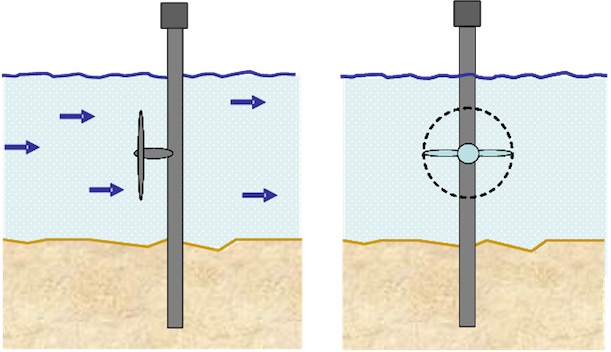
A simplified schematic of an underwater tidal turbine. Image via Wikimedia Commons/Feldoncommon
The researchers looked at the construction of multiple rows of these sorts of turbines, placed in a variety of locations within the Firth. Their models took into account the depth of the water at each given location, observed tidal speeds and heights over the course of each month, and a number of other variables.
Ultimately, the team found that the maximum practical capacity of 1.9 gigawatts would be possible with three rows of turbines, built in the locations mapped below (B, C, and D on the map). Because each row slows down the movement of the tides that pass through it, building more then three would only marginally improve the power capacity, while increasing the overall cost of the project at a constant rate. (A, on the map, is a proposed alternate scheme that would produce a similar level of energy but at a higher cost.)

Image via Proceedings of the Royal Society A/Adcock et. al.
Of course, there are numerous impediments to constructing tidal turbines on such a huge scale, which would dwarf any current tidal energy project in existence. Some are concerned that tidal turbines could have negative ecological effects, disrupting fish and other wildlife communities. Research into just how these sorts turbines would affect local ecosystems is in its beginning stages. Additionally, in areas like the Pentland Firth, turbines would have to be constructed with large enough gaps for ships to pass through, since the channel is a crucial shipping waterway, but the authors of this paper took this sort of spacing into account when making their calculations.
As of now, the biggest hurdle is price: without any carbon pollution regulation schemes in place, most renewable sources of energy, including tidal power, just aren’t as cheap as burning coal or other fossil fuels. But many energy companies have already recognized that, long-term, the cost of fossil fuel production will increase—both because of eventual regulations of the emissions of greenhouse gases and because of fossil fuels are becoming increasingly costly to extract—and harnessing the power of the tides could provide a reliable way to meet a portion of our energy demands.
7 Comments on "Is Scotland the “Saudi Arabia” of Tidal Power?"
TIKIMAN on Mon, 22nd Jul 2013 12:04 pm
Tidal power is a good idea in theory, however any new ‘renewable’ energy source is extremely expensive and salt water is very corrosive and would need constant maintenance.
GregT on Mon, 22nd Jul 2013 3:56 pm
“Harnessing the swift tides of the Pentland Firth, a waterway along Scotland’s Northern coast, could generate enough electricity to meet half of the country’s needs.”
COULD meet half of their electricity needs. All they have to do now is figure out how to POSSIBLY meet the other 50%, and then after that, figure out a way to grow and transport food, transport people, extract, refine, and manufacture resources and everything else that fossil fuels currently do for us.
All of these so called ‘renewable’ ways to produce electricity, MIGHT possibly offset production from fossil fuel inputs, but they will not replace fossil fuels in all other sectors of modern industrial society. Including the resource extraction, refinement, manufacturing, shipping, installation, and ongoing maintenance of the so called ‘renewable’ energy sources themselves.
It would be a much better idea to try to solve the problem of future food production, before we even consider how to keep our electronic gadgetry running. Computers, TVs, and lightbulbs, do not grow food.
energyskeptic on Mon, 22nd Jul 2013 4:49 pm
You’d only get power twice a day at high tides.
Electricity doesn’t solve the problem: trucks, trains, tractors, and other essential combustion engines run on OIL.
Tidal power work a bit like dams, directing falling water through turbines. Scotland is far from any cities that could use the power, to get the twice a day power elsewhere requires an expensive grid infrastructure, as well as massive dams and turbines, which need to cope with corrosive sea water. Potential environmental issues are flooding of wetlands and harming marine life.
Alice Friedemann
http://www.energyskeptic.com
Kenz300 on Mon, 22nd Jul 2013 5:17 pm
Cost-competitive Renewable Energy
http://www.renewableenergyworld.com/rea/news/article/2013/06/from-the-editor-1
Arthur on Mon, 22nd Jul 2013 5:45 pm
“COULD meet half of their electricity needs. All they have to do now is figure out how to POSSIBLY meet the other 50%”
At the engineering university in the seventees I was taught that if western society would have to cut it’s energy consumption in half, it still would be feasible to have a recognizable western society, albeit on a stricter regime.
Progress in the future will mean: do more with less energy. And the key to achieve that is of course innovation.
Arthur on Mon, 22nd Jul 2013 5:52 pm
“Electricity doesn’t solve the problem: trucks, trains, tractors, and other essential combustion engines run on OIL. ”
In Europe all trains run on electricity. If no heavy duty storage technology can be developed, it simply means we have to build new (electrified) railtracks again, like we had 100 years ago.
dale mcmillian on Mon, 26th Apr 2021 7:15 am
Excellent article!Back in the early 60’s I was stationed in Fairford, England. Took a trip to Channel Islands and noticed extreme tides and wondered if turbines would perform like hydroelectric systems from waterfalls. I believe strongly in future of this technology, however, I do not believe combined wind, solar, and water will ever totally replace fossil fuels.