
Peak Oil is You

Donate Bitcoins ;-) or Paypal :-)


Page added on September 5, 2016

Intermittent Renewables Can’t Favorably Transform Grid Electricity

Many people are hoping for wind and solar PV to transform grid electricity in a favorable way. Is this really possible? Is it really feasible for intermittent renewables to generate a large share of grid electricity? The answer increasingly looks as if it is, “No, the costs are too great, and the return on investment would be way too low.” We are already encountering major grid problems, even with low penetrations of intermittent renewable electricity: US, 5.4% of 2015 electricity consumption; China, 3.9%; Germany, 19.5%; Australia, 6.6%.
In fact, I have come to the rather astounding conclusion that even if wind turbines and solar PV could be built at zero cost, it would not make sense to continue to add them to the electric grid in the absence of very much better and cheaper electricity storage than we have today. There are too many costs outside building the devices themselves. It is these secondary costs that are problematic. Also, the presence of intermittent electricity disrupts competitive prices, leading to electricity prices that are far too low for other electricity providers, including those providing electricity using nuclear or natural gas. The tiny contribution of wind and solar to grid electricity cannot make up for the loss of more traditional electricity sources due to low prices.
Leaders around the world have demanded that their countries switch to renewable energy, without ever taking a very close look at what the costs and benefits were likely to be. A few simple calculations were made, such as “Life Cycle Assessment” and “Energy Returned on Energy Invested.” These calculations miss the fact that the intermittent energy being returned is of very much lower quality than is needed to operate the electric grid. They also miss the point that timing and the cost of capital are very important, as is the impact on the pricing of other energy products. This is basically another example of a problem I wrote about earlier, Overly Simple Energy-Economy Models Give Misleading Answers.
Let’s look at some of the issues that we are encountering, as we attempt to add intermittent renewable energy to the electric grid.
Issue 1. Grid issues become a problem at low levels of intermittent electricity penetration.
In 2015, wind and solar PV amounted to only 12.2% of total electricity consumed in Hawaii, based on EIA data. Even at this low level, Hawaii is encountering sufficiently serious grid problems that it has needed to stop net metering (giving homeowners credit for the retail cost of electricity, when electricity is sold to the grid) and phase out subsidies.

Figure 1. Hawaii Electricity Production, based on EIA data. Other Disp. electricity is the sum of various other non-intermittent electricity sources, including geothermal and biomass burned as fuel.
Hawaii consists of a chain of islands, so it cannot import electricity from elsewhere. This is what I mean by “Generation = Consumption.” There is, of course, some transmission line loss with all electrical generation, so generation and consumption are, in fact, slightly different.
The situation is not too different in California. The main difference is that California can import non-intermittent (also called “dispatchable”) electricity from elsewhere. It is really the ratio of intermittent electricity to total electricity that is important, when it comes to balancing. California is running into grid issues at a similar level of intermittent electricity penetration (wind + solar PV) as Hawaii–about 12.3% of electricity consumed in 2015, compared to 12.2% for Hawaii.
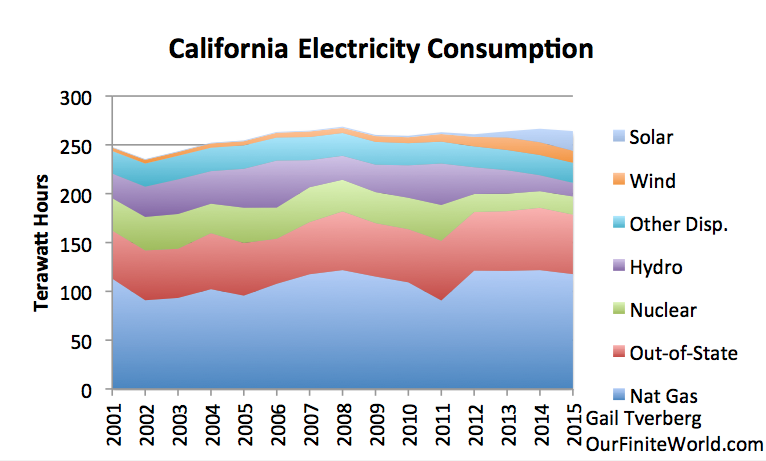
Figure 2. California electricity consumption, based on EIA data. Other Disp. is the sum of other non-intermittent sources, including geothermal and biomass burned for electricity generation.
Even with growing wind and solar production, California is increasingly dependent on non-intermittent electricity imported from other states.
Issue 2. The apparent “lid” on intermittent electricity at 10% to 15% of total electricity consumption is caused by limits on operating reserves.
Electric grids are set up with “operating reserves” that allow the electric grid to maintain stability, even if a large unit, such as a nuclear power plant, goes offline. These operating reserves typically handle fluctuations of 10% to 15% in the electricity supply.
If additional adjustment is needed, it is possible to take some commercial facilities offline, based on agreements offering lower rates for interruptible supply. It is also possible for certain kinds of power plants, particularly hydroelectric and natural gas “peaker plants,” to ramp production up or down quickly. Combined cycle natural gas plants also provide reasonably fast response.
In theory, changes can be made to the system to allow the system to be more flexible. One such change is adding more long distance transmission, so that the variable electricity can be distributed over a wider area. This way the 10% to 15% operational reserve “cap” applies more broadly. Another approach is adding energy storage, so that excess electricity can be stored until needed later. A third approach is using a “smart grid” to make changes, such as turning off all air conditioners and hot water heaters when electricity supply is inadequate. All of these changes tend to be slow to implement and high in cost, relative to the amount of intermittent electricity that can be added because of their implementation.
Issue 3. When there is no other workaround for excess intermittent electricity, it must be curtailed–that is, dumped rather than added to the grid.
Overproduction without grid capacity was a significant problem in Texas in 2009, causing about 17% of wind energy to be curtailed in 2009. At that time, wind energy amounted to about 5.0% of Texas’s total electricity consumption. The problem has mostly been fixed, thanks to a series of grid upgrades allowing wind energy to flow better from western Texas to eastern Texas.

Figure 3. Texas electricity net generation based on EIA data. The Texas grid is separate, so there is no imported or exported electricity.
In 2015, total intermittent electricity from wind and solar amounted to only 10.1% of Texas electricity. Solar has never been large enough to be visible on the chart–only 0.1% of consumption in 2015. The total amount of intermittent electricity consumed in Texas is only now beginning to reach the likely 10% to 15% limit of operational reserves. Thus, it is “behind” Hawaii and California in reaching intermittent electricity limits.
Based on the modeling of the company that oversees the California electric grid, electricity curtailment in California is expected to be significant by 2024, if the 40% California Renewable Portfolio Standard (RPS) is followed, and changes are not made to fix the problem.

Issue 4. When all costs are included, including grid costs and indirect costs, such as the need for additional storage, the cost of intermittent renewables tends to be very high.
In Europe, there is at least a reasonable attempt to charge electricity costs back to consumers. In the United States, renewable energy costs are mostly hidden, rather than charged back to consumers. This is easy to do, because their usage is still low.
Euan Mearns finds that in Europe, the greater the proportion of wind and solar electricity included in total generation, the higher electricity prices are for consumers.
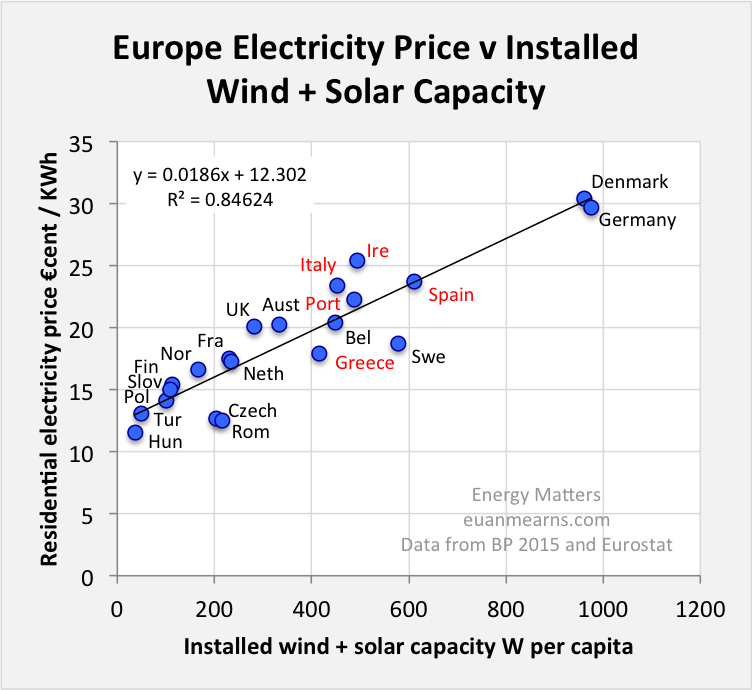
Figure 5. Figure by Euan Mearns showing relationship between installed wind + solar capacity and European electricity rates. Source Energy Matters.
The five countries shown in red have all had financial difficulties. High electricity prices may have contributed to their problems.
The United States is not shown on this chart, since it is not part of Europe. If it were, it would be a bit below, and to the right of, Czech Republic and Romania.
Issue 5. The amount that electrical utilities are willing to pay for intermittent electricity is very low.
The big question is, “How much value does adding intermittent electricity add to the electrical grid?” Clearly, adding intermittent electricity allows a utility to reduce the amount of fossil fuel energy that it might otherwise purchase. In some cases, the addition of solar electricity slightly reduces the amount of new generation needed. This reduction occurs because of the tendency of solar to offer supply when the usage of air conditioners is high on summer afternoons. Of course, in advanced countries, the general tendency of electricity usage is down, thanks to more efficient light bulbs and less usage by computer screens and TV monitors.
At the same time, the addition of intermittent electricity adds a series of other costs:
- Many more hook-ups to generation devices are needed. Homes now need two-way connections, instead of one-way connections. Someone needs to service these connections and check for problems.
- Besides intermittency problems, the mix of active and reactive power may be wrong. The generation sources may cause frequency deviations larger than permitted by regulations.
- More long-distance electricity transmission lines are needed, so that the new electricity can be distributed over a wide enough area that it doesn’t cause oversupply problems when little electricity is needed (such as weekends in the spring and fall).
- As electricity is transported over longer distances, there is more loss in transport.
- To mitigate some of these problems, there is a need for electricity storage. This adds two kinds of costs: (1) Cost for the storage device, and (2) Loss of electricity in the process.
- As I will discuss later, intermittent energy tends to lead to very low wholesale electricity prices. Other electricity providers need to be compensated for the effects these low prices cause; otherwise they will leave the market.
To sum up, when intermittent electricity is added to the electric grid, the primary savings are fuel savings. At the same time, significant costs of many different types are added, acting to offset these savings. In fact, it is not even clear that when a comparison is made, the benefits of adding intermittent electricity are greater than the costs involved.
According to the EIA’s 2015 Wind Technologies Market Report, the major way intermittent electricity is sold to electric utilities is as part of long term Power Purchase Agreements (PPAs), typically lasting for 20 years. Utilities buy PPAs as a way of hedging against the possibility that natural gas prices will rise in the future. The report indicates that the recent selling price for PPAs is about $25 to $28 per MWh (Figure 6). This is equivalent to 2.5 to 2.8 cents per kWh, which is very inexpensive.
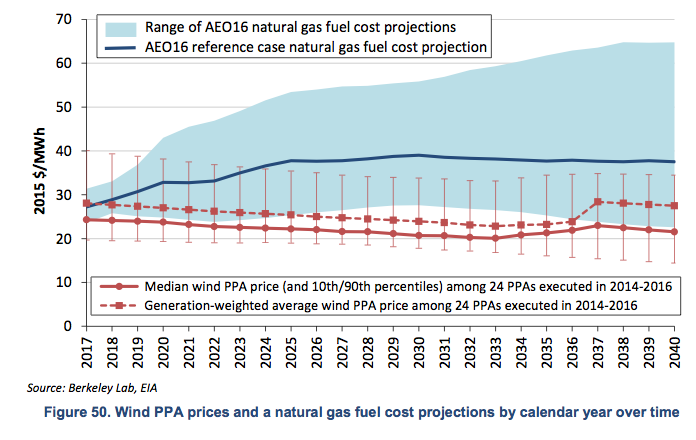
Figure 6. EIA exhibit showing the median and mean cost of wind PPAs compared to EIA’s forecast price of natural gas, from 2015 Wind Technologies Market Report.
In effect, what utilities are trying to do is hedge against rising fuel prices of whatever kind they choose to purchase. They may even be able to afford to make other costly changes, such as more transmission lines and energy storage, so that more intermittent electricity can be accommodated.
Issue 6. When intermittent electricity is sold in competitive electricity markets (as it is in California, Texas, and Europe), it frequently leads to negative wholesale electricity prices. It also shaves the peaks off high prices at times of high demand.
In states and countries that use competitive pricing (rather than utility pricing, used in some states), the wholesale price of electricity price varies from minute to minute, depending on the balance between supply and demand. When there is an excess of intermittent electricity, wholesale prices often become negative. Figure 7 shows a chart by a representative of the company that oversees the California electric grid.

Figure 7. Exhibit showing problem of negative electricity prices in California, from a presentation at the 2016 EIA Annual Conference.
Clearly, the number of negative price spikes increases, as the proportion of intermittent electricity increases. A similar problem with negative prices has been reported in Texas and in Europe.
When solar energy is included in the mix of intermittent fuels, it also tends to reduce peak afternoon prices. Of course, these minute-by-minute prices don’t really flow back to the ultimate consumers, so it doesn’t affect their demand. Instead, these low prices simply lead to lower funds available to other electricity producers, most of whom cannot quickly modify electricity generation.
To illustrate the problem that arises, Figure 8, prepared by consultant Paul-Frederik Bach, shows a comparison of Germany’s average wholesale electricity prices (dotted line) with residential electricity prices for a number of European countries. Clearly, wholesale electricity prices have been trending downward, while residential electricity prices have been rising. In fact, if prices for nuclear, natural gas, and coal-fired electricity had been fair prices for these other providers, residential electricity prices would have trended upward even more quickly than shown in the graph!

Figure 8. Residential Electricity Prices in Europe, together with Germany spot wholesale price, from http://pfbach.dk/firma_pfb/references/pfb_towards_50_pct_wind_in_denmark_2016_03_30.pdf
Note that the recent average wholesale electricity price is about 30 euros per MWh, which is equivalent to 3.0 cents per kWh. In US dollars this would equate to $36 per MWh, or 3.6 cents per kWh. These prices are higher than prices paid by PPAs for intermittent electricity ($25 to $28 per MWh), but not a whole lot higher.
The problem we encounter is that prices in the $36 MWh range are too low for almost every kind of energy generation. Figure 9 from Bloomberg is from 2013, so is not entirely up to date, but gives an idea of the basic problem.
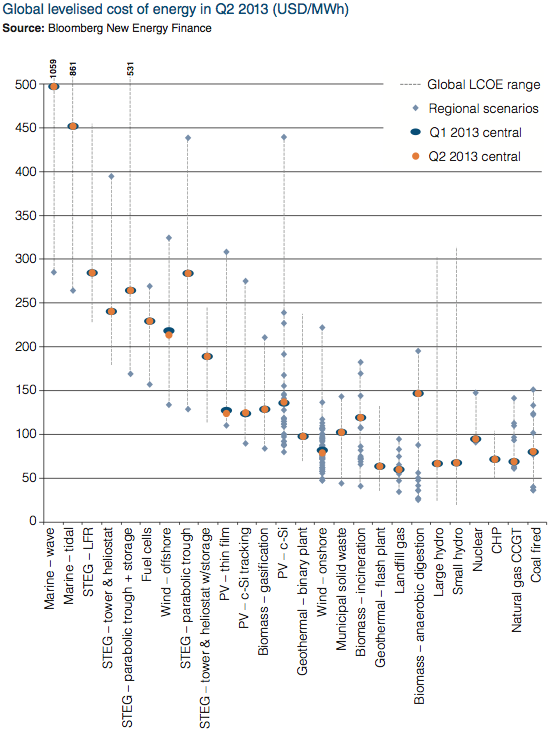
Figure 9. Global leveled cost of energy production by Bloomberg.
A price of $36 per MWh is way down at the bottom of the chart, between 0 and 50. Pretty much no energy source can be profitable at such a level. Too much investment is required, relative to the amount of energy produced. We reach a situation where nearly every kind of electricity provider needs subsidies. If they cannot receive subsidies, many of them will close, leaving the market with only a small amount of unreliable intermittent electricity, and little back-up capability.
This same problem with falling wholesale prices, and a need for subsidies for other energy producers, has been noted in California and Texas. The Wall Street Journal ran an article earlier this week about low electricity prices in Texas, without realizing that this was a problem caused by wind energy, not a desirable result!
Issue 7. Other parts of the world are also having problems with intermittent electricity.
Germany is known as a world leader in intermittent electricity generation. Its intermittent generation hit 12.2% of total generation in 2012. As you will recall, this is the level where California and Hawaii started to reach grid problems. By 2015, its intermittent electricity amounted to 19.5% of total electricity generated.

Figure 10. German electricity generated, based on BP Statistical Review of World Energy 2016.
Needless to say, such high intermittent electricity generation leads to frequent spikes in generation. Germany chose to solve this problem by dumping its excess electricity supply on the European Union electric grid. Poland, Czech Republic, and Netherlands complained to the European Union. As a result, the European Union mandated that from 2017 onward, all European Union countries (not just Germany) can no longer use feed-in tariffs. Doing so provides too much of an advantage to intermittent electricity providers. Instead, EU members must use market-responsive auctioning, known as “feed-in premiums.” Germany legislated changes that went even beyond the minimum changes required by the European Union. Dörte Fouquet, Director of the European Renewable Energy Federation, says that the German adjustments will “decimate the industry.”
In Australia, one recent headline was Australia Considers Banning Wind Power Because It’s Causing Blackouts. The problem seems to be in South Australia, where the last coal-fired power plants are closing because subsidized wind is leading to low wholesale electricity prices. Australia, as a whole, does not have a high intermittent electricity penetration ratio (6.6% of 2015 electricity consumption), but grid limitations mean that South Australia is disproportionately affected.
China has halted the approval of new wind turbine installations in North China because it does not have grid capacity to transport intermittent electricity to more populated areas. Also, most of China’s electricity production is from coal, and it is difficult to use coal to balance with wind and solar because coal-fired plants can only be ramped up slowly. China’s total use of wind and solar is not very high (3.9% of consumption in 2015), but it is already encountering major difficulties in grid integration.
Issue 8. The amount of subsidies provided to intermittent electricity is very high.
The renewable energy program in the United States consists of overlapping local, state, and federal programs. It includes mandates, feed-in tariffs, exemption from taxes, production tax credits, and other devices. This combination of approaches makes it virtually impossible to figure out the amount of the subsidy by adding up the pieces. We are pretty certain, however, that the amount is high. According to the National Wind Watch Organization,
At the federal level, the production or investment tax credit and double-declining accelerated depreciation can pay for two-thirds of a wind power project. Additional state incentives, such as guaranteed markets and exemption from property taxes, can pay for another 10%.
If we believe this statement, the developer only pays about 23% of the cost of a wind energy project.
The US Energy Information Administration prepared an estimate of certain types of subsidies (those provided by the federal government and targeted particularly at energy) for the year 2013. These amounted to a total of $11.3 billion for wind and solar combined. About 183.3 terawatts of wind and solar energy was sold during 2013, at a wholesale price of about 2.8 cents per kWh, leading to a total selling price of $5.1 billion dollars. If we add the wholesale price of $5.1 billion to the subsidy of $11.3 billion, we get a total of $16.4 billion paid to developers or used in special grid expansion programs. This subsidy amounts to 69% of the estimated total cost. Any subsidy from states, or from other government programs, would be in addition to the amount from this calculation.
Paul-Frederik Bach shows a calculation of wind energy subsidies in Denmark, comparing the prices paid under the Public Service Obligation (PSO) system to the market price for wind. His calculations show that both the percentage and dollar amount of subsidies have been rising. In 2015, subsidies amounted to 66% of the total PSO cost.

Figure 11. Amount of subsidy for wind energy in Netherlands, as calculated by comparing paid for wind under PSO with market value of wind energy. Exhibit from http://www.pfbach.dk/firma_pfb/references/pfb_towards_50_pct_wind_in_denmark_2016_03_30.pdf
In a sense, these calculations do not show the full amount of subsidy. If renewables are to replace fossil fuels, they must pay taxes to governments, just as fossil fuel providers do now. Energy providers are supposed to provide “net energy” to the system. The way that they share this net energy with governments is by paying taxes of various kinds–income taxes, property taxes, and special taxes associated with extraction. If intermittent renewables are to replace fossil fuels, they need to provide tax revenue as well. Current subsidy calculations don’t consider the high taxes paid by fossil fuel providers, and the need to replace these taxes, if governments are to have adequate revenue.
Also, the amount and percentage of required subsidy for intermittent renewables can be expected to rise over time, as more areas exceed the limits of their operating reserves, and need to build long distance transmission to spread intermittent electricity over a larger area. This seems to be happening in Europe now. In 2015, the revenue generated by the wholesale price of intermittent electricity amounted to about 13.1 billion euros, according to my calculations. In order to expand further, policy advisor Daniel Genz with Vattenfall indicates that grids across Europe will need to be upgraded, at a cost of between 100 and 400 billion euros. In other words, grid expenditures will be needed that amount to between 7.6 and 30.5 times wholesale revenues received from intermittent electricity in 2015. Most of this will likely need to come from additional subsidies, because there is no possibility that the return on this investment can be very high.
There is also the problem of the low profit levels for all of the other electricity providers, when intermittent renewables are allowed to sell their electricity whenever it becomes available. One potential solution is huge subsidies for other providers. Another is buying a lot of energy storage, so that energy from peaks can be saved and used when supply is low. A third solution is requiring that renewable energy providers curtail their production when it is not needed. Any of these solutions is likely to require subsidies.
Conclusion
We already seem to be reaching limits with respect to intermittent electricity supply. The US Energy Information Administration may be reaching the same conclusion. It chose Steve Kean from Kinder Morgan (a pipeline company) as its keynote speaker at its July 2016 Annual Conference. He made the following statements about renewable energy.

Figure 12. Excerpt from Keynote Address slide at US Energy Administration Conference by Steve Kean of Kinder Morgan.
This view is very similar to mine. Few people have stopped to realize that intermittent electricity isn’t worth very much. It may even have negative value, when the cost of all of the adjustments needed to make it useful are considered.
Energy products are very different in “quality.” Intermittent electricity is of exceptionally low quality. The costs that intermittent electricity impose on the system need to be paid by someone else. This is a huge problem, especially as penetration levels start exceeding the 10% to 15% level that can be handled by operating reserves, and much more costly adjustments must be made to accommodate this energy. Even if wind turbines and solar panels could be produced for $0, it seems likely that the costs of working around the problems caused by intermittent electricity would be greater than the compensation that can be obtained to fix those problems.
The situation is a little like adding a large number of drunk drivers, or of self-driving cars that don’t really work as planned, to a highway system. In theory, other drivers can learn to accommodate them, if enough extra lanes are added, and the concentration of the poorly operating vehicles is kept low enough. But a person needs to understand exactly what the situation is, and understand the cost of all of the adjustments that need to be made, before agreeing to allow the highway system to add more poorly behaving vehicles.
In An Updated Version of the Peak Oil Story, I talked about the fact that instead of oil “running out,” it is becoming too expensive for our economy to accommodate. The economy does not perform well when the cost of energy products is very high. The situation with new electricity generation is similar. We need electricity products to be well-behaved (not act like drunk drivers) and low in cost, if they are to be successful in growing the economy. If we continue to add large amounts of intermittent electricity to the electric grid without paying attention to these problems, we run the risk of bringing the whole system down.
77 Comments on "Intermittent Renewables Can’t Favorably Transform Grid Electricity"
Go Speed Racer on Mon, 5th Sep 2016 3:18 pm
Awesome article, way overdue.
This type of info is seldom found.
The shrill Hillary liberal witches have turned
windmills and solar into a God they pray to,
for solving the looming fossil fuels energy crisis.
BUT if it won’t produce power at night, and it
won’t produce power when it’s cloudy, and
it won’t produce power when the wind stops
blowing, then it’s just not much of a power source is it.
But the shrill Hillaries don’t care about that,
they just care about political correctness and
conformity to the group to maintain political power.
Thanks to their stupidity, they will maintain
political power, but not electrical power.
JN2 on Mon, 5th Sep 2016 3:45 pm
GSR, latest EIA numbers show USA H1 2016 renewables at 16.9%, wind 5.9%, solar 1.3%. California is of course much better.
dave thompson on Mon, 5th Sep 2016 3:52 pm
Electricity that we use in modernity is only about 20% of the total energy consumption to begin with. What is going to replace the other 80% that is used for transporting trucks, trains, planes, ocean shipping, barge shipping? Ok fine I can see some suburban electric cars short term travel, but that is one place we need it the least. another trip to the mall, that is closing.
ghung on Mon, 5th Sep 2016 4:04 pm
“Intermittent Renewables Can’t Favorably Transform Grid Electricity”
Gosh, Gail, then the gridweenies need to transform their freakin’ grid, eh? Kodiak, AK has done it. Texas is doing it. Tough shit if the rest of you are too spoiled, stupid, or broke to do it. And quit using so much power anyway. Some of us live fine on a fraction of the average gridweenie’s consumption. How’s that big suburban AC unit doing for you?
It isn’t ‘intermittant renewable” electricity. It’s society’s expectations that need to be (will be) “transformed”.
@ Go Speed Racer :18+ years, and doing just fine, thankyou. See, above, about ‘too stupid’, and your gridweenie expectations.
rockman on Mon, 5th Sep 2016 4:25 pm
“Is this really possible? Is it really feasible for intermittent renewables to generate a large share of grid electricity? The answer increasingly looks as if it is, “No, the costs are too great, and the return on investment would be way too low.” We are already encountering major grid problems”.
Can private industry alone make it happen…probably not. Can govt alone make it happen…no. Can environmentalists alone make it happen…hell no. LOL.
But working together…hell yes. That’s how Texas became a world leader in wind power. Grid problem? Not when the state use $7 BILLION in tax payer money to expand the grid. ROR problem? Not for the investors who pumped $BILLIONS into new wind farms. Problem for environmentalists? No…much better than building new coal fired plants to take advantage of our huge reserves.
On December 20, 2016, a low-pressure weather system crossed through the Texas panhandle and created sustained wind speeds of 20 to 30 mph. The burst of wind propelled Texas to surpass its all-time record for wind energy production, with wind providing 45 percent of the state’s total electricity needs — or 13.9 gigawatts of electric power — at its peak.
On average wind provides 10% of our electricity.
If TPTB in the largest fossil fuel producing state can come together for a common goal then it might be possible in a number of other states.
Boat on Mon, 5th Sep 2016 5:39 pm
Just a few years ago the US was spending 3-4 billion a year on transmission capability, now around 20 billion. Wonder why “Our Finite World” would exclude this type of information.
Apneaman on Mon, 5th Sep 2016 5:42 pm
Boat, I wonder why you would exclude a link to said information?
makati1 on Mon, 5th Sep 2016 8:13 pm
Renewable energy is 27% of the electric needs of the Philippines. But it still needs ~400,000 bbls per day of oil to make it’s economy work and grow. Still, not bad for a country of ~100,000,000 people.
claman on Mon, 5th Sep 2016 8:29 pm
In northern Europe the weather is shifting all the time.
We have a grid that covers England, Norway, Sweden, Germany and The Nether lands.
If it is not blowing one place it will be blowing on the other, and if it should not blow att all, we depend on norwegian hydropower, swedish nuclear power, russian/home made gas or wood fired plants that can be started and stopped at wish .
America is a little different. You have huge areas with almost the same weather, which of course will influence the stability of alternative energy production. And because of that you see alternative energy as independable. And so it is when you have almost the same weather over a whole continent.
In Northern Europe you never know what the weather will be a week or two ahead.
Harquebus on Mon, 5th Sep 2016 9:30 pm
Renewables ain’t really renewable. They can not replicate themselves with the total energy that they provide.
They are okay until, maintenance or replacement is required in a resource scarce world. They will lay broken and idle just like the tractors on farms and the trucks in their yards.
kanon on Mon, 5th Sep 2016 9:36 pm
ghung: “Gosh, Gail, then the gridweenies need to transform their freakin’ grid, eh?”
As RE grows and supplied ever more energy, Gail just grows more shrill.
Go Speed Racer on Mon, 5th Sep 2016 9:42 pm
The solution is genetically engineered hamsters.
Running on giant squirrel wheels up to 6 feet in diameter. But the cats won’t like it.
So nobody reads the article. They just keep praying to the windmill Gods. The article says if you exceed 15% windmill crap power, the grid can’t use the power because it is unstable, it comes and goes.
But the shrill windmill proponents keep demanding more windmills. How about if the wind stops blowing you windmill advocates have to go and crank them by hand.
rockman on Mon, 5th Sep 2016 9:47 pm
“The total amount of intermittent electricity consumed in Texas is only now beginning to reach the likely 10% to 15% limit of operational reserves.”
First, “only beginning”? How does “10% to 15%” of the largest electricity consuming state represent an “only” footnote? Texas consumes almost twice as much as #2 CA. Texas that consumes a tad more the 10% of ALL THE ELECTRICITY in the USA?
And it would appear that Texas producing 45% of its consumption last December shows its “operational reserves” limit is not 15%. Granted it didn’t do it for very long but that isn’t the definition of a limit.
As has been said many times: the enemy of “good” is “perfection”. Granted the US production of alt energy per capita is pathetic compared to the likes of Germany. OTOH Texas and Germany are about equal in wind power…tied for #4 globally.
And then you have my Yankee cousins that have been putting up every road block they could devise for more then a decade to block offshore wind ON US GOVT PROPERTY. Which matches the hypocrisy of NY state banning frac’ng while importing all the frac NG from PA it can.
IMHO the difficultly of alt energy development in many states is more politically based then economic or technological. The fact that the largest fossil fuel producing state is also one of the largest alt energy producers not just in the country but in the entire world should shame many of our citizens.
rockman on Mon, 5th Sep 2016 10:17 pm
“How about if the wind stops blowing…”. No f*cking problem in Texas: we just crank up the NG and coal burners. But the wind still blows often enough to produce about as much wind power as the ENTIRE COUNTRY OF GERMANY. Producing almost half of our electricity (even for shorts periods) from wind during abnormally high demand events is doing a lot better the 80% of the country. Again folks need to grasp the fact that Texas hasn’t become a major producer of alt electricity to eliminate the fossil fuels we are burning but to stop building out MORE ff burning plants…especially coal fired plants. Texas electricity dermand has been booming
Produce as more alt electricity then Texas and you can bitch about our “intermittent capacity”. But until then you’re the bitch. LOL.
And just discovered some data: according to the EIA Montana, Kansas and N & S Dakota have almost as much with d power potential as Texas. I suspect the same old problem: the grid. Thank goodness Texas opted for its own separate grid.
Ladd Prier on Mon, 5th Sep 2016 11:48 pm
An excellent article that deftly underlines some of the troubles incurred when soft science and immature technologies are co-opted by demagogic if not subversive leaders and turned into political hammers that are used to attack established industry.
Go Speed Racer on Tue, 6th Sep 2016 3:03 am
So now you tellin me all those rednecks
with steerhorns on the hoods of their
Cadillacs, the ones who love guns and hate
energy conservation,
and hate liberals,
all of a sudden all those texas rednecks
are in love with windmills?
cheeze louize what new lows is the country falling to.
at this rate, next thing the republicans will be demanding
a social safety net for the poor.
everything is all backwards.
Cloggie on Tue, 6th Sep 2016 3:10 am
First rule of thumb for the post peak world: better intermittent electricity than no electricity at all.
La Tverberg is looking a gift horse in the mouth. Until fusion will work some day, if at all, solar, wind, hydro, bio fuel, etc. is all we’ve got in the long run.
We couldn’t care less if you can’t run your washing machine on a moment you would prefer. Why not doing it by hand? Intermittancy my foot.
You might say that solar and wind are pretty well developed but that storage technology is lagging behind. The possibilities for storage are endless:
– pumped hydro storage
NorNed: subsea electricity cable between Netherlands and Norway for bidirectional electricity transport, huge financial success. Several others between Germany, Britain, Denmark and Norway have been built since.
https://en.wikipedia.org/wiki/NorNed
– Norway Wants to Become Europe’s Battery Pack
http://www.spiegel.de/international/europe/norway-wants-to-offer-hydroelectric-resources-to-europe-a-835037.html
The possibilities for hydro storage are even better in North America than in Europe (Rockies).
– local chemical storage.
Industry forecasts that by 2020 prices of $100-200/kwh can be expected. 5 kwh (<1000$) is enough to cover a family for 24 hours.
http://www.greentechmedia.com/articles/read/How-Soon-Can-Tesla-Get-Battery-Cell-Cost-Below-100-per-Kilowatt-Hour
Again, I bought my first IBM-compatible PC (it was actually a Philips) on a loan of 5000,- guilders ($3000) in 1987, replacing my Commodore64, on which I had done the calculations for my thesis, against the will of my professor who had insisted I should work on his Burroughs mainframe.lol The HP desktop I have today dwarfs the capabilities of that 1987-PC, price 1100 euro. That is thirty years later. Can serve as a template for energy technology developments.
In Germany for instance development of new storage technologies has high priority.
Official energy site German government:
https://www.bundesregierung.de/Content/DE/StatischeSeiten/Breg/Energiekonzept/0-Buehne/ma%C3%9Fnahmen-im-ueberblick.html
Das Ziel der Energiewende ist es, das Zeitalter der erneuerbaren Energien so schnell wie möglich zu erreichen. Und gleichzeitig den Preis für Strom bezahlbar zu halten.
(German policy is to arrive at the era of renewable energy as fast as possible. And at the same time keep electricity price affordable)
The possibilities for renewable energy are endless, we just have to roll up our sleeves and don’t whine too much about “inevitable collapse”.
Over the last 30 years we have seen an immense progress in the field of IT. The coming 30 years we should have a similar development in the field of energy and storage. In 30 years time we will know of we succeeded or not.
Nothing ventured, nothing gained.
Try before you die.
Or in Dutch: “niet geschoten is altijd mis” (if you don’t shoot, you’ll always miss).
Cloggie on Tue, 6th Sep 2016 6:25 am
This is a better article describing Norway’s ambitions to become a storage hub for renewable energy from continental Europe:
http://spectrum.ieee.org/green-tech/wind/norway-wants-to-be-europes-battery
The first sub-sea cable between Norway and the Netherlands was a financial success and paid itself back in 7 years (economic life expectancy 30-40 years). More cables will follow, like one between Denmark and the Netherlands:
https://www.ensoc.nl/nieuws/nederland-haalt-straks-windenergie-uit-denemarken
One way to combat intermittancy is to even out differences by connecting huge territories together in a single grid, including storage facilities. To put it simplistically: the wind is always blowing somewhere.
The old 580 km operates with AC, which comes with 4% transport loses.
The new Danish-Dutch cable will operate on DC, which hardly gives any losses at all.
More European hydro-storage capacity can in the long run be found in Iceland and Greenland:
https://askjaenergy.com/2014/08/14/greenaland-and-iceland-as-strategic-energy-storage-for-peak-load-demand/
For European countries like the Netherlands, “networking” is everything.
In 2015:
Import 31%
Export 22%
http://www.tennet.eu/nl/nieuws/nieuws/marktprijzen-elektriciteit-in-nederland-dalen-verder/
The price of electricity has decreased in the Netherlands because of this relatively new possibility to trade electricity on a European scale. You simply have more options to choose from: hydro electricity from Norway, renewable energy from Germany, etc.
simonr on Tue, 6th Sep 2016 7:02 am
There is a cable en route, linking france to ireland and ireland and the uk are linked.
Basically the whole continent is linked.
Davy on Tue, 6th Sep 2016 7:13 am
Clog, where you are deceiving yourself with the scale of time and quantity. You are failing to understand systematic requirements of substitution and transition. The technology might have worked in a different world but not the overpopulated world we are in today with systematic issues of depletion and failing infrastructure and social fabric. You Europeans are a wonderfully talented and creative people but it is too late for much more of that creativity and development. When you reach the end of the line it is over. We are near the end of development for multiple catch 22 reasons. We are in an energy trap and we are in the trap of a turning of an epoch based on climate and the earth ecosystem. These two conditions are far above human civilization. We can’t even get along in the best of times how about in the beginnings of a die off? We are in the situation of a break down in complexity and we have not even hit the worst of limits and diminishing returns. How are all these huge projects going to happen with social and economic decline and failures? You are living in a fantasy world of habituated stimulations of development and affluence. This has clouded your reality. I hope I am wrong and you are right. I do not want to die prematurely in a great die off but that is what reality is pointing to.
Davy on Tue, 6th Sep 2016 7:21 am
One issue with renewables is the scale of both time and quantity. Can we produce enough in enough time to manage a transition? The other issue is interconnectedness and spreading contagions of failure. It is more than grid failures it is the economic failures that follow grid failures. Human attitudes that allow adaptability are also facing a scale issue. Too many people are clueless to what it means to flip a switch. We have markets and democratic ideas that say people have a right to choose. Majorities will sway the policy even if they are not rational. Less known or admitted is we have a corrupted system that seems impervious to change because change would mean a loss of control. Many in control understand the issues and have no interest in what the future brings so long as the future is to their advantage.
The issue of renewables is multidimensional making any discussion complex. Complexity does not socialize well. People want less carbon as long as the cost are reasonable. What people think is reasonable is influenced by unrealistic expectations. We have been spoiled by fossil fuels so our conditioning is out of synch from reality. The other issue is systematic and relates to can we manage an energy transition in an environment of depletion? Peak oil dynamics are going to make it increasingly difficult to transition because of the loss of economic strength. Renewable technology has not proven robust enough to stand alone. People are not interested in having their behavior controlled allowing maximum social adaptations. People do not want to carpool unless it saves them money not saves society energy. People want to use power on demand regardless of effects on the greater system. People do not want to powerdown except discretionary efforts per values of personal sacrifice.
It is not clear our economic system can transition and or powerdown even a little without destructive change. We are already in deflation and physical decay how can we add more disruption to the current deflationary conditions and still maintain a minimum operating level of economic activity required to maintain modern civilization? Greenies will tell us renewables are an economic boost not a drag on activity. The problem is the investment in renewables represents a trap for any economy requiring immediate payoffs to power through a difficult and expensive transition. Without immediate payback we are faced with increasing debt in an environment of excessive debt. Debt is not about quantity it is about relationships. Debt becomes a waste stream of real activity when it is malinvested.
There is the question of regionalism if global change is not possible. Can this be done at some level in some locations? Europe is a wonderful case in point. Can we manage a transition that is within a Byzantine fortress? If renewables were not a global product I would say maybe but the needs of the manufacturing process make this technology a global one that must have the support of a global economy. I see little optimism with a modern renewable economy. I do see a great need to produce as much of this technology as possible as quickly as possible in whatever form and this is because it offers a bridge to survivability. Ideally we can make renewable technology end user with decentralized applications. We need as much as we can manage and more. When the lights start to flicker options will make a difference.
Cloggie on Tue, 6th Sep 2016 8:11 am
“Clog, where you are deceiving yourself with the scale of time and quantity.”
I think neither of us can claim to have intimate knowledge about the accurate timing of almost anything, including peak oil or climate change or global population numbers. My new expectation (wild guess really) for peak oil is 2030 instead of 2015, which is what most here thought to happen in 2012. I could change my mind again in 2020. And perhaps rockman is right and is the entire concept of peakoil meaningless in a possible chaotic world of the future where oil production could be determined (limited) more by conflict than by geology.
My argument: start working and you will find out how far you will get.
The main difference between you and me is technology. I admit that I have more faith in technological solutions than you, but I also suspect that deep inside, you have less interest in any technological solutions whatsoever and that you want to reinvent civilization completely, more towards a radical sort of Henry David Thoreau – Walden:
https://en.wikipedia.org/wiki/Walden
That’s a valid personal choice. You are probably more romantic than I am.
Back on topic:
Really combating intermittancy: connecting North-American and European grids via Greenland:
https://askjaenergydotcom.files.wordpress.com/2014/08/hvdc-europe-america_hydro-power_askja-energy-partners-map-2.png
P.S. Davy, why don’t you start writing a book Davy? You have meanwhile written so many meters worth of text that you can expect to complete such a task, departing from your own set of values.
Boat on Tue, 6th Sep 2016 8:43 am
This is a link to US energy/electricity maps. Looks distributed to me.
http://www.vox.com/2014/6/12/5803998/the-us-energy-system-in-11-maps
Kenz300 on Tue, 6th Sep 2016 8:46 am
Renewable energy use continues to grow around the world. As battery storage solutions ramp up even more wind and solar generation will be developed.
Renewable Energy Generation Breaks Records Every Month in 2016 – EcoWatch
http://www.ecowatch.com/renewable-energy-breaks-records-1987755555.html
Big Oil’s Nightmare Comes True – EcoWatch
http://www.ecowatch.com/california-climate-policy-1988157045.html
Endless growth, especially endless population growth is unsustainable………….
Climate Change will impact all of us and cause enormous problem for countries and people around the world……… this is the great challenge of our times……. will future generations be doomed to suffer the consequences of our actions….
Should We Be Having Kids In The Age Of Climate Change?
http://www.npr.org/2016/08/18/479349760/should-we-be-having-kids-in-the-age-of-climate-change
rockman on Tue, 6th Sep 2016 8:50 am
Racer – “all of a sudden all those texas rednecks are in love with windmills?” Far from “all of a sudden”. Apparently you’re not familiar with the tens of thousands of windmills Texans have been in love with for more then 100 years. Tens of millions of cattle have been raised in the state thanks to our windmill powered water wells. Seriously: that’s probably why few folks here have a problem with looking at our wind turbines…the sight of windmills gives our rural folks warm fuzzies. LOL.
And the Texas love affair with wind power has absolutely nothing to do with conservation or “saving the planet”. Increasing consumption of electricity and not conservation is the primary motivation. Remember Texas is the largest coal burning state…twice as much as #2. The state IS NOT turning away from burning coal or NG, our primary fuel for electricity generation.
Even the push to expand wind power instead of building more ff fired plants has nothing to do with saving the planet: the state has been in a battle with the feds for years over the production of GHG. A dog fight that was only going to grow as our electricity demand continues to boom. You are aware of the significant shift in population and businesses to Texas, aren’t you? And not just from other parts of the country: a number of European heavy industry companies have relocated to S Texas to take advantage of cheaper and more dependable energy.
The boom in Texas wind power was strictly a business decision made by private investors with the support of the state govt, the voters and even many environment groups. The only folks that made a bit of a fuss was over bird kills by the turbines. But in a state that kills MILLIONS OF BIRDS (including migratory flocks) annually during hunting season it never developed into a serious issue.
Strictly a BUSINESS DECISION…and a damn good one as it turns out. LOL.
Sissyfuss on Tue, 6th Sep 2016 8:56 am
Attila the Hun was more romantic than you, Clogenstien. And Thoreau from Walden
tried to show the world a true perspective of what it meant to be human.
shortonoil on Tue, 6th Sep 2016 9:06 am
Most renewable energy appears to have about a 25 year payback period, or an ROR of 1.25%. 1.25% is a rate of return that is 4.5 times better than what the FED is paying, and much better than what 30% of sovereign bonds are paying; which have negative rates. It is 2.5 times better than what most saving accounts are paying. Renewables may not be able to transform the grid, but they are about the best deal in town.
So what is the point of the article? Is the point that our present way of life is going the way of the dodo bird. I think most of us already knew that! Preaching to the choir has a long history of avid practitioners?
shortonoil on Tue, 6th Sep 2016 9:16 am
“I think neither of us can claim to have intimate knowledge about the accurate timing of almost anything, including peak oil or climate change or global population numbers.”
Is that saying that you don’t know anything, but you are going to post it anyway?
NOTED
Boat on Tue, 6th Sep 2016 9:24 am
clog,
perhaps rockman is right and is the entire concept of peakoil meaningless in a possible chaotic world of the future where oil production could be determined (limited) more by conflict than by geology.
Peak oil will be a dead conversation when primarly EV’s and some other factors take enough market share from oil. 2030 seems like a reasonable guess. By 2022 we will have a much better idea of price, improved capability and availability.
Like solar and wind, once EV’s go well past the price tipping point, there will be an explosion in sales.
Davy on Tue, 6th Sep 2016 9:25 am
Clog, I have no choice but to be open to either direction and I am fine with either direction of development in a crisis and or power-down in a crisis. Our future is likely both because right or wrong the global leadership is going towards development.
The big difference between you and me is time frame. You are comfortable pointing to a possible collapse period out past your life span. My parents are the same way. You are rooted in the idea of development continuing during your lifetime. Technology for you is a continuation. For me technology is what is killing us but that is only acedemic. In the world of the here and now technology is all we have readily available to mitigate and adapt.
I am going to embrace technology to leave it. I am going to inovate the best of it into a new age that sees the end of modern technology. The end of modern technology will occurs within a time frame so modern technology will be salvaged and adapted by humans that are very adaptable if they are given a little stability, excess energy, and some knowledge.
I am also calling into question the status quo. Your scenarios all revolve around the status quo along with an understanding of human civilization with a revisionist 20th century history that concviently supports your existence. I call into question 20th century history as more irrelevant than useful in the great turning of the modern age of humans that is a turning of climate and epoch. Going forward right is wrong and wrong is right concerning modernism. Everything we were brought up to believe in must be called into question because our very existence is in question. With that kind of existential crisis facing us we have to be humble and honest. There is nothing humble about corrupted modernism. There is nothing humble about your vision of the future. You appear honest but deceived.
Cloggie on Tue, 6th Sep 2016 9:35 am
“Attila the Hun was more romantic than you, Clogenstien.”
You give romanticism a bad name.
And if Americans like you gladly teamed up with Stalin to destroy Europe, they would have done the same with Attila the Hun, if they had the chance.
https://www.youtube.com/watch?v=wBMnDLQr7-M
I’m talking a lot about Paris-Berlin-Moscow but it would foolish to do that without “securing European-America”, that is break the bond between them and the Sanhedrin and draw the former to our side. At 6:47 in the video, US sociologist Wallerstein, a prominent member of the Sanhedrin, admits that Washington would prefer an alliance with China over the current one with Europe. He correctly states that Europe grudgingly accepted the current junior role in Trans-Atlantic alliance and suggests that Europe would prefer an alliance with Russia. The latter may be true, but without a complementary US-Chinese alliance. Because that would be a winning alliance, just like the US-Soviet one between 1933-1945. Under no circumstance should Paris-Berlin-Moscow happen before either a US-Chinese war or the US breaking apart. Until that happens, PBM should wait. Because the Sanhedrin wouldn’t mind destroying (this time Greater) Europe once again, if that meant yet another American Century.
“And Thoreau from Walden tried to show the world a true perspective of what it meant to be human.”
Yeah, yeah, drool, drool. After two year Thoreau had enough of his hut in the woods and went back to civilization. Romantic dreams are wonderful for theater or movie… until they become reality.
Cloggie on Tue, 6th Sep 2016 10:00 am
Shorty says: “Is that saying that you don’t know anything, but you are going to post it anyway? NOTED”
OMG, I have been unmasked for the villain that I am.lol
You are from the Hills-group? OK, than I explain it to you once again, this time slowly.
I do post 2030 as tentatively a possible new date for peak oil (including unconventional sources), but with the clearly stated reservation, since I burned myself last time by taking the stories by ASPO-2000, Campbell, Heinberg at face value.
And apparently you are still stuck in those stories, desperate as you are to interpret $45 oil prices as a proof that PO is immanent and that when oil price is $20 it is really really over.lol
One thing is certain: there is enough fossil fuel to fry us all. What today is considered a “dreg” can be a viable source of energy tomorrow, thanks to technology. Under the North-sea between Britain and Holland alone for instance there is 20 times more coal than all the cumulative fossil fuel burned in history:
http://www.dailymail.co.uk/news/article-2593032/Coal-fuel-UK-centuries-Vast-deposits-totalling-23trillion-tonnes-North-Sea.html
Perhaps technology will be developed to burned the stuff subsea, I don’t know. Should we aim to do that? Of course not. My point is, it is very well possible that there is enough fossil fuel left to set up a renewable energy base. This btw is EU-wide accepted policy: move into renewables swiftly. By 2050 most of the job should have been completed.
Is it going to be a bumpy road? Very likely. Oil prices could be $145 again in two years time. Perhaps they will resort to methane ice harvesting from the ocean floor, perhaps not.
With this perspective, the significance of the exact peak-oil date could move to the background.
rockman on Tue, 6th Sep 2016 10:06 am
“…perhaps rockman is right and is the entire concept of peakoil meaningless”.
???? First, obviously PO is not a ” theory. Second, the PO dynamic in recent years has claimed thousands of American lives and seriously injured tens of thousands more as well consumed $TRILLIONS of tax payer money.
The Rockman doesn’t consider the POD as meaningless…not even close. OTOH the actual date of global PO is rather irrelevant. Just consider how the price of oil has swung from $100+ to less then $30 per bbl and the rig count boomed and then collapsed in the last few years. It doesn’t matter if one feels we’ve just passed global conventional PO or if global liquid fuel peaks in the coming years…the POD doesn’t really give a f*ck. LOL.
Cloggie on Tue, 6th Sep 2016 10:23 am
“The Rockman doesn’t consider the POD as meaningless…not even close. OTOH the actual date of global PO is rather irrelevant.”
Two contradicting sentences in one quote.
Perhaps we can agree on this:
There was this clean cut, nice ASPO-2000 bell-curve shaped prediction of oil production in time, made big after 2005 for the general public by Heinberg, entirely defined by geology in a peaceful environment:
https://upload.wikimedia.org/wikipedia/commons/f/fe/GlobalPeakOil.png
The idea was that we, like paralyzed rabbits staring in the poachers light, would approach the inevitable peak oil date and afterwards slide ever faster into the abyss of industrial nothingness.
This bell-curve shaped definition of peak oil could prove to be meaningless for the longevity of the industrial age, if suddenly technologies emerge that can access former inaccessible fossil fuel reserves economically after all.
Davy on Tue, 6th Sep 2016 10:25 am
“One thing is certain: there is enough fossil fuel to fry us all. What today is considered a “dreg” can be a viable source of energy tomorrow, thanks to technology.”
We are already fried the question is when. “Dreg” energy cannot maintain and grow a complex civilization that must see “growing” growth. That statement would be true in a stable world with a climate and ecosystem not in disruption and failure. We have neither currently. Environment allows civilization. There is no negotiations with the environment only acquiescence by the environment. There can be a bargaining period but that is very short and often represent a time of wasted effort and resources. This is exactly our situation currently. Limits and diminishing returns always trumps efficiency and substitution. Knowledge is limited. Resources are limited. Systematically all human constructions physical and abstract cycle within the great cycle of time and epochs. We are mainly concerned about the scale in time and quantity of a few years but this cycling holds true even with such a short time frame because we are on the cusp of great changes across multiple thresholds. We are in the vicinity and within tipping points now. It appears increasingly likely our understanding of scaling is even worse than we suspected just a few short years ago regarding the prime foundations of our modern civilization that being climate, environment, energy, and economy. Technology is just a small aspect that we have elevated to sainthood and we now worship as a false god. We see technology though a habituated sense of exceptionalism and progress and disregard the damage attributing the damage to other reasons. Technology is a Pandora’s Box of doors that once passed through cannot be returned through.
Davy on Tue, 6th Sep 2016 10:34 am
Clog, just because peak oil dynamics is evolving does not mean it is not evolving on a foundation of facts. It does not matter if the understanding of peak oil changes because the basics of peak oil are sound. Predictions are always just predictions. Your predictions are also falling short of perfection. You have yet to achieve anything close to a perfect track record. In fact daily your predictions are falling flat on their face. When I say “your” I am referring to you and the rest of the techno-optimist that dominate modern life. Modern life is failing spectacularly and you guys are patting each other on the back and laughing on the way to your demise. This is typical of all civilizations just before they collapse.
speculawyer on Tue, 6th Sep 2016 10:50 am
I’ll post what I posted else where:
Never have an actuary do the job of an engineer.
First of all, for the first 30% or so of renewables, you don’t need ANY storage. And then as you add more, there are many additional factors to consider . . . geographic diversity (it is always sunny/windy somewhere), source diversity (when the sun isn’t shining, the wind is often blowing), demand-response programs can provide a great way of controlling demand as needed (such as controlled water heaters, water pump systems with storage, etc.), additional transmission lines can be added to spread out generation & demand loads among a larger area, existing hydropower facilities can be modified into pumped-hydro storage facilities, adding offshore wind which we have not done increases wind capacity factor, adding additional renewable sources further adds clean energy (geothermal plants, tidal power plants, biomass, wave power, hydropower, etc.), and by the time all these techniques are maxed out, storage will be much cheaper.
Oh you sad “Can’t do quitters”. Just constantly whining how it can’t be done. Thank god for Silicon Valley innovators for continuing to build a better future. The Hawaii issue was only due to the fact that it was ALL solar PV and no attempts to use the above techniques were done. Just a utility that got mad because it was losing customers. They have since revised their rules and reopened the PV plan. People can add solar PV as long as they minimize their output to the grid by using things like a residential battery. Hawaii should add a pumped hydro facility ASAP.
Just Gail with her usual doomerism. But she’s not an innovator or engineer. She’s an actuary . . . a person who calculates the rates at which people die. That probably gives her a grim outlook on everything.
Apneaman on Tue, 6th Sep 2016 10:52 am
Clogged, too funny. You call, ASPO-2000, Campbell, Heinberg “stories”, then post a cheerleading article from the Daily Mail (from 2014) about undersea coal mining as a possible future energy source and throw in the word “technology” for extra emphasis. You obviously do not know the difference between an analysis and a “story”. Cloggie the happy dutch boy. I’d be happy too if my world and future view was informed by the Daily Mail.
“Engineers are planning to sink the first boreholes into the seabed using a rig on the coastline around Tynemouth later this year.”
Later this year? That was two years ago Clogged, so why not share with us all the results of this test drilling? How’s the big under the sea coal project coming along? Why not post an article from Popular Mechanics from 1955 informing us of our bright future with flying cars N stuff, because of not yet invented “technology”?……yabut just you wait N see by golly!
Apneaman on Tue, 6th Sep 2016 10:54 am
“Thank god for Silicon Valley innovators for continuing to build a better future.”
Grow up for fuck sakes.
speculawyer on Tue, 6th Sep 2016 11:00 am
“So nobody reads the article. They just keep praying to the windmill Gods. The article says if you exceed 15% windmill crap power, the grid can’t use the power because it is unstable, it comes and goes.”
That’s the typical “Can’t do” doomerism that is just pathetic. It is just NOT TRUE. That is just an engineering problem that can be solved (see my above post).
There are plenty of places that get more than 15% of their power from windmills. I think Texas is up to around 20%. And one of Texas’ “problems” is that they generate excess wind energy at night when people are sleeping and using little electricity. That’s not a problem that is an OPPORTUNITY. Cheap excess electricity at night? . . . time to buy plug-in cars to suck up the excess electricity into batteries at night. Then they can sell more of their oil to other people. Be like Norway . . . they buy lots of EVs and drive on their abundant hydropower so they can sell more of their oil to others.
speculawyer on Tue, 6th Sep 2016 11:04 am
““Thank god for Silicon Valley innovators for continuing to build a better future.”
Grow up for fuck sakes.”
Yeah, I should just curl up into a fetal position and just bitch & moan. That is so much more productive! LOL. Look at Ghung, he’s been off-grid for over decade. I’m grid-tied but I generate 110% of my net electricity needs with a solar PV array. And that includes my electric car.
You want to roll-over and die . . . go ahead. But I’m for innovation.
rockman on Tue, 6th Sep 2016 11:14 am
Spec – “…even if wind turbines and solar PV could be built at zero cost, it would not make sense to continue to add them to the electric grid in the absence of very much better and cheaper electricity storage than we have today.” Just noticed this asinine statement. In Texas, the largest electricity consuming state, getting 10% of its e- from wind and, as you indicate, none of it goes into storage. But even your 30% limit misses the mark here: last December 45% of Texas e- demand came from wind and still every watt went straight into the grid.
Amazing is’t: despite all the times the Rockman has explained the dynamics of how Texas became one of the leading alt energy producers ON THE ENTIRE PLANT the anti-alt energy folks ignore the FACTS and keep posting faulty conclusions about the potential.
Davy on Tue, 6th Sep 2016 11:25 am
“Yeah, I should just curl up into a fetal position and just bitch & moan.”
Isn’t that what you are doing with your security blanket of technology and development?
JGav on Tue, 6th Sep 2016 11:38 am
Rockman – Yeah, I used to live in west Texas. There’s a saying there : “One day the wind stopped blowin’ and all the damn chickens fell over.”
Gail does make a point or two however concerning cost and storage. Texas was able to restructure its grid to accommodate, but not everybody’s gonna be able to do that.
speculawyer on Tue, 6th Sep 2016 11:40 am
“Isn’t that what you are doing with your security blanket of technology and development?”
No, I’m personally working hard to move things along. I installed my own PV system. I help others install them.
If things go bad, well I least I went down fighting.
Truth Has A Liberal Bias on Tue, 6th Sep 2016 11:52 am
I’m sick of all the retards who think free solar
is gonna make free solar combines to harvest our
free crops grown with free fertilizer etc etc etc
It’s the magic porridge pot of the utopian future.
Free energy for all! Too cheap to meter!!
Solar powered truck fleets and solar powered
commercial refrigeration!! Fucking Utopias
piss me off. Fucking retards!
Cloggie on Tue, 6th Sep 2016 12:10 pm
“Later this year? That was two years ago Clogged, so why not share with us all the results of this test drilling? How’s the big under the sea coal project coming along? ”
Apey, I appreciate that you are too busy using your googleator to evaluate queries like “climate change we are all fucked” and next report the most sensational to us, again thank you very much for your tireless efforts.
So there we go…
https://www.theguardian.com/environment/2016/jul/25/burning-coal-gas-uk-seabeds-flame-pollution-report-coal-authority-ucg
Summary:
plans to set fire to coal under the seabed at up to 19 sites around the UK would cause significant climate pollution, groundwater contamination and toxic waste. The Coal Authority has granted licences for underground coal gasification covering more than 1,500sq km of seabed of northern England, Wales and east central Scotland. The Scottish and Welsh governments have put temporary moratoriums on the technique. But Cluff Natural Resources has licences for nine potential undersea coalfields off northern England, amounting to 640 sq km valid until 2020.
So, licenses granted for 19 sites. Won’t be long until the Canadian Northern Territories will be one lush jungle with monkeys and what not, due to CO2 induced “Greening of the Earth”. And since Canada has always been the most popular destination for those Dutch who couldn’t make it in Holland or because they were too right-wing during WW2, if our dikes can’t hold the water due to sea level rising, you at least know what to expect.lol
Seriously, it are messages like these that prove the point that anybody who thinks he in 2016 can make rock solid remarks about the future of fossil fuel production/consumption on this planet, including accurate timing, doesn’t really have a clue.
P.S. I made a mistake: the reserves under the North Sea are not up to 20 times the total amount of fossil fuel burned cumulatively on this planet to date but… 1000 times. Sorry, mixed up barrel and ton, my bad.
Cloggie on Tue, 6th Sep 2016 12:25 pm
…and once you realize that, you have to conclude that the only way to reduce the role of fossil is by putting caps on CO2 production and not waiting until the stinking material runs out, because it appears that the entire earth crust is one huge tar ball.
rockman on Tue, 6th Sep 2016 12:31 pm
JGAV – Not sure that everyone couldn’t upgrade their grid…if they are willing to pay for it. The state spent $7 BILLION of our tax payer money to upgrade ours. That’s the point I’ll continue to pound: it took COOPERATION between the state govt, private investors, the tax payers (like those in Austin that VOTED for higher initial rates to draw the investors in) and the environmentalists who didn’t want to see more NG and coal fired plants built.
It’s going to be very difficult to draw widespread public support for any alt if the sole pitch is to “save the planet” or “doing it for the children”.
JN2 on Tue, 6th Sep 2016 12:56 pm
Rock, you wouldn’t support alts for your daughter? And her children? Or only if it was financially viable due to leftie voters in Austin?