
Peak Oil is You

Donate Bitcoins ;-) or Paypal :-)


Page added on March 16, 2016

Heinberg: 100% Renewable Energy: What We Can Do in 10 Years

If our transition to renewable energy is successful, we will achieve savings in the ongoing energy expenditures needed for economic production. We will be rewarded with a quality of life that is acceptable—and, perhaps, preferable to our current one (even though, for most Americans, material consumption will be scaled back from its current unsustainable level). We will have a much more stable climate than would otherwise be the case. And we will see greatly reduced health and environmental impacts from energy production activities.
But the transition will entail costs—not just money and regulation, but also changes in our behavior and expectations. It will probably take at least three or four decades, and will fundamentally change the way we live.
Nobody knows how to accomplish the transition in detail, because this has never been done before. Most previous energy transitions were driven by opportunity, not policy. And they were usually additive, with new energy resources piling onto old ones (we still use firewood, even though we’ve added coal, hydro, oil, natural gas, and nuclear to the mix).
Since the renewable energy revolution will require trading our currently dominant energy sources (fossil fuels) for alternative ones (mostly wind, solar, hydro, geothermal, and biomass) that have different characteristics, there are likely to be some hefty challenges along the way.
Therefore, it makes sense to start with the low-hanging fruit and with a plan in place, then revise our plan frequently as we gain practical experience. Several organizations have already formulated plans for transitioning to 100 percent renewable energy. David Fridley, staff scientist of the energy analysis program at the Lawrence Berkeley National Laboratory, and I have been working for the past few months to analyze and assess those plans and have a book in the works titled Our Renewable Future. Here’s a very short summary, tailored mostly to the United States, of what we’ve found.
Level One: The Easy Stuff
Nearly everyone agrees that the easiest way to kick-start the transition would be to replace coal with solar and wind power for electricity generation. That would require building lots of panels and turbines while regulating coal out of existence. Distributed generation and storage (rooftop solar panels with home- or business-scale battery packs) will help. Replacing natural gas will be harder, because gas-fired “peaking” plants are often used to buffer the intermittency of industrial-scale wind and solar inputs to the grid (see Level Two).
Electricity accounts for less than a quarter of all final energy used in the United States. What about the rest of the energy we depend on? Since solar and wind produce electricity, it makes sense to electrify as much of our energy usage as we can. For example, we could heat and cool most buildings with electric air-source heat pumps, replacing natural gas- or oil-fueled furnaces. We could also begin switching out all our gas cooking stoves for electric stoves.
Transportation represents a large swath of energy consumption, and personal automobiles account for most of that. We could reduce oil consumption substantially if we all drove electric cars (replacing 250 million gasoline-fueled automobiles will take time and money, but will eventually result in energy and financial savings). Promoting walking, bicycling, and public transit will take much less time and investment.
Buildings will require substantial retrofitting for energy efficiency (this will again take time and investment, but will offer still more opportunities for savings). Building codes should be strengthened to require net-zero-energy or near-net-zero-energy performance for new construction. More energy-efficient appliances will also help.
The food system is a big energy consumer, with fossil fuels used in the manufacture of fertilizers, food processing, and transportation. We could reduce a lot of that fuel consumption by increasing the market share of organic local foods. While we’re at it, we could begin sequestering enormous amounts of atmospheric carbon in topsoil by promoting farming practices that build soil rather than deplete it—as is being done, for example, in the Marin Carbon Project.
If we got a good start in all these areas, we could achieve at least a 40 percent reduction in carbon emissions in 10 to 20 years.
Level Two: The Harder Stuff
Solar and wind technologies have a drawback: They provide energy intermittently. When they become dominant in our overall energy mix, we will have to accommodate that intermittency in various ways. We’ll need substantial amounts of grid-level energy storage as well as a major grid overhaul to get the electricity sector close to 100 percent renewables (replacing natural gas in electricity generation). We’ll also need to start timing our energy usage to coincide with the availability of sunlight and wind energy. That in itself will present both technological and behavioral hurdles.
After we switch to electric cars, the rest of the transport sector will require longer-term and sometimes more expensive substitutions. We could reduce our need for cars (which require a lot of energy for their manufacture and decommissioning) by increasing the density of our cities and suburbs and reorienting them to public transit, bicycling, and walking. We could electrify all motorized human transport by building more electrified public transit and intercity passenger rail lines. Heavy trucks could run on fuel cells, but it would be better to minimize trucking by expanding freight rail. Transport by ship could employ sails to increase fuel efficiency (this is already being done on a tiny scale by the MS Beluga Skysails, a commercial container cargo ship partially powered by a 1,700-square-foot, computer-controlled kite), but relocalization or deglobalization of manufacturing would be a necessary co-strategy to reduce the need for shipping.
Much of the manufacturing sector already runs on electricity, but there are exceptions—and some of these will offer significant challenges. Many raw materials for manufacturing processes either are fossil fuels (feedstocks for plastics and other petrochemical-based materials) or require fossil fuels for mining or transformation (e.g., most metals). Considerable effort will be needed to replace fossil-fuel-based industrial materials and to recycle non-renewable materials more completely, significantly reducing the need for mining.
If we did all these things, while also building far, far more solar panels and wind turbines, we could achieve roughly an 80 percent reduction in emissions compared to our current level.
Level Three: The Really Hard Stuff
Doing away with the last 20 percent of our current fossil-fuel consumption is going to take still more time, research, and investment—as well as much more behavioral adaptation.
Just one example: We currently use enormous amounts of concrete for all kinds of construction. The crucial ingredient in concrete is cement. Cement-making requires high heat, which could theoretically be supplied by sunlight, electricity, or hydrogen—but that will entail a nearly complete redesign of the process.
While with Level One we began a shift in food systems by promoting local organic food, driving carbon emissions down further will require finishing that job by making all food production organic, and requiring all agriculture to build topsoil rather than deplete it. Eliminating all fossil fuels in food systems will also entail a substantial redesign of those systems to minimize processing, packaging, and transport.
The communications sector—which uses mining and high-heat processes for the production of phones, computers, servers, wires, photo-optic cables, cell towers, and more—presents some really knotty problems. The only good long-term solution in this sector is to make devices that are built to last a very long time and then to repair them and fully recycle and remanufacture them when absolutely needed. The Internet could be maintained via the kinds of low-tech, asynchronous networks now being pioneered in poor nations, using relatively little power. An example might be the AirJaldi networks in India, which provide Internet access to about 20,000 remote users in six states, using mostly solar power.
Back in the transport sector: We’ve already made shipping more efficient with sails, but doing away with petroleum altogether will require costly substitutes (fuel cells or biofuels). One way or another, global trade will have to shrink.
There is no good drop-in substitute for aviation fuels; we may have to write off aviation as anything but a specialty transport mode. Planes running on hydrogen or biofuels are an expensive possibility, as are dirigibles filled with (non-renewable) helium, any of which could help us maintain vestiges of air travel. Paving and repairing roads without oil-based asphalt is possible, but will require an almost complete redesign of processes and equipment.
Great attention will have to be given to the interdependent linkages and supply chains connecting various sectors (communications, mining, and transport knit together most of what we do in industrial societies). Some links in supply chains will be hard to substitute, and chains can be brittle: A problem with even one link can imperil the entire chain.
The good news is that if we do all these things, we can get beyond zero carbon emissions; that is, with sequestration of carbon in soils and forests, we could actually reduce atmospheric carbon with each passing year.
Doing Our Level Best
This plan features “levels”; the more obvious word choice would have been “stages.” The latter implies a sequence—starting with Stage One, ending with Stage Three—yet accomplishing the energy transition quickly will require accelerating research and development to address many Level Two and Three issues at the same time we’re moving rapidly forward on Level One tasks. For planning purposes, it’s useful to know what can be done relatively quickly and cheaply, and what will take long, expensive, sustained effort.
How much energy will be available to us at the end of the transition? It’s hard to say, as there are many variables, including rates of investment and the capabilities of renewable energy technology without fossil fuels to back them up and to power their manufacture, at least in the early stages. This “how much” question reflects the understandable concern to maintain current levels of comfort and convenience as we switch energy sources. But in this regard, it is good to keep ecological footprint analysis in mind.
According to the Global Footprint Network’s Living Planet Report 2014, the amount of productive land and sea available to each person on Earth in order to live in a way that’s ecologically sustainable is 1.7 global hectares. The current per capita ecological footprint in the United States is 6.8 global hectares. Asking whether renewable energy could enable Americans to maintain their current lifestyle is therefore equivalent to asking whether renewable energy can keep us living unsustainably. The clear answer is: only temporarily, if at all. So why bother trying? We should aim for a sustainable level of energy and material consumption, which on average is significantly lower than at present.
One way or another, the energy transition will represent an enormous societal shift. During past shifts, there were winners and losers. In the current instance, if we don’t pay great attention to equity issues, it is entirely possible that only the rich will have access to renewable energy, and therefore, ultimately, to any substantial amounts of energy at all.
The collective weight of these challenges and opportunities suggests that a truly all-renewable economy may be very different from the American economy we know today. The renewable economy will likely be slower and more local; it will probably be a conserver economy rather than a consumer economy. It will also likely feature far less economic inequality. Economic growth may reverse itself as per capita consumption shrinks; if we are to avert a financial crash and perhaps a revolution as well, we may need a different economic organizing principle. In her recent book on climate change, This Changes Everything, Naomi Klein asks whether capitalism can be preserved in the era of climate change. While it probably can (capitalism needs profit more than growth), that may not be a good idea because, in the absence of overall growth, profits for some will have to come at a cost to everyone else.
This short article only addresses the energy transition in the United States; other nations will face different challenges and opportunities. Poor nations will have to find ways to provide all their energy from renewable sources while advancing in terms of the U.N. Human Development Index. Nations especially vulnerable to sea level rise may have other immediate priorities to deal with. And nations with low populations but very large solar or wind resources may find themselves in an advantageous position if they are able to obtain foreign investment capital without too many strings attached.
The most important thing to understand about the energy transition is that it’s not optional. Delay would be fatal. It’s time to make a plan—however sketchy, however challenging—and run with it, revising it as we go.
26 Comments on "Heinberg: 100% Renewable Energy: What We Can Do in 10 Years"
sunweb on Wed, 16th Mar 2016 3:36 pm
He never gives up. Follow the money.
Davy on Wed, 16th Mar 2016 3:48 pm
We can do it and likely will just not the greenwash way. More likely it will be a hybrid affair of a greatly reduce human economy still scavaging off this or that hydrocarbon and modern man toy. This along with people and animal power or basically anything that works. Humans are resourceful.
A renewable world is a hoax to give us hope. In any case any renewables is better than the brown status quo. It is useful equipment for a collapsed world that is easy to salvage.
I just purchased panels today to run a fence charger for my goat/cattle grazing system. If the grid goes down I still want to have my fence hot to manage my animals.
Pennsyguy on Wed, 16th Mar 2016 3:55 pm
Exactly Davy. All attempts for transition/survival should be on the local level. Think of western Europe after Rome collapsed.
Anonymous on Wed, 16th Mar 2016 5:43 pm
Mr Heinberg is a nice fellow, and most of what he says on various topics makes sense. However, he is speaking about is strictly from an americant perspective. Yes, the uS is an incredibly wasteful lot, but he completely ignores how and why they got that to be way. Extracting tribute from the entire world via its petro-dollar, dollar hegemony (coupled with military threats and FTA’s) system is what allows the uS to direct between 1/4 and 1/3 of the entire planets resources to the ‘homeland’. That is where the ‘problem’ lies. This causal resource transfer(world>america) is what allows americans to waste they way they do-and little else. Mr Heinberg does not seem to be fully aware of the either the functions, or scope(or even of its existence?),of the uS imperial wealth pump(s). The citizens of the UK are not more efficient because they are so frugal and virtuous(compared to americants), its because the British Isles simply lack the resources to provide any more than they do. One could easily argue even the current British consumption patterns themselves are unsustainable, given the overpopulation and resources available there, and thus, hardly a good basis for comparison either. He also ignores the small problem that at current rates, the uS has to build the ~ of a new city of 1 million every single year(how (‘sustainable is that?). The uS loves to comment of Chinese ghost cities all the time, yet the uS has to build the ~ every single year. The uS does not do this of course, it just builds more slummy car-dependant sprawl tacked onto already overburdened areas. Its even less clear when and how the, and under what conditions the ‘switch’ to EVs will occur. He asserts that this will happen, as an unquestioned fact.
Long story short, much of what Mr Heinberg proposes, or feels should feel happen(in the uS), would be accomplished if the uS petro-dollar system collapsed. This would also collapse the empires world-wide network of military bases, ‘super-carrier’ battle groups, and global spy networks. Cut off the of causal flow of resources to the empire, funded by money-from-air) and the empire will starve. The ‘waste’ problem he speaks of will solve itself, as the ‘typical americant’,or its war-machine, or its elites, will no longer have the resources of 1/3 of the world at their fingertips to waste on frivolous pursuits-or global dominance either.
Its clear from this however, that Mr. Heinberg expects the uS will continue to have unfettered access to the world’s resources(on terms it alone dictates), and that its petro-dollars will be the de-facto global currency of choice. Its this set of assumptions that Mr Heinberg feels will permit the uS to fund and supply this transition to the green-eco villagish sort of uS society he speaks of, and it can happen in a (relatively) painless and seamless way.
I for one, and not so sure about these assumptions.
John Kintree on Wed, 16th Mar 2016 5:44 pm
The yin and yang of respecting limits and pursuing innovation need to permeate every aspect of modern culture.
Davy on Wed, 16th Mar 2016 6:00 pm
“Which Presidential Frontrunner Is The Best For Energy?”
http://oilprice.com/Latest-Energy-News/World-News/Which-Presidential-Frontrunner-Is-The-Best-For-Energy.html
“Hillary Clinton”
• Have every U.S. home powered by renewable energy by 2027
• Ban offshore drilling
• Implement $30 billion plan to help coal communities transition away from coal production and move towards developing clean energy
• Implement a three-month gas tax holiday, where the 18-cent per gallon federal tax on gas between Memorial Day and Labor Day would be lifted
• Impose a “windfall profits tax” on oil companies
• Begin negotiations for a North American Climate Compact between the United States, Canada, and Mexico
• Set ambitious emissions reduction goals
• Develop common infrastructure standards across the continent
• Invest in low-carbon transportation
• Set continent-wide reduction standards for methane
• Work to strengthen national pipeline safety regulations
• Create a new national infrastructure bank to invest in new infrastructure projects
• Make the federal permitting process for clean energy more efficient in order to expand access to it
“Donald Trump”
• Remove the cap and trade tax that the Obama administration has passed
• Wants to use the natural gas in the Marcellus Shale
• Plans to cut off U.S. support in Libya unless they give the U.S. 50 percent of their oil for the next 25 years
• Wants to lift permitting restrictions on drilling for oil, and heavily increase drilling in the U.S.
• Wants to build up domestic supplies of oil and natural gas to reduce our dependence on OPEC, which he blames for the volatility in global oil prices
• Increase fracking
• Supports the Keystone pipeline
• Make major improvements to the country’s infrastructure
GregT on Wed, 16th Mar 2016 8:05 pm
Anonymous declares ‘total war’ on Donald Trump
“Dear Donald Trump, we have been watching you for a long time and what we see is deeply disturbing”
http://globalnews.ca/news/2578728/anonymous-declares-total-war-on-donald-trump/?utm_source=Homegnca-new-brunswick&utm_medium=MostPopular&utm_campaign=2014
makati1 on Wed, 16th Mar 2016 9:08 pm
Anonymous, you are spot on. America, the plunderer, wants to keep it’s greed going as long as possible. I’m all for collapsing the USD system and taking down the empire, even though it will affect my family still there. They will have no future if the empire is not brought down soon. None.
There is no significant switch to any form of ‘renewable’ energy in the near future or ever. The only ‘renewable’ energy is sunlight. The kind and amount that falls on the earth every day. That is not even 1% of that needed to power today’s world. Sweat and muscle are the only truly renewables. All else are dreams.
sidzepp on Wed, 16th Mar 2016 9:55 pm
Western civilization has been living in a fantasy world for the last 250 years. We have relied on our science and technology to create a world that we think will keep progressing and adapting to the challenges of the time.
Perhaps we should relabel this website PEAK HABITAT, for where we give token acknowledgement to the problems we have created, we stumble along blindly with the myopic belief that we will rely on our science and technology to solve the problems for us.
theedrich on Wed, 16th Mar 2016 10:29 pm
Yes, Anon, you’re right IF you take Mr. Heinberg and his PCI literally. However, their real message is not so much what we ought to do right now, which they know to be unacceptable to the “American way of life.” What they are in effect saying is that, AFTER the collapse, these suggestions of theirs are what you can do in order to stay alive. The members of the PCI are smart people, not the deformed minds who demand America absorb the entire dark invasion from the Third World in order to expiate their (sniff) White Guilt. They do not agree with Georg Sörös and his MoveOn.org and other madmen calling for an “Open Society” drowning in low-IQ, minimally schooled, unassimilable aliens.
But in the current media climate they cannot say that. They are nonetheless fully aware that the world — including, believe it or not, America — is headed for a train wreck. They are suggesting ways of ameliorating the resulting pain. One may agree or disagree with their suggestions, but it is important to understand that they are working under cultural constraints and political correctness which make frank talk impossible.
The Post Carbon Institute is to be commended for its contributions to future survivability. It is among the few groups that have not swallowed the prevalent genosuicidism spewed out by the bribe-ocratic regime, its crony capitalism and its ministries of propaganda.
Outcast_Searcher on Wed, 16th Mar 2016 10:32 pm
Show me Americans which will make more than a token effort to reduce their carbon footprint. Show me Capitol Hill politicians which will do ANYTHING meaningful to reduce carbon emissions (instead of maximizing their own or their party’s chances of re-election), and I may have more faith.
In the mean time, the idea that the world will voluntarily reduce its carbon emissions to near zero (in the shadow of the laughable “Paris Accords”) has almost no credibility.
Oh, and show me the third world dramatically reducing their population (while in the real world, they dramatically INCREASE population). Somehow, I don’t see these things happening any time soon.
GregT on Wed, 16th Mar 2016 11:07 pm
The Post Carbon Institute embraces racial and gender equality, and multiculturalism theedrich.
Aric on Thu, 17th Mar 2016 12:20 am
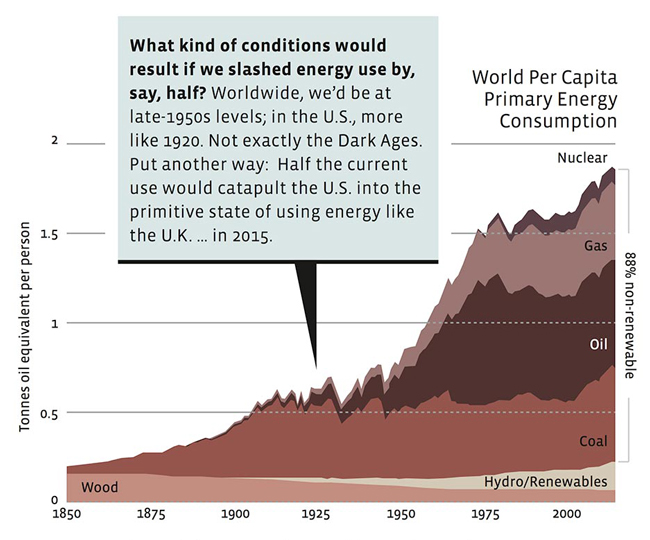
The caption in his graph says everything you need to know. ‘cut energy use in half, worldwide we would be at 1950’s levels. In 1950 the world population was about 2.5 billion, now the world’s population is 7.2 billion and rapidly growing. If we were to go socialist and force the world to cut energy use by half, population growth would stop and 5 billion people would die.
GregT on Thu, 17th Mar 2016 12:48 am
Aric,
A large percentage of the world’s population uses very little fossil fuel energy. First world countries back in the 50’s were already extremely wasteful. Undoubtedly there would be a reduction in the world’s population, but nothing in comparison to what’s in store for us if we keep burning fossil fuels. Whether it is already too late or not, is still up for debate, but if we don’t change our ways soon, all 7.5 billion of us could die.
From the above article:
“The most important thing to understand about the energy transition is that it’s not optional. Delay would be fatal.”
makati1 on Thu, 17th Mar 2016 2:27 am
Aric, I would propose that the biggest die off will be the Western one billion people (US, EU, Japan, Australia & New Zealand.) After all, they consume 60% of the world’s resources. The other six plus billion consume the other 40%.
A Filipino uses ~5% of the energy that the average American uses. Do you think THEY will suffer the most when the crash happens? I don’t think so. Ditto for Africa and the Asian countries. They are still a lot more self-sufficient than any Western country.
yoananda on Thu, 17th Mar 2016 2:34 am
Transition to renewable is a failure in Germany : electricity is too expansive and not enough available for industrials.
It’s not just a “volume graph” that we are dealing with.
theedrich on Thu, 17th Mar 2016 3:44 am
Yes, Greggie Boy, the PCI officially accepts all kinds of equality. Because any person or organization speaking the truth is automatically cast into the outer darkness outside medialand — and will certainly get no contributions from the snowflakes, let alone from “official” sources. As long as the Yid culture of paranoia and Christian hypocrisy rule the regimes of the West, truth will be disallowed. So the PCI must play the game if it is to survive. It is only after desperation sets in that any real change will be possible. And then people can perhaps begin implementing some of PCI’s suggestions. Who knows? Maybe even in Canada.
Davy on Thu, 17th Mar 2016 5:32 am
“A large percentage of the world’s population uses very little fossil fuel energy.” True but what they do use is extremely important because it is what feeds them with no alternatives. Non-carbon based subsistence farming is becoming rare and has little ability to support the teaming masses of the overpopulated urban areas near most 3rd world agricultural areas.
“A Filipino uses ~5% of the energy that the average American uses. Do you think THEY will suffer the most when the crash happens?” YES, The P’s are one of those countries most exposed to a collapse with a population 1/3 the US population concentrated in an area the size of Arizona. They have a destroyed fishery and their forest are significantly damage and leaving a dangerously eroded landscape. Water problems are arising from overuse and pollution. The P’s is in the crosshairs of climate change.
practicalMaina on Thu, 17th Mar 2016 8:03 am
Yoananda is that the reason for their record low unemployment?
We do not need some crazy change to reduce electricity consumption 50% here in the US. The land where everyone can afford to spend an extra couple bucks on a light-bulb that will last longer and use a fraction of the electricity. LED, efficient heat pumps, water heating using waste heat or solar, unplugging shit when not in use. Refrigerators today are actually energy hogs compared to antique models. The old ones had better insulation, a locking latch, no defrost cycle and usually had the heat dumped out above the device, not below.
practicalMaina on Thu, 17th Mar 2016 8:05 am
And when I say where everyone can afford to buy LED, I mean if you can afford to be taxed by the grid on the monthly, find a way to save a few bucks to cut your light bill down, and also on excess heat being dumped into your house, causing your ac and fridge to work harder.
Kenz300 on Thu, 17th Mar 2016 9:14 am
Climate Change is real…. it will impact all of us……we need to move to clean energy production with wind and solar power and clean energy consumption with electric vehicles………
Fossil fuels are the cause of Climate Change….. we need to deal with the cause…. the world needs to move away from coal and embrace the future of wind and solar energy
Climate Change is real…… utilities need to deal with the cause (fossil fuels)
100% electric transportation and 100% solar by 2030
https://www.youtube.com/watch?v=RBkND76J91k
————
Exxon’s Climate Change Cover-Up Is ‘Unparalleled Evil,’ Says Activist
http://www.huffingtonpost.com/entry/exxon-evil-bill-mckibben_561e7362e4b028dd7ea5f45f?utm_hp_ref=green&ir=Green§ion=green
GregT on Thu, 17th Mar 2016 12:37 pm
“True but what they do use is extremely important because it is what feeds them with no alternatives. Non-carbon based subsistence farming is becoming rare and has little ability to support the teaming masses of the overpopulated urban areas near most 3rd world agricultural areas.”
I don’t believe that Heinberg is advocating that any one nation has more energy available the any other. I believe that he is advocating a levelling of the playing field, so to speak.
“According to the Global Footprint Network’s Living Planet Report 2014, the amount of productive land and sea available to each person on Earth in order to live in a way that’s ecologically sustainable is 1.7 global hectares. The current per capita ecological footprint in the United States is 6.8 global hectares.”
Not that I see that happening. We in the West are not about to voluntarily lower our lifestyles to the levels currently seen in 3rd world countries. That won’t happen until it is forced upon us. By then it will be too late.
GregT on Thu, 17th Mar 2016 2:15 pm
theedrich,
“And then people can perhaps begin implementing some of PCI’s suggestions. Who knows? Maybe even in Canada.”
I’ve already begun implementing some of PCI’s suggestions, here in Canada. How about you?
makati1 on Thu, 17th Mar 2016 7:42 pm
Practical, you are spot on on all of your savings ideas. We implemented most of them here and cut our electric bill by at least 30%. Electric in Manila costs about $0.29 per KwH. All of our electrical items are on power cutoffs to prevent the ‘standby’ features, built-in clocks, etc. from wasting electric. Only the fridge is on all of the time.
Kenz300 on Fri, 18th Mar 2016 10:09 am
Fossil fuel companies are spending millions to spread doubt about Climate Change……
4 Ways Exxon Stopped Action on Climate Change
http://ecowatch.com/2015/11/27/exxon-stopped-climate-action/?utm_source=EcoWatch+List&utm_campaign=1d016dacb9-Top_News_11_28_2015&utm_medium=email&utm_term=0_49c7d43dc9-1d016dacb9-86023917
Kenz300 on Sat, 19th Mar 2016 8:03 am
The Kochs Are Plotting A Multimillion-Dollar Assault On Electric Vehicles
http://www.huffingtonpost.com/entry/koch-electric-vehicles_us_56c4d63ce4b0b40245c8cbf6
Inside the Koch Brothers’ Toxic Empire | Rolling Stone
http://www.rollingstone.com/politics/news/inside-the-koch-brothers-toxic-empire-20140924?page=2