Fusion machines: The second-hand market

Whatever their size, fusion devices are fine pieces of technology that are complex to design and expensive to build. As research progresses and experimental programs unfold, however, scientific institutions routinely feel the need for machines with additional capacities, up-to-date equipment or exotic features. When an upgrade is not possible the “old” device appears on an unofficial “second-hand market,” more often donated than sold—just like one might give away a perfectly functional but not-quite-cutting-edge computer to a nephew, a neighbour or a local association.
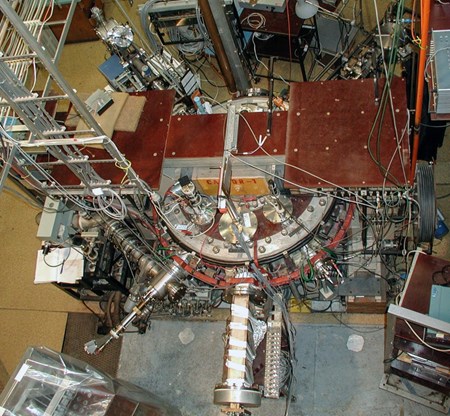
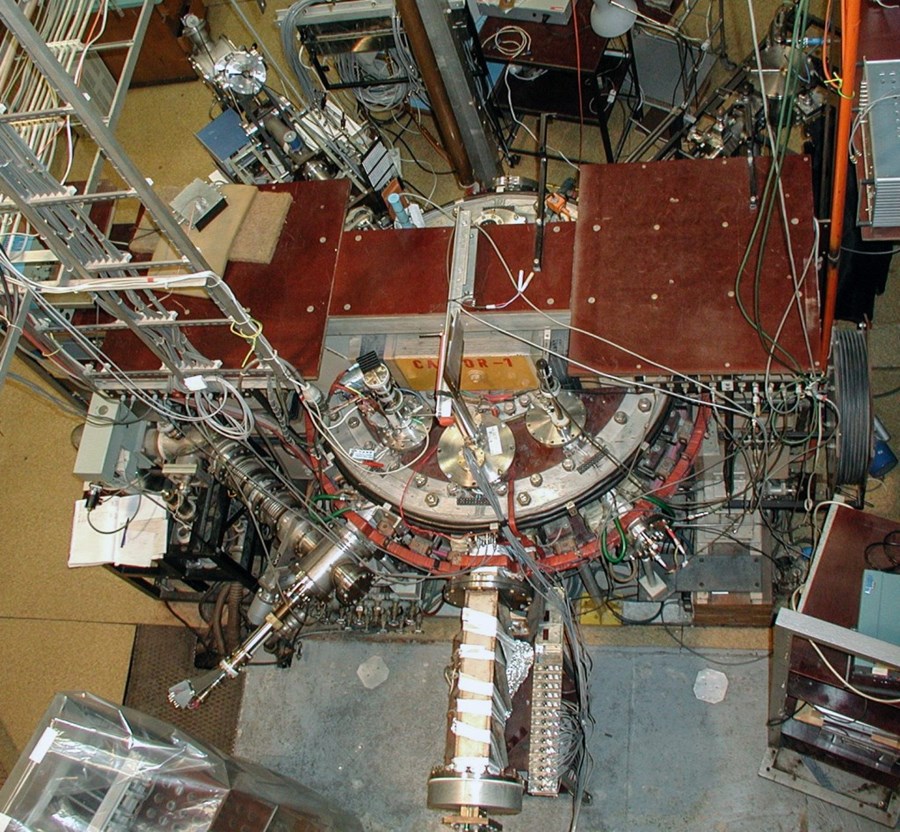
The grandfather of all tokamaks: originally an upgrade of the Russian TM-1 that operated at the Kurchatov between 1963 and 1968, it now serves educational purposes at the Czech Technical University (CTU) in Prague under the name GOLEM.
Russia, which built and upgraded tokamaks at a very fast pace throughout the 1970s and 1980s, has been one of the most generous contributors to this second-hand market.
In 1975, the Kurchatov Institute decommissioned an upgrade of TM-1—a machine that belonged to the
early series of small tokamaks developed in the 1960s—and had it shipped to the Czech Academy of Science where it operated for some 30 years under the name
CASTOR. (This grandfather of all tokamaks now serves educational purposes as
GOLEM).
The LIBTOR tokamak, installed since 1982 at Libya’s Tajoura Nuclear Research Centre, is the rechristened TM4-4 machine, which operated at the Kurchatov Institute from 1969 to 1973. Components from another Russian machine—the larger
T-7 (1979-1985) and the first to be equipped with superconducting toroidal field coils— have been reused in China’s HT-7.
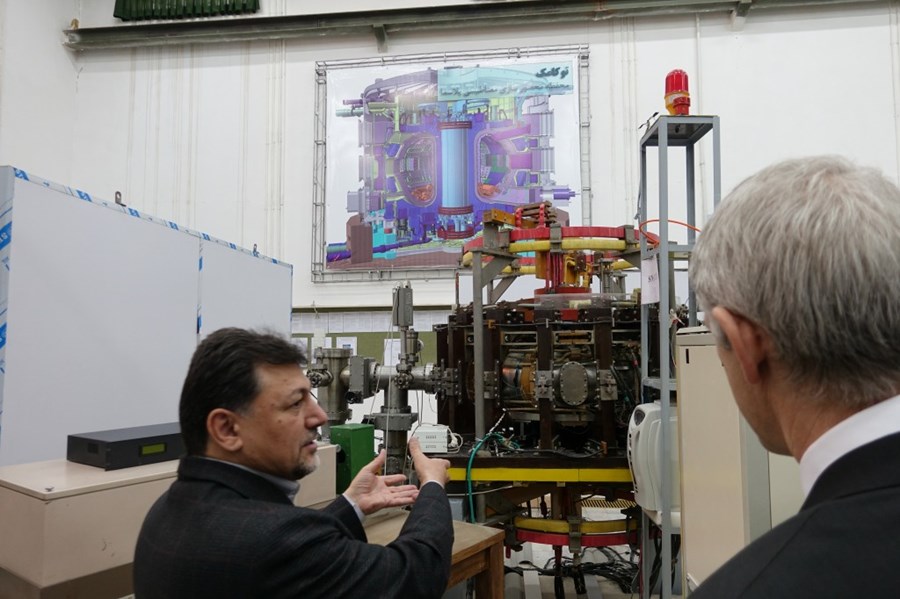
A lesser known Russian machine, TVD, was handed over to Iran in 1994 where, in conformity with the long-standing tradition of giving fusion projects the name of mountains¹, it became
Damavand, Iran’s highest peak and a significant feature in Persian mythology.
Giving away second -and fusion devices is a way of planting the seeds of fusion research in aspiring countries. Portugal for instance, has been operating a small tokamak named
ISTTOK since 1990 that is based on a machine that began its career in 1974 at the Dutch institute FOM (now
DIFFER) under the name TORTUR (!).
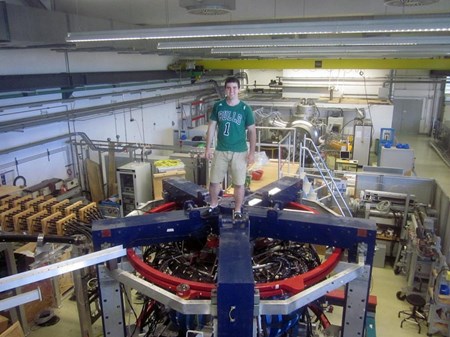
A well-travelled machine: born WEGA from French-German-Belgian parents in 1974, rechristened HIDRA at age 40, the stellarator cum tokamak device has operated under four different roofs on two continents.
In 1999 Brazil received the 20-year-old TCA tokamak from the Ecole polytechnique fédérale de Lausanne, in Switzerland. The device’s French name (Tokamak à Chauffage Alfvèn) carries on in the Brazilian acronym TCABR (or TCA-Br). Brazil, which voiced interest in joining ITER in the late 2000s, also operates the NOVA-UNICAMP tokamak, which was the Nova II tokamak at Kyoto University, Japan, in a former life.
As they progress in their research, former “receivers” often become “givers.” China for instance, after benefitting from Russian components for
HT-7 and German components (from the original ASDEX) for
HL-2A, gave away HT-6B (1982-1992) to Iran, now installed as
IR-T1 at Azad University in Tehran.
Nick Balshaw from the United Kingdom Atomic Energy Agency (UKAEA) tracks down “
all the world’s tokamaks” as a hobby. He has listed more than a dozen machines (including stellarators) that have changed hands in their lifetime—and not just once.
Take the present
HIDRA (Hybrid Illinois Device for Research and Applications), which was
transferred in 2014 from the Max Planck Institute of Plasma Physics (IPP) in Greifswald, Germany, to the University of Illinois in Urbana-Champaign.
The device, which was described by
Physics Today as “a tokamak and stellarator rolled into one,” had seen the light of day 40 years earlier in Grenoble, France, as a joint German-French-Belgian project under the name “Wendelstein Experiment in Grenoble for the Application of Radio Frequency Heating”—
WEGA, in short.
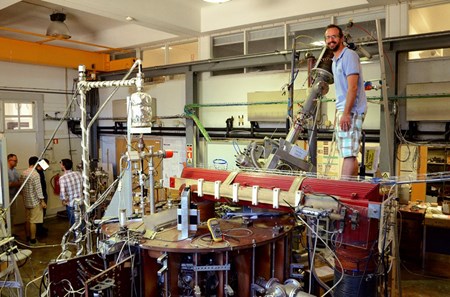
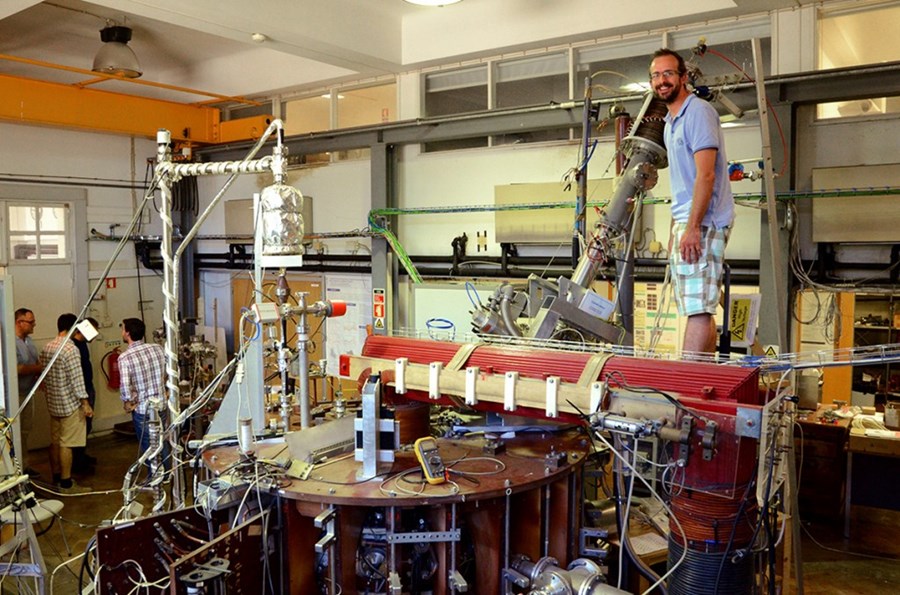
Another fusion student stands happily on a tokamak: the Portuguese ISTTOK is the former TORTUR from the Dutch institute FOM (now DIFFER).
WEGA operated in Grenoble for about 10 years, was transferred in 1984 to the University of Stuttgart, Germany, and resumed operation at IPP in 2001—still under the WEGA acronym, but with the “G” now standing for Greifswald and not Grenoble and the final “A” for Ausbildung (“training”) in German.
By the end of 2013, as the latest incarnation of the Wendelstein project (
Wendelstein 7-X) was nearing completion, WEGA was shut down and eventually sailed across the Atlantic. In sum, in over more than 40 years of existence the device has operated under four different roofs on two continents.
In the second-hand market, fusion devices are handed over free of charge (except for transportation costs, which are generally paid by the receiver). There is however one example of a “for sale” tag attached to a tokamak—and a hefty one at that.
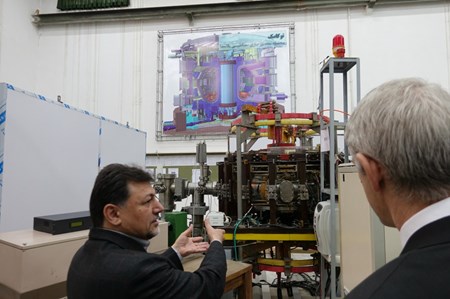
How small the early tokamaks were! This is IR-T1, in operation since 1994 at Azad University in Tehran. The device is the former Chinese HT-6B (1982-1992).
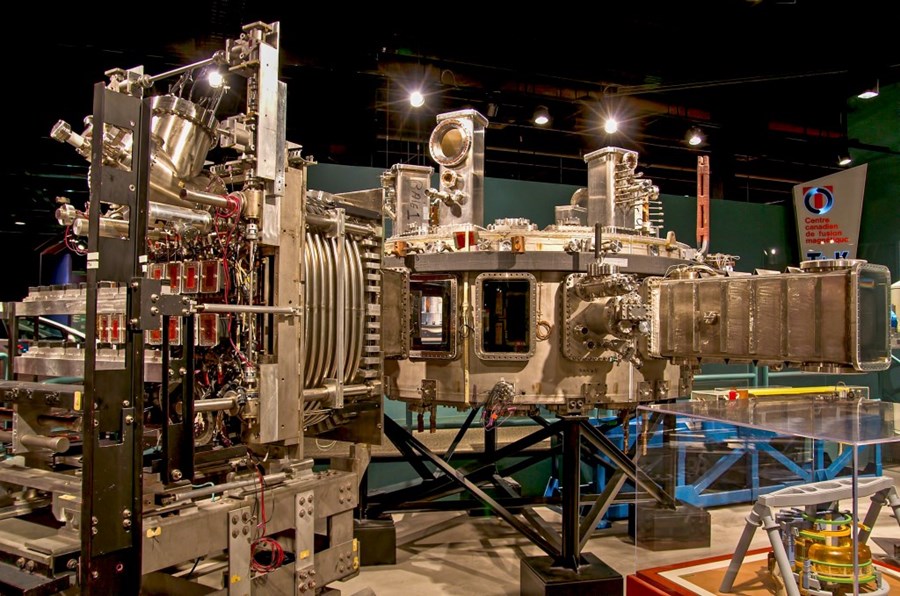
Canada entered fusion research in the late 1970s, and by 1986 the Canadian Centre for Fusion Magnetics (CCFM) operated an experimental tokamak in the Varennes suburb of Montreal. This medium-sized machine, named Tokamak de Varennes, specialized in the study of plasma-wall interactions, and for more than one decade formed the kernel of CCFM activity.
Unfortunately, by 1997 the project had to be folded for lack of funding. CCFM was left with a perfectly operational machine on its hands, potentially worth millions of dollars, and it was
ready to sell. Among the potential buyers was Iran, whose ambitious fusion research program had to rely on outdated machines.
The Iranian offer was in the range of USD 50 to 90 million (depending on the sources). It would have been enthusiastically accepted if the diplomatic context had been different: Iran was at the time under US-imposed sanctions and even in Canadian government circles, there was reluctance to realize the transaction.
The solution to the dilemma came from General Atomics: in order to upgrade its DIII-D tokamak, the company needed powerful gyrotrons … of the kind, precisely, that equipped the Tokamak de Varennes.
Amputating one of the heating systems from the machine considerably reduced its operational value and, as expected, Iran pulled out of the deal.
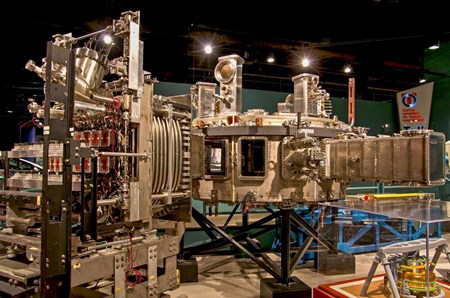
A rare, if not unique, example of a tokamak with a ”for sale” tag attached: the Tokamak de Varennes, now one of the most spectacular exhibits at the Canada Science and Technology Museum in Ottawa, Canada.
As one final twist to the whole episode, the Tokamak de Varennes was transferred in 2001 to Canada’s federal capital, Ottawa, where it now stands as one of the most spectacular exhibits at the Canada Science and Technology Museum — a unique example of a fusion machine on display for the general public.
¹
The tradition of giving the name of a mountain to a fusion research project originates with “Matterhorn”, the secret program conducted at Princeton University in the 1950s. The choice reflected Lyman Spitzer’s passion for mountaineering and called on the parallel between the difficulties of reaching the summit of a high peak and those of harnessing fusion energy. Several fusion projects have since been christened with mountain names—Wendelstein among them.
iter.org




Go Speed Racer on Mon, 18th Jun 2018 4:21 pm
I will take one.
Put into my backyard.
Bolt the optional moonshine distiller
onto the side.
Add a hickory wood salmon smoker
onto the top level, at that point
might actually get some energy out of it.
Anonymouse1 on Mon, 18th Jun 2018 5:18 pm
Just wait, in a couple of decades you will be pick up a used ITER reactor in near-mint condition, for pennies on the Euro. And best of all, since it wont have produce one watt of net-energy, you know it be in good condition.
Anonymouse1 on Mon, 18th Jun 2018 5:19 pm
edit: be able to, bah
Antius on Tue, 19th Jun 2018 3:40 am
The world has thrown huge amounts of money behind Tokamak fusion. The idea is to contain huge, low density plasma within magnetic rings. If the confinement time is long enough and plasma instabilities can be controlled, then the plasma may generate more thermal power than is required to heat it. ITER is predicted to generate 10 times more heat than the heating power required to maintain it. The confinement time issue has largely been solved by increasing the size of the reactor. Since power production is a function of plasma volume and escape rate is a function of surface area, scaling up the device makes it easier to achieve breakeven. That’s assuming that plasma instability does not also exhibit negative scaling effects that require further reducing plasma pressure.
But here’s the rub. To contain plasma instability, the pressure of the confining magnetic fields must be about two orders of magnitude greater than the plasma pressure. The magnetic pressure achievable with magnetic fields of 10 Tesla, which is about the limit of what is achievable with superconducting magnets, if 200bar. So plasma pressure is limited to 2bar. Fusion power at any temperature is proportional to the square of pressure. ITER plasma volume will be 840m3. At 2bar, it will generate up to 500MW of fusion power, about 0.6MW/m3. Compare that to a pressurised water reactor, which generates about 80MW/m3 – about 100 times more than ITER, or a fast breeder reactor, which has power density of 300MW/m3. ITER was projected to cost 17billion Euro, but with cost over-runs it is costing more. Let’s say $US30billion. For a device that will produce 500MW of heat, or 200MW of electricity if we can convert the heat into electric power. That’s $150million/MWe. Again, about two orders of magnitude greater than a pressurised water reactor. Most of the heat released by fission is released as heat in ceramic fuel pellets. Most of the heat released by De-T fusion is released as fast neutron energy, which must deposit their energy within liquid lithium within a cooling jacket. This makes the reactor walls and superconducting magnets brittle and radioactive. A fusion reactor will have a finite life and intense radioactivity will make it difficult and expensive to maintain.
This should give some idea of the mountain that needs to be climbed in order for a tokamak to stand any chance becoming a commercially viable device. Plasma pressure will need to increase by at least an order of magnitude to reach the required power density, but it will be difficult to achieve that without plasma instability overwhelming the confining magnetic field. On top of that, there is a mountain of other technical problems associated with turning what is basically an intense neutron source into an electric power source. Even if ITER works exactly as its proponents intend it to, it is difficult to see any rapid transition to commercially competitive power.
Go Speed Racer on Tue, 19th Jun 2018 5:34 am
Thanks for posting, Ants On Us,
That’s the best damn explanation I ever saw,
of why fusion power sucks.
I just knew by instinct that I could get
more power out of a couple of burning sofa’s.
But you put the numbers on it, pressure
levels. Proved that the energy density sucks.
What a scam. Gubbamint welfare.
AND that’s just wrong, because they could
put the money onto something that actually works.
Antius on Tue, 19th Jun 2018 6:30 am
An interesting article here on z-pinch fusion, which is basically fusion within plasma created by a high current electric arc, in which plasma is contained and compressed by the magnetic field created its own arc current – the Lorenz effect.
https://www.sciencedaily.com/releases/2016/10/161028115240.htm
Peak temperature is 30million Kelvin and peak pressure is about 1billion atmospheres – nine orders of magnitude greater than achievable in a tokamak. It is easy to see why this approach is inherently more promising than a magnetic confinement tokamak. If we are building fusion reactors in 50 years’ time, they are much more likely to be based on some sort of fast-burn z-pinch than magnetic confinement tokamak.
Antius on Tue, 19th Jun 2018 7:06 am
“What a scam. Gubbamint welfare. AND that’s just wrong, because they could put the money onto something that actually works.”
The problem is that three generations of scientists have dedicated their careers to the development of tokamak fusion and energy agencies have poured huge sums into the concept across the world. There is simply too much institutional inertia and vested interest in the idea to publicly admit that it is unlikely to ever be workable. Hence, the crazy situation we find ourselves in. There are other more promising approaches that could yield fruit. But there is institutional resistance to development of anything that might be seen to be in open competition with ITER. There is a similar institutional inertia right now holding back nuclear fission energy; stretching build-times and costs to infinity, based upon embedded institutional bias towards ‘renewable’ energy sources.
Carrol Quigley described a similar situation amongst the generals of WW1. By the end of the American Civil War, rifles had developed a range and accuracy that make cavalry obsolete. Yet fifty years later, cavalry remained an entrenched part of all major European armies. Why? Most of the military leaders on both sides were ‘Cavalry Men’ brought up and committed to maintaining that tradition. Hence the absurd situation of having to haul hundreds of thousands of tonnes of fodder to the front lines of the Somme, to feed horses that were practically useless components of the war machine at that point. On the German side, the Zeppelin fiasco was driven by the same psychology. Fast forward another twenty years and the British adherence to dreadnought battleships and their failure to recognise the game changing significance of the aircraft carrier, would cost them their Pacific fleet.
These things only usually end when their advocates are forced out of power by humiliating defeat. When European nations are facing blackouts and economic turmoil and politicians stop getting paid, then at this point new governments will decide that it is time to cut their losses and members of the ‘old boys club’ of tokamak fusion will lose credibility. Suddenly there will be an appetite for things that actually work. The same with pie in the sky renewable energy dreams.
Cloggie on Tue, 19th Jun 2018 7:15 am
Suddenly there will be an appetite for things that actually work. The same with pie in the sky renewable energy dreams.
Renewable energy actually works, in practice, not just on a drawing board:
https://www.energy-charts.de/power.htm?source=all-sources&week=44&year=2017
Oh and it doesn’t run out, unlike oil, gas and uranium.
And at least as important: it has a very positive image, world-wide. The nuke-boys will never overcome the bad image that remains from Chernobyl and Fukushima.
https://www.youtube.com/watch?v=GuT5vNljXVk
Cornmill, Zeddam, Holland, built in ca. 1440, long before America was ever heard of.
Still works (for tourists).
alain le gargasson on Tue, 19th Jun 2018 7:23 am
If you like the theory of disruption, unfortunately in French
http://www-fusion-magnetique.cea.fr/en_savoir_plus/articles/disruptions/these_c_reux.pdf
MASTERMIND on Tue, 19th Jun 2018 8:06 am
In case you were wondering, one-third (95 out of 289) of all American Nobel Prizes in the Sciences have been earned by Immigrants to the United States.
-Neil deGrasse Tyson
MASTERMIND on Tue, 19th Jun 2018 8:19 am
West Point grad who posed with ‘Communism will win’ in cap discharged
https://www.msn.com/en-us/news/us/west-point-grad-who-posed-with-communism-will-win-in-cap-discharged/ar-AAyPXpa?ocid=ob-tw-enus-677
My brother from another mother! Communism will win! West point is ruled by Nazi’s now..Next they will be burning books.
MASTERMIND on Tue, 19th Jun 2018 8:24 am
I guess it wasn’t PC enough for the fascist US military..Exxon doesn’t want their troops to have free speech..
MASTERMIND on Tue, 19th Jun 2018 8:36 am
World largest multinational bank HSBC investor alert “Man Battle stations”
https://imgur.com/a/AdEYswT#o1JJgSK
MASTERMIND on Tue, 19th Jun 2018 8:43 am
Trump’s Getting Us Ready to Fight a Nuclear War
https://www.alternet.org/trumps-getting-us-ready-fight-nuclear-war?src=newsletter1093438
Duncan Idaho on Tue, 19th Jun 2018 11:07 am
I used to like science fiction quite a bit.
It is old and stale now.
Antius on Tue, 19th Jun 2018 1:45 pm
“In case you were wondering, one-third (95 out of 289) of all American Nobel Prizes in the Sciences have been earned by Immigrants to the United States.”
Proof that a few thousand mostly European and Chinese scientists have benefited the US with their inventions. I bet that tiny minority of people have done more good for the US than all the rest of the millions of imported third world filth combined.
Millikike just can’t help but pump his Marxist poison. His people are a permanent fifth column, rotting the western nations from within.
Cloggie on Tue, 19th Jun 2018 2:21 pm
Trump’s Getting Us Ready to Fight a Nuclear War
Regardless if it is true or not, you should be screaming for joy, millimind. Wasn’t it you who repeatedly called for the destruction of Russia with a first strike, leading to millions of deaths?
https://goo.gl/images/t6GZZC
MASTERMIND on Tue, 19th Jun 2018 2:36 pm
Trump is not the danger. That lies in who follows him.
So how might this happen?
Ten easy stages:
1. A president (2020) is elected (again) on the promise of eternal greatness. (Trump having failed to deliver.) Almost certainly a jesusfreak and godbotherer. If Trump is impeached, that will mean Pence anyway.
2. Those promises remain unfulfilled.
3. The economy continues into its tailspin.
4. The disillusioned majority faces acute privation.
5. The nation begins to violently disintegrate into disparate regions.
6. A state of emergency is declared.
7. The military sides with the existing government (they have no choice)
8. Civil war breaks out (2023?) as US regions demand autonomy.
9. Martial law is declared under the post Trump president
10. You have a fascist (or more likely theo-fascist) dictatorship, attempting to control a disintegrating nation. He will use extreme brutality to do it, having no other options.
https://medium.com/@End_of_More/trump-is-not-the-danger-that-lies-in-who-follows-him-e84d717b2670
MASTERMIND on Tue, 19th Jun 2018 2:37 pm
Antius
Almost half of Fortune 500 companies were founded by American immigrants or their children
https://www.brookings.edu/blog/the-avenue/2017/12/04/almost-half-of-fortune-500-companies-were-founded-by-american-immigrants-or-their-children/
MASTERMIND on Tue, 19th Jun 2018 2:38 pm
Antius
We should deport the right wingers in America..they are in general a bunch of uneducated, fat obese slobs..
Cloggie on Tue, 19th Jun 2018 3:02 pm
5. The nation begins to violently disintegrate into disparate regions.
6. A state of emergency is declared.
7. The military sides with the existing government (they have no choice)
8. Civil war breaks out (2023?) as US regions demand autonomy.
9. Martial law is declared under the post Trump president
10. You have a fascist (or more likely theo-fascist) dictatorship, attempting to control a disintegrating nation. He will use extreme brutality to do it, having no other options.
https://medium.com/@End_of_More/trump-is-not-the-danger-that-lies-in-who-follows-him-e84d717b2670
Precisely the scenario I think is going to happen, initially.
What the article completely ignores though is the potential role of foreign powers, weapon deliveries and foreign mercenaries, if not armies, who, like in 1776, could play a decisive role.
https://goo.gl/images/Dmzofo
MASTERMIND on Tue, 19th Jun 2018 3:09 pm
Clogg
When the civil war breaks out.Ole whitey is done..I mean can you imagine someone like Lebron chasing down some trump voter with an assault riffle in his hands?
LMFAO!
MASTERMIND on Tue, 19th Jun 2018 3:23 pm
Canada ‘troubled’ by US separation of migrant families: minister
https://www.yahoo.com/news/canada-troubled-us-separation-migrant-families-minister-192749051.html
Release the children to their parents you fat piece of shit!
Wait till the oil starts to run out, then its payback time!
Anonymouse1 on Tue, 19th Jun 2018 3:25 pm
I recommend craigslist if you are looking for a used fusion reactor. Sure, lots of spam posts, and, and sometimes, you see a fusion reactor listed at a price that sounds too-good-to-be-true, it probably is. But that is the true of lots of things, like sofas and EZ-chairs, and not just old tokamak reactors.