



I work at UC Davis, a University with at least two (that I know about) centers devoted to research “aimed at developing a sustainable market for plug-in vehicles.” I run into a lot of researchers and environmental advocates who are completely dedicated to the mission of accelerating the deployment of electric vehicles. They view electrifying a large share of the transportation fleet as one key piece of the climate policy puzzle.
I am also an economist. The research coming out of the economics community has pretty consistently demonstrated that electric vehicles currently have marginal (at best) environmental benefits. I run into a lot of economists who are perplexed at the hostility these findings have generated from pockets of the environmental community.
I have followed and pondered these clashes for some time now, in part for the entertainment value, but also because of what this conflict reveals about how the different disciplines think about climate policy.
As the Paris climate summit concludes, the spotlight has been on goals such as limiting warming to 2 or even 1.5 degrees Celsius, and how the agreed-to actions fall short of the necessary steps to achieve them. There has been much less focus on where targets like 2 degrees Celsius come from, and what the costs of achieving them would be. A lot of the policies being discussed for meeting goals like an 80% reduction in carbon emissions carry price tags well in excess of the EPA’s official “social cost of carbon,” one measure of the environmental damages caused by CO2 emissions. It is quite likely that these different perspectives, about how to frame the climate change problem, will define the sides of the next generation of climate policy debate (if and when we get past the current opposition based upon a rejection of climate science).
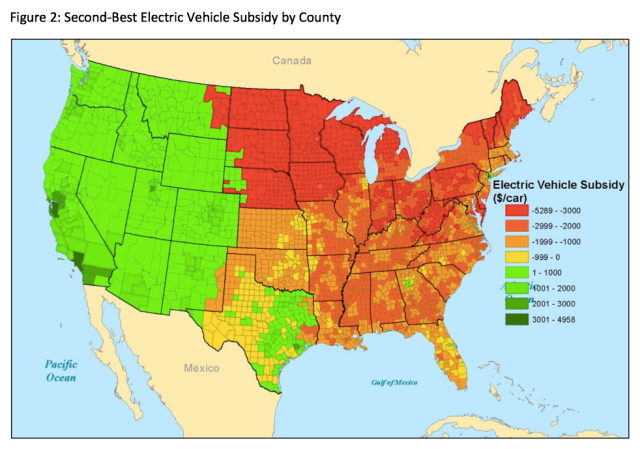
To be clear, the research on EVs is not (for most places) claiming that electric cars yield no environmental benefit. The point of papers like Mansur, et. al, and Archsmith, Kendall, and Rapson is that these benefits are for the moment dwarfed by the size of public and private funds directed at EVs. Some have criticized aspects of the study methodologies (for example a lack of full life cycle analysis), but later work has largely addressed those complaints and not changed the conclusion that the benefits of EVs are substantially below the level of public subsidy they currently enjoy. Not only that, but Severin Borenstein and Lucas Davis point out that EV tax credits are about the most regressive of green energy subsidies currently available.
Another common, and more thought provoking, reaction I’ve seen is the view that the current environmental benefits of EVs are almost irrelevant. The grid will have to be substantially less carbon intensive in the future, and therefore it will be. The question is, what if it’s not? It seems likely that California will have a very low carbon power sector in 15 years, but I’m not so sure about the trajectory elsewhere. This argument also raises the question of sequencing. Why are we putting so much public money into EVs before the grid is cleaned up and not after?
This kind of argument comes up a lot when discussing some of the more controversial (i.e., expensive) policies directed at CO2 emissions mitigation. Economists will write papers pointing to programs with an implied cost per ton of CO2 reductions in the range of hundreds of dollars per ton. One reaction to such findings is to point out that we need to do this expensive stuff and the cheap stuff or else we just aren’t going to have enough emissions reductions. Since we need to do all of it, it’s no great tragedy to do the expensive stuff now.
It seems to me that this view represents what was once captured in the “wedges” concept and is now articulated as a carbon budget. Environmental economists call it a quantity mechanism or target. The underlying implication is that we have to do all the policies necessary to reach the mitigation target, or we are completely screwed. So we need to identify the ways (wedges) that reduce emissions and get them done, no matter what the costs may be.
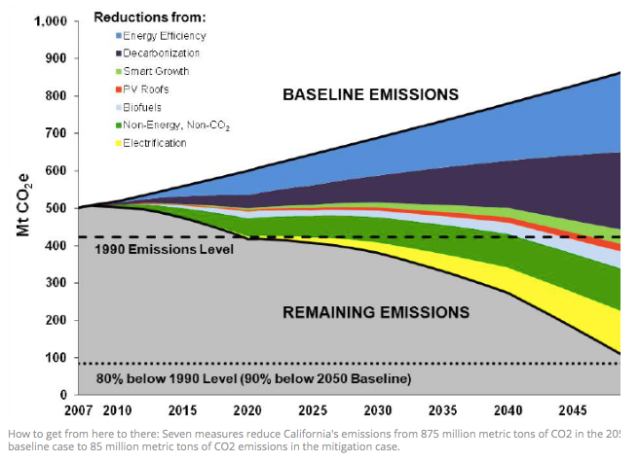
According to this viewpoint we shouldn’t quibble over whether program X costs $100 or $200 a ton if we’re going to have to do it all to get the abatement numbers to add up. Sure, it may be ideal to do the cheap stuff (clean up the power sector) first and then do the expensive stuff (roll out EVs), but we’re going to have to do it all anyway.
At the risk of oversimplification, many environmental economists think of the problem in a different way. Each policy that reduces emissions has a cost, and those reductions create an incremental benefit. The question is then “are the benefits greater than the costs”? From this framing of the problem, a statement like “we have to stick to the carbon budget X, no matter what the costs” doesn’t make sense. Any statement that ignores the costs doesn’t make sense.
It does appear that to reduce emissions by 80% by 2050, we will have to almost completely decarbonize the power sector and largely, if not completely, take the carbon out of transportation. That’s just arithmetic. How does one square that with research that implies such policies currently cost several hundred dollars a ton?
In particular, how do we reconcile this with the EPA’s estimates of the social cost of carbon that are in the range of $40/ton? In their paper on the lifecycle carbon impacts of EVs and conventional cars, Archsmith, Kendell, and Rapson, using $38/ton as a cost of carbon, estimate the lifetime damages of the gasoline powered, but pretty efficient, Nissan Versa to be $3200. In other words, replacing a fuel efficient passenger car with a vehicle with NO lifecycle emissions would produce benefits of $3200. That puts $10,000 in EV tax credits in perspective.
Many proponents of those policies no doubt believe that the benefits of abatement (or costs of carbon emissions) are indeed many hundreds of dollars per ton. Or they could believe that costs of many of these programs are either cheaper right now than economists claim, or will become cheaper over the next decades. Some justify the current resources directed at EVs as first steps necessary to gain the advantages of learning-by-doing and network effects. Others make the point that the average social cost of carbon masks the great disparity in the distributional impacts of those costs. Perhaps climate policy should be trying to limit the maximum damages felt by anyone, instead of targeting averages. How do residents of the Marshall Islands feel about the US EPA’s social cost of carbon?
All these are legitimate viewpoints. However, there is also the fact that the quantity targets we are picking, like limiting warming to 2 degree Celsius increase and/or reducing emissions by 80% by 2050, are somewhat arbitrary targets themselves. It’s hard to claim that the benefits of abatement are minuscule if we fall slightly short of that target and suddenly become huge if we make it. This encapsulates the economists’ framing of the climate problem as a “cost-based” one. Under this viewpoint we should keep pushing on abatement as much as we can, and see if the costs turn out to be less than the benefits. If not, we adjust our targets in response to what we learn about abatement costs (in addition to climate impacts).
This motivates so much of the economics research focus on the costs and effectiveness of existing and proposed regulations. That community doesn’t view it as sweating the small stuff. Under this framing of the issue, maybe having a fleet of super fuel efficient hybrids makes more sense, even if it results in higher carbon from passenger vehicles than a fleet of pure EVs might.
Or maybe EVs do turn out to be the best option. The two sides will have to recognize where the other is coming from, or the next round of climate policy debates may be as frustrating as this one.
joe on Fri, 18th Dec 2015 2:06 pm
Without detailed knowledge of how to build an electric car people simply do not understand whats involved in the construction of these vehicles or how these industrial processes impact the environment.
Most consumers just want a car, if it helps the world then even better, right? Perhaps a better way to look at this would some kind of ‘direct emission’ and ‘indirect emission’ costing model that costs cars on a ‘total cost of greenhouse gas emission’ system. Such systems could in theory reveal the cost as a function of impact. Reality may be much harder to implement unless it was handed over to a public AI system which was totally auditable by all parties. A kind of ‘enviro neutrality’ system.
Pennsyguy on Fri, 18th Dec 2015 2:21 pm
Even if cars ran on water or air, using them means mining and processing at least one ton of various materials to move one or two people around, Then there are the roads to be maintained. Bring back the Pennsylvania Railroad.
Anonymous on Fri, 18th Dec 2015 2:33 pm
Electric mass transit, or perhaps e-bikes or similar systems, do make sense. But using EV’s to sustain suburbia, sprawl, and strip-mall USA? Not so much. It would hardly matter how ‘clean’ the grid in the US were to become(lol), it would change very little. The problem is not with electric transport as such, but rather that everyone, at least in Americaland(and possibly others), see EV’s as direct drop in substitutes for gas and oil powered cars.
That is the ‘problem’. Not subsidies, or lack of, or a dirty grid even.
GregT on Fri, 18th Dec 2015 3:31 pm
There is so much wrong with this article that it’s difficult to find a place to start. Even if we were able to cut CO2 emissions 90% by 2050, that still would not begin to solve the problem. Green house gases accumulate in the environment. We either stop, or we continue to make our situation worse. Like floating in a boat in the middle of the ocean, habitually poking holes in the hull, and debating how many more holes can be made before the boat sinks.
I wonder? How many eCONomists would be required to solve that problem?
penury on Fri, 18th Dec 2015 4:19 pm
Every solution to the human predicament appears to trust that tech will save us all. There is no solution. Mitigation might be feasible for a small portion of humans however, society as we currently know it is going away. Every attempt at mitigation carries a cost. Nations cannot afford the cost, most groups are not aware of what is coming so nothing will be done,
dissident on Fri, 18th Dec 2015 4:33 pm
That graph is fudged BS like the IEA oil production plots. The top two contributions are complete nonsense pulled out of nowhere like “undiscovered reserves”. Carbon sequestration is dead in the water and will not be registering as blip even by 2030. Efficiency is clearly treated like some sort of panacea and they pretend that they can even estimate it. Have you checked out the price of many hybrid vehicles? The markup is insane and nobody would buy them based on savings. They charge you a markup that offsets any fuel savings by well over 100%. And if the fuel price skyrockets in the future, your hybrid is worthless junk anyway.
Spec on Fri, 18th Dec 2015 4:40 pm
He misses the point of the incentive programs. They are not meant to give a proportional amount of environmental benefit per dollar spent. They are meant to jumpstart and entire new industry and get it rolling. Eventually, the incentives will be phased down.
GregT on Fri, 18th Dec 2015 4:49 pm
“They are meant to jumpstart and entire new industry and get it rolling”
Exactly! More of the same that got us into this mess in the first place. Industry, and economics. Both have two things in common. They require finite resources, and a cheap, abundant source of energy.
sidzepp on Fri, 18th Dec 2015 4:52 pm
Okay Economists lets;
Do a study and the effects of rising seas levels and the cost of relocating million of people from coastal areas.
Lets do a cost study on the billion plus people who will be affected by the depletion of river systems because of the loss of glaciers in the Himalayas.
Lets do a cost study on the deforestation that is widespread throughout the planet.
Lets do a cost study on the continual encroachment of major deserts on marginal land.
Lets do a cost study on the depletion of the marine life in the oceans.
Lets do a cost study on the continual depletion of soil.
Lets do a cost study on the changing temperatures and that effect on agricultural practices.
Lets do a cost study on the chaos and disorder that is likely to grow and how societies and nations will react to preserve their own self-interests, environment be damned.
Anonymous on Fri, 18th Dec 2015 5:02 pm
Spec, what is the ‘point’ of jump starting an entirely new industry if it only real purpose is to sustain the status-quo, just by slightly different ,and more costly means? Not that this author recognizes that. He clearly views the damage done by cars as a purely dollar driven exercise. And what is meant by ‘incentive’ anyhow? In the american empire, the oil auto corporations were also heavily ‘incentivized'(read subsidized) AND still are-a century on. The most generous raft of public subsidies and regulatory latitude ever seen have been lavished on privately held oil and auto corporations, to what effect? The ‘incentives’ for private 2.5 ton+ gas powered cars were never phased down either fyi. They are still in full effect and impose huge costs.
Incentives for 2 ton battery powered cars to replace(also subsidized) 2.5 ton gas powered cars are not a social good, and will produce few, if any, of the the supposedly desired results, no matter what the author thinks.
JuanP on Fri, 18th Dec 2015 5:13 pm
http://www.prodecotech.com/
GregT on Fri, 18th Dec 2015 5:36 pm
Did you read the FAQ Juan?
“Our 2015 version 5 e-bike design has increased water resistance compared to our rear mounted battery design however it’s important to keep your e-bike protected from water. You should avoid whenever possible to ride your bicycle in the rain.”
“How long until a battery needs to be replaced?
With proper care, the batteries can last as long as 7 years.”
At least after the seven year mark, a bike with a dead battery would be much easier to pedal, than pushing a dead car.
makati1 on Fri, 18th Dec 2015 5:41 pm
The subject was well covered by the above intelligent comments. Nothing more needs to be added. ^_^
onlooker on Fri, 18th Dec 2015 6:10 pm
Isn’t what we are really talking about here Jevons paradox. Whereby any efficiency and energy saving will just be transferred to some other venture and pursuit. We do not need more of anything at this point nor can we any longer afford to transition to anything at this point. We DO need less of everything. Less people, less economic activity, less consuming. We simply have two choices do it voluntarily or be forced to do it in other words, have it done to us.
Anonymous on Fri, 18th Dec 2015 6:23 pm
No I don’t think it is onlooker. While EV’s may be more ‘efficient’ on a individual level, the idea that an all EV FLEET, substituting for the current gas one,would yield net savings, either in energy, materials, or dollars *overall* is anything but clear. My sense of it is, that an all-EV, drive everywhere sprawl world would consume about the same amount of resources as the all gas model does now. It *could* be slightly less, or a little more! even, but one it wouldn’t be-is a huge windfall of resources saved. I really doubt the all private EV world would leave much resources left over(if any!) to waste on other, equally frivolous pursuits.
onlooker on Fri, 18th Dec 2015 6:33 pm
Yeah Anonymous, all the more reason the optimists of the main stream media and such are just talking foolishness. Right here on PO we quickly put to rest any idiotic feel good drivel intended for the naive masses. Thanks A for that dose of reality.
twocats on Fri, 18th Dec 2015 6:38 pm
Tons of americans would love to de-sprawl and live in an efficient neighborhood with limited EV vehicles (maybe shared like Car to Go or similar idea) but unless you are a Tech-Bro, or Chinese Embezzler, or a Patent Lawyer suing a Tech-Bro, no one can afford an apartment let along a house in any of these cities. Seattle, SF, Oakland, Berkeley, LA, Portland, (and I’m betting most of East Coast too) are all but shut down for an affordable apartment if you make less than $50,000 a year. I’m not claiming any of these places is sustainable, but the idea that people still dream of suburban sprawl is somewhat dated.
dissident on Fri, 18th Dec 2015 7:11 pm
@twocats,
Exactly. The affordability is simply not there so nothing will change. And there is no effort to make any right choice affordable.
GregT on Fri, 18th Dec 2015 8:12 pm
We need more uber rich developers and real estate tycoons. Oh wait, isn’t The Donald…..um, never mind.
Anonymous on Fri, 18th Dec 2015 9:56 pm
‘People’ may not dream of suburban sprawl, or at least some may not. But oil, auto, zoning regulators, real estate, banking, traffic engineers, big box chains DO dream of sprawl. Its a cornerstone of their business model. Actually, its THE reason for their very existence. They never stop dreaming about, promoting it, or trying to build more of it. And they fight tooth and nail against any effort to reign it in, or minimize it. EV’s are they currently thought of, especially in Americaland, or any place the US has exported car-sprawl to, is intended to leave that entire sprawl industry intact, and maintain it as a viable business model.
Whenever someone says they see EVs as being small, compact. eco-friendly components of livable, walkable cities or towns, you know are not paying much attention to how EV’s are actually built and promoted. In fact, this explains why EVs’ despite being practical 100 years ago are so rare. ‘Engineer’s keep trying to give them all the attributes of a gas-powered car. IE able to drive obese americans from NY to disneyland in California at a whim. This ‘goal’ helps keeps EV’s perpetually on the drawing boards, and helps keep the world safe for oil powered cars for the foreseeable future. Or until the economy collapses to the point there is no where left worth driving to. Whichever is first…
Kevin Cobley on Fri, 18th Dec 2015 10:13 pm
A society of compact walkable neighbourhoods small{under 100sqm)row houses and 3 story walkup apartments, everybody in walking distance of shops, schools. Mass transit systems between neighbourhoods and CBD’s, no roads(except for small scales delivery and trades), no Garages, no Parking and a highly developed Fibre broadband to eliminate travelling.
The only “green cars” are no cars.
twocats on Fri, 18th Dec 2015 10:22 pm
yep, I’m from Americaland, and I guess I should have said, “a vibrant minority”. You are correct that even at this massively late stage the vast majority of Vast Americans (and up and coming Asian middle-classes) JUST DO NOT GET IT. And when they do, the culture and existing infrastructure DOMINATE and DROWN OUT even modest changes.
When the economy inevitably does collapse it will probably lead to such a traumatic experience, even beyond the massive deaths that will occur around most people, the loss of one’s cultural worldview, I imagine most people will be up to their ears in PTSD and not doing much of anything except scavenging for scraps of food or standing in the newly formed emergency bread lines.
twocats on Fri, 18th Dec 2015 10:29 pm
@Kevin, agreed, and this is what anonymous and many people are talking about in terms of existing infrastructure (and crucially per Anon) the elite, wealthy, & decision makers are all still aiming towards Build Out of existing city planning.
We should have dozens of model towns up and running by this point. Not only would it have allowed experimentation with what works and what doesn’t, you’d be raising 1,000s to 10s of 1,000s of kids in these “sustainable-lite” lifestyles, kids that know how to grow food, fix a tractor, trouble shoot a PV array.
It’s like Looper where all the cars are retrofitted to run on whatever bullshit they got left, maybe literally bull shit.
Go Speed Racer on Fri, 18th Dec 2015 10:40 pm
The answer is for everybody to sell their car and buy a bicycle. You first.
GregT on Fri, 18th Dec 2015 10:54 pm
“The answer is for everybody to sell their car and buy a bicycle. You first.”
Not until you pry the steering wheel from my cold dead hands, and the hands of my children, my grandchildren, and their children. Destroying the environment for all future generations, and life as we know it on the planet Earth, is my right, it is not a privilege for anybody else.
John Ladasky on Fri, 18th Dec 2015 11:13 pm
This article over-simplifies several major issues.
First, as shown in the chart, I agree that improvements in energy efficiency continue to be the low-hanging fruit in the tree. Now, given that I have already made major improvements to MY personal energy efficiency, what ELSE can I do?
I can support candidates for political office that pledge to make businesses, civic institutions, and other individuals (besides myself) become more efficient. I do so. But there aren’t always candidates to carry the banner of environmental responsibility in every election. And when they get to office, they often face fierce opposition from people who are making money off the status quo. My investment in politics, in time and in money, frequently does not pay off.
Now, the next big category of environmental gains is listed as decarbonization. How do I participate in that? That’s almost completely out of my hands. It’s in the hands of politicians, who have famously kicked the can down the road for decades. Well, perhaps there is one way I can decarbonize my life: I could put up solar panels. I have done this.
Now let’s go back to the category of energy efficiency for a moment. Where do energy-efficient innovations come from? Some of them come from social policy, such as infill development and improved mass transit. We have to convince people they want to live in cities to realize those benefits. Many Americans resist that strongly. (I don’t, but I also can’t afford to move from my current residence. To be fair, Silicon Valley is pretty built up, and my commute is very short. Also, if I move to a downtown apartment, where would my solar power come from? Landlords and developers still aren’t going solar, and I don’t understand why not.)
A significant number of energy-efficient innovations are not social, but technological. When you buy an Energy Star appliance or LED bulbs, these items cost extra, at least at first. They may pay for themselves in the long run. What is YOUR personal tolerance for delayed economic gratification? For most people, it’s far too short.
Finally: I know that economists may boggle at this concept, but I know that some of the money that I have spent going green has not benefited me. I knew before I even took out my wallet. So why did I bother? The answer is that I’m not just making a purchase for me. I am making a down-payment on a better future for other people who will come after me.
Early adopters drive the IMPROVEMENT of technologies, which have the potential to make the environmental impact of each of the small categories in the chart above become larger. Remember, in the 1970’s, solar panels required more energy to manufacture than they ever produced. Anti-environmentalists can be found all over the Internet who act as if we never progressed beyond that time. Someone needed to build, deploy, and evaluate those low-quality solar panels 40 years ago in order for us to have the great ones we have today.
When I bought a whiz-bang induction stove/cooktop to replace my old electric stove, was the hundreds of extra dollars I spent ever going to be returned to me? Hey, it cooks better with 40 amps than my old stove did with 50 amps. But a stove is a low duty-cycle appliance. Those 10 amps are even basically free to me, because I have solar power and net metering. But induction cooking appliances are coming down in price, probably because of economies of scale and technological improvements. I had a hand in that.
The solar panels that I bought in 2005 are about 20% less efficient, and 40% more expensive, than the ones you can buy today. Again, I had a hand in that. In fact, when I bought my PV system, I hoped for a future in which PV was widely affordable. I’m pleased and astonished that it has happened so quickly. There are a lot of solar installations in my neighborhood.
Now, I have a son — so you could say that I’m engaged in the time-honored endeavor of defending my own DNA’s future. But actually, I wasn’t expecting to have any kids, and I was an environmentalist long before I became a parent.
Here’s what I’ve done over the decades:
1) Deliberately lived close to work, under 10 miles commute, since the early 1990’s.
2) Commuted frequently by bus, light rail, or even by bicycle.
3) Kept my family small.
4) First car: 1989 Mercury Tracer, 38 MPG long before it was fashionable.
5) Second car: 2004 Toyota Prius. 50 MPG when I drive it (42 MPG when my wife does… :^).
6) Super-insulated a house, upgraded all lighting and appliances.
7) Installed a 4.0 kW grid-tied solar PV system in 2005.
And this week, I expect to replace my wife’s old car, a 1994 Honda Civic, with a lightly-used Chevy Volt. We will be doing a significant portion of our driving on sunshine. This is a long-held dream for me. I’m tickled that I can buy an affordable electric car.
In summary: I’m buying efficient and electrified vehicles with more in mind than MY pocketbook, or even the PRESENT state of the environmental impact of electrified vehicles. I’m trying to invest in a better future, one which I fully expect that I won’t see in its completion.
Economists should put a value on social responsibility, just so that they can incorporate it in their mental models.
GregT on Fri, 18th Dec 2015 11:14 pm
“yep, I’m from Americaland, and I guess I should have said, “a vibrant minority”
Don’t give up without a fight twocats, ignore the flag waving rednecks, some things really are worth saving. America was founded on some very good principles.
GregT on Fri, 18th Dec 2015 11:19 pm
Good for you John Ladasky,
You are on the right track, but the rabbit hole runs much deeper than that.
gdubya on Fri, 18th Dec 2015 11:39 pm
John – it’s a good start, and matches much of what I have done.
Sadly the general uptake is still statistically zero.
GregT on Sat, 19th Dec 2015 1:33 am
And queue in 5, 4, 3, 2, 1, the mindless flag waver from MO. Murica’s the best, fuck the rest. Yeeehaa. Don’t like us, we’ll just kill you all.
onlooker on Sat, 19th Dec 2015 2:16 am
John L, you are too be commended for all you have done. Unfortunately, this was something that should have been done in mass years back. The failures fall both on the governments but also the people. People have been sleepwalking these last few decades even has once solvable problems have mushroomed into unsolvable predicaments. Of course the powers that be are major culprits for that showing an ounce of leadership or even trying to alert the masses. We here on this site know all we know because we have educated ourselves you could say gotten our degree in doom haha. Seriously, as Greg said the rabbit hole goes much deeper and I am not saying to resign in hopelessness but I am saying we must understand exactly where we are as a society so as to act accordingly. That unfortunately means everyone and we have not reached everyone not by a long shot.
onlooker on Sat, 19th Dec 2015 2:16 am
for not showing. Sorry
GregT on Sat, 19th Dec 2015 2:46 am
Thanks for continuing to be a voice of reason onlooker. I know that I allow my emotions to get in the way of myself, sometimes. IMHO you are one of the few here that maintains a semblance of decorum. Good for you. Somebody to look up to. Thanks.
onlooker on Sat, 19th Dec 2015 3:02 am
thanks Greg always appreciate your encouragement. how is the weather in Canada?
GregT on Sat, 19th Dec 2015 3:19 am
Where do you live onlooker? What do you do? And how old are you? I you don’t mind me asking.
adamc18 on Sat, 19th Dec 2015 3:23 am
The economist’s article is rubbish, but the succession of comments here contains more thought-provoking reason and common sense than I have seen anywhere for a long time.
It has made me wonder why someone hasn’t produced a discussion and graphs to try to justify the utility and continuing existence of economists.
onlooker on Sat, 19th Dec 2015 3:25 am
Live in upstate NY. I am 53 yrs old. As for what I do, well I am still connected to the Matrix you could say but I am endeavoring to apprise myself on being self sufficient in regards especially to food growing and medical self care. I also have a Filipino girlfriend for the past 9 years she is on board with whatever I do. Also, I am always alert to communities that may be worthwhile being part of. So, I am okay with revealing my info.
GregT on Sat, 19th Dec 2015 3:38 am
I just turned 54, a month ago, so that makes me more experienced than you. 🙂
I appreciate your perspective onlooker, you make me think outside of my ‘box’. You have much more patience, apparently, than I do, and I appreciate that as well. Even though I have never met you,
I have a great deal of respect for you already.. I have seen enough, to understand who you really are. Two big thumbs up for you onlooker.
onlooker on Sat, 19th Dec 2015 4:25 am
Yes Greg and it is not easy dealing with these subjects so we are all bound to get emotional. I too feel your posting is both very articulate and objective. Despite what some may say. We are all trying to digest some pretty disturbing stuff. Anytime you want to talk more in depth feel free to write me a note on the PO email server. stay well and Merry Christmas and Happy New year.
Davy on Sat, 19th Dec 2015 4:41 am
“And queue in 5, 4, 3, 2, 1, the mindless flag waver from MO. Murica’s the best, fuck the rest. Yeeehaa. Don’t like us, we’ll just kill you all.”
Greg, do I get under your skin? You can’t stand the fact I don’t see the world as you do and refuse to join the crowd and be an extremist on your cherished issues. I have a regular voice and you hate me for that. I see you kiss your buddies asses, bash your enemies, and generally throw cold water on anyone else trying to make sense of the world. They call people like you bored. I am sorry retirement didn’t turn out as planned. I should have warned you that leaving you routine in the real world and starting a new life especially in a midlife can turn to midlife crisis. Advice for bored no-it-all’s, lighten up and accept the fact when you shit it stinks too.
Davy on Sat, 19th Dec 2015 5:11 am
John Ladasky, I admire what you have done and your general focus, attitudes, and life system. It is mine too. You are in a different place of course but the efforts are similar. It is people like you who are trying that can be an example of relative resilience and increased sustainability per your local.
Remember it is community that matter so at some point you are at their mercy. Communities are at the mercy of the higher and so on all the way up to the global. I say this because until the shake-out comes we all derive our employment and support from this global system. The shake out will force us into an unknown localized arrangement.
Some will say why bother because collapse will swallow you up anyway. We really don’t know how collapse will unfold. If we have a long emergency it will be your efforts that give you a cushion for further adjustments. If there are a critical mass of people like you then your community will have a cushion with increased resilience in the face of decay and collapse.
If this “sucker blows” hard who knows if your efforts matter but I feel you still have a cushion. I did not see on your list short term prep items like long shelf life food. What I saw on your list was status quo efficiency and conservation efforts which are exemplary. Take it a step forward since you seem able and willing. Do short term prep. Long shelf life food is highest on my prep list of needs.
I commend you for what you are doing within our status quo cage. Many of us would like to break out and stop the madness but unfortunately there is no checking out until we all check out. Even those who can decouple to a large degree are still part. Even the simple third world’er living a subsistence living is exposed.
Time is special when we live in the here and now. When we live in the future is when we degrade the here and now with anxiety and fear of a scary future. I myself often look upon my kids with sadness because I know their life will likely be shortened and painful.
Be happy on one level you have done what many status quo’ers should do. Think of all the poor lifestyles and attitudes that could be changed that could lengthen our normal lives. Think how many could be helped indirectly by causing less damage or directly from assistance in examples of proper lifestyles for a collapsing world.
In the end status quo is not sustainable in the real earth system. This is all too apparent by the waste stream we call modern man. We are destroying and have destroyed a global ecosystem that cannot be denied. We will have to rebalance. This rebalance will mean all you have done will be swept away at some point. Now it matters and it is the here and now we need to live and enjoy.
Dredd on Sat, 19th Dec 2015 5:20 am
They left old fingerprints showing the deed was done long ago (Weekend Rebel Science Excursion – 54).
makati1 on Sat, 19th Dec 2015 5:20 am
Guys, Davy doesn’t own a mirror.
Davy on Sat, 19th Dec 2015 5:32 am
Mak, you can’t stand my voice because it disturbs your propaganda of hate and resentment. Looks like you are stepping up to gang bang with your buddy because might makes right and the majority is right. That’s how Mak gets his thrills. Your buddy needs help BTW. You used to show superior strength with your silent treatment. I respected that in you. Now I know I got under your clammy skin.
JuanP on Sat, 19th Dec 2015 6:38 am
On rainy days, I use http://miami.car2go.com/
On sunny days (most of the time), I use my old folding ebike https://www.prodecotech.com/electric-bikes/genesis-v3/
I put a bag on the battery when I get caught by rain. So far so good. I only commute two days a week when I volunteer at the local urban farm coop. I work from home. My wife gives me rides, too, now and then. This is not for everyone.
dave thompson on Sat, 19th Dec 2015 9:31 am
Electric cars are FF-hydrocarbon extenders. Remove the FF-hydrocarbons and no more electric cars.
Chris Hill on Sat, 19th Dec 2015 9:39 am
I love the idea of a walkable community. Apartment living,, in my experience, is difficult to stand long term. In the three apartments I lived in, there was always one thing in common, inconsiderate neighbors. From the ones who stamped around overhead at 3am to the neighbors across the hall who had to let us all enjoy their fights to the kids bouncing basketballs outside at 6am right under my bedroom window, a**holes are a common feature of apartment living. Until courtesy becomes more valued, nobody who can afford not to is going to live in an apartment. Another huge problem with apartments is landlords who will do whatever they can to save a dollar even if it is unsafe or uncomfortable to tenants. It isn’t their place, so they don’t care if the temperature is set too cool in the winter of the hot water is really lukewarm.
Humanity would really have to improve a lot to make apartment living anything more than the least unpleasant option.
Mike616 on Sat, 19th Dec 2015 9:52 am
This article is already dated, by? WALL STREET.
The oil majors are already dead.
http://video.cnbc.com/gallery/?video=3000467301
Of course the current auto tax credit is greater than it’s benefit now, but it won’t be there in 5 years. It’s temporary. As soon as EV’s are CHEAPER to Build then ICE it would be eliminated. And in 5 years, that’s what’s going to happen.
Ford to invest 4.5 billion and deliver 13 new electric/hybrid models.
BMW considering changing it’s whole fleet in 5 years.
NOTE: Exxon’s Tillerson to be FIRED Soon, oh I should have said “retired”. Then we’ll see if shareholders have the guts to turn the company into the Wind and Solar powerhouse it needs to convert to to SURVIVE, and save EXXON JOBS.
Also, Global Warming is 200 to 300% Worse than currently projected. The Methane Leaks in the Arctic have been confirmed.
ennui2 on Sat, 19th Dec 2015 10:06 am
“Exactly! More of the same that got us into this mess in the first place. Industry, and economics. Both have two things in common. They require finite resources, and a cheap, abundant source of energy.”
You wouldn’t be posting in this thread if the government hadn’t become actively involved in technological development (Arpanet).
Pete Bauer on Sat, 19th Dec 2015 11:01 am
Hello
Electric cars go 100 miles / gallon.
That means if a gallon of gas is burnt in a power plant and from that electricity generated, it will go 100 miles. But if you run the vehicle directly on that gas (using engine), it will go only 30 – 35 miles.
So even if we burn Coal in a power plant which releases 50 % more CO2, it goes 200 % more distance. So running Electric vehicles on Coal fired electricity is still more cleaner than running vehicle on gasoline.
Now only 50% of the electricity comes from Coal Worldwide, the other 50% comes from cleaner Natgas, zero pollution sources like Nuclear, Hydro, Wind, Solar, Biomass etc.
So ultimately Electric vehicles are much more cleaner and that’s why China is making a big jump on EVs.
So to summarize, Economists are from Jupiter who believe that resources are infinite, but Electric cars are from Earth who take this planet’s resources seriously.