
Peak Oil is You
Donate Bitcoins ;-) or Paypal :-)


Page added on February 18, 2014

Do Renewables Lower Energy Consumption?


If a coal power plant is closed and replaced by a wind farm and that wind farm produces the same amount of electricity as the coal plant, what happens to energy consumption? Depending on the coal power plant, and how you define energy consumption it could do anything from stay the same to falling by a factor of three. Welcome to the perplexing world of measuring energy consumption in an increasingly renewables world.
In popular discussion the phase “energy consumption” is used with little regard for its meaning. Yet, in many respects it is a problematic term. Take the European Union. It has a target of getting 20% of its energy consumption from renewable energy by 2020. Let me put that more accurately. It has a target of getting 20% of its final energy consumption from renewable energy. The word final is key, yet you will almost never see it appear in discussions about renewable energy targets.
There are two ways of measuring total energy consumption: primary and final energy consumption. Primary energy consumption is a measure of the energy content of all the oil, coal, natural gas etc that is taken out of the ground. Essentially we ask how much energy is released when we burn the stuff. Typically this is reported in tonnes of oil equivalent, that is how many tonnes of oil would release the same amount of energy if burned.
Final energy consumption is slightly different. It is the energy delivered to the final consumer. For example it only measures the electricity that is produced by a power plant, it does not care about the heat produced from burning coal or natural gas that was not converted to electricity. So, for a 50% efficient power plant the primary energy consumption is two times higher than the final energy consumption.
This sounds simple enough. But here is another problem. How do we measure primary energy consumption for renewable sources such as wind, solar, and hydro-electricity? In the case of coal we can ask how much energy is released when we burn the stuff. Obviously we do not burn anything for wind, solar and hydro. So, what do we do? Here we have two choices. We can use the energy content of the electricity generated as the primary energy. This is called the “physical energy content” method, and is used by groups such as the International Energy Agency. The second choice is to ask how much fossil fuel energy would have been required to produce the same amount of electricity. This is called the partial substitution method, and is used by BP in their often cited Statistical Review of World Energy. In the case of BP they add up all of the wind and solar electricity generated and convert it to primary energy assuming that it would have been burned in a 38% efficient fossil fuel power plants, that is BP say primary energy consumption from wind and solar is more than two times higher than the IEA does.
Which is correct? The correct is answer is neither. What we should really ask is what measure is most appropriate for the question we are trying to answer.
Let’s imagine that we are trying to measure the energy efficiency of an economy. Typically this is done by recording its energy intensity, we just divide energy consumption by GDP. Now further imagine that a country was getting all of its electricity from coal power plants, and this represented 50% of its primary energy consumption. What would happen to its energy intensity if we replaced it all with solar?
If we used the IEA’s definition of primary energy consumption the energy intensity would improve by more than 25%, simply because the primary energy consumption from electricity generation has more than halved. If we used BP’s measure then things would stay where they are. Neither answer is satisfactory. After all we could use 5, 10, 15 or 20% efficient solar panels to get the job done. The efficiency of generating solar electricity then is completely irrelevant to how we measure how efficient the economy is.
In a similar vein consider two rather simplified purely electric energy systems, both with annual electricity demands of 100 terawatt hours. One gets all of its electricity from 35% efficient coal power plants, while the other gets them from 15% efficient solar panels. Now, replace those 35% efficient coal power plants with 40% efficient coal power plants and what happens? The energy intensity of the economy improves. But replace those 15% efficient solar panels with 20% efficient solar panels and absolutely nothing happens to energy intensity. Again, this is somewhat unsatisfactory.
To illustrate these points I will finish by considering Denmark, the country which gets more of its energy from wind farms than anywhere else.
Below I have plotted the change in Danish total primary energy consumption between 1990 and 2012 (from BP’s primary energy statistics) using the partial substitution and final energy content methods for wind electricity. If we use the partial substition method then Denmark’s primary energy consumption is essentially unchanged since 1990. However if we use the physical energy content method primary consumption has declined by almost 9%.
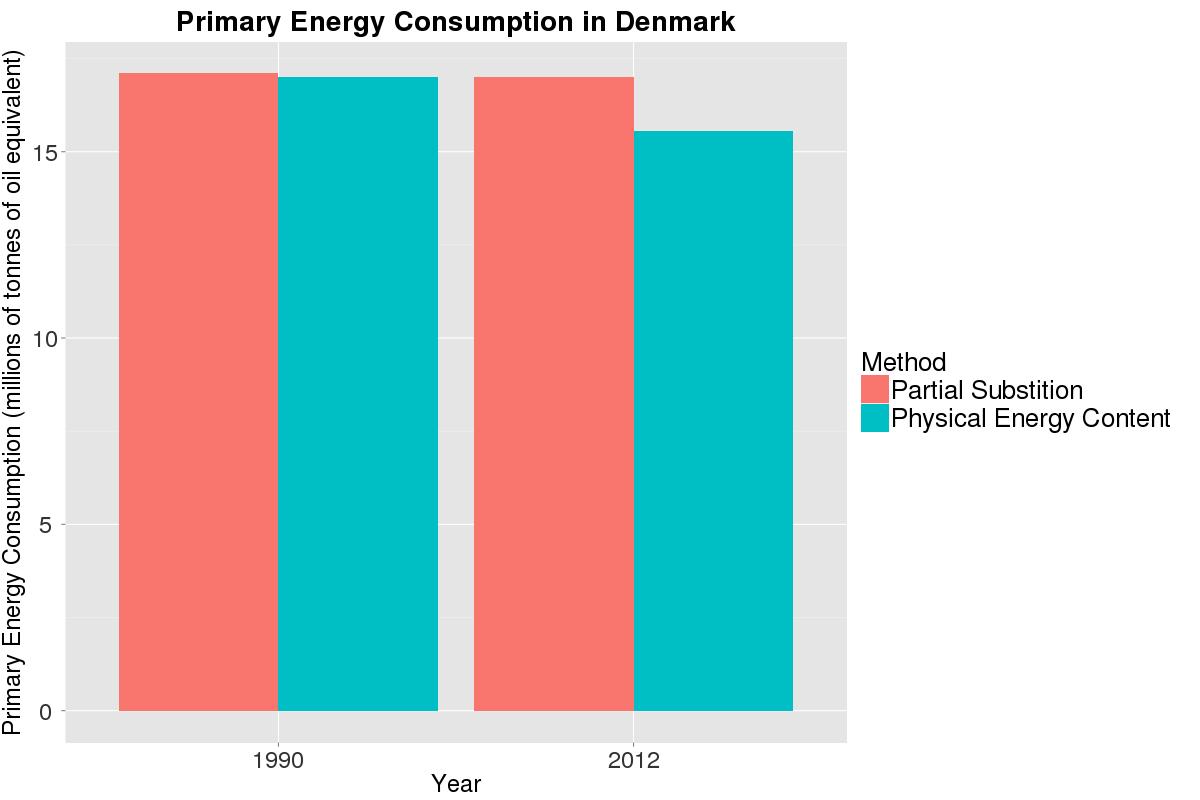
Now, you may be tempted to conclude from this that using the physical energy content method is a good thing if you want to promote the benefits of wind farms. But consider what percentage of primary energy consumption comes from wind farms using the partial substitution and physical energy content methods. It is two times lower using the physical energy content method.

In this case the partial substition method appears to be a much better way to track the changes in wind power penetration, otherwise we are saying a unit of fossil fuel electricity is worth two times more than wind in primary energy terms. Of course if you wanted to downplay the growth of wind farms it should be obvious how to do it.
So, as the cliche goes, “lies, damn lies, and statistics.” The above can be read as a way to properly deconstruct energy consumption statistics, or as a guide to how to misuse them. Please do the former.
20 Comments on "Do Renewables Lower Energy Consumption?"
DC on Tue, 18th Feb 2014 8:51 pm
EC is a crap site that shills for fossil-fuels, but this a worthwhile question they raise.
The short of it is, NO they do not. Thats because the system is not looking to reduce energy consumption-but to expand it. IoW, the goal is to grow the total supply of energy available to waste. What is growing the total power supply intended to do? Why to power the infinitely expanding economy of course.
Most people fail to grasp this simple truth. Energy is needed to drive an endlessly expanding economy. Therefore, renewables are intended to help out with that task. They are not, and never were intended to ‘reduce’ pollution, save the earth, or money-but to expand the total pool of energy available. And of course, expanding population, expanding resource use along with it.
Now in principle, ‘we’ could use renewable power any way we like, yes even to reduce power consumption, but ‘we’ don’t want to use renewables that way. We could sharply reduce our energy use tomorrow, and all the benefits that go along with that, without ever building a single turbine or panel. The reason ‘we’ dont do anything like that is simple enough. ‘We’ dont decide how energy is used in this society, corporations do. Thus green energy, is to be used in the service of yet more consumption.
Northwest Resident on Tue, 18th Feb 2014 9:04 pm
I’m surprised the writer of this article didn’t mention the amount of energy that it takes to create and maintain the renewables. That amount of energy can be substantial, and there have been legitimate questions as to whether or not a solar panel, for example, ever generates enough electricity during its lifetime to make up for all the energy that went into producing, shipping, installing and maintaining it.
Here is an article that seems to prove that finally, we are starting to get solar panels that show a positive energy “profit”, but the only qualifier is based on installation and maintenance efficiency:
“Solar energy has a reputation as being a clean energy source but hasn’t earned it — at least not up until now. That’s because in a darkly ironic truth, the power used to manufacture solar panels still comes mainly from electricity generated by fossil fuels. But a new study from Stanford researchers says that the balance may be tipping: all the solar panels online around the world last year produced enough energy to make up for the energy it took to make them, researchers are able to say with more than 50 percent confidence.
——————————————————————————–
There are some important caveats to that future outlook
The future looks even brighter, according to the study, with researchers projecting that the industry will be generating enough power between 2015 and 2020 to offset all of the historic creation costs. There are some important caveats to that future outlook, including that installation and materials costs continue to drop at the rapid rate they have been. Still, the researchers are optimistic solar has finally turned an important corner on its way to becoming a more mainstream energy source. Their full results were published today in the journal Environmental Science and Technology.”
http://www.theverge.com/2013/4/2/4174204/solar-panels-finally-generate-more-energy-than-they-consume
J-Gav on Tue, 18th Feb 2014 9:30 pm
Note the goal: EU getting 20% of its “final” energy consumption from renewables. That’s all folks, don’t expect more … and we’re still a good ways off from even that. Which leaves 80% from … something else, if I’m not too seriously mathematically challenged.
Davy, Hermann, MO on Tue, 18th Feb 2014 10:01 pm
We are in an energy trap within a global limits to growth predicament. Basically the only solution is a massive drop in population along with the end of industrial man. This can happen voluntarily or by the force of nature. Either way it will happen. It will not be the former which is voluntary. We know we are unable to reduce population. If we accept the reality of these predicaments then we must begin the effort now to prepare, adjust, mitigate, and adapt to a rapidly deteriorating social, climate, and economic system. This effort will have to be at the grass roots level from the bottom up. The top down is paralyzed by social, economic, and ideological constraints that appear to be beyond our abilities to overcome.
Great ideas bellow!
@N/R – I’m surprised the writer of this article didn’t mention the amount of energy that it takes to create and maintain the renewables. That amount of energy can be substantial, and there have been legitimate questions as to whether or not a solar panel, for example, ever generates enough electricity during its lifetime to make up for all the energy that went into producing, shipping, installing and maintaining it.
@Gav – Note the goal: EU getting 20% of its “final” energy consumption from renewables. That’s all folks, don’t expect more … and we’re still a good ways off from even that. Which leaves 80% from … something else, if I’m not too seriously mathematically challenged.
@DC – We could sharply reduce our energy use tomorrow, and all the benefits that go along with that, without ever building a single turbine or panel
Arthur on Tue, 18th Feb 2014 10:31 pm
Umm J-Gav, that’s 20% for… 2020, that’s 6 years from now. There will be a life after 2020, with further expansion of the renewable energy sector.
The new German government recently agreed to increase the renewable electricity target for 2020: 35% –> 40%
http://www.spiegel.de/politik/deutschland/energiewende-koalition-will-windrad-schwemme-bremsen-a-932599.html
MSN fanboy on Tue, 18th Feb 2014 11:05 pm
No lol, I thought the point of renewables was to maintain energy consumption.
If it lowers consumption it means it isn’t working.
Davy, Hermann, MO on Wed, 19th Feb 2014 12:55 am
@arthur –
Umm J-Gav, that’s 20% for… 2020, that’s 6 years from now. There will be a life after 2020, with further expansion of the renewable energy sector.
The new German government recently agreed to increase the renewable electricity target for 2020: 35% –> 40%
Arthur, those are big plans and I have doubts. The ability to go from a small amount to 20% was admirable. For Germany to go to the 35% or above will be heroic considering the economic and energy infrastructure obstacles. The sweet spots are taken and the ROI on these renewables over the 20% becomes problematic when all the fancy grid additions are considered. All these grand plans while they phase out Nuk power. I would not doubt the Germans in normal times but these will not be normal times soon. Expect these plans to gather dust.
Makati1 on Wed, 19th Feb 2014 2:07 am
Current solar and wind will last until they wear out. End of game. By the time the panel on your roof give out, there will be no new ones to replace them.
The comment that the world produced enough solar power to make all of the existing panels is fine, except it took ALL of the solar power to do so. It is only when solar can do so on ‘excess’ energy will they be ‘renewable’ and that day will never come. Ditto for wind.
Neither system can maintain the mines, refining, factories, roads, shipping, machines, and people to keep any ‘renewable’ system alive past oil/NG/coal. None can. There are no ‘renewables’ other than the one we grew up in in the prehistoric times. Sunlight.
Davy, Hermann, MO on Wed, 19th Feb 2014 2:18 am
@Makati – yeap, agreed, the AltE folks are as bad as the folks talking about outposts on the moon and mars. It does not add up for renewables. The amount of space on the globe needed to provide the excess power you describe Makati is enormous. There are not enough sweet spots in my opinion to make renewables a positive energy vector. The AltE present value costs are very bad in a contracting economy. When you are looking at a payback of 5 to 7 years and your economy is contracting how are you also going to grow that economy if you start a massive AltE buildup like Germany is planning. Long term investments are going to suffer soon and AltE’s will suffer more than others because of the payback period.
GregT on Wed, 19th Feb 2014 5:58 am
How does using more energy, to create something that produces more energy, that requires more energy to manufacture more stuff to use that energy, so that we can continue growing our economies and our populations which also require more energy, reduce energy consumption?
I must admit I’m a bit confused, or maybe I’ve just had a long day.
ulenspiegel on Wed, 19th Feb 2014 6:07 am
Davy, hermann wrote: “For Germany to go to the 35% or above will be heroic considering the economic and energy infrastructure obstacles.”
You miss the point, most energy infrastructure is old, replacemnet is due anyway, the differential costs for RE suitable infrastructure are relatively small.
However, the basic problem is, that you do not understand, that most of the primary energy savings come/will come from the heating sector and very likely from transportation. The electricty generation is a mionor theatre of war, interesting because change to heat pumps or community heating makes most sense with REs.
As long as the heating sector gives highest contribution to primary energy, is is no surprise that the change is small in the last years, modern heating systems are very efficient. 🙂
In Denmark the situation is nice because they have much wind – they can simply replace a lot of fossil heat 1:1
with electric heat.
This is not possible in Germany, therefore, better insulation of buildings is required and will of course reduce primary energy demand an increase the share of REs. Get correct data and understand them, please.
Meld on Wed, 19th Feb 2014 7:13 am
Bottom line – Surplus energy is needed to grow an economy whether that’s through efficiency savings , (which of course is then governed by jevon’s law)or through expansion of energy supply.
Fossil fuels are not replaceable with renewables. DC hit the nail on the head with the comment about renewables helping out with creating a little bit more surplus energy (even that is debatable), they were never built to take over from fossil fuels, just to give a bit more spunk to the economy.
Look at the world economy, it’s collapsing due to less and less surplus energy from decreasing EROEI levels. It’s really that simple. Once it passes a certain point globalization will shut down to a pre-industrial level (only precious rarities will be traded from then on, as has been the norm for thousands of years)
What I find most funny about some of these comments is the use of government targets as some kind of definitive argument. The belief that we WILL have renewables because the government target says so. When was the last time anyone’s government hit any kind of target ever? When was the last time anyone’s government told the truth? when was the last time anyone’s government was actually correct about anything? In most cases where they do hit targets it’s because they have massaged the numbers. Let’s not bring Germany up please, that bubble is popping as we speak.
ulenspiegel on Wed, 19th Feb 2014 8:40 am
Sorry, that is nonsense.
In countries with high RE generation from cheap sources you can replace directly chemical energy (NG, oil) with electricity in the heating sector. High taxation of fuel helps, too.
Therefore, the Denish strategy reduces of course not the primary energy consumption that much, but reduces fossil primary energy and costs of imports.
In Germany, in contrast to Denmark, we face the basic problem, that the curren final energy demand can not be substituted with RE on a 1:1 base for physical reasons! Therefore, a useful strategy includes efficicency gains or usage of RE energy that does not appear in the primary/final energy calculation, like solar gains via heatpumps, passive use of solar another.
Without correct data on primary energy demand, final energy demand and rate of transition you get nonsensical results. 🙂
ulenspiegel on Wed, 19th Feb 2014 8:47 am
Or you could in case of Germany argue from a different POV:
The goals for the reduction of primary energy use will not be met because of a too low generation of RE electricity, but because of a too slow reduction of space heataing demand and much too low replacement rate for ICE with EVs.
These problems were already known in 2008/9 when the 40% reduction of primary energy was implemented with too rosy assumptions like shrinking population etc.
The decision to abandon nuclear energy in 2011 at a higher rate, destroyed some buffers, but was no basic problem.
meld on Wed, 19th Feb 2014 8:58 am
We’ll see who’s right eventually Ulenspiegel. 🙂
I tend to look at the world around me and at what humans actually do rather than theory (which is almost always proved wrong)
If renewables were the godsend people make them out to be then everyone would be switching to them as fast as they possibly could. no?
Surely we could manufacture enough wind turbines and solar panels to power the entire world today couldn’t we? so why aren’t we doing it? why is the renewable sector massively subsidised? and why does only one person in my town of 5000 people have solar panels?
These are all important questions that need to be answered by the RE crowd. Even if you’re right jevons law predicts that the energy demands put on RE will be exponential anyway. how do you explain that?
Arthur on Wed, 19th Feb 2014 9:12 am
If renewables were the godsend people make them out to be then everyone would be switching to them as fast as they possibly could. no?
No, first they have to write off the old investments. Plus, it is only now that renewable energy is becoming cost competitive, therefore it is only now that we see huge increase in the adoption of renewable energy, first and foremost in Europe, because fossil energy there is twice as expensive as in North-America, so we in Europe are crossing the substitution threshold much earlier than NA. High fossil prices in Europe are a blessing in disguise.
Davy, Hermann, MO on Wed, 19th Feb 2014 11:53 am
@ulenspiegel – Lived in Nurnberg for a year and my mothers side 100% German blood. I admire Germany and I would not put it past the Germans to make this happen. They have the organization and discipline as a society. The problem is beyond their society and in the greater complex global system that all our support systems rely on. We are talking economics in a world where economics are going to fail us through the finance system. I am not saying it can’t be done I am saying the financial resources will not be there. The easiest AltE investments have been made. The people, organization, communities with the best comparative advantage have invested. What is left is a situation of diminishing returns to AltE introductions. The other difficult item is integrating all this AltE to the national grid without financial damage to the grid operators. We are talking a big investment in new transmission. The storage issues is not resolved. Nuclear phase out is not resolved. Like you also said replacement period is coming up further bleeding capacity to grow the AltE penetration. I see big headwinds making this difficult. The fact that German’s are efficient, organized, and motivate as a people to succeed will help
@Meld – I have read some counter arguments to a 1-1 application of Jevon’s Law. It does not always apply but we are talking theory. You and DC are hitting the nail with surplus energy which in finance would be surplus capital. Just like some of the huge BigO projects that were invested in and now have constrained further large investments until these very large projects start returning on investment. It is worse for AltE because the payback period is further out because of the lower production per dollar invested.
@ulenspiegel – you are very correct on the primary energy issues with AltE replacing Fossil produced heat. Anytime you have a conversion energy is lost – sunlight/wind to electricity to heat or fossil (gas lets say) to heat. You mentioned a very import barrier to altE introduction in a economy as a whole and that is the huge amount needed for heat or in warm climates cooling. IMHO overcoming this is beyond efficient use of AltE. Your increases in efficiency through insulation will run into diminishing returns. So in a time of financial contraction you will not have the money for the build out of efficient efforts at some point they become expensive and yield less result. It is best IMHO to not go big but small in effort along with change of attitude. I see a dual system of AltE for low power demand in a local setting or residential application. Use the grid for large demand. Change behavior to use less. Use biomass (wood) when possible to heat. Ultimately the population must take a serious reduction or any of this does not add up long term!
If improper introduction of AltE takes place you will have malinvestment and cause further economic stress further affecting AltE introductions. It is a vicious circle when you are on the down slope of an energy gradient. You have less surplus energy to invest.
Kenz300 on Wed, 19th Feb 2014 3:32 pm
Energy Collective — a shill for the fossil fuel and nuclear industries……….
Planting seeds of doubt about their competition in order to protect their PROFITS.
Using the same game plans of lies, half truths and misinformation that the Cigarette companies did for decades until people wised up.
meld on Wed, 19th Feb 2014 4:33 pm
I’m presuming you are fully loaded behind solar stocks then Arthur? Yingli Green Energy is up 20% this year. Buy Buy BUY!
😉
Arthur on Thu, 20th Feb 2014 10:05 am
No meld, no solar stocks, but I am about to finish a contract, the rewards of which will be transformed into a solar installation on my roof. A heat pump using my garden soil as the cold side probably will be next. And this spring I will use my 100 m2 Dutch city garden to plant some veggies and potatoes (or potatos? Where is Dan Quayle when you need him?). I have a modest pension plan, probably with Royal Dutch Shell stocks in it, did not check for 15 years. Would not be surprised if these papers will be null and void by the time I would like to cash in.