
Peak Oil is You

Donate Bitcoins ;-) or Paypal :-)


Page added on January 16, 2014

Chasing the Dream of Half-Price Gasoline from Natural Gas
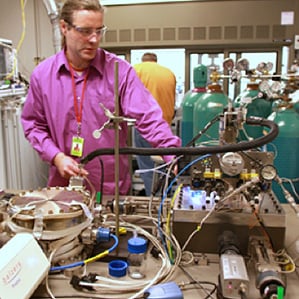
Quick screen: A technician at Siluria operates some of the company’s equipment for quickly making and testing new catalysts.
At a pilot plant in Menlo Park, California, a technician pours white pellets into a steel tube and then taps it with a wrench to make sure they settle together. He closes the tube, and oxygen and methane—the main ingredient of natural gas—flow in. Seconds later, water and ethylene, the world’s largest commodity chemical, flow out. Another simple step converts the ethylene into gasoline.
The white pellets are a catalyst developed by the Silicon Valley startup Siluria, which has raised $63.5 million in venture capital. If the catalysts work as well in a large, commercial scale plant as they do in tests, Siluria says, the company could produce gasoline from natural gas at about half the cost of making it from crude oil—at least at today’s cheap natural-gas prices.
If Siluria really can make cheap gasoline from natural gas it will have achieved something that has eluded the world’s top chemists and oil and gas companies for decades. Indeed, finding an inexpensive and direct way to upgrade natural gas into more valuable and useful chemicals and fuels could finally mean a cheap replacement for petroleum.
Natural gas burns much more cleanly than oil—power plants that burn oil emit 50 percent more carbon dioxide than natural gas ones. It also is between two and six times more abundant than oil, and its price has fallen dramatically now that technologies like fracking and horizontal drilling have led to a surge of production from unconventional sources like the Marcellus Shale. While oil costs around $100 a barrel, natural gas sells in the U.S. for the equivalent of $20 a barrel.
But until now oil has maintained a crucial advantage: natural gas is much more difficult to convert into chemicals such as those used to make plastics. And it is relatively expensive to convert natural gas into liquid fuels such as gasoline. It cost Shell $19 billion to build a massive gas-to-liquids plant in Qatar, where natural gas is almost free. The South African energy and chemicals company Sasol is considering a gas-to-liquids plant in Louisiana that it says will cost between $11 billion and $14 billion. Altogether, such plants produce only about 400,000 barrels of liquid fuels and chemicals a day, which is less than half of 1 percent of the 90 million barrels of oil produced daily around the world.
The costs are so high largely because the process is complex and consumes a lot of energy. First high temperatures are required to break methane down into carbon monoxide and hydrogen, creating what is called syngas. The syngas is then subjected to catalytic reactions that turn it into a mixture of hydrocarbons that is costly to refine and separate into products.
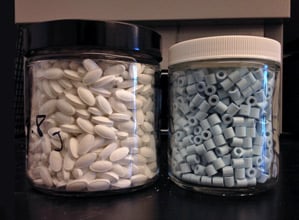
Powerful pills: Two versions of catalysts developed by Siluria to convert natural gas into ethylene, which can be used to make gasoline and chemicals.
For years, chemists have been searching for catalysts that would simplify the process, skipping the syngas step and instead converting methane directly into a specific, desired chemical. Such a process wouldn’t require costly refining and separation steps, and it might consume less energy. But the chemistry is difficult—so much so that some of the world’s top petroleum companies gave up on the idea in the 1980s.
Siluria thinks it can succeed where others have failed not because it understands the chemistry better, but because it has developed new tools for making and screening potential catalysts. Traditionally, chemists have developed catalysts by analyzing how they work and calculating what combination of elements might improve them. Siluria’s basic philosophy is to try out a huge number of catalysts in the hope of getting lucky. The company built an automated system—it looks like a mess of steel and plastic tubes, mass spectrometers, small stainless steel furnaces, and data cables—that can quickly synthesize hundreds of different catalysts at a time and then test how well they convert methane into ethylene.
The system works by varying both what catalysts are made of—the combinations and ratios of various elements—and their microscopic structure. Siluria was founded based on the work of Angela Belcher, a professor of biological engineering at MIT who developed viruses that can assemble atoms of inorganic materials into precise shapes. Siluria uses this and other methods to form nanowires from the materials that make up its catalysts. Sometimes the shape of a nanowire changes the way the catalyst interacts with gases such as methane—and this can transform a useless combination of elements into an effective one. “How you build up the structure of the catalyst matters as much as its composition,” says Erik Scher, Siluria’s vice president of research and development.
The process of making and testing catalysts isn’t completely random—Siluria has the work of earlier chemists to guide it, and it has developed software that sorts out the most efficient way to screen a wide variety of possibilities. The result is that what used to take chemists a year Siluria can now do in a couple of days, Scher says. “We’ve made and screened over 50,000 catalysts at last count,” he says. “And I haven’t been counting in a while.”
Nonetheless, some seasoned chemists are skeptical that Siluria can succeed. Siluria’s process is a version of one that chemists pursued in the 1970s and 1980s known as oxidative coupling, which involves reacting methane with oxygen. The problem with this approach is that it’s hard to get the reaction to stop at ethylene and not keep going to make carbon dioxide and water. “The reaction conditions you need to convert methane to ethylene do at least as good a job, if not better, of converting ethylene into carbon dioxide, which is useless,” says Jay Labinger, a chemist at the Beckman Institute at Caltech.
In the late 1980s, Labinger wrote a paper that warned researchers not to waste their time working on the process. And history seems to have borne him out. The process “hasn’t been, and doesn’t appear at all likely to be” an economically viable one, he says.
Yet in spite of the challenging chemistry, Siluria says the performance of its catalysts at its pilot plant have justified building two larger demonstration plants—one across San Francisco Bay in Hayward, California, that will make gasoline, and one in Houston that will only make ethylene. The plants are designed to prove to investors that the technology can work at a commercial scale, and that the process can be plugged into existing refineries and chemical plants, keeping down capital costs. The company hopes to open its first commercial plants within four years.
Siluria can’t tell you exactly how it’s solved the problem that stymied chemists for decades—if indeed it has. Because of the nature of its throw-everything-at-the-wall approach, it doesn’t know precisely how its new catalyst works. All it knows is that the process appears to work.
The hope for finding more valuable uses for natural gas—and making natural gas a large-scale alternative to oil—doesn’t rest on Siluria alone. The abundance of cheap natural gas has fueled a number of startups with other approaches. Given the challenges that such efforts have faced, there’s good reason to be skeptical that they will succeed, says David Victor, director of the Laboratory on International Law and Regulation at the University of California at San Diego. But should some of them break through, he says, “that would be seismic.”
10 Comments on "Chasing the Dream of Half-Price Gasoline from Natural Gas"
Makati1 on Thu, 16th Jan 2014 2:18 pm
Techie dreams in a gas bubble… POP!
robertinget on Thu, 16th Jan 2014 2:45 pm
In the 80’s my two favorite terms;
“Cogeneration” and “Catalyst”
JUst perhaps, three decades later we may be hearing these words popularized.
Don’t know about you but just the word ‘catalyst’ sounds like such a problem solver, lending magic in every human
interest.
Paulo on Thu, 16th Jan 2014 3:04 pm
As long as all the surplus and cheap nat gas isn’t flared off before the new plants get set up?
Maybe we can set up home style plants perched over our septic tanks?
I’ll believe it when it works, and not before
Paulo
Ty454 on Thu, 16th Jan 2014 4:47 pm
Hey, the cylindrical catalyst in the container on the right-hand side look exactly like the ceramic bio-media in my turtle tank’s wet/dry filter! I never knew I was sitting on such a gold mine.
Mike999 on Thu, 16th Jan 2014 5:02 pm
Chasing the Dream of Cancer at 30. Great.
Solar will be cheaper then ALL Other Energy Sources in 5 years 11 months. Anything else is an Unprofitable DEAD END.
rockman on Thu, 16th Jan 2014 5:13 pm
A cross post from the other thread in case you missed it:
“…about $20 for the natural gas equivalent of a $100 barrel of crude.” On what basis: Btu equivalent? $ equivalent? Does that number factor in the conversion cost of NG to motor fuel? And lastly no one in the country runs their vehicle on oil…they use gasoline or diesel. So now one has to figure out that relationship. Just as one has to figure out how much the $billions in GTL plant costs would affect the final cost of the product. After all it isn’t only just the actual operations cost to convert to a liquid that matters but has to include amortization of those huge plant costs. After all why haven’t we seen a huge number of GTL projects started since oil prices boomed and NG prices crashed. Even if this new technique can greatly reduce the operational costs what would it cost to build a commercial size GTL plant…the same as existing technology or would it be less…or more?. Have they even bothered to estimate what a commercial size plant that used this new method would cost? Making a few gallons of motor fuel on a work bench doesn’t prove anything regardless of what it cost to do it IMHO. And even if that production cost is lower than existing technology the cost of building a new plant based on this technology has to be factored in.
Without those details a $20 NG = $100 oil is rather meaningless IMHO.
First, that 100 year supply BS is based upon what: a major switch to NG to power our vehicles? A complete switch to NG by eliminating all coal fired plants in the US? No…it’s some made up number of how much NG someone thinks we’ll produce compared to how much we are using TODAY when almost no NG is being utilized for vehicle transport and we still burn a lot of coal to make electricity. Today the US has enough oil RESERVES to power every vehicle in the country. The problem is we can’t produce it as fast as we burn it. And if we switch to NG to run most of our cars are we going to be in the same situation: lots of NG RESERVES but we can’t get it out of the ground faster then we’re burning it? So do we then start importing a huge % of that NG just as we are doing today with oil?”
And: “…when the cost of oil starts to rise again, at a certain point the large GTL plants will be economical and then will be built,”. Here’s the problem with that supposition: the last time oil prices climbed that high the world economy crashed and the price of oil/motor fuel collapsed along with it. That obvious fact isn’t lost for the folks who would have to invest 100’s of billions needed to expand GTL plants to any significant level. And then there’s the obvious relationship between the price of oil and NG: when oil prices boomed around ’08 NG prices also boomed to levels about 3X what they are today. So what prices do the GTL investors use to estimate the cost of their feedstock: the $2/mcf we had just a couple of years ago, the $4.25/mcf we have today or the $12/mcf we had just 5 years ago? One needs to have a very certain estimate of that cost to consider investments that could require 5+ years just to recover the initial capex let alone start making a profit.”
Bob Owens on Thu, 16th Jan 2014 6:00 pm
This is basically an arbitrage between the price of gas and oil. If gas goes up in price the arbitrage ends and the new plants close. But why bother with this at all? We currently sell CNG vehicles for use on the road. There is no energy loss from a conversion. All flared gas could be used in local vehicles. Why are we so stupid? I’ll never understand.
rockman on Thu, 16th Jan 2014 6:42 pm
Bob – Good point. Unfortunately CNG stations for private vehicles are almost non-existent in the US so there’s almost no market for such vehicles.
And the flaring of NG has nothing to do with a lack of market for CNG vehicles or anything else. If the cost to get that NG to a pipeline is more than the value of the NG being flared it won’t make it to the market place. It has to do with economics and not if we’re stupid or not. I’m flaring about $40/day of NG from one of my oil wells in Texas. I’ll be glad to give it to you for free. All you need do is spend the $200,000 to hook it up to the pipeline. I figure it will take about 13 years for you to get your money back. Not really though…the well won’t probably last that long. But regardless it’s yours for free. After you pay the land owner 25% and the state of Texas 6.5% of your revenue. And no…nether one will help you pay for the connection.
DC on Thu, 16th Jan 2014 7:22 pm
Well, if this article proves anything, its where amerikans true priorities lie, after weapons that is. Its CHEAP toxic fossil-fools for there GM garbage cans. Now, this process will never work, at least not in key manner these guys hope it will. Thats the *cheap* part. GTL\CTL is an expensive and complex process, and it always will be. South Africa had decades to figure it out. Germany had all the motivation in the world to during WW2 to make the process faster, cheaper, more efficient. The technical and manpower resources of entire national economies of their disposal, how many GTL plants are there in the world today?
We have known about the process for a century now just about and its barely more efficient today that it was in 1930. So these guys can raise all the millions they want from suckers in the US with zero knowledge of what hes up against or whether what he is trying to do is even achievable.
Something about a fool and his money comes to mind….
Kenz300 on Thu, 16th Jan 2014 8:02 pm
The price of wind and solar gets cheaper every year.
Second generation ethanol can now be made from algae, cellulose and waste.
We have over 2200 landfills in the US that can be converted to produce biofuels, energy and recycled materials for new products. This can provide local energy and local jobs. The raw materials are already being collected so they provide inexpensive inputs to the process.