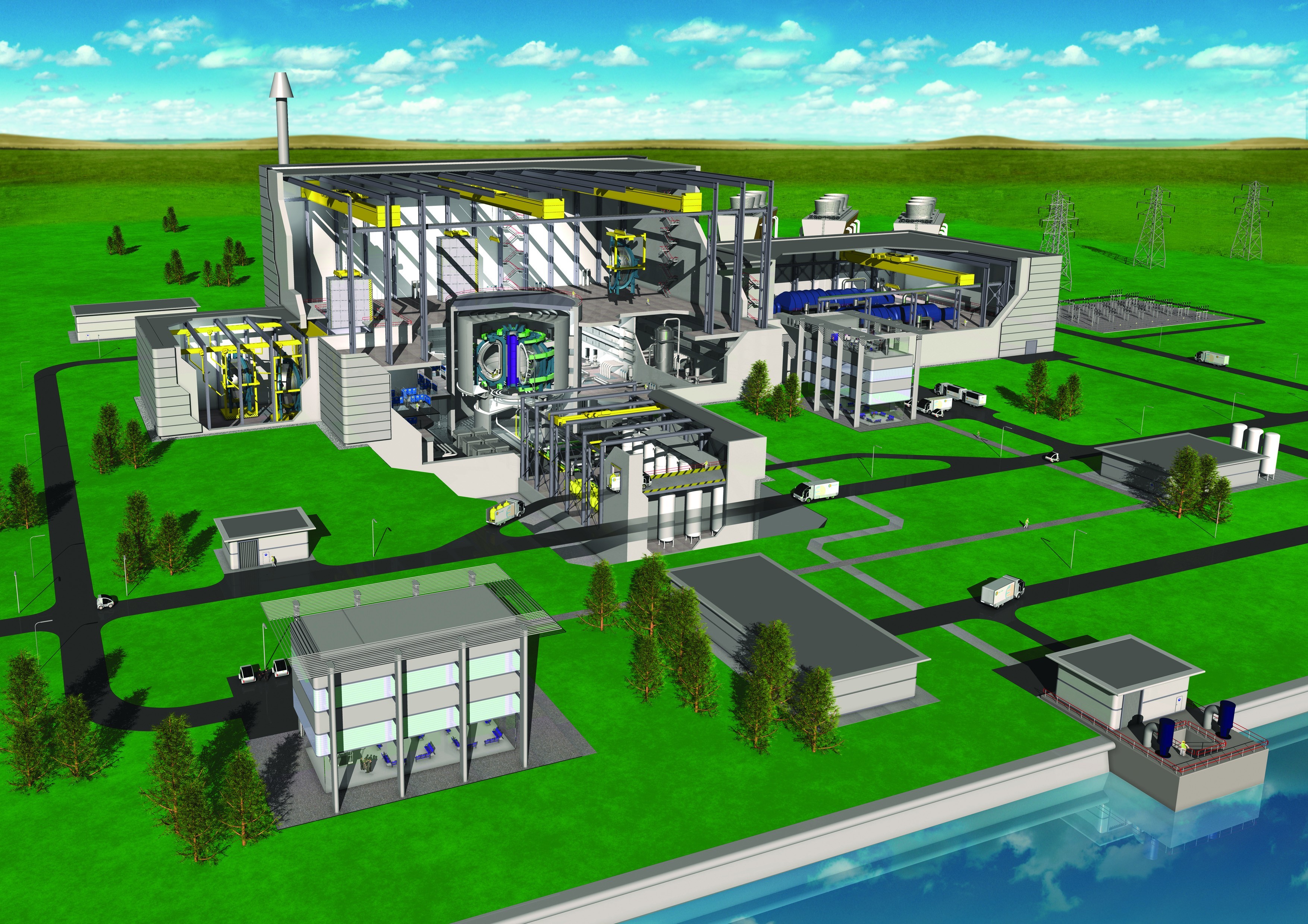
The missing piece to producing net power remains better confinement, which is a measure of how good the magnetic field is at keeping the plasma energy, for which a bigger tokamak, such as ITER is needed. Afterwards, the technological challenges of bringing fusion power to the electricity grid will be addressed by a DEMO-type reactor. Individual countries are exploring ways to do this, and the IAEA is providing a platform for information sharing and exchange in order to facilitate the research and technology development.
China has made significant progress in planning for a device called China Fusion Engineering Test Reactor (CFETR) that would bridge the gaps between ITER and DEMO. Construction of the CFETR could start at around 2020 and be followed by construction of a DEMO in the 2030s.
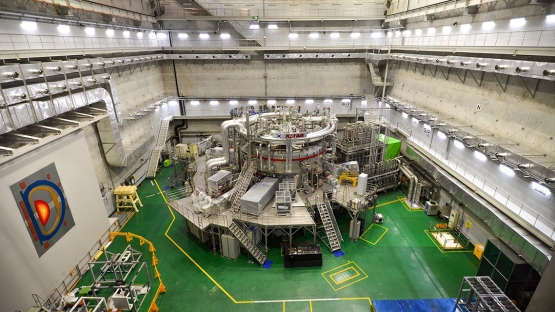
The European Union and Japan are jointly building a powerful tokamak called JT-60SA in Naka, Japan, as a complement to ITER on a privileged partnership called the Broader Approach Activities. In addition to constructing the JT-60SA, the joint programme consists of two other projects, the Engineering Validation and Engineering Design Activities for the International Fusion Materials Irradiation Facility (IFMIF/EVEDA), and the International Fusion Energy Research Centre (IFERC). This partnership represents a well-integrated approach to support ITER and to prepare to undertake the engineering design and construction of a subsequent DEMO.
India has announced plans to begin building a device called SST-2 to develop components for a DEMO around 2027, and then start construction of a DEMO in 2037.
South Korea initiated a conceptual design study for a K-DEMO in 2012 targeting the construction by 2037 with potential for electricity generation starting in 2050. In its first phase (2037-2050), K-DEMO will develop and test components and then utilize these components in the second phase after 2050 to demonstrate net electricity generation.
Russia plans the development of a fusion-fission hybrid facility called DEMO fusion neutron source (FNS), a reactor that would harvest the fusion-produced neutrons to turn uranium into nuclear fuel and destroy radioactive waste. The DEMO-FNS is planned to be built by 2023, and is part of Russias’ fast-track strategy to a fusion power plant by 2050.
The United States of America is considering an intermediate step called Fusion Nuclear Science Facility (FNSF) to be used for the development and testing of fusion materials and components for a DEMO-type reactor. Plans call for operation to start after 2030, and construction of a DEMO after 2050.
Main findings and discussion carried out in the IAEA DEMO Programme Workshop series can be found here.
IAEA




Cloggie on Sat, 12th May 2018 11:31 am
21st century renewable
22nd century fusion
MASTERMIND on Sat, 12th May 2018 11:41 am
Clogg
To many “if’s”….you fat sack of white shit…
penury on Sat, 12th May 2018 12:03 pm
Fusion always twenty years away. The good news people make billions to keep hope alive.
Cloggie on Sat, 12th May 2018 12:20 pm
To many “if’s”….you fat sack of white shit…
http://tinyurl.com/y954o3nb
Duncan Idaho on Sat, 12th May 2018 12:59 pm
“Fusion always twenty years away.”
It is one of the few constants we have, like the speed of light.
No matter when observed, be it 1950 or 2018, it is always a constant, 20 years away.
onlooker on Sat, 12th May 2018 3:28 pm
Because all our dying civilization has left is false hope ie. Fusion
dave thompson on Sat, 12th May 2018 11:02 pm
I always say even if humans can get one of these contraptions going say in the near future what then? How many would be needed to power industrial civ? How many, where and at what cost would these monstrosities be used in any practical sense?
Go Speed Racer on Sun, 13th May 2018 6:11 am
If I put a penny and a quarter stacked together on the train tracks, the train comes thru and the two coins will become fused together. This is an example of
fusion that works. But electrical energy from fusion ,
that doesn’t work.