
Peak Oil is You

Donate Bitcoins ;-) or Paypal :-)


Page added on January 19, 2012

ERoEI, desert solar, oil replacements, realistic renewables and tropical islands
Late last year, Tom Blees, I and a few other people from the International Award Committee of the Global Energy Prize answered reader’s energy questions on The Guardian’s Facebook page. The questions and answers were reproduced on BNC here. Now we’re at it again, this time for the website Eco-Business.com (tagline: Asia Pacific’s sustainable business community). My section is hosted here (Part I), and Tom’s here (part III).
Part II, which I don’t reprint, answered by Iceland’s Thorsteinn Sigfusson, covered the relationship between large-hydro and climate change, and why solar conversion isn’t used more extensively.
I’ve reproduced my and Tom’s answers below.
—————————————
Barry Brook’s Q&A
Sunil Sood: What are the “Real Energy Payback Periods” for Solar PV and Wind Energy Systems? Taking in to account the energy consumed during manufacture of components, balance of systems, transportation, installation, servicing and variations in availability of energy and usage patterns, actual life expectancy (not theoretical). Are we consuming more of ‘Dirty Coal’ to produce these so-called ‘Clean’ energies?
Calculating true energy paybacks are tough. Every energy system has initial investments of energy in the construction of the plant. It then must produce energy for a number of years until it reaches the end of its effective lifetime. Along the way, additional energy costs are incurred in the operation and maintenance of the facility, including any self-use of energy. The energy payback period is the time it takes a facility to “pay back” or produce an amount of energy equivalent to that invested in its start-up. A full accounting of energy payback includes not only the materials and energy that are input into the extraction (mining) and manufacturing processes, but also some pro-rata calculation for inputs into the factory that constructed the power generation facility, some estimate for human (worker) inputs, etc. As you can imagine, it can be difficult to fully integrate all possible inputs.
 However, there are reasonable ballpark estimates for a range of technologies, including wind, solar PV, solar thermal and nuclear. Material inputs tells one part of the story, and some attempts are a standardized comparison are given here and here for a few technologies (wind, solar thermal, Gen III nuclear). As a short-cut for estimate of total energy-returned-on-energy-invested (ERoEI), we can use studies that have looked at the life-cycle emissions of alternative technologies, and then calibrate these against the emissions intensity of the background economy used to produce the technology. This gives us an approximate ERoEI. Based on a range of studies, the estimates range from 180 to 11 for Gen III nuclear, 30 for wind, 11 for solar thermal and 6 for solar PV. That is, your PV panels would repay their inputs 6 times over during their lifespan, and if they lasted on your roof for 25 years then the payback time is about 4 years. If a nuclear plant had a ERoEI of 50 and operated for 40 years, its energy payback time would be 10 months.
Sophie Hughes, General Manager, CPR Sustainability, Sydney: As we battle with NIMBY-ism and planning issues, should international governments be focusing on building large scale renewable energy projects in uninhabited areas, such as central Australia or the edges of the Sahara? Is this feasible and does this mean that we need to focus more efficient infrastructure and storage capacities, rather than being dazzled by the technologies themselves.

All energy technology options have their pros and cons, and so investment decisions should ideally be based on a set of logical, consistent and unbiased criteria. This should include considerations of cost, externalities (e.g., CO2e emissions and toxins emitted per MWh of energy), technological maturity, dispatchability, reliability, safety, energy returned on energy invested, sustainability and security of material inputs and fuel, facility lifespan, land use, public acceptability, and so on. Typically however, many (most) of these are left out of decision making – public and private. As an example, a recent analysis of the ‘fit-for-service criteria’, life-cycle emissions and levelized costs of technology options, can be read here, here and here.
So, as to the specific question, it would make sense for governments to invest in large-scale desert-based solar plants if, on the basis of a rational analysis using these criteria, it was shown to be a superior option compared to alternatives. At present, desert solar has many large uncertainties, especially in terms of cost (including transmission from remote locations), amount of energy storage required, and technological maturity. My view is that it is worth developing, via multi-lateral funding and RD&D initiatives, a number of large demonstration plants for a range of new renewable and next-generation nuclear technologies – and then on the basis of performance, governments and the market can work together on commercial deployment. For a checklist of what types of details any large-scale alternative energy plan should (ideally) cover, see here.
Susan: Given that oil is a finite resource, and our society is unlikely to re-invent itself, what is the most exciting development that you see that has the potential to replace our dependence on oil? And, what are the difficulties in getting solar power from remote areas, like the Sahara Desert or the Australian Outback – identified as some of the best solar sources – to the places where people actually live? Is there anything new on the horizon that may improve this?
 Oil will ultimately be replaced by some mixture of batteries, synthetic fuels, exotic energy carriers and, probably, small modular nuclear reactors. Desert-based solar could, if proven economic, be used to generate hydrogen from water via electrolysis or direct heat processes, as could nuclear heat or electricity. Pure hydrogen can be difficult to manage and transport, however, so derivatives such as hydrogen-nitrogen (e.g., ammonia, hydrazine) and hydrogen-carbon synfuels (e.g., methanol, dimethyl ether) may end up being preferred. See here for some detailed discussion of the many potential applications for ammonia. Batteries using lithium air or other advanced technologies will likely be increasingly used for passenger vehicles. There are also serious concepts for using refined metals like boron in a closed B-O cycle as a totally recyclable energy carrier for combustions engines (just add heat to recharge).
Large transport fleets like rail will move increasingly towards electrification, and ship-borne cargo transport will probably depend more on small nuclear reactors rather than huge diesel engines – as the Russian private ice-breaker fleet already does. As to transmission of electricity from remote locations to high-demand centres, the current limitations are cost – $1 to 10 million per km for Ultra-High-Voltage Direct-Current lines (UHVDC), with the actual cost depending on the power rating and other factors (huge generation facilities would require many lines). Some exciting work is being done in the area of high-temperature superconductivity, but this is many years off commercial application.
Tom Blees’ Q&A
Brooks Keene: The IEA has more or less acknowledged that global oil production has or will soon peak (see here). What implications does this have for the need to decarbonize our economies, and what role can businesses play in leading the way towards creating policy frameworks that create the right incentives for navigating the road ahead?
While there are different opinions for when the world reaches “peak oil”, most agree that we either have already hit that mark or will soon do so. Assuming that’s the case, the response of businesses depends to a great degree on what businesses we’re talking about. The oil companies would seem to have little incentive to make major changes (short of prospecting for more oil), since their costs are always passed on to consumers, in either shortages or gluts. They’re looking at many more years of virtually guaranteed healthy (if not obscene) profits as long as the majority of transport depends on gasoline, diesel, and aviation fuels based on petroleum.
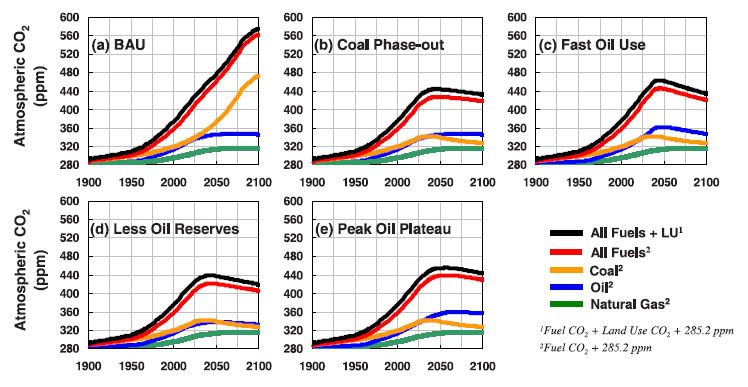 That being said, gas companies have a tremendous incentive to take advantage of concerns about peak oil, especially now that fracking is expanding almost exponentially. The push to convert automobiles and other ground transport to compressed natural gas has been with us for a while and can be expected to increase, especially if fracking continues to expand–though anti-fracking pressures based on environmental concerns may affect that, in some countries more than others.
Though some environmentalists have embraced natural gas as an alternative to coal in electrical generation, this is a Faustian bargain that is driven more out of desperation than logic or conviction. Those who are pushing the hardest for an all-renewables future know that they need what is euphemistically called “backup power” for when solar and wind facilities aren’t producing. How one can call the system that provides about 75% or more of one’s energy “backup” is a mystery, but so it is in today’s energy politics.
The hard data available to date indicates that the only way we can decarbonize—eliminating both oil and gas—is to employ nuclear power as backup, and to devise methods of using renewables plus nuclear and biomass to make the transportation fuels we need, in addition to the electricity that our societies will come to depend on more and more in the future. Businesses not directly involved in the energy sector have few options in terms of directly affecting the course of energy policy. Sure, we see some businesses putting up solar arrays or making other politically correct token gestures, but these are window dressing that relies on subsidies, not really consequential in the effort to decarbonize human energy systems. The decisions that matter will be made within the energy sector, and those decisions will continue to accommodate the fossil fuel industries—be they coal, oil, or gas—unless governments lay down the law and force through policies that make it impossible for the status quo to continue. Carbon taxes are a first step, but support for a massive buildout of nuclear power (as we see in China today and to a lesser degree in some other countries) is critical to making progress in cutting greenhouse gas emissions in a meaningful way.
Shadi Saboori: What would be an optimal way to create incentives for businesses to transition to renewable energy? (And one that is politically realistic).
This is touched on in the previous response. Assuming that the term “renewable energy” doesn’t include nuclear power, the options for businesses that wish to transition to renewables are dictated primarily by the degree of subsidization offered. Customer demand is also a factor, such that if a company believes that hyping their green credentials by putting solar panels on their roofs will help business, then it’s more likely that they’ll take that step even if it costs them money in the long run. Thanks to generous subsidization by many governments, however, businesses can make it a paying proposition because, unlike many homeowners, they have the wherewithal to put up the sometimes fairly large sums up front, knowing that they’ll more than make back their investment over time due to tax deductions, generous depreciation and other allowances, and especially feed-in tariffs.
 While all these incentives do encourage businesses to transition to renewable energy, is that necessarily a good thing from a societal standpoint? After all, the only reason that it’s at all profitable for the few companies that do it is because a large base of ratepayers are splitting up the cost amongst themselves (usually unknowingly). In other words, while such deployment (of solar, usually) makes things appear to be progressing in terms of societal transition to renewables, it’s simply not economically rational without the subsidies, so the wealthy (the companies that do it) are taking advantage of the less well-heeled individual citizens. If everyone were to attempt to transition to solar thusly, it would obviously be impossible, since there would be no pool from which the subsidies could be derived.
When it comes to large energy-intensive industries, even massive solar arrays can’t hope to provide the energy they’ll need, which is why some of Germany’s major industries with long histories in that country are either demanding specially reduced electricity rates or threatening to leave the country. Germany, of course, is where renewables—particularly solar and wind—have had enthusiastic government support for the last couple decades or so. Of course when the government cuts a discount energy rate deal with such industries to offset the steadily climbing electricity costs, it transfers even more of a burden onto the shoulders of regular consumers, forcing their escalating rates even higher.
Ultimately, the truly consequential decisions about a nation’s energy policy will be made by governments, with individual businesses moving in one direction or another based on their economic self-interest. And if Germany and Denmark—as the two nations with the longest history of continued government support for non-nuclear renewables—are any guide, the transition to an all-renewables future is nothing we can expect to consider viable in the foreseeable future.
Berend Jan Kleute, Bluerise BV: Island environments have unique characteristics that make them interesting to provide a general view of how possible integration of renewable energy (RE) systems can be implemented. Tropical islands usually have the greater potential of conversion using traditional RE technology (wind, solar) given their resource availability. Unfortunately islands very often lack the luxury of interconnection to a large grid, and the limited space and resources make energy storage and widespread deployment of these traditional RE systems (due to intermittency) unfeasible. The lack of an effective storage/buffer solution limits the penetration potential of traditional RE sources. What role do you foresee for different RE systems, including wind and solar, and in particular baseload RE technologies such as Ocean Thermal Energy Conversion (OTEC) and Seawater Air-conditioning (SWAC) to achieve a 100% energy self-sufficiency of tropical islands?
Even in the most environmentally cooperative islands (breezy tropical settings) wind and solar alone will simply not be able to lead to 100% self-sufficiency without considerable energy storage, not something that’s heretofore been demonstrated at scale except at great expense. OTEC and SWAC theoretically could provide true baseload power, but these two also have yet to be scaled up.
As someone who spent a couple decades working on some of the world’s stormiest seas, whenever I consider the often glib assurances that OTEC and wave power and other such systems will someday carry a meaningful amount of the load in supplying mankind’s energy demands, I cannot help but be skeptical. For while such systems may scale up and perform quite well for months, Mother Nature has a way of kicking up the power of the ocean in ways that are truly awesome to behold, and when that happens even the sturdiest manmade contraptions are often brought to ruin. I suspect it is difficult for many people who hold out high hopes for such systems—or for many of those who design them, for that matter—to truly appreciate what they’re up against. For my part, having experienced hurricane-force winds several times in the Bering Sea and a hurricane in the Caribbean that broke wind speed records, I would have to say that I’ll believe these ocean-tapping systems will work over the long haul when they’ve been deployed and operated successfully for many years.
One technology that I believe will soon be seeing widespread deployment on island groups is plasma converters, which I wrote about in my book Prescription for the Planet. I’ve posted a chapter on this technology online for those who wish to read about it in detail. These systems allow for efficient recycling of virtually everything, being essentially molecular deconstructors. Disposal of municipal solid waste, sewage sludge, discarded tires and other waste is especially problematic for islands, what with limited space for landfills and water contamination issues that can sometimes result. Plasma converters eliminate the need for landfills altogether and allow waste materials to be converted into electricity (usually extremely expensive on islands) and building materials. They also do away with the need for an entirely separate recycling infrastructure, since everything can be discarded in any mix and the plasma converters will sort it all out. Another bonus for island groups that have problems with reef destruction: the inert glassy slag resulting from treating wastes can be used to build artificial reefs, or to augment the surviving reefs.
But even if all the islands’ waste is efficiently converted and the electricity from it is piped into the island grid, there will still be a shortfall. Barring dependence, to one degree or another, on either fossil fuels or nuclear power, I suspect that islands that can manage the cost of substantial wind and solar systems will end up adding the cost of as much storage as they can muster and their citizens will learn to live with energy rationing and occasional failures. Several companies are prepared to provide small modular nuclear power systems, however, that could serve islands perfectly. The Russians are also planning on deploying reactors on barges, and these could also provide all the energy that island groups require. I believe the next couple decades will see more and more island groups turning to nuclear power, which has a very small footprint (or none, in the case of floating or submerged systems), low operating and maintenance costs, and no emissions.
5 Comments on "ERoEI, desert solar, oil replacements, realistic renewables and tropical islands"
DC on Thu, 19th Jan 2012 4:27 am
Started out good, then it got to this part
Q/Oil will ultimately be replaced by some mixture of batteries, synthetic fuels, exotic energy carriers and, probably, small modular nuclear reactors. Desert-based solar could, if proven economic, be used to generate hydrogen from water via electrolysis or direct heat processes, as could nuclear heat or electricity. Pure hydrogen can be difficult to manage and transport, however, so derivatives such as hydrogen-nitrogen (e.g., ammonia, hydrazine) and hydrogen-carbon synfuels (e.g., methanol, dimethyl ether) may end up being preferred.
Batteries are not energy sources-they are carriers.
Synthetic fools? -ALL dervived form Fossil-fuels, and are as expensive and just as toxic as FF are. None will ever exist @ scale needed beyond niches applications.
Exotic energy carrier??! WTH is that mean? Ultra-capacitor vapoprware?, dilithium crystals? what?
Modular Nuclear reactoes..omg..is he serious? We cant afford or properly manange our large-UN-modular ones…
Hydrogen from Solar PV…just when you thought he couldnt get any worse, he comes up with that. And what does he plan to do with that boondoggle? Prob use it in$ 250k Hydrogen fool-cell cars so the 1% can live exhaust free in there gated enclaves no doubt. Clearly he has trouble understanding H2 from solve incurs about a 75% energy loss from useing PV electricty directly. But when all you care is keeping cars running on another heavily subsizied and dangerous liquid fool, I guess that doesnt factor.
Way to ruin a otherwise good article with runaway techo-fantasy trips..
BillT on Thu, 19th Jan 2012 7:39 am
Some dreamers are high on the best money can buy…lol. But, reality is a bitch and is NOT part of the above article. Too many hours watching re-runs of “The Jetsons”?
sunweb on Thu, 19th Jan 2012 10:31 am
ERoEI is math and not the real world of processes, huge machines, massive buildings and global transportation. This essay has pictures to make the point.
>>>>>>>>
Solar and wind capturing devices are not alternative energy sources. They are extensions of the fossil fuel supply. There is an illusion of looking at the trees and not the forest in the “Renewable” energy world. Not seeing the systems, machineries, fossil fuel uses and environmental assaults that create the devices to capture the sun, wind and biofuels allows myopia and false claims.
ERoEI is only a part of the the equation. Each of these processes and machines may only add a miniscule amount of energy to the final component of solar or wind devices. How else would we do it? There is always the old way. Who of us will go down in the mine first?
A story in pictures and diagrams:
From Machines making machines making machines
http://sunweber.blogspot.com/2011/12/machines-making-machines-making.html
BillT on Thu, 19th Jan 2012 11:27 am
sunweb, I have seen your articles and agree 100%. But, I don’t think there will be much to ‘go down into the mines’ for in the future. Coal has degraded to something not much better than dry hardwood. Minerals are down to barely smells, not nuggets. Those born today will live to see a much different world before they die. A much harder existence.
kervennic on Thu, 19th Jan 2012 1:33 pm
These projections are pure fantasy as they entirely omit the material side of the story.
The examples are countless and the whole story boil down to this very simple catch: We have used all the cheap and good concentrated raw material so we need (much much) more energy and envireonemental footprint to get the same amount, when energy become scarce and produced or store using more and more material…
Some figures:
– 90 % of the metal form of zirconium is used by the nuclear industry. It is central to fuel storage and not recycled. The reserves are of a few decades. How are you going to implement an expansion of the nuclear sector ?
– At best lithium can provide, reserve wise, batteries for only a few percent of current cars. And at a much greater price than oil today. Apart from known source of lithium other sources are so dilute they would require a huge amount of energy to concentrate.
-Oil industry is using a growing percentage of the steel production and steel production is more and more energy intensive (i think 16 % of chinese energy use goes for steel). We are well over 10 % from what i read, and projects like keystone or gigantic riggs in alaska and brasil will swallow even more of it.
Recycling is not an option in many cases, especially crucial and noble use. It requires to much energy and work especially when metals have been mixed, like copper and steel in cars. You can only reuse the steel in concrete, and this means an end use. Besides a huge amount of metal is used in dispersive use, like catalysis, pigment, electronic devices, with no chance to concentrate it back.
So industry is fucked and has no solution except going faster toward collapse. it’s growth has been unplanned and pushed by grid and power. Not by intelligence of the material world.