


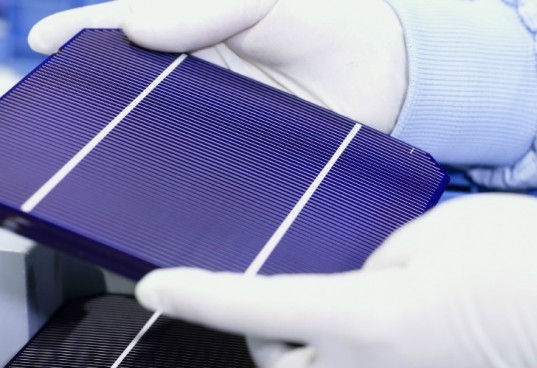
Here, the discussion is on perovskite solar cells; a technology that promises to be cheaper than that based on silicon. Perovskites are a large class of materials; those being studied as solar cell materials have several advantages, including the fact that they can be manufactured in the form of thin films, don’t need to be so extremely pure as silicon, have a band gap close to the theoretical optimum.
That, however, doesn’t necessarily make perovskites a “breakthrough” in the field. Even assuming that perovskite cells could reach an efficiency high enough to be marketable, the problem is that, at present, the cost of the cells is only about 30% of the total cost of a solar plant. Even if perovskite cells were to cost half as much in comparison to silicon ones, that would be no improvement unless their efficiency were to match or exceed that of silicon. Otherwise, the whole plant would probably cost more because it would have to occupy more space.
In practice, to have a breakthrough in solar power, we would need a technology which is 1) significantly cheaper than silicon, 2) much more efficient, 3) that uses no rare and non-renewable elements (that rules out, in the long run, cells that use tellurium or gallium). That’s a tall order, especially considering that we are bumping into the physical limits of single-junction cells; which cannot have efficiencies higher than a little more than 30%. Silicon, because of some quirks of the way the universe works, happens to be placed almost in an optimal position in terms of band-gap and, at the same time, to be a widely available element in the earth’s crust. So, it is, in many respects, an optimal choice for solar cells, and already not so far away from its theoretical limits. I think that we’ll stay with silicon for a long, long time. Surely we will improve the technology, but don’t expect miracles. That silicon works so well is already a miracle!
_______________________
Further notes:
1. Here, in Florence, a colleague of mine has built a nice solar plant that uses multi-junction GaAs cells and concentrating mirrors, attaining, I think, around 50% efficiency. I saw it: it is a wonder of technology, full of gears, motors, optics, sensors, computers, and things. But I didn’t dare to ask him how much it would cost to buy one for the roof of my house!
2. True breakthroughs may occur “downstream” with respect to energy production; for instance with batteries and the diffusion of a new generation of electric vehicles. There is no thermodynamic limit to the number of times that a battery can be recharged without degrading.
3. “heavy-duty trucks, locomotives, and ships run on diesel fuel” in the article below is, in part, a canard. Here in Europe, locomotives already run on electricity. Trucks can run on electricity, too, (http://mondoelettrico.blogspot.it/2014/08/ehighway-il-filocarro-elettrico.html). For ships, the problem is not so much how to push them on, there are ways. It is another one, much more difficult (see e.g. https://blogdredd.blogspot.it/2015/08/why-sea-level-rise-may-be-greatest.html). And the only way to solve that problem is to rush into renewable energy as fast as possible.
_________________________
Van Noorden, R. September 24, 2014. Cheap solar cells tempt businesses. Nature #513 470-471.
There is another potential snag: perovskites contain a small amount of toxic lead, in a form that would be soluble in any water leaching through the cells’ protection. Although Snaith and others have made films with tin instead, the efficiency of these cells is only just above 6%.
ERRATA on Mon, 16th May 2016 10:34 am
Unfortunately, solar energy (strictly, precisely – electricity generated from PV panels) is very poor for the reasons described here:
https://damnthematrix.wordpress.com/2016/05/10/another-study-on-the-eroei-of-solar-pv
Davy on Mon, 16th May 2016 10:37 am
#4 would be you need scaling which includes a healthy economy and a reasonable pathway for transition. In our case as a modern civilization based on fossil fuels and growth with population in overshoot this is likely not possible. This type of technology can make a difference but only a difference around the edges.
ghung on Mon, 16th May 2016 10:50 am
@ERRATA: Yet another easy-to-debunk article/study, and I grow tired of posting links to the vast number of sources that prove that the ERoEI of PV can, if properly deployed, be quite high. I have no doubt whatsoever that in their almost 22 years of continuous use, our first PV panels, manufactured in 1994 paid off their energy and carbon debts long ago. I can hear the pump they now power humming quietly as I type. 35 degrees north latitude; average rainfall nearly 2 meters. Fact is, no one can say what their ERoEI will be, because, on average, no one knows how long they will last. Once again, calling bullshit as I see it.
PracticalMaina on Mon, 16th May 2016 11:04 am
Ghung, I often wonder what arrays they use for studies like that. I would assume any study coming from a ff company on renewable EROEI would be based on the worst possible install. I have seen a couple places with some pretty damn bad orientations, (one of the worst I have ever scene I saw this weekend) where the power output is probably a small fraction of what the panels should be theoretically putting out.
ghung on Mon, 16th May 2016 11:06 am
From the link: “Theoretical calculations of what PV modules should generate made by manufacturers do not take into account operational degradation due to surface dirt. Nor do they take into account poor orientation, unit failure or breakage, all of which are quite common.”
We now have 58 PV panels from 5 manufacturers, from 21 years old to 4 years old, and have had NO FAILURES and virtually no degradation in output. Surface dirt? There’s this new thing called WASHING YOUR PANELS. A little soap and water about once a year does it for us. In fact, rain keeps them quite clean. Next these folks will claim other energy sources don’t require maintenance, eh? Poor orientation? Well, duh…. Breakage? Ask the folks at Fukushima about “breakage”, or the folks in the coal mining sector about upkeep on their machines. The only breakage we’ve ever had (even including 1″ hail), was in shipping (early on).
ghung on Mon, 16th May 2016 11:12 am
@PracticalMaina: Sure, since incentives have encouraged all sorts of deployments that aren’t optimal. Plenty of other incentivised technologies have had that problem as well (biofuels?). It’s easy to hold PV to a higher standard, especially by those who have agendas.
ghung on Mon, 16th May 2016 11:28 am
Another questionable claim in the article: “And you just need to look at the outputs as shown below. Solar PV produces a dribble in winter.”
Again, must be location specific info. I log all output from our arrays, and ALL of our most productive days have been in winter; mainly mid January to early March. PV loves cold, clear winter days. One day in early February this year, our arrays were producing over 120% of their rated output for several hours. Our largest array actually tripped its main breaker (since upgraded).
String900 on Mon, 16th May 2016 11:34 am
Solar already cheaper than Coal.
There’s no going back now.
Either get into solar or die.
penury on Mon, 16th May 2016 11:39 am
Another attempt to show that life as we (U.S.)know it will continue into the future, the only changes will be things will be less expensive, work easier, and require less effort on the part of humans to live the life you have dreamed of. This reminds me the spreader is full and its time for me to spread the manure.
JN2 on Mon, 16th May 2016 11:53 am
Wow! The highest hope:doom comments ratio I’ve seen on PO.com for a long time. Thanks 🙂
ghung on Mon, 16th May 2016 11:59 am
@JN2: Not sure who that was aimed at, but never confuse my comments for hopium. All things considered, I’m sure industrial civilization is screwed. I just get tired of articles that blame a technology for the way it’s implemented. The problem isn’t our technology; it’s us, and our collective behavior.
dave thompson on Mon, 16th May 2016 12:43 pm
Ghung, How much have you spent on batteries and inverter replacement?
Apneaman on Mon, 16th May 2016 2:01 pm
If I remember correctly, something like 85% of the water the humans use is for industrial purposes including manufacturing alt energy.
Water refugees, water trains, diverting rivers, irrigating vegetables with fracking waste water, billion dollar desal plants, increasing maximum allowable cooling water temps at nuke plants, pumping ground water faster than a scared rabbit fucking. What’s next? I’m sure it will be fine. They’ll think of something eh?
India to ‘divert rivers’ to tackle drought
“Ms Bharti said the river-linking project would be the first in Indian history since independence in 1947.”
http://www.bbc.com/news/world-asia-india-36299778
Alt energy is so awesome it even creates lakes for humans (similar to the one described in the new testament).
The dystopian lake filled by the world’s tech lust
Hidden in an unknown corner of Inner Mongolia is a toxic, nightmarish lake created by our thirst for smartphones, consumer gadgets and green tech
“…stretching into the distance, lies an artificial lake filled with a black, barely-liquid, toxic sludge.
Dozens of pipes line the shore, churning out a torrent of thick, black, chemical waste from the refineries that surround the lake. The smell of sulphur and the roar of the pipes invades my senses. It feels like hell on Earth.”
http://www.bbc.com/future/story/20150402-the-worst-place-on-earth
‘And the
techno capitalistsdevil who deceived them was thrown into the lake of fire and brimstone, where theconsumerbeast and theElon Muskfalse prophet are also; and they will be tormented day and night forever and ever.’Revelation 20:10
dave thompson on Mon, 16th May 2016 2:54 pm
My average electric bill is 1,200 per year,mayebe 1,400 in bad summers. I looked into a solar voltaic system and it would cost me about 25,000.00 to 30,000.00 for my electric needs, batteries included. The salesman told me (when I asked) the batteries alone were $7,000-12,000 depending on capacity calculations, the more over capacity the longer the batteries last. The batteries need replacement every 5-7 years on average (again this is the salesman talking when I asked). So the system would never pay for itself and would cost a lot more over time, then just using grid tied power.
sunweb on Mon, 16th May 2016 3:03 pm
They aren’t renewable, they may be repeatable if you have a fossil fuel supply system and a global industrial infrastructure. Look at just the making of the low iron glass which requires an economy of scale to make glass affordable.http://sunweber.blogspot.com/2015/03/making-glass_8.html
Or look at the various parts of the solar energy collecting system and the infrastructure underwriting them. http://sunweber.blogspot.com/2015/04/solar-devices-industrial-infrastructure.html
Davy on Mon, 16th May 2016 3:05 pm
Dave you can do a much more modest system for much less and still use grid power. Think about resilience in the face of grid instability that could happen in the future. I would also do it yourself and lose the middle man who is getting a hefty markup.
sunweb on Mon, 16th May 2016 3:09 pm
Or look at the total assessment published in Energy Policy by Ferrucio Ferroni and Robert J. Hopkirk and titled Energy Return on Energy Invested (ERoEI) for photovoltaic solar systems in regions of moderate insolation. they considered not only the usual energy inputs for modules and its components and/or some immediate accesories to them, but also some societal sine qua non energy input expenses for solar systems and concludes that in these regions (countries like Germany and Switzerland), the EROI is 0.85:1.
sunweb on Mon, 16th May 2016 3:09 pm
Or Scientific studies show it takes years to payback the energy used in solar electric devices. EROI (Energy Returned on Energy Invested) says it takes energy – mining, drilling, refining, transporting, installing, maintenance, and replacement parts – to make the devices necessary to capture solar energy.
Spain’s Photovoltaic Revolution: The Energy Return on Investment by Prieto, Pedro A., Hall, Charles 2013.
http://www.springer.com/energy/renewable+and+green+energy/book/978-1-4419-9436-3
and http://energyskeptic.com/2013/tilting-at-windmills-spains-solar-pv/
and B o o k R e v i e w : E n e r g y i n A u s t r a l i a – P e a k O i l , S o l a r P o w e r , a n d A s i a’ s E c o n o m i c G r o w t h by G r a h a m P a l m e r http://www.springer.com/energy/renewable+and+green+energy/book/978-3-319-02939-9
Spain’s Photovoltaic Revolution presents the first complete energy analysis of a large-scale, real-world deployment of photovoltaic (PV) collection systems representing 3.5 GW of installed, grid-connected solar plants in Spain. Prieto and Hall conclude that the EROI of solar photovoltaic is only 2.45, very low despite Spain’s ideal sunny climate. Germany’s EROI is probably 20 to 33% less (1.6 to 2), due to less sunlight and efficient rooftop installations.
“Solar advocates can learn from this analysis . . . “ Not looking at the reality of EROI “is not good science and leads to wasted money and energy that could have been better spent preparing more wisely for declining fossil fuels in the future.”
This study does not detail the environmental destructive mining, toxic chemicals or air and water pollution necessary to get the materials for manufacturing and installing solar devices. It is the sun not the devices that is renewable, green and sustainable.
dave thompson on Mon, 16th May 2016 3:17 pm
I am not saying that there are no advantages to going solar on a small scale individual basis. The problem I see is the greenwashing of renewables as being industrial civilizations savior. I do have a small solar system in storage for emergency use. But sorry folks for me in an urban setting the power from the grid is still much cheaper then even a modest system might afford. The cost of a small system to offset my electric bill is not cost effective over time at least that I have been able to calculate.
onlooker on Mon, 16th May 2016 3:22 pm
Dave, you hit the nail on the head. Both wind and solar can be useful on a individual limited basis but it is no solution to our energy predicament on a macro civilization spanning basis.
dave thompson on Mon, 16th May 2016 3:29 pm
I also want to say thanks to sunweb for the info he has put together on his site. If people were interested in knowing just how much deception goes on when it comes to the new “clean green energy future of renewables” sunweb is a great place to start. I suspect however for people that want to believe in the BS they just will not look at the facts. In that case read the latest from Naomi Cline, LOL!
GregT on Mon, 16th May 2016 3:29 pm
dave t,
We received 3 separate quotes on a standalone off grid system. Grid tied is not an option here just yet. The average payback time at current electric rates here was 23 years, not including battery or parts replacement. Your quote and electric consumption sounds to be very close to ours. Given that our electricity comes 100% from hydro, there is no reason for us to do it other than for piece of mind. Our focus is on power outages, or electricity in the case of the grid going down. Refrigeration, irrigation and potable water, keeping the lights on at night, and perhaps some entertainment. An emergency system can be put together for much less, but storage would still remain to be a longer term issue. Refrigeration and water can be worked around without batteries, but not reliable here during the winter months when it is completely overcast and raining for weeks on end. Solar is great, but not without serious limitations, at least here in the pacific Northwest.
Davy on Mon, 16th May 2016 3:32 pm
I agree Dave and both you and I are on the same wavelength with the green washing fallacy. As for a home solar system having something to power lights and charge batteries is a plus. I use both grid and solar power. I would like to go all solar but I am not there yet. I have a big prep list and all solar is on it.
dave thompson on Mon, 16th May 2016 3:43 pm
Here in Illinois we can do net metering with ComED. However the stipulation being a homeowner cannot have a battery storage system and one needs a transfer shutoff switch in case of power outages. So what would be the point?
ghung on Mon, 16th May 2016 6:00 pm
@ dave thompson who asked; “Ghung, How much have you spent on batteries and inverter replacement?”
We haven’t replaced any of our inverters. Our oldest inverters are a pair of Trace SW4024s now in their 15th year of operation. I added an Outback 2024 a few years later (pure sine) for sensitive loads. The only repair required was the cooling fan in the Outback which they provided free (great company). The original fan never actually failed, they just sent me a notice that it might (bad batch). We’ve had zero balance-of-system-failures except a very early Trace C-40 charge controller, likely hit by lightning, but was repairable. Still on the shelf as a spare. We now have four Outback MPPT controllers.
Batteries? We’re on our second set. The first (20 Rolls/Surrette L-16 type) failed in their 8th year due to my screw-up. Our current set, 12 big Hawker 2 volt cells (a 52KwH forklift battery) is going very strong; installed in October of 2007; cost was about $5800. We’ve been saving for a new set, and plan to replace the Trace inverters fairly soon with more modern and efficient Outbacks (cost will be around $3300 for two). I’ll re-task the older Outback.
Again, our PV system has had no failures other than the one mentioned.
As for ERoEI of BOS stuff, that could vary widely depending on the system. In our case, that energy/carbon is probably offset by the fact that we didn’t bring the grid in the almost a mile that would have been required. It also would have cost us about $16K.
sunweb on Mon, 16th May 2016 6:07 pm
onlooker on Mon, 16th May 2016 3:22 pm
Dave, you hit the nail on the head. Both wind and solar can be useful on a individual limited basis but it is no solution to our energy predicament on a macro civilization spanning basis.
It is only good as a stop gap and should include extra auxiliary equipment for failure. I had a small pancake fan go out in the inverter. Can’t make one of those. http://sunweber.blogspot.com/2013/10/a-small-fan.html
dave thompson on Mon, 16th May 2016 6:11 pm
Sounds like a cool set up Ghung. You were thinking good thoughts when you set yourself up with the big battery array. My understanding is that people make the mistake of not providing for about 3x power to what you expect to use. Off grid photo voltaic systems do work wonders. Still quite expensive and not for the faint of heart. Thanks for the info.
Practicalmaina on Mon, 16th May 2016 6:13 pm
Dave T, the advantage is if the grid goes to crap, you can reuse the resourse you invested in on your roof. Plus being in Illinois you can really help shut down peabody and the local coal burning plants. I have read they are considering dropping 2 gigawatts of coal power and the area nuke operator also claims it is not going to be able to continue without increased rates.
Practicalmaina on Mon, 16th May 2016 6:15 pm
Are there water cooled inverters yet? It would make sense to find a way to use the waste heat for DHW.
ghung on Mon, 16th May 2016 6:25 pm
I’ll add, having read more comments, I had several reasons for going off grid. One was cost of hooking to the grid. Another was a time in the past when I struggled to pay bills, especially utilities and mortgages (on top of child support and providing for children, etc.). I see utility dependence as being in the same category as debt slavery and some other things.
I also disagree that my lifestyle isn’t more environmentally friendly. I don’t know how much coal was burned to build my system components. I only know that I haven’t paid BIG ELECTRIC to burn any coal in 18 years.
People who live off grid, energy-wise are necessarily more efficient, IMO; a different mindset. And funny that some of you keep defining things in terms of dollars. Pretty shitty way to gauge things as I see it. Slaves to your incomes?
There’s actually a pretty big learning curve going from being a grid weenie to living off grid, but once one masters off-grid living, I can’t see going back. No utility bills. No mortgage. No car payments. It’s a retirement plan for one who has a rather stark view of our collective economic future. In reality, I was never all in for your growth and consumption-based culture anyway. Had to think of something.
dave thompson on Mon, 16th May 2016 6:34 pm
As a grid “weenie” I don’t have a choice here in suburbia. If I went off grid power the village would condemn my house as unlivable.
ghung on Mon, 16th May 2016 6:37 pm
Sunweb said; “Both wind and solar can be useful on a individual limited basis but it is no solution to our energy predicament on a macro civilization spanning basis.”
Our energy conundrum (and everything else) is actually a great reason for acquiring some energy independence now. There are no solutions, really, other than the ones we make for ourselves.
Your grid could go down hard and I wouldn’t notice excepting that the internet and phones would likely go as well. At least I’ll be keeping whatever beer is left cold, and ice for tea… and have time to think about my next step. Yes, I keep spare parts.
Off to water the new blueberries with some solar-pumped spring water (that’s “sprang watuh” in these parts).
ghung on Mon, 16th May 2016 6:39 pm
Gosh, Dave, maybe you should consider a move…..
makati1 on Mon, 16th May 2016 7:12 pm
DREAM: “An energy miracle? But we already have it!”
REALITY: “We’re Running A F**king Casino” Congressman Admits DC Is A “Sinkhole Of Leeches”
“America’s on an irreversible decline and no one in Washington seems to care . . . God help us.”
http://www.zerohedge.com/news/2016-05-16/were-running-fking-casino-congressman-admits-dc-sinkhole-leeches
“God” had nothing to do with the falling of the empire. It is suicide by American greed.
Apneaman on Mon, 16th May 2016 8:08 pm
Windfall: When Renewable Energy is not Sustainable
“Now comes what could be the coup de grâce: the life expectancy of a wind turbine is 20 years, and the first wave of those built in the new age of wind are now approaching that age. After that age, bearings wear out, blades fall off, towers topple. Germany, a world leader in switching to renewable sources of energy, had to tear down more than 500 elderly turbines just last year. The country is graced by 25,000 of the monsters, more than a thousand of which could face decommissioning, at huge expense, every year.
The subsidies underpinning the industry also, it turns out, have a 20-year shelf life. In many cases the 20-year term was made explicit in the legislation. In others, it is implicit in the rising financial desperation of governments everywhere. Without government subsidies, there will be no wind industry.”
http://www.dailyimpact.net/2016/05/16/windfall-when-renewable-energy-is-not-sustainable/
Surf on Mon, 16th May 2016 9:07 pm
“Now comes what could be the coup de grâce: the life expectancy of a wind turbine is 20 years, and the first wave of those built in the new age of wind are now approaching that age.”
The oldest operating wind farm in the US is the Altimont pass in California. The turbines there were 31 years old and still functioning when they were replaced with larger ones. The primary reason for the turbine replacements is to reduce bird deaths. The altimonte pass was the worst in the US and possibly the world in terms of bird deaths. It is important to note that all those removed turbines were still working.
Routine maintenance is an amazing thing. IF the bearing wars out replace it. If the blades fall off modify the design and fix it. (that was a problem in the 80’s and it was permanently fixed at altimont), toppling tower, never happened at altimont.
Newer turbine designs are mechanically simple. The gear box was eliminated by using direct drive generators. That eliminated a lot of hardware that can break. It also reduced the number of bearings and manufactures now use better longer lasting bearings. Overall I am quite confident that today’s new turbines will last 50 years
Davy on Mon, 16th May 2016 9:13 pm
Ghung, I have been considering a small wind power source to generate power when the sun is down to supplement my solar system. Do you have any thoughts or recommendations?
ghung on Mon, 16th May 2016 10:28 pm
Davy,, do a site survey first. Get a data logging anemometer up where you hope to put a wind generator and find out if you have enough potential. That’s all that really matters. Better to spend $500 bucks on a nice Davis weather station you can use for years than waste $5K on a wind generator and tower. In my experience, most people think they have much more useful wind than they really do.
Avoid those cheap sub-1000 watt units you see. They may produce useful power on top of Pikes Peak, but most other places, they’re just pricey lightning rods. Homepower.com has had a lot of great articles on smaller residential wind generators up to about 10 Kw. Very site specific, wind power.
Davy on Tue, 17th May 2016 5:43 am
As is the case many times of the years “thanks G”
peakyeast on Tue, 17th May 2016 7:17 am
@ghung:
Have you measured or noticed the degradation of solar cell efficiency on your old panels?
I am very curious about this feature.
peakyeast on Tue, 17th May 2016 7:19 am
@Davy: What ghung says about the small wind generators I have also heard from many sources – and experienced one time at a friends place. They are not viable.
Davy on Tue, 17th May 2016 7:26 am
Thank Peaky, It is one of those things that seems like a great fit with solar during the day and wind day and night but I understand the actually reality of the application is a different story. I will stick with solar especially since I am in a marginally windy area. The winds get better to the west of me in Kansas and Oklahoma.
sunweb on Tue, 17th May 2016 7:57 am
ghung on Mon, 16th May 2016 6:37 pm
Sunweb said; “Both wind and solar can be useful on a individual limited basis but it is no solution to our energy predicament on a macro civilization spanning basis.”
I didn”t say that, I was quoting onlooker.
ghung on Tue, 17th May 2016 8:20 am
http://www.windpowerengineering.com/construction/calculate-wind-power-output/
Gusty winds and turbulence reduce output significantly in most cases. Wind turbines perform best with strong steady winds across flat land or at altitudes above surrounding terrain. Tall towers are best, but also make maintenance problematic. Homepower magazine does regular articles on small-scale wind energy:
2014 Wind Turbine Buyer’s Guide
“Without question, wind is a tough renewable energy resource to tap. The best wind resource is high above the ground, requiring tall towers. And it’s an unforgiving resource, pounding on the equipment, which needs to be robust and requires regular maintenance. Building machines that can be productive while withstanding the rigors of life at tower top is no easy task. Add to this that uneducated customers want to keep costs down, and we end up with unrealistic expectations and market pressure for lower-quality equipment. What’s a potential wind energy lover to do? ….
I was an early subscriber to Homepower; still have my old issues. It used to be geared more to the DIY home energy producer, but is still a worthy source. Taught me more than any other source. Back issues are available for download.
ghung on Tue, 17th May 2016 8:25 am
Sorry, Sun. Some of you could do a better job of quoting sources, as in using quotes (“…”). Anyway, it sounded like something you would agree with.
denial on Tue, 17th May 2016 8:34 am
So many people think that solar is “here” and we are saved we just need to have
1.political will
2.fossil fuels run out or become expensive
3. a solar panel break through
Fools! I have done over 30 solar installs myself and I know that they are getting better but they are not the silver bullet…I don’t preach this to my customers because I still need their $$
I can’t tell you how many times I have heard educated statisticians say we just need to switch over its no problem…..just doing a back of the envelope calculations it is a big problem….solar cannot replace solar with todays technology….even one of the biggest techies out there Bill Gates recognizes this problem and has said we need an energy miracle….
JuanP on Tue, 17th May 2016 8:44 am
Davy, I had a 150w, a 250w, and a 400w wind gens when my wife and I lived aboard a sailboat for a few years. We were completely off grid except for the first six months when we were docked with services. Al the wind gens broke down repeatedly and they produced a lot less electricity than the 125-250w PV panels compared to their capacity rating. I’ve also seen and worked on almost every marine wind gen there is.
In a sailboat with open ocean air, the wind gens worked great in complimenting the panels and I always had more electricity than we needed on the boat. We never had to run the engine to charge the larger than necessary batteries, not even once. The system was perfectly designed, installed, and operated since I am a perfectionist.
On land these small gens do will not generate electricity most of the time. I second Ghung’s advice against purchasing a small wind gen for your farm and his advice on measuring your wind speeds for a year first. I haven’t checked but I don’t think your location has enough wind based on your general area’s winds, but on mountaintops the wind will be stonger. The tower’s height is extremely important and money should not be skimped on setting the gen as high as reasonably possible. You should consider a larger wind mill because they last longer and work better. I’ve seen many small wind gens broken or not working in my life.
JuanP on Tue, 17th May 2016 9:00 am
GregT, Ghung recommended Homepower Magazine above and I do the same. I recommend that Greg, Davy, NWR, and other preppers subscribe to Homepower mag and UK’s Permaculture mag. Both are fascinating for preppers.
Make sure to get access to digital back issues online with your subscription. You can also buy all the back issues on CD or DVD.
I have learned tons from these two mags over the years. I believe that almost every question a prepper could have will be answered by multiple articles in one or both of this magazines. I can’t recommend them enough!
Davy on Tue, 17th May 2016 9:08 am
Thanks for the advice Juan.
GregT on Tue, 17th May 2016 10:14 am
Seconded.
Thanks Juan.