
Peak Oil is You

Donate Bitcoins ;-) or Paypal :-)


Page added on December 18, 2013

Algae converted to crude oil in less than an hour
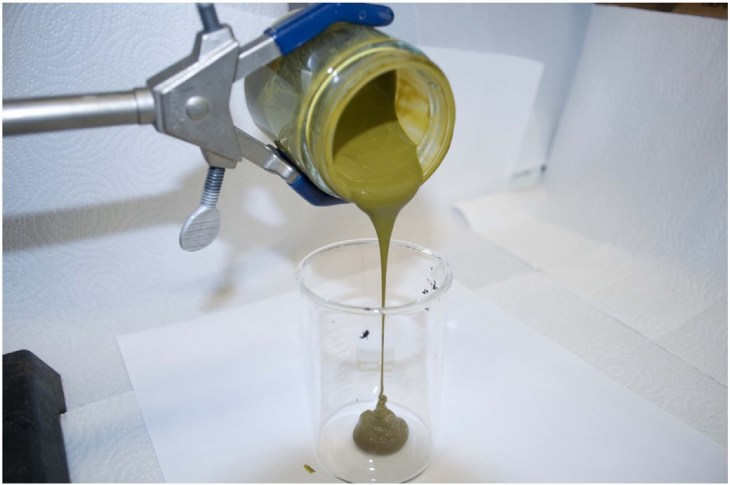
The day when planes, trucks and cars are commonly revved up on pond scum may be on the near horizon thanks to a technological advance that continuously turns a stream of concentrated algae into bio-crude oil. From green goo to crude takes less than an hour.
The goo contains about 10 percent to 20 percent algae by weight. The rest is water. This mixture is piped into a high-tech pressure cooker where temperatures hover around 660 degrees Fahrenheit and pressures of 3,000 pounds per square inch in order to keep the mixture in a liquid phase.
Inside the cooker are “some technology tricks that other people don’t have” that help separate the plant oils and other minerals such as phosphorous from the water, Douglas Elliott, a fellow at the Department of Energy’s Pacific Northwest National Laboratory in Richland, Wash., explained to NBC News.
An hour after being poured into the cooker, gravity separates the crude oil from the water as it flows out the other end. “We can clean up that bio-crude and make it into liquid hydrocarbons that could well serve to displace the gas, diesel, and jet (fuel) that we make from petroleum now,” he added.
What’s more, a further water-processing step recovers methane — essentially natural gas — from the leftover plant material. The remaining nitrogen-rich water and recovered phosphorous can be recycled to grow more algae.
Elliott and colleagues describe the process in a paper accepted for publication in the journal Algal Research. Utah-based biofuels company Genifuel Corp. has licensed the technology and is working with an industrial partner to build a pilot plant.
Revisited technology
The so-called hydrothermal liquefaction technology that Elliott and his colleagues used to create the bio-crude was pioneered in the 1970s, but fell out of favor as researchers focused on developing algae strains that yield high amounts of oil in the form of lipids.
To recover the oil from these high-yielding plants, the algae is dried and the oils extracted in a process that is energy intensive and thus expensive.
Hydrothermal liquefaction “has the advantage that it makes use of the whole algae, therefore it has the significant advantage that there is no need to promote lipid accumulation or indeed to extract lipids,” Aris Karcanias, a managing director at FTI Consulting in London, explained to NBC News in an email.
“Furthermore,” the expert in renewable energy added, “there is no need to expend energy for the algae drying process.”
Despite the advantages, until now, Elliott explained, most demonstrations of the technology have been at the lab scale and done in so-called batch reactors. That is, the teams can only produce one batch of crude at a time. In addition, they use chemical solvents to separate the water from the oil.
Using the continuous process described in Algal Research, “we find that, if we do it the right way, we don’t need those chemical steps,” Elliott said.
Challenges ahead
Among the remaining challenges to make algae-derived biofuels a contender in the global energy marketplace is the ability to efficiently grow a sufficient amount of the plant for conversion into biofuels, according to Elliott.
There are also regulatory hurdles such as rewriting standards and specifications to allow the plant-derived oils to be blended into, or used in lieu of, petroleum-based fuels. “The fact is, they do look a little bit different and they have slightly different properties,” he explained.
In addition to Genifuel, who is collaborating with the Department of Energy on this process, other companies pursuing algae-based biofuel technology worth watching include Sapphire Energy, Cellana, and Synthetic Genomics, according to energy consultant Karcanias.
Throughout the industry, he said, “further research is required to enhance algal oil productivity on a continuous basis, ability to demonstrate wastewater treatment and optimize nutrient cycle.” If that’s achievable on a commercial scale, he added, “It will be an important and indeed useful step forward.”
John Roach is a contributing writer to NBC News. To learn more about him, visit his website.
11 Comments on "Algae converted to crude oil in less than an hour"
GregT on Wed, 18th Dec 2013 5:45 pm
“That is, the teams can only produce one batch of crude at a time.”
I wonder how long each batch will run a lawnmower?
DC on Wed, 18th Dec 2013 6:03 pm
Yay technology has saved us, again! For about the 5000th time or so. I lost track somewhere around the affordable hydrogen car announcement, the fuel-cell that will power my home breakthrough, the ultra-cheap and light as paper Solar panel discovery, and the colonization of Mars. But this clearly is the real deal, unlike the past several thousand breakthroughs that for whatever reason, still have yet to appear in any way shape or form that I can actually see and touch that have been announced over the last 3 or 4 decades.
Beery on Wed, 18th Dec 2013 6:47 pm
How on Earth is pumping MORE CO2 into the atmosphere “an important and indeed useful step forward”?
The only way it can be so described is if the final goal is the eradication of all life on Earth.
Bob Inget on Wed, 18th Dec 2013 7:18 pm
Clearly, some fuel is required to heat that pressure cooker. Can we count that?
(can you just imagine how much heat, pressure, time, it took to make the real stuff?)
Why not go all the way with the secrets and make diesel or kerosene?
Terry Mcnamie on Wed, 18th Dec 2013 8:47 pm
And? honestly scientists are too concerned with what they can do rather than what they should be doing. Big whoop you turned algae into crude, mother nature did that without thinking about it for the last few million years. It’s like the companies that spend millions creating robot dogs, is anybody really excited by that? real dogs are far more energy efficient, loving and fun than some POS robot. Science needs a big fat funding cull ASAP, maybe then we’ll get some inventions that actually benefit a collapsing society rather than ones that would benefit a make believe society that will never come about.
pik on Wed, 18th Dec 2013 8:58 pm
Beery……….
By using algea to create hydrocarbons to burn you are just recycling carbon that already exist in the biosphere. Burning biomass is considered carbon neutral as apposed to dredging up fossil fuels that have been safely sequestered under ground for millions of years which will introduce more carbon to the biosphere.
J-Gav on Wed, 18th Dec 2013 9:01 pm
“If that’s achievable on a commercial scale …” says it all, for now at least, but I guess we can always close our eyes, cross our fingers, click our heels … and expect to get back to Kansas.
BillT on Wed, 18th Dec 2013 11:47 pm
Ah, pik, but if you burn MORE carbon energy in the process than you get in return, you are losing ground. These techie wet dreams of instant wealth are usually energy neutral or even energy sinks. And Mother nature did it with non-carbon energy sources called gravity, biochemistry and solar energy.
pik on Thu, 19th Dec 2013 12:33 am
Ah, BillT
Why cant you do it with hydro electricity or geo-thermal or wind or solar or tidal or wave or any combination of renewable energy? Who says you have to burn any carbon in the process?
SilentRunning on Thu, 19th Dec 2013 2:52 am
This is one of those “fluff” news stories that reveals next to nothing.
The main question is: How EFFICIENT is the process? How much energy out do you get for the energy in?
If you process 1000 pounds of algae, but only get 1 tablespoon of oil – that is never going to be practical. Yes, *theoretically* you are making oil, but the costs in money and energy would never make it practical.
Norm on Thu, 19th Dec 2013 11:29 am
It will produce enough fuel to run a Cox .049, if y’all know what that is.