
Peak Oil is You
Donate Bitcoins ;-) or Paypal :-)


Page added on November 6, 2012

A new Study on Integration of Renewables in Germany

DENA[1] published its first grid study in 2005 and a second grid study in 2010. The first report stressed the vulnerability of the power grid by demonstrating that UCTE’s European security rules for electricity transmission grids were violated already in 2003.
The energy turnaround in 2011 (“die Energiewende”) has eroded the validity of the first two reports.
In August 2012 DENA has published a third study on the integration of renewables in Germany [3]. The study was made in cooperation with Aachen University[2].
It is the purpose of the study to analyse how the political targets will change the electricity supply system by 2050 and to identify infrastructure challenges. The study is mainly based on the Guiding Scenario 2009 [1], published by the Federal Ministry for the Environment, Nature Conservation and Nuclear Safety (BMU)[3]. The Guiding Scenario 2010 [2] was not yet published when DENA began working on the integration study.
BMU’s guiding scenarios as the official targets
The guiding scenarios are important references in German energy policy. They include three basic scenarios with different penetrations of renewable energy, A, B and C. The DENA study is based on the basic scenario A.
Figure 4-17 in the DENA report presents an overview of the expected future capacity pattern for the electricity industry:

The corresponding production pattern (from Guiding Scenarios 2010):
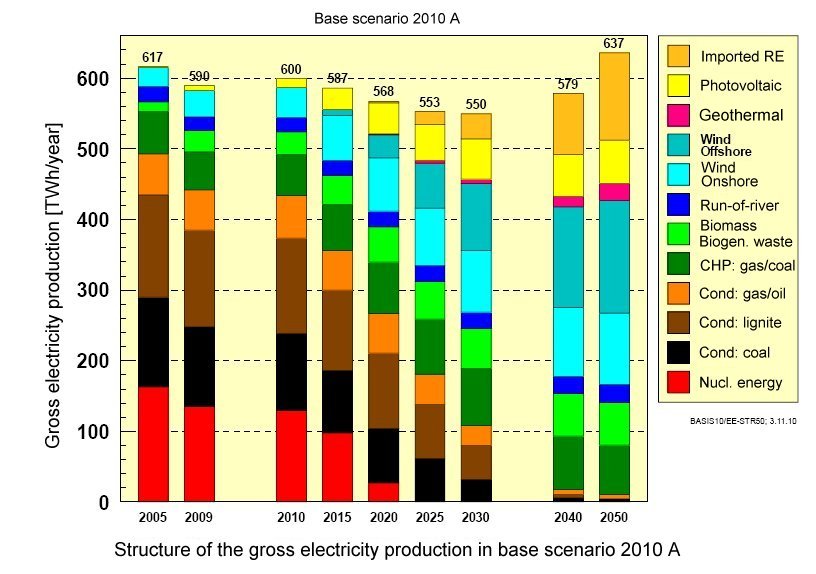
The import is assumed to be renewable electricity (EE). 123 TWh or about 20% of the consumption must be imported. PV covers 12% of the consumption with 31% of the installed capacity.
It may be a reasonable conclusion that Germany cannot be self-sufficient in renewable energy. For a neighbouring country the assumed origin of the import is interesting.

The import will require new transmission facilities with a double-figure capacity in GW. The model has calculated necessary transfer capabilities in 2050. Between Germany and region 2 (Denmark, Norway, Sweden and Finland), and between Germany and region 4 (France, Portugal and Spain), 0 GW will do, while 71 GW will be needed between Germany and region 3.
The results indicate a simplified theoretical model and preliminary results. Good estimates of future transfer patterns in Europe will be very interesting. Therefore a further improvement of data and models should be encouraged.

External costs can reduce the additional cost considerably (the blue curve). However, external costs are not well defined, so the adjusted cost has limited information value.
For scenario A the total German share of renewables will be 55% in 2050 and the emission of CO2 will be reduced by 85%. For the electricity production the share of renewables will be 86% (table 1 in [2]).
The authors of the Guiding Scenarios 2010 are convinced that the transition is possible for all scenarios between 2010 and 2050. Balancing of the variable production will be possible with additional storage facilities. A list of measures is organized in the following groups:
1. Conversion of power generation to a large renewables share
2. Increasing efficiency in heat supply, especially energy-related modernisation of buildings
3. Increasing efficiency in the electricity sector
4. Increasing efficiency in the transport sector
5. Expansion of renewables in the heat sector
6. Expansion of renewables in the transport sector
The DENA study aims at a closer analysis of the electricity sector
The new DENA study analyses the electricity sector, mainly based on the Guiding Scenario 2009. It does not discuss the likelihood or the relevance of the scenario.
The modeling for the DENA study includes:
-Necessary reserve capacity
-Development of the production system
-Market simulation including price formation
-Necessary grid reinforcements
The results seem to some degree to be replications of the results in the guiding scenarios.
An interesting chart shows the development in “secured production capacity”:

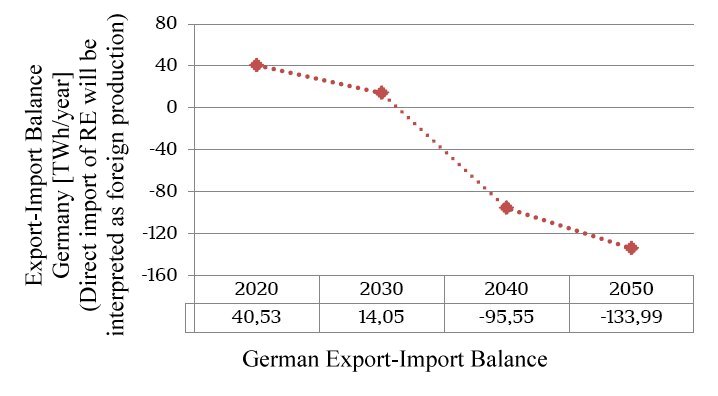
It is obvious that the need for import of renewable electricity develops between 2030 and 2050.
The DENA study quantifies the negative residual demand. A part of this cannot be eliminated by available means. It is called “not integrative power”.
| From table 4-3 and fig. 4-35 | 2020 | 2030 | 2040 | 2050 | |
| Negative residual demand | Number of hours | 29 | 1056 | 2764 | 3829 |
| Maximum value [GW] | -8.7 | -38.7 | -58.7 | -70.6 | |
| Average value [GW] | -3.4 | -8.6 | -13.6 | -17.3 | |
| Energy [TWh] | 0.1 | 9.1 | 37.5 | 66.3 | |
| Not integrative power | Number of hours | 0 | 86 | 603 | 1969 |
| Maximum value [GW] | – | -14.5 | -40.0 | -62.5 | |
| Average value [GW] | – | -3.8 | -8.9 | -10.7 | |
| Overflow [TWh] | 0 | 0.3 | 5.4 | 21.1 | |
The study does not specify the necessary grid extensions. It says (section 4.6.2) that a virtual grid has been assumed for the calculations.
The DENA study also includes calculation of additional cost of the renewables program. The results are slightly higher than that in Guiding Scenarios 2010.
The main conclusions of the DENA study:
-Conventional power plants will still be needed to a considerable extent in 2050. A new generation of efficient and flexible units must be able to interact efficiently with the uncontrollable production.
-Germany cannot remain self-sufficient in electricity supply. Import of electricity will increasingly be necessary after 2030. Both production capacity abroad and transmission facilities must be secured in due time. In Germany a well balanced mix of technologies including renewables, conventional power plants, storage facilities, grid extensions and demand side management will be needed in order to maintain security of supply.
-A complete integration of renewables in the power system is not possible. The production from renewables and CHP in one hour can exceed the electricity demand by 70 GW in 2050. A part of this production can be exported or stored. In case of delayed grid reinforcements or limitations in other countries the challenges within Germany will be even harder.
-Grid extensions are urgently necessary in both transmission and distribution systems. The extensions are already now considerably behind schedule.
-Electricity supply will be clearly more expensive in 2050 than today. The present market arrangement will not be able to cover the cost. New market arrangements must therefore be developed.
The DENA study does not add much to BMU’s guiding scenarios
During the reading of the DENA study the necessity of understanding the underlying guiding scenarios became increasingly clear. The DENA study is for practical reasons based on the Guiding Scenarios 2009. The difference is not significant. Therefore results from the 2010 edition have been presented in this paper.
A comparison of the two reports leaves the impression that much more specific data and results are presented as tables in the scenario report than in the DENA study. Section 7.3 of the scenario report gives quite specific guidelines and recommendations for the transition, while the conclusions of the DENA report (summarized above) are of rather general nature.
This observation does not mean that the scenario report is adequate for all purposes, but the DENA analysis of the electricity sector deserves more details in the presentation and probably also a more detailed modeling.
Some necessary research and development activities deserve special attention:
-A new generation of conventional thermal power plants must meet nearly contradictory specifications such as operational flexibility, multi-fuel operation, high energy efficiency, low environmental impact, robustness and economic efficiency.
-It will take new sophisticated market arrangements to give market participants investment incentives for the development and construction of the right mix of production technologies.
One Comment on "A new Study on Integration of Renewables in Germany"
Arthur on Tue, 6th Nov 2012 5:38 pm
Wonderful, all these “UCTE’s European security rules for electricity transmission grids”
But… better energy available intermittently than no energy at all… It should be no concern if the grid in Europe will resembles third world standards in the future because of the application of renewables. That is why a smart grid is so important so suppliers can ration energy. And with current technology this can be done with powerelectronics and internet technology. Nothing new needs to be invented, everything is there. What is needed is (hard) choices and investment.
Meanwhile Germany keeps on course as they increased their solar capacity with another 50% during the past year. Solar power’s share in the country’s electricity production rose to 6.1% from 4.1% a year ago. Wind power gained slightly to 8.6% from 8.0%. Biomass plants accounted for almost 6%. Total renewables: 26% of electricity production (US 10%). Denmark is record holder with 41%.