
Peak Oil is You

Donate Bitcoins ;-) or Paypal :-)


Page added on August 9, 2016

An Updated Version of the “Peak Oil” Story

The Peak Oil story got some things right. Back in 1998, Colin Campbell and Jean Laherrère wrote an article published in Scientific American called, “The End of Cheap Oil.” In it they said:
Our analysis of the discovery and production of oil fields around the world suggests that within the next decade, the supply of conventional oil will be unable to keep up with demand.
There is no single definition for conventional oil. According to one view, conventional oil is oil that can be extracted by conventional methods. Another holds it to be oil that can be extracted inexpensively. Other authors list specific types of oil that require specialized techniques, such as very heavy oil and oil from shale formations, that are considered unconventional.
Figure 1 shows the growth in unconventional oil supply for three parts of the world:
- Oil from shale formations in the US.
- Oil from the Oil Sands in Canada.
- Oil characterized as unconventional in China, in a recent academic paper of which I was a co-author. (Temporarily available for free here.)

Figure 1. Approximate unconventional oil production in the United States, Canada, and China. US amounts estimated from EIA data; Canadian amounts from CAPP. Oil prices are yearly average Brent oil prices in $2015, from BP 2016 Statistical Review of World Energy.
Oil prices in 1998, which is when the above quote was written, were very low, averaging $12.72 per barrel in money of the day–equivalent to $18.49 per barrel in 2015 dollars. From the view of the authors, even today’s oil prices in the low $40s per barrel would be quite high. Since the above chart shows only yearly average prices, it doesn’t really show how high prices rose in 2008, or how low they fell that same year. But even when oil prices fell very low in December 2008, they remained well above $18.49 per barrel.
Clearly, if oil prices briefly exceeded six times 1998 prices in 2008, and remained in the range of six times 1998 prices in the 2011 to 2013 period, companies had an incentive to use techniques that were much higher-cost than those used in the 1998 time-period. If we subtract from total crude oil production only the production of the three types of unconventional oil shown in Figure 1, we find that a bumpy plateau of conventional oil started in 2005. In fact, conventional oil production in 2005 is slightly higher than the later values.

Figure 2. World conventional crude oil production, if our definition of unconventional is defined as in Figure 1.
I would argue that far more crude oil production was enabled by high oil prices than I subtracted out in Figure 2. For example, Daqing Oil Field in China is a conventional oil field, but greater extraction has been enabled in recent years by polymer flooding and other advanced (and thus, high-cost) techniques. In the academic paper referenced earlier, we found that the amount of unconventional oil extracted in China in 2014 would be increased by about 55%, if we broadened the definition of unconventional oil to include oil made available by polymer flooding in Daqing, plus some other types of Chinese oil extraction that became more feasible because of higher prices.
Clearly, this same kind of shift to more expensive extraction methods has occurred around the world. For example, Brazil has been attempting to extract oil from below the salt layer of the ocean using advanced techniques. According to this article, Brazil’s “pre-salt” oil production was expected to exceed 600,000 barrels per day by the end of 2014. This oil should count, in some sense, as unconventional oil.
Massive investments in the Kashagan Oil Field in Kazakhstan were enabled by high oil prices. Some initial production began, but was discontinued, in September 2013. Production is expected to resume in October 2016.
There are clearly many smaller fields where higher extraction was made possible by high oil prices that allowed oil companies to utilize more advanced techniques. Deepwater drilling also became more feasible because of higher prices. Another example is Russia, which is reported to have heavy oil extraction that would not be commercially feasible if oil prices were below $40 to $45 per barrel. If we were to add up all of the extra oil production in many areas of the world that was enabled by higher prices, the total amount would no doubt be substantial. Subtracting this higher estimate of unconventional oil in Figure 2 (instead of the three-country total) would likely result in more of a “peak” in conventional oil production, starting about 2005.
Thus, if we think of conventional oil production as that which is possible at low oil prices, the forecast by Colin Campbell and Jean Laherrère was pretty much correct. Production of conventional oil did seem to peak about 2005 or shortly thereafter. We simply don’t have the data to estimate how much we could have extracted, if oil prices had remained low. Furthermore, oil prices did rise substantially, relative to 1998 prices, making Campbell’s and Laherrère’s forecast of higher prices correct.
I suppose that we could even say that if conventional oil were all that we had in 2005 and subsequent years, supply would have fallen far short of demand, based on Figure 2. This last statement is somewhat debatable, however, because there would have been other feedbacks, as well. It is possible that if total supply were very short, oil prices would have spiked to even a higher level than they really did. The resulting recession would likely have brought prices down, and temporarily brought demand back in line with supply. If prices had stayed low, there might have been a second round of shortages, with even a greater supply problem. This, too, might have been resolved by another price spike, quickly followed by another recession that brought world demand back down to the level of supply.
Of course, conventional crude oil isn’t the only type of liquid fuel that we use. When we add all of the pieces together, including substitutes, what we find is that since 1998, broadly defined oil production (“liquids”) has been rising quite rapidly.
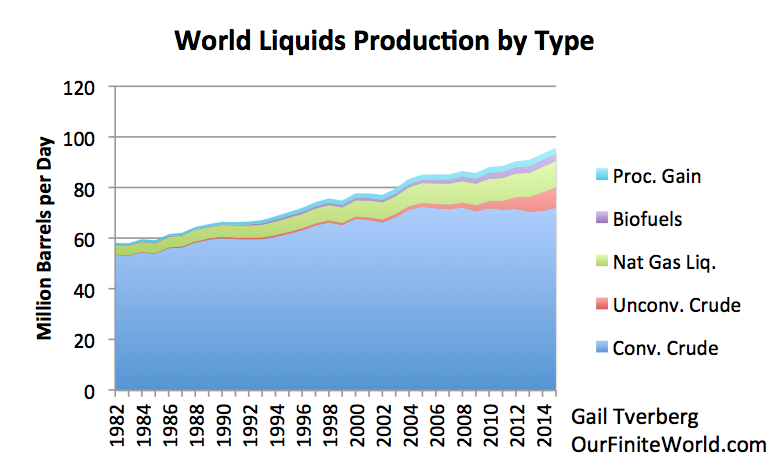
Figure 3. World Liquids by Type. Unconventional oil is from Exhibit 1. Conventional oil is total crude oil from EIA, and other amounts are estimated from EIA International Petroleum Monthly amounts through October 2015. (EIA’s category “Other Liquids” is referred to as Biofuels in Figure 3, since this is its primary component. Other liquids also include coal and gas to liquids and other small categories.)
In fact, since 2005, Figure 4 shows that the single highest year of growth in oil production (broadly defined) was 2014, with 2.47 barrels per day. (This is based on crude oil data from EIA Beta Report Table 11.b, plus values for other liquids from EIA’s International Energy Statistics. Annual amounts for 2015 were estimated based on data through October.)
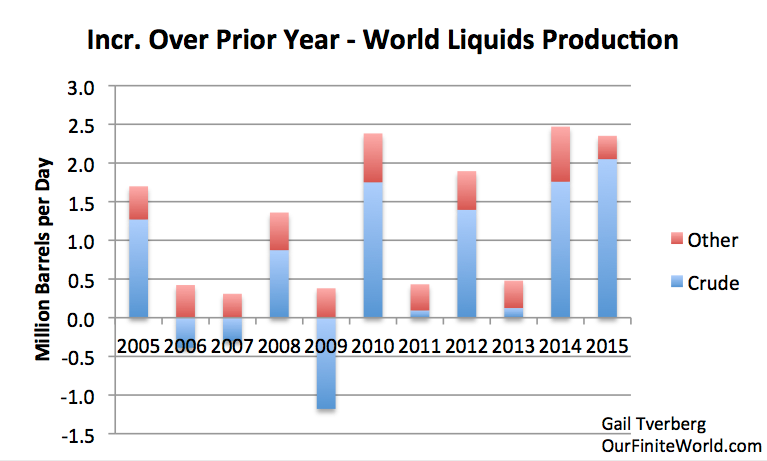
Figure 4. Increase over prior year in total oil liquids production, based on EIA data. 2015 other liquids amounts estimated based on data through October 2015.
Figure 4 shows that the increase in oil supply in 2015 is almost as high as in 2014. The 2005 to 2015 period shown indicates a lot of “ups and downs.” The only two high years in a row are 2014 and 2015. This would seem to be at least part of our “oil glut” problem.
Exactly by how much oil production needs to increase to stay even with demand depends upon price–the higher the price, the smaller the quantity that buyers can afford. At a price of $100 per barrel, a reasonable guess might be that about 1 million barrels per day in consumption might be added. If categories other than crude oil are increasing by an average of 440,000 barrels per day, per year (based on data underlying Figure 4), then crude oil production only needs to increase by 560,000 barrels per day to provide an adequate supply of fuel on a total liquids basis.
If production of crude oil is actually increasing by more than 2.0 million barrels per day when only 560,000 barrels per day are needed at a price level of $100 per barrel, clearly something is badly out of balance. According to EIA data, the countries with the five largest increases in crude oil production in 2015 were (1) US 723,000 bpd, (2) Iraq 686,000 bpd, (3) Saudi Arabia 310,000 bpd, (4) Russia 146,000 bpd, and (5) UK 106,000 bpd. Thus, US and Iraq were the biggest contributors to the global glut in 2015.
What Is Going Wrong?
Not only did a lot of people hear the Peak Oil story, a great many responded at once. Governments added requirements for more efficient vehicles. This tended to lower the quantity of additional oil supply needed. At the same time, governments added mandates for the use of biofuels, also reducing the need for crude oil. Arguably, the US-led Iraq war, which began in 2003, was also about getting more crude oil.
Oil companies also rushed in and developed oil resources that might be profitable at a higher price. These new developments often take more than ten years to produce oil. Once companies have started the long path to development, they are unlikely to stop, no matter how low oil prices drop.
It is becoming apparent that if oil prices can be raised to a high enough level, a lot more oil is available. Figure 5 shows how I see this as happening. We start at the top of the triangle, where there is a relatively small quantity of inexpensive oil, and we gradually work toward the expensive oil at the bottom.
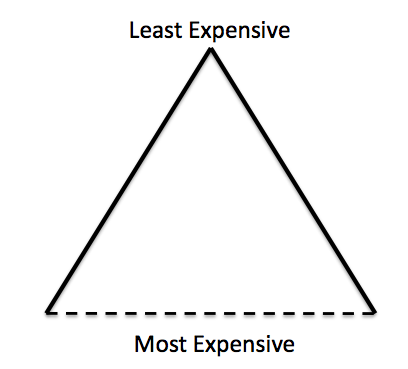
Figure 5. Resource triangle, with dotted line indicating uncertain financial cut-off.
The amount of oil (or for that matter, any other resource) isn’t a fixed amount. If the price can be made to rise to a very high level, the quantity that can be extracted will also tend to rise–in fact, by a rather large amount. The “catch” is that wages for the vast majority of workers don’t rise at the same time. As a result, goods made with high-priced oil soon become too expensive for workers to afford, and the economy falls into recession. The result is prices that fall below the cost of production. Thus, the limit on oil supply is not the amount of oil in the ground; instead, it is how high oil prices can rise, without causing serious recession.
While wages don’t rise with spiking oil prices, increasing debt can be used to hide the problem, at least temporarily. For example, cars and homes become less affordable with higher oil prices, since oil is used in making them. If governments can lower interest rates, monthly payments for new homes and cars can be lowered sufficiently that new car and home sales don’t fall too far. Eventually, this cover-up reaches limits. This happens when interest rates start turning negative, as they now are in some parts of the world.
Thus, by ramping up buying power with low interest rates and more debt, governments were able to get oil prices to stay above $100 per barrel for long enough for producers to start adding production that might be profitable at that price. Unfortunately, the amount of additional oil demand isn’t really very high at that price. So, instead of running out of oil, we ran into the reverse problem–too much oil relative to the amount that the world economy can afford when oil prices are $100+ per barrel.
The attempt by governments to fix the oil shortage problem didn’t really work. Instead, it led to the opposite mismatch from the one we were expecting. We got an oversupply problem–a problem of finding enough space for all our extra supply (Figure 6). Unless we have infinite storage, this pattern clearly cannot continue forever.

Figure 6. Weekly ending stocks of crude oil and petroleum products through July 29. Chart by EIA.
Eventually, this oversupply problem is likely to result in “mother nature” cutting off oil production in whatever way it sees fit–oil prices dropping to close to zero, bankruptcies of oil companies, or collapses of oil exporters. With lower oil supply, we can expect recession.
Misunderstanding the Real Problem
In the early 2000s, the story that Peak Oilers came up with (or perhaps the way it was interpreted in the press) was that the world was “running out” of conventional oil, and that this would lead to all kinds of problems. Oil prices would rise very high, and oil depletion would take place over a long period, as shown in a symmetric Hubbert Curve. As a result, at least small quantities of additional energy products with high “Energy Returned on Energy Invested” (EROI) were needed to supplement the energy products that would be produced based on the slowly depleting Hubbert Curve. Our oil supply problems were viewed as a unique situation, calling for new and unique solutions.
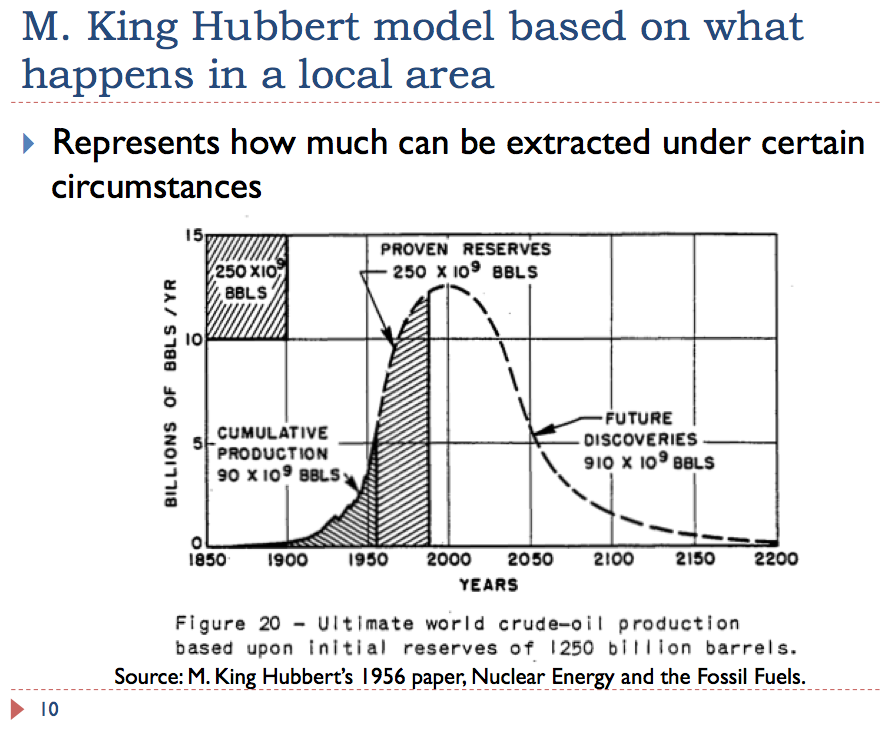
In my view, this story came about through over-reliance on models that likely were accurate for some purposes, but not for the purpose that they later were being used. One of these over-extended models was the supply and demand curve of economists.
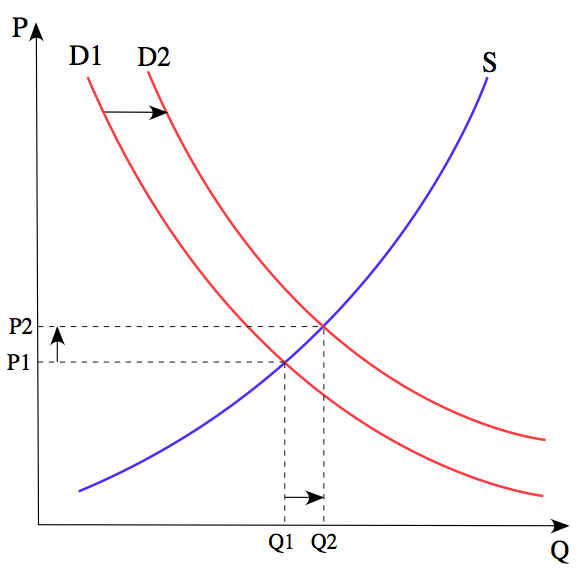
Figure 7. From Wikipedia: The price P of a product is determined by a balance between production at each price (supply S) and the desires of those with purchasing power at each price (demand D). The diagram shows a positive shift in demand from D1 to D2, resulting in an increase in price (P) and quantity sold (Q) of the product.
This model “works” when the goods being modeled are widgets, or some other type of goods that does not have a material impact on the economy as a whole. Substituting high-priced oil for low-priced oil tends to make the economies of oil importing countries contract. This effect indirectly reduces demand (and thus prices) for many products (not just oil), an impact not considered in the simplified Supply and Demand model shown in Figure 7. Also, the very long lead times of the oil industry are not reflected in Figure 7.
Two other models that were used beyond the limits for which they were originally designed were the Hubbert Curve and the 1972 Limits to Growth model. Both of these models are suitable for determining approximately when limits might be hit. Even though Peak Oilers have believed that these models can accurately determine the shape of the decline in oil supply and in other variables after reaching limits, there is no reason why this should be the case. I talk about this problem in my recent post, Overly Simple Energy-Economy Models Give Misleading Answers. Thus, for example, there is no reason to believe that 50% of oil will be extracted post-peak. This is only an artifact of an overly simple model. The actual down slope may be much steeper.
The Real Story of Resource Limits that We Are Reaching
Instead of the scenario envisioned by Peak Oilers, I think that it is likely that we will in the very near future hit a limit similar to the collapse scenarios that many early civilizations encountered when they hit resource limits. We don’t think about our situation as being similar to early economies, but we too are reaching a situation of decreasing resources per capita (especially energy resources). The resource we are most concerned about is oil, but there are other resources in short supply, including fresh water and some minerals.
Research by Joseph Tainter and by Peter Turchin indicates that some of the issues involved in previous resource-based collapses are the following:
Growing Complexity. Citizens who discovered they were reaching resource limits typically tried to work around this problem. For example, hunter-gatherers turned to agriculture when their population grew too large. Later, civilizations facing limits added irrigation to raise food output, or raised large armies so that they could attack neighboring countries. Making these changes required greater job specialization and more of a hierarchical system–two aspects of growing complexity.
This increased complexity used part of the resources that were in short supply, since people at the top of the hierarchy were paid more, and since building new capital goods (today’s example might be wind turbines and solar panels) takes resources that might be used elsewhere in the economy. Eventually, growing complexity reaches limits because costs rise faster than the benefits of growing complexity.
Growing Wage Disparity. With growing complexity, wage disparity became more of a problem.

Figure 8. People at the bottom of a hierarchy are most vulnerable.
I have described this problem as “Falling Return on Human Labor Invested.” Ultimately, this seems to be a major cause of collapse. Workers use machines and other tools, so this return on human labor has been leveraged by fossil fuels and other energy resources used by the system.
Spiking Resource Prices. Initially, when there is a shortage of food or fuel, prices are likely to spike. A major impediment to long-term high prices is the large number of people at the bottom of the hierarchy (Figure 8) who cannot afford high-priced goods. Thus, the belief that prices can permanently rise to high levels is probably false. Also, Revelation 18: 11-13 indicates that when ancient Babylon collapsed, the problem was a lack of demand and low prices. Merchants found no one to sell their cargos to; no one would even buy human slaves–an energy product.
Rising Debt. Debt was used to enable complexity and to hide the problems that people at the bottom of the resource triangle were having in purchasing goods. Ultimately, increased debt was not successful in solving the many problems the economies faced.
Ultimately, Failing Governments. Governments need resources for their purposes, whether hiring armies or making transfer payments to the elderly. The way governments get their share of resources is through the use of tax revenue. When people at the bottom of the hierarchy were cut out of receiving adequate resources (through low wages), the amounts they could afford to pay in taxes fell. Governments would sometimes collapse directly from lack of tax revenue; other times collapses occurred because governments could no longer afford large enough armies to defend their borders.
Ultimately, Falling Population. With low wages and governments requiring higher tax levels to fund their programs, people at the bottom of the hierarchy found it difficult to afford adequate nutrition. They became more susceptible to plagues. Loss of battles to neighboring countries could at times play a role as well.
Lessons We Should Be Learning
Even if we made it past peak conventional oil, there is likely a different, very real collapse ahead. This collapse will occur because the economy cannot really afford high-priced energy products. There are too many adverse feedbacks, including increasing wealth disparity and the likelihood of not enough revenue for governments.
We can’t count on long-term high prices. The idea that fossil-fuel prices will gradually rise, and because of this, we will be able to substitute high-priced renewables, seems very unlikely. In the United States, our infrastructure was mostly built on oil that cost less than $20 per barrel (in 2015 dollars). We know that with added debt and greater complexity, we were temporarily able to get oil to a high-price level, but now we are having a hard time getting the price level back up again. We really don’t know high a price the economy can afford for oil for the long term. The top price may not be more than $50 per barrel; in fact, it may not be more than $20 per barrel.
We need to look for inexpensive replacements for both oil and electricity. Many substitutes are being made to produce electricity, since indirectly, electricity might act to replace some oil usage. There is considerable confusion as to how low these prices need to be. In my opinion, we can’t really raise electricity prices without pushing economies toward recession. Thus, we need to be comparing the cost of proposed replacements, including long distance transport costs and the cost of adjustments needed to match electric grid requirements, to wholesale electricity prices. In both the US and Europe (Figure 9), this is typically less than 5 cents per kWh. (In Figure 9, “Germany spot” is the wholesale electricity price in Germany–the single largest market.) At this price level, producers need to be profitable and to pay taxes to help support governments.

Figure 9. Residential Electricity Prices in Europe, together with Germany spot wholesale price, from http://pfbach.dk/firma_pfb/references/pfb_towards_50_pct_wind_in_denmark_2016_03_30.pdf
Replacements for oil need to be profitable and be able to pay taxes, at currently available price levels–low $40s per barrel, or less.
We need to be careful in aiming for high-tech solutions, because of the complexity they add to the system. High tech solutions look wonderful, but they are very difficult to evaluate. How much do they really add in costs, when everything is included? How much do they add in debt? How much do they add (or subtract) in tax revenue? What are their indirect effects, such as the need for more education for workers?
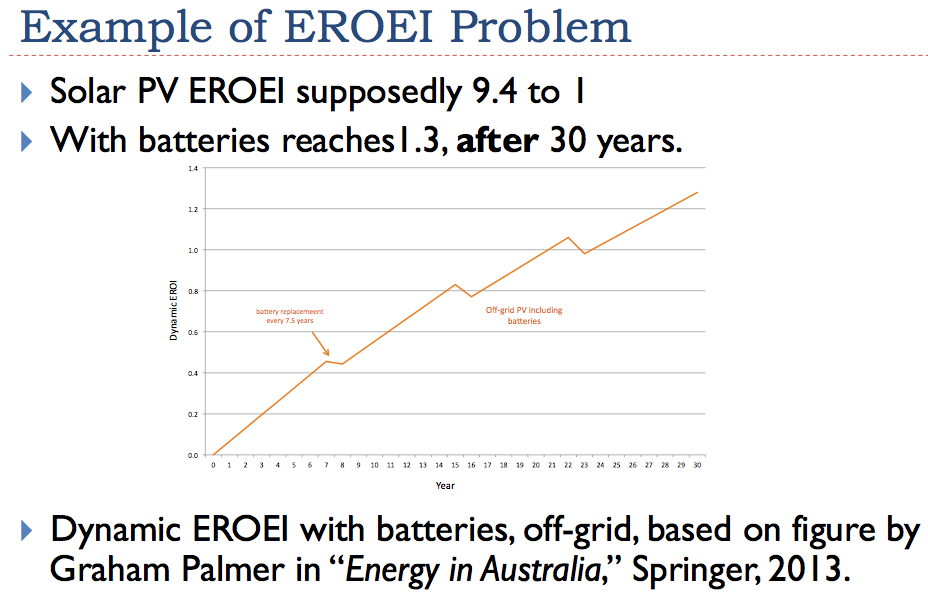
We need to be alert to the possibility that solar PV and most wind energy may be energy sinks, rather than true energy sources. The two hallmarks of providing true net energy to society are (1) being able to provide energy cheaply, and (2) being able to provide tax revenue to support the government. When actually integrated into the electric grid, electricity generated by wind or by solar generally requires subsidies–the opposite of providing tax revenue. Total costs tend to be high because of many unforeseen issues, including improper siting, long-distance transport costs, and costs associated with mitigating intermittency.
Unless EROI studies are specially tailored (such as this one and this one), they are likely to overstate the benefit of intermittent renewables to the system. This problem is related to the issues discussed in my recent post, Overly Simple Energy-Economy Models Give Misleading Answers. My experience is that researchers tend to overlook the special studies that point out problems. Instead, they rely on the results of meta-analyses of estimates using very narrow boundaries, thus perpetuating the myth that solar PV and wind can somehow save our current economy.
Too much debt, and too low a return on debt, are likely to be part of the limit we will be reaching. Investment in complexity requires debt, because complexity requires capital goods such as wind turbines, solar panels, computers and the internet. The return on this additional debt is likely to drop lower and lower, as complex solutions are added that have less and less true value to society.
We need to remember that as far as the economy is concerned, it is total consumption of energy resources that is important, not just oil. Wages reflect the leveraging impact of all energy sources, not just oil. If energy consumption per capita is rising, more and better machines can help raise output per capita, making workers more productive. If energy consumption per capita is falling, the world economy is likely moving in the direction of contraction. In fact, we may be headed in the direction of early economies that eventually collapsed.
When we look at the data, we see that world energy consumption per capita appears to have peaked about 2013. In fact, the big drop in oil and other commodity prices began in 2014, not long after energy consumption per capita hit a peak.

Figure 10. World energy consumption per capita, based on BP Statistical Review of World Energy 2105 data. Year 2015 estimate and notes by G. Tverberg.
The world seems to have hit peak coal, because of low coal prices. In fact, falling coal consumption seems to be the cause of falling world energy consumption per capita. Whether or not most people regard coal highly, coal is pretty much essential to the world economy. A recent decrease in coal consumption is what is pulling world energy consumption per capita down. We do not have any other cheap fuel to make up the shortfall, suggesting that our current downturn in energy consumption (shown in Figure 10) may be permanent.
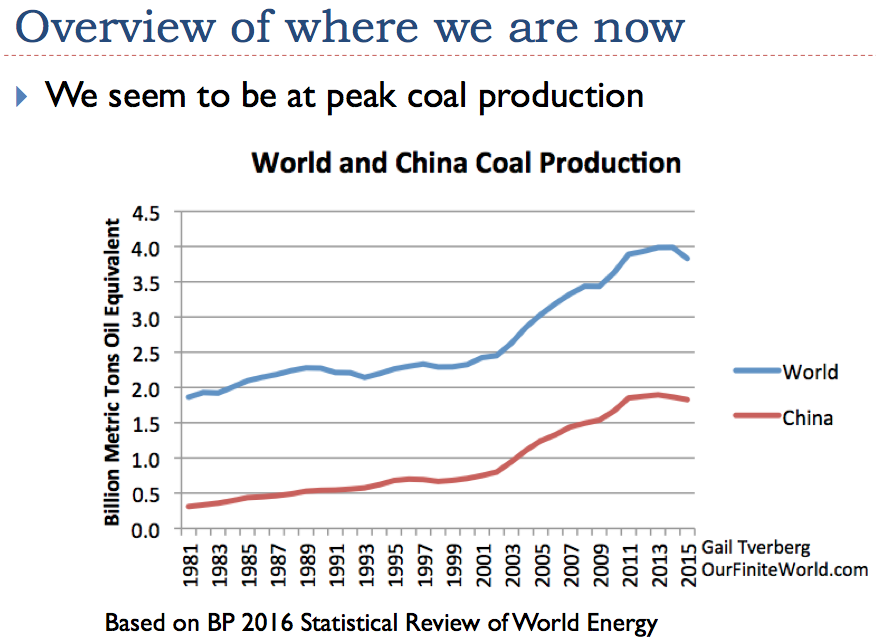
Figure 11. World and China appear to be reaching peak coal.
We should not be surprised if the financial problems that the world is now encountering will eventually resolve badly. This seems to be how the Peak Oil story will finally play out. Without rising energy per capita, the world economy tends to shrink. Without economic growth, it becomes very difficult to repay debt with interest. Wealth disparity becomes more and more of a problem, and it becomes increasingly difficult for governments to collect enough revenue to support their needs. Our problems begin to look more and more like those of earlier economies that hit resource limits, and eventually collapsed.
Gail Tverberg Our Finite World
88 Comments on "An Updated Version of the “Peak Oil” Story"
peakyeast on Wed, 10th Aug 2016 11:41 am
The comments here at PO more and more resembles a group that all has been married to each others for too long.. 🙂
shortonoil on Wed, 10th Aug 2016 1:26 pm
“Most systems are comprised of components. As components are replaced with better tech the erio can certainly go up. Think hydraulic dam turbines and generators. “
Dr, Arnoux and I were discussing this today; how many people there are that want to believe in the Tooth Fairy. There has been no new laws of physics as applied to thermodynamics in almost 100 years. Trying to change reality by wishing it away is a child’s game. Unfortunately, your sand box is growing ever more lethal every day.
ellsworth on Wed, 10th Aug 2016 2:20 pm
short, why doesn’t increasing technological efficiency lead to at least a slower decline in EROI? Is it because there was also energy used in creating the new technology, that must be subtracted from the gross energy returned? …The perspective needs to be wider?
marmico on Wed, 10th Aug 2016 2:26 pm
Produce the data for the ETP Fuctard Formula, dickhead. Arnoux is a quack.
The EROI in my gasoline tank is the highest ever in the history of the oil market. Shale oil well head EROI has zoomed upwards with the dramatic drop in drilling/completions.
Joe D on Wed, 10th Aug 2016 5:46 pm
Increasing technological efficiency has a short term gain in a race with depletion.
Roger on Wed, 10th Aug 2016 6:31 pm
Apenaman,
“I also have some highly relevant quotes from Aragorn, but we’ll save those for when we next play fantasy story time.”
Thanks for the Lord of the Rings quotes…one of my favorite books/movies! I too enjoy fantasy novels, especially those written by Christian authors like JRR Tolkien with Biblical themes/motifs. I’ve heard (uncertain if it’s true) that Tolkien even helped lead CS Lewis (radical atheist who turned into the foremost Christian apologist of the last century) to Christ during their time at Oxford.
Apneaman on Wed, 10th Aug 2016 7:07 pm
Roger, why do you believers always bring up an atheist becoming a believer as if it proves something? Oh Yeah, well I know a guy who used to be a Dallas Cowboys fan, but he saw the light and now cheers for the Philadelphia Eagles – so there. Was C.S. Lewis a life long atheist? Seems unlikely to me given the time and place he was born. I’m a lifer, yet most of the atheist stories I hear are from people who once believed. Mostly because they had it driven into their head when they were impressionable kids. See it doesn’t count if you were brought up religious, then stopped believing when you got older then decided to believe again. That’s not a conversion, that’s flip flopping.
Chronicles of Narnia has more Christian/biblical themes. LOTR has quite a bit of pagan, old norse stuff in it. BTW the most major themes and stories predate the bible. Like the flood story. The Jews borrowed plenty in their Babylonian captivity and from others as well. Religious borrowing is the rule not the exception. So is having no evidence to support any of the fairy tales. Why would you need evidence though eh Roger, since it’s supposed to be a matter of faith? You hear the gospel (good news) and either believe it or not – have faith or don’t, right? All these American so called Christians running around trying to prove Jesus and the Bible with bad science and bad historical and archaeological evidence…God would be pissed at them wouldn’t he? They have no faith in the gospel. They need the standards of secular science to be convinced and to convince others. Faithless isn’t that?. Looks like the lake of fire for them eh?
Apneaman on Wed, 10th Aug 2016 7:21 pm
Roger, a brief skimming of this wiki page lends me to believe that you people really don’t know what the fuck you are talking about.
https://en.wikipedia.org/wiki/List_of_Christian_denominations
The Facts and Stats on “33,000 Denominations”
The 20,000 30,000 numbers and David Barrett’s statistics Part II
http://www.philvaz.com/apologetics/a106.htm
33,000 Denominations! Holy fuck Roger what are you people smoking!
And I’m supposed to believe you people have a monopoly on the truth?
Atheism is really simple. It means you simply do not believe in any higher power. Nothing more nothing less. I guess technically I’m agnostic since I don’t actually “know” that there is no creator.
ghung on Wed, 10th Aug 2016 8:29 pm
Yeah, Ap, agnostic is as good as anything I guess. I’m really what Greer refers to as an an “indifferentist”; the realization that the universe is utterly indifferent to our existence. Doesn’t care either way no matter how much we beg and plea. This, of course, sets us free to make the world what we will of it, barring some natural disaster or something. We can trash our biosphere; universe doesn’t care. We are even free to create God in our own image and make up stories about our place in said universe (which doesn’t even notice).
Roger on Wed, 10th Aug 2016 9:30 pm
Apneaman,
“I’m a lifer, yet most of the atheist stories I hear are from people who once believed. Mostly because they had it driven into their head when they were impressionable kids. See it doesn’t count if you were brought up religious…”
That’s the gospel truth, though actually in regards to “those brought up Christian” not being true Christians (which isn’t a matter of culture, but what you believe in your heart…what you know in your head is irrelevant) rather than your version as applied to true atheists, which I won’t dispute. In the words of Jesus:
“Truly, truly, I say to you, unless one is born again he cannot see the kingdom of God.”
John 3:3 (John 3 is a very good chapter to read).
Therein lies a huge problem…most “cultural” Christians are not true believers. Yet, the world looks to them for an understanding of Christianity, rather than Christ (I.e., His word, the Gospels). Much confusion created…many are lead astray.
“BTW the most major themes and stories predate the bible. Like the flood story. The Jews borrowed plenty in their Babylonian captivity and from others as well. Religious borrowing is the rule not the exception.”
Yes, Moses wrote the account of the flood long after it happened. As for “borrowing”, given that it actually happened, why is it surprising that other cultures also retained knowledge of such a catastrophic event? That’s exactly as I’d expect….
“So is having no evidence to support any of the fairy tales. Why would you need evidence though eh Roger, since it’s supposed to be a matter of faith?”
Actually, you misunderstand the meaning of faith. God gave us our brains, and He expects us to use them. The reason people go to hell isn’t because they’re evil (by God’s standard we all fall short), it’s simply because they failed to love the truth. For the most part, the problem is in the heart rather than head–that is, people choose to believe what suites their desired lifestyle, rather than conforming their lifestyle to what is true.
Regarding the atheists I’ve encountered, not one has a cogent world view. That is, a consistent framework addressing the big questions in life:
1. Why does anything exist…e.g., the universe. Can “something” come from “nothing”?
2. What is the purpose of this life…why are we here?
3. What is the source of human morality?
4. Where are we headed after death?
As for evidence supporting the truth of the Bible, it’s abundant…and has withstood the test of time quite well. But, as I’ve tried to explain, the issue is one of the heart, not the head….pointless to cite evidence. However, if you truly seek evidence, examine the prophecies relating to Christ’s first coming. If you grasp mathematical probability, it should be quite obvious that Jesus is the Messiah foretold thousands of years before His incarnation, and that it’s simply impossible for anyone else to fulfill these prophecies. Only God can do such, and He told us in advance and in such a way as to allow no room for doubt. Really takes no “faith” as you define it…just a heart searching for truth.
“They need the standards of secular science to be convinced and to convince others. ”
Science is neither secular or religious…scientists are. The ones I admire the most (e.g. Newton and Einstein) believed in God and would likely be appalled by the notion that science and God are somehow independent…true science boils down to understanding God’s creation.
Roger on Wed, 10th Aug 2016 9:48 pm
Apenaman,
“Atheism is really simple. It means you simply do not believe in any higher power. Nothing more nothing less. I guess technically I’m agnostic since I don’t actually “know” that there is no creator.”
Actually, that sounds more like “checking your mind at the door” to me….as noted above, living with an incoherent world view because it suits your desired lifestyle.
God’s word is true:
“For the wrath of God is revealed from heaven against all ungodliness and unrighteousness of men who suppress the truth in unrighteousness, because that which is known about God is evident within them; for God made it evident to them. For since the creation of the world His invisible attributes, His eternal power and divine nature, have been clearly seen, being understood through what has been made, so that they are without excuse.”
Romans 1:18-20 NASB
The stars in the night sky aren’t some freak accident…much to beautiful.
makati1 on Wed, 10th Aug 2016 10:09 pm
Roger, religion is just another form of brain washing that your parents started when you were born and probably their parents did it to them and on and on. It started when humans did not understand nature or the universe so they invented stories. Then someone realized what a great scam it was and they could gain power and wealth from those “believers”.
If your religion is the only true one, and it is so good, explain how Protestants, Jews, Muslims, Catholics, etc. all believe in the SAME god yet go to war with each other to prove that their ‘flavor’ is the only true one?
The world can exist just fine with the simple creed: “Do onto others as you would have them do onto you”, better known as “The Golden Rule”. But that will never happen. Too many people live off of religion’s other side, tithes and would never agree that the big temples and huge land holdings were not necessary.Not even tithes.
Religion is the worst plague to ever exist and it is still spreading hate and death even today.
Roger on Wed, 10th Aug 2016 11:40 pm
makati1,
“Roger, religion is just another form of brain washing that your parents started when you were born and probably their parents did it to them and on and on. It started when humans did not understand nature or the universe so they invented stories. Then someone realized what a great scam it was and they could gain power and wealth from those “believers”.”
Bingo–you’re exactly right!! If you read the Gospels, you will learn that Jesus was very much against “religion”. In fact, He was crucified by the religious leaders of the time.
“If your religion is the only true one, and it is so good, explain how Protestants, Jews, Muslims, Catholics, etc. all believe in the SAME god yet go to war with each other to prove that their ‘flavor’ is the only true one?”
Good question! Could write all night on this…will have to condense it down.
1. First, most “religious/cultural” believers profess faith but are not “true believers” in their stated religion (applies equally to Christians, Jews, Muslims). That is, they are clueless as to what their scriptures teach (I.e., the Bible or Koran).
2. The listed religions do not believe in the same God/god. Christianity and Islam do not worship the same God/god. Islam explicitly teaches that “God has no Son”, in a direct rejection of Jesus as God the Son. In fact, those who follow the Koran are instructed to kill Christians, whereas those who follow the Bible are instructed to love Muslims.
3. The answer to your question regarding the reason for war (and fill in the blank…murder, hatred, immorality, etc…) is the fact we live in a fallen world. It started in the garden of Eden when we first rebelled against God…and has been spiraling downward ever since. Fear not though, God is in complete control and has purpose in His works. Remember that God is love and he seeks our love…which requires Him to give us freedom to choose or reject Him…which led us to reject Him…which lead to this fallen world we find ourselves in. However, there is hope and eternal life in Jesus.
“The world can exist just fine with the simple creed: “Do onto others as you would have them do onto you”, better known as “The Golden Rule”. But that will never happen. Too many people live off of religion’s other side, tithes and would never agree that the big temples and huge land holdings were not necessary.Not even tithes.
You quote Jesus, and rightly so–if the world believed His words, it would happen now…but, very few believe. However, it will happen when He returns and sets up His kingdom. The Bible contains far more prophecy concerning His second coming than His first…from which it is obvious (if you can’t grasp it from the numerous other things happening in the world now; most folks realize time is about up, but are clueless as to what’s coming) that His return is very near.
“Religion is the worst plague to ever exist and it is still spreading hate and death even today.”
Agreed. Love truth, seek God…He will find you when your heart is in it.
makati1 on Thu, 11th Aug 2016 12:33 am
Roger, how you can twist what I wrote into Religion is fascinating!
First, the Golden Rule precedes the fiction you call he bible. It is just logic.
Second, there is no god. Never was. Never will be. When you die, it is totally over. Lights out. No spirit world after.
If your ‘religious’ condition persists, I suggest psychiatric help. lol.
Sissyfuss on Thu, 11th Aug 2016 7:15 am
Roger, glad you found something that makes sense of the world so you can sleep at night. Now in your somnambulistic coma you can lead others to shut off their minds, stop evolving, and be good little sheeple. Also, Einstein was not religious and your heart just pumps blood. All your thoughts and feelings take place in your brain due to chemical processes after millions of years of trial and error.
Davy on Thu, 11th Aug 2016 9:20 am
Yea, Siss, that too but I think there is more to life because of Life. It is just as bad to dive off into the abyss of the ego and say there is nothing and we are just chemicals reacting as it is to be a Roger and think we are exceptionally connected to the maker of this all. There is a timeliness to the Universe and a connectivity. Of course I have no idea of the details but hints are everywhere. At some point we are dead and gone. I doubt we are going to talk to grandpa and there are no gates to cross when the lights go out. Yet, everything is still there just as before it is just that part of life that thinks it is separate that goes away and becomes reconnected. This is just an observation I have no clue to anything and the older I get the more holes appear in my brain. IOW I am slowly turning back to where I came and in a very short time will be nothing.
PracticalMaina on Thu, 11th Aug 2016 9:35 am
Don’t eat the apple, but please bang your siblings to populate the world, stone disobedient children, and such….also don’t say my name in vain but feel free to rape..
Sissyfuss on Thu, 11th Aug 2016 1:07 pm
Davy, the Buddha says that after our death our molecules scatter into the all of the universe never to reassemble into anything resembling our original being. The Dali Lama says that at our moment of death we attain total consciousness for a millisecond. At least we got that going for us.
(Big hitter the Lama.)
Roger on Thu, 11th Aug 2016 8:35 pm
makatia1,
“Second, there is no god. Never was. Never will be. When you die, it is totally over. Lights out. No spirit world after.”
Prove it.
The moral code written on the human heart is proof of a “law giver.” Where there is law, there is judgement. You choose to hope for eternal nothingness, rather than entertain the notion of judgement day, not because it’s the popular opinion (most folks on this planet profess a belief in God/judgement), but (I suspect) because it suits your desired lifestyle.
Roger on Thu, 11th Aug 2016 8:46 pm
Sissyfuss,
“Coincidence is God’s way of remaining anonymous.”
Albert Einstein
Sissyfuss on Thu, 11th Aug 2016 9:17 pm
From Wikipedia,”he called himself an agnostic,he believed in a pantheistic god and not a personal god, a belief he criticized”. Quote”I do not believe in a personal god and I have never denied this but have expressed this clearly”. Get to confession,Rogue and say 3 thousand hail Marys.
Sissyfuss on Thu, 11th Aug 2016 9:20 pm
Yes Davy, there is a timelessness to the universe and we ain’t included.
Apneaman on Thu, 11th Aug 2016 9:50 pm
God’s anonymity is not the problem it’s god’s absence in a world of never ending suffering and slaughter. How many creatures are getting the guts torn out and eaten alive right this very second? How many children are being raped and beaten and starving? How many people are being tortured? How many people are having their bodies eaten away by disease? How much physical pain is being felt right now? How much emotional pain is being felt? Every second of everyday of every year since humans began – suffering suffering suffering. How many killings? How many rapes? How many cruel painful deaths? billions and billions – what for? Roger if your god exists – he’s one fucking cruel bastard.
makati1 on Thu, 11th Aug 2016 10:19 pm
Roger, prove there IS a god. There is no proof, just belief. Your reply was pathetic! There is no god except in your mind. Get over it.
Roger on Thu, 11th Aug 2016 10:27 pm
Apneaman,
Your point is an excellent one — truly worthy of careful consideration. Why does God allow suffering and evil in the world?
If you want the answer, here it is:
https://m.youtube.com/watch?v=t7-gP1gC8gM
Roger on Thu, 11th Aug 2016 10:33 pm
makati1,
You are correct, neither of us has “proof.” However, I possess a cogent world view…which you lack.
Account for the existence of the universe.
Apneaman on Thu, 11th Aug 2016 10:39 pm
Roger, I finished my search many years ago, so I’ll be taking a pass on youtube. The only thing that would convince me of god is if god came and met me. And I’d say…Yahweh got some splaining to do.
makati1 on Thu, 11th Aug 2016 10:47 pm
Roger, the laws of physics produced the big bang, not some creator bullshit. I suggest a lot of education in the math and sciences (not at a religious supported college) and then see if you still “believe”.
You WANT to believe because it makes you feel comfortable and you have someone to blame your failures on. Someone to pray to in times when you are about to pee your pants because something “bad” has happened. A crutch because you are weak.
Most of the wars since man found “religion” have been religion based. Billions have died in the name of some religion over time. Study real history.
What world view? A very narrow one, like yours,that appears to be uneducated in reality. I must applaud your parents. They did a thorough job of indoctrination on you. It should be called “child abuse”.
makati1 on Thu, 11th Aug 2016 10:52 pm
Ap, love that reply. I cannot imagine a real god that would not prove his existence. This “belief proof” is pure high grade bullshit. But, in 10,000+ years, no god has ever shown up to claim his right. ( Wandering profits don’t count, no matter who they claim for a parent.)
Cloggie on Fri, 12th Aug 2016 3:24 am
Roger, before we discuss about the question whether God exists or not, please give us an idea of how he/she might look like in order to make the discussion meaningful?
I had a car, it was 420 cm long, had a green color and in the chassis there engraved the umber 3TT5WES****
There you have it. Now you can come over and verify whether this car exists or not.
Regarding your God:
– does he/she speak English?
– can he/she get an orgasm?
– what is his/her IQ?
– does he/she like Belgian chocolate?
– does he/she have a family, if not who created your God?
– does he/she keep a register of my behavior and if yes: with pencil/paper, digital or photographic memory?
– in case your God comes with a heaven/hell please indicate stellar coordinates or perhaps parallel universe?
Thanks in advance for your time!
Davy on Fri, 12th Aug 2016 5:19 am
Yea, Siss that was what I said. The ego that says “I am” is a slave to time and mortality. Hyper self-awareness is where the sickness of separation occurs. Of all life know to us ours is the most extreme in its distance from its source hence the wild and elaborate fictions of meaning and truth. The truth should be self-evident and instinct instead it is debatable. Self-awareness creates doubt and doubt creates guilt in a never ending circle of second guessing. Life is fooling itself is all we are at that level. Life coming to self-reflect on itself as a separate entity and in the process getting fooled. It is this being fooled that breaks the vicious circle. If there is a God I am sure he is fooling himself because if he isn’t what a serious God he would be. Imagine never being surprised or never experiencing something new. If life were all knowing and did not fool itself there would be no movement. Life would know its next move and there would be paralysis. Life is an expression of the universe and we are life reflecting on that. We are reflecting linearly on a non-linear. We are a part reflecting on the whole. That is a separation and being fooled. I imagine death is the return from the abyss of self-reflection. Anyone like me that thinks they got the poop on the truth is truly fooling themselves.
makati1 on Fri, 12th Aug 2016 6:31 am
Roger, I might add that, had you been born:
In Saudi Arabia, you would be Muslim.
In India, Hindu.
In Thailand, Buddhist.
In Japan, Shinto.
In China, Confucianist.
In Mongolia, Shamanist.
You beliefs are based on your place of birth and your parents beliefs, not yours. You are what fate made you, not some god. You could have been born into an atheist family and never thought about a god.
I have been there. 34 years as a Protestant… because my parents were Protestants, but they fail in their indoctrination, or never really tried. Then, I tried Mormonism for the next 31 years and was secretary to four Mormon bishops. Tat was when I saw behind the curtain and dropped out of religion forever. It is a scam. Pure bullshit. Another con game perpetrated by those who want power and an easy life.
You too will see that someday, if you live long enough. Some god will not save you or give you an eternal life of ease. Or, on the case of Muslims, 70 beautiful virgins. Or the Mormon’s ofr of another world to be a god of. Or … well whatever other promises that are always predicated on your “worthiness” usually tied to some offering or tithe, etc.
An adult does not need fairy tales to make it through his or her four score plus years. Only common sense and some intelligence to make good decisions and to pick themselves up an move on after the bad ones.
makati1 on Fri, 12th Aug 2016 6:32 am
Oops! …24 years as a Protestant…
Roger on Fri, 12th Aug 2016 7:06 pm
makati1,
“Roger, the laws of physics produced the big bang, not some creator bullshit. I suggest a lot of education in the math and sciences (not at a religious supported college) and then see if you still “believe”.”
I am educated, B.S. & M.S. in petroleum engineering from the University of Texas, and have studied math (calculus, vector calculus, differential equations, La Place transforms, etc.) and science (engineering physics, general chemistry, physical chemistry, thermodynamics, geology, etc.) and find both quite compatible with God. In fact, they strengthen my faith.
“You WANT to believe because it makes you feel comfortable and you have someone to blame your failures on. Someone to pray to in times when you are about to pee your pants because something “bad” has happened. A crutch because you are weak.”
Actually, I came to faith when my heart would no longer accept the lie (in simple terms, “everything is due to random chance” …though they dress it up quite a bit). The math just doesn’t work, so why buy into it? And, yes my faith gives me great comfort…if God weren’t in control there would be no hope for this world.
Lastly, regarding “the laws of physics” producing the Big Bang …. The laws of physics don’t produce anything. They’re man’s attempt to understand this universe.
The “Author” of the laws of physics created the Big Bang.
Roger on Fri, 12th Aug 2016 10:02 pm
makatia1,
“Roger, I might add that, had you been born:
In Saudi Arabia, you would be Muslim.
In India, Hindu.
In Thailand, Buddhist.
In Japan, Shinto.
In China, Confucianist.
In Mongolia, Shamanist.
You beliefs are based on your place of birth and your parents beliefs, not yours. You are what fate made you, not some god. You could have been born into an atheist family and never thought about a god.
I have been there. 34 years as a Protestant… because my parents were Protestants, but they fail in their indoctrination, or never really tried.”
I was born into a Christian culture, and for my first 45 years was a “professing” (or, “cultural”) Christian. Exactly what you speak of.
However, in hindsight I now understand that being a Christian has nothing to do with your point of origin (Christianity is actually dying fastest in the West and growing fastest in other cultures). In fact, the West’s present material wealth/”materialism”” is a great stumbling block.
“Again I say to you, it is easier for a camel to go through the eye of a needle, than for a rich man to enter the kingdom of God.””
Matthew 19:24 NASB
” Then, I tried Mormonism for the next 31 years and was secretary to four Mormon bishops. Tat was when I saw behind the curtain and dropped out of religion forever. It is a scam. Pure bullshit. Another con game perpetrated by those who want power and an easy life.”
First, Mormans are not Christians, despite what you may have heard….they deny the divinity of Jesus.
Second, why did you “try” Mormanism? Admire their “devout manner”…an advancement opportunity or job…perhaps they indoctrinated you into their “family”…? If you stayed in the lie for 31 years, it must have provided you some satisfaction. That is, I seriously doubt your heart’s search for truth lead you there…otherwise, one or two years at the most and you would be gone.
The world is full of lies…pick one to meet your desires. If you seek truth, examine the Gospels (begin with John)…don’t let anyone tell you what Christianity is (people lie)…go to the source. When your heart seeks truth, God will find you.
Sissyfuss on Fri, 12th Aug 2016 10:35 pm
Rogue, Jesus said his current generation will not pass away before all the terrible shit he prophesied would come true. I see no one from that era still hanging around yet the world is still sputtering along. Maybe like all those doomsday preachers that keep picking the wrong day for the end times to begin, old JC was confused as well.
Kenz300 on Sun, 14th Aug 2016 2:30 pm
Electric cars, trucks, bicycles and mass transit are the future….
fossil fuel ICE cars are the past…………..
The Netherlands’ ban on gas-powered cars ‘likely to become law’, all new cars electric by 2025
https://electrek.co/2016/08/14/netherlands-ban-gas-powered-cars-likely-law-all-new-cars-electric-2025/
Scotland blows away the competition – 106% of electricity needs from wind – joins select club
https://electrek.co/2016/08/14/scotland-electricity-needs-from-wind/
Roger on Sun, 14th Aug 2016 9:29 pm
Sissyfuss,
You’re referring to:
“Now learn the parable from the fig tree: when its branch has already become tender and puts forth its leaves, you know that summer is near; so, you too, when you see all these things, recognize that He is near, right at the door. Truly I say to you, this generation will not pass away until all these things take place.”
Matthew 24:32-34 NASB
Jesus was speaking of the generation that “sees all these things take place.” The key “thing” being the regathering of the Jews into the land/nation of Israel, which is what the reference to the “fig tree” budding means. That happened in 1948 (after 2000 years of dispersion…the wasteland they returned to has flourished and the once dead Hebrew language is revived)…these things were predicted by Old Testament prophets…thousands of years ago.
So you see, the generation Jesus was referring to is our generation….we are the ones who are seeing “all these things”…and will see his return.