
Peak Oil is You

Donate Bitcoins ;-) or Paypal :-)


News from January 2005
Setback to pipeline plans
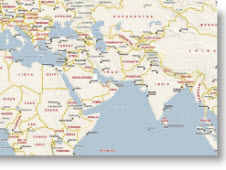
For both energy hungry India and its swiftly growing neighbor, Pakistan, the need for natural gas is more pressing than ever. Pakistan has one of the world’s fastest-growing populations and its demand for gas will expand significantly over the next two decades. India’s gas demand will almost double by 2015, and due to the decline of its reserves it will be forced to import increasing amounts of gas. As the world’s second-largest gas reserve, Iran is the most geographically convenient supplier of gas to both countries.
U.S. senator questions oil supply
Venezuelan President Hugo Chávez has repeatedly threatened to stop oil exports to the U.S. in the event of military aggression against his country. Chávez also has said he wants to increase oil exports to China, lessening Venezuela’s reliance on the U.S. market, which accounts for more than half of the country’s daily exports of 2.2 million barrels of oil and petroleum-derived products.
U.S. powerless to dollar’s plunge?
The not-so-almighty U.S. dollar will continue to lose strength as the trade deficit widens, and there is little or nothing that the government can do about it, according to analysts. The impact on the American consumer will be felt most by travelers overseas, said David Wyss, chief economist for Standard & Poor’s, who expects the […]
What Could Go Wrong In 2005?
DeTocqueville once wrote, “The more things change, the more they stay the same.†In the case of the United States in 2005, the opposite might be true: the more things stay the same, the more they are likely to change…for the worse. In that regard, compiling a list of potential threats to the US as […]
Senator Worried About Cutoff of Venezuelan Oil
The chairman of the Senate Foreign Relations Committee wants to know what contingency plans the United States has in place to counter a disruption in crude oil and petroleum product imports from Venezuela. Venezuela is the fourth-biggest petroleum exporter to the United States, even though the State Department has said the OPEC member is not […]
Eni Announce New Oil Discovery in Deepwater Gulf of Mexico
Eni has announced today a new oil discovery in Deepwater Gulf of Mexico, from the Allegheny South exploration well located 260 kilometers south of New Orleans in Green Canyon Block 298. Allegheny South was drilled to a total depth of 4,870 meters in 1,000 meters of water.
Eni has a 100% Working Interest and is the Operator.
The estimated new reserves discovered are 20 million of barrels of oil equivalent.
The positive well results and the proximity to the Allegheny field (Eni 100%) will make production start-up possible in 2005.
Eni’s current production in the US Gulf of Mexico is 42,000 barrels of oil equivalent per day.
PO.com – A single day of oil consumption for the U.S. alone.

Crude Oil Rises for 3rd Day as Cold Weather May Boost Fuel Use
Crude oil for February delivery rose 53 cents, or 1.1 percent, to $46.90 a barrel at 10:13 a.m. on the New York Mercantile Exchange. Oil is 36 percent higher than a year ago.
The President’s Speech
(If this one doesn’t give it, the next one will.) January, 2005–In December of 2003 I got a two-page letter from President Bush defending his energy polices. It came with an eight-page enclosure to back up the letter. Now I honestly have no idea why someone that busy would take the time to defend himself […]
Through Arms to Syria, Putin Challenges US Middle East Game Rules
Disturbing reports were coming out of the Russian capital Wednesday, January 12, about Russian president Vladimir Putin’s plan to accede to Syria’s request for advanced weaponry during president Bashar Assad’s visit to Moscow on January 24.
DEBKAfile’s US and Israeli security sources quickly contradicted reports that 18 Iskander-M or SS-X-26 surface-to-surface missiles were on the table. The items for sale, they revealed, are advanced SA-10 air defense systems of the type that protects Moscow and shoulder-held SA-18 anti-air missiles, whose transfer to the Hizballah and/or Iraqi guerrillas would move at least two sets of goal posts in the Middle East balance of strength.
OPEC to Meet on Jan. 30
OPEC oil ministers will meet on Jan. 30 as scheduled despite a request from Iraq to move the date of the meeting to avoid a clash with the Iraqi elections, an OPEC spokesman said yesterday. “The meeting will go ahead as scheduled. All the ministers have been consulted and a decision has been reached,†the official said.

Dollar on an oily slope
The unabated rise of international oil prices and depreciation of the dollar will push economic growth in the US down to about 2.5% in 2005, but will have little impact on economic growth in the European Union, where growth is expected to accelerate modestly. Stronger economic fundamentals in the EU will support the continued impressive economic growth in non-Japan Asia.
Do or dry, Sydney: cut water use by half or face a crippling shortage
Sydney needs to more than halve its water consumption to prevent a dire water shortage in 25 years, research by national water utilities concludes.
Water experts say the answer lies in a huge change in personal and industrial attitudes to water use, not just water restrictions.
Moscow Melts in Record Warm Spell
Moscow is enjoying the warmest January in recorded history, and the weather is expected to continue to look more like April for the next few days as balmy Atlantic winds sweep across European Russia and keep temperatures comfortably above freezing.
“These have been the warmest first 10 days of January since the beginning of weather monitoring in the country in 1879,” Tatyana Pozdnyakova of the Moscow weather bureau said Wednesday.
Does Ruppert Compromise Peak Oil Theory?
Now, I hesitate to point this out, because I know that Ruppert prides himself on his journalistic professionalism, as well as his police training, and I certainly wouldn’t want to needlessly embarrass him, but the truth of the matter is that the article that The Great One re-posted appears to be a fake — a fake that was planted, no doubt, for the ‘Peak’ team to ‘find.’
The Myth of ”Peak Oil”
I am often asked about the “peak oil” theory. I’ve even had some people send me junk mail predicting when the date would come. Sometime in June, 2006, I recall. (Unsolicited investment advice: go very long!) I didn’t really pay attention. And yet many do.
There are websites, books, email lists, conferences, and tracts of every sort promoting this doomsday theory, and, yes, the domain name peakoil.com is taken. In millennialist language, these people say that the human race is on the verge of a massive turning point because oil is nearly depleted. You can fill in the rest.
Contact the author here: chfeatherstone@hotmail.com
The End of Oil?
As Kenneth Deffeyes notes in Beyond Oil: The View from Hubbert’s Peak, it meant that as of 2003, there was no major underutilized oil source left on the planet. Even as established oil fields have reached their maximum production capacity, there has been disappointing production from new fields. Globally, according to some geologists’ estimates, we have discovered 94 percent of all available oil.
Stocks falling……on dwindling supplies!
Crude oil rose in New York, extending yesterday’s gain to a six-week high, after an Energy Department report showed a greater-than-expected drop in U.S. inventories.
Talk of oil decline moving into mainstream
Talk of peak oil is moving from obscure energy workshops and technical journals into the social consciousness via books, National Geographic and other magazines and college curriculum.
The Myth of ”Peak Oil”
There are websites, books, email lists, conferences, and tracts of every sort promoting this doomsday theory (here is a google of the subject, and, yes, the domain name peakoil.com is taken). In millennialist language, these people say that the human race is on the verge of a massive turning point because oil is nearly depleted. You can fill in the rest.
Next Generation of Supercapacitors
Super Charged A tiny South Korean company is out to make capacitors powerful enough to propel the next generation of hybrid-electric cars By Glenn Zorpette IEEE SpectrumNessCap is one of about 10 makers of ultracapacitors, devices that can store so much charge that they are beginning to blur the functional distinction between the capacitor and […]
BP narrowly misses full year production target
BP’s fourth-quarter trading statement brought mixed news on Wednesday. Annual production rose 4 per cent year-on-year to more than 4m barrels of oil equivalent a day.
—
The UK oil group said oil and gas from its share of the TNK-BP operations rose by a healthy 34 per cent year-on-year to 965,000 barrels a day. However, increases in export duty from Russia were expected to cut operating profit by $170m relative to the third quarter.
FT
***
App. 25% of BP output now comes from TNK
DOE and NYSERDA Join To Demonstrate Advanced Electric Energy Storage Devices
NEWS MEDIA CONTACT: Tom Welch, 202/586-5806
FOR IMMEDIATE RELEASE October 7, 2004
[b]DOE and NYSERDA Join in $7.1 Million Program to Demonstrate Advanced Electric Energy Storage Devices[/b]
WASHINGTON, DC — Two major energy storage projects to demonstrate advanced electric energy storage devices in New York State have been selected as part of a joint initiative between the Department of Energy s (DOE) Energy Storage Research Program and the New York State Energy Research and Development Authority (NYSERDA). In addition, five smaller analysis and development projects for novel storage technologies have also been selected. The entire three-year program will cost $7.1 million.
…
Contracts for the following advanced energy storage demonstration projects are currently being negotiated and NYSERDA will announce the awards at a later date
[click for PDF of press release]
China ‘threat’ strengthens US-Japan military ties
This is just the beginning of a war of nerves of military strategy among the world’s three most powerful countries, based on real hardball politics, military hardware and spyware. The theater is the East China Sea, surrounding Taiwan and Okinawa.
The actors are Japan, its ally the United States, and an increasingly powerful China that already is an economic powerhouse and is expanding and upgrading its military on the sea, on land and in the air.
Saudi Arabia Country Analysis Brief
Some outside analysts, notably Matthew Simmons of Houston-based Simmons and Company International, have disputed Aramco’s optimistic assessments of Saudi oil reserves and future production, pointing to — among other things — more rapid depletion rates and a higher “water cut” than the Saudis claim. EIA forecasts that Saudi oil production capacity could reach 18.2 million bbl/d by 2020, and 22.5 million bbl/d by 2025, a prediction which the Saudis have said is “unrealistic.”
OPEC seeks to quell doubts over oil cut
OPEC oil producers on Saturday said they had already moved to rein in excess supply, a day after doubts over the group’s resolve to cut sent prices into a tailspin.
Oil prices fell 4 percent on Friday to the lowest level since July despite the cartel’s agreement to wipe out one million barrels per day (bpd) of excess supply from January 1. Top OPEC producer Saudi Arabia said on Saturday that it was not worried by the price fall. “Don’t panic,” said Saudi Oil Minister Ali al-Naimi. “I tell you it will go up on Monday.”
http://www.tehrantimes.com/Description.asp?Da=1/12/2005&Cat=9&Num=2
Tripartite Gas Pipeline Talks Today
Within a week of India warming up to Saudi Arabia in oil diplomacy and signing a 25-year deal with Iran, Petroleum Minister Mani Shankar Aiyar is exploring new horizons in the same field. Before leaving for Yangon, to hold talks with his counterparts from Bangladesh and Myanmar, Aiyar said yesterday: “We are having a tripartite meeting of energy ministers from India, Bangladesh and Myanmar in Yangon on Jan. 12 to see how gas from Myanmar could flow from India through a land pipeline.â€Â
“The idea is to explore the possibility of Myanmar-India gas pipeline,†he said.

Russia to increase natural gas exports to Turkey
Russia and Turkey have agreed to implement large-scale projects in the energy sector, Russian President Vladimir Putin said at a meeting with Turkish entrepreneurs in Moscow on Tuesday, Jan. 11.
The meeting took place in the wake of an official visit of Turkish Prime Minister Recep Erdogan who discussed with Putin the questions of business cooperation between two countries.
http://www.tehrantimes.com/Description.asp?Da=1/12/2005&Cat=9&Num=18
Europeans Wonder: Snow, Where’d You Go?
Bears in Slovakia are awakening early from hibernation. So are barmaids in Bavaria, unseasonably busy in outdoor beer gardens. Bushes are blooming in Austria, and skiers at snowless Bosnian resorts are chilling out in hotel pools.
Forgoing a white Christmas was one thing, but the utter absence of snow for weeks on end from the Baltics to the Balkans has many Europeans pining for what seems – so far, anyway – like The Winter That Wasn’t.
How NOT to Deal with the Crisis
I’ve heard some cracked ideas about how to respond to the mass denial around resource depletion and this is one of the most cracked. Psychotherapy is pseudo-science, pseudo-medicine, and is not going to touch the highly-evolved mechanisms that permit people to deny the crisis. My answer to the author of the article: the answer is […]
ExxonMobil VP Discusses New Resources & Advanced Technology
McGill noted that world demand for oil and gas is expected to increase by 1.7 percent per year, while the world’s oil and gas fields on average are declining in production at a rate of 4 to 6 percent per year. This base decline, coupled with the growing demand for oil and gas, means that the amount of new daily production needed in 2020 is nearly equivalent to replacing all of today’s daily production.
Oil News Categories
Recent Board Topics
Archive
LATEST NEWS HEADLINES
- Why the IEA is Wrong About Peak Oil Demand
- Did we inadvertently speed global warming?

- Venezuela’s Oil Monopoly Eases
- Why Germany is Choosing Natural Gas Over Nuclear Power
- U.S. coal-fired electricity generation decreased in 2022 and 2023
- America Cracks Down on Methane Emissions from Oil and Gas Facilities
- Meet America’s Newest Oil Trader Extraordinaire: Joe Biden
- Is It Time To Refill America’s Strategic Petroleum Reserve?
- Oil prices set to end year 10% lower as demand concerns snap winning streak
- What’s Driving America’s New Oil and Gas Boom?
- China’s peak oil demand bombshell eviscerates Danielle Smith’s energy strategy
Member Comments
- on James Schlesinger on peak oil
- on U.S. coal-fired electricity generation decreased in 2022 and 2023
- on Kunstler: Oh Say Can You See?
- on US Warship, Commercial Ships Under Attack In Red Sea
- on Saudi Arabia’s Oil Strategy Is About More Than Destroying The US Shale Business
- on Things That Make You Go Hmm… Like The Death Of The Petrodollar, And What Comes After
- on New England’s last coal plants to voluntarily shut down
- on Germany’s Merkel Pledges Millions To Save Forests
- on UK: Return to slop bucket as homes face ban on sending food waste to landfill
- on China to Double Oil, Gas Production by 2030
- on New England’s last coal plants to voluntarily shut down
- on New England’s last coal plants to voluntarily shut down
- on New England’s last coal plants to voluntarily shut down
- on New England’s last coal plants to voluntarily shut down
- on New England’s last coal plants to voluntarily shut down
- on New England’s last coal plants to voluntarily shut down
- on New England’s last coal plants to voluntarily shut down
- on New England’s last coal plants to voluntarily shut down
- on New England’s last coal plants to voluntarily shut down
- on Kunstler: Oh Say Can You See?
PO Real Time
No tweets available