Telegraph: US Faces Lost Decade
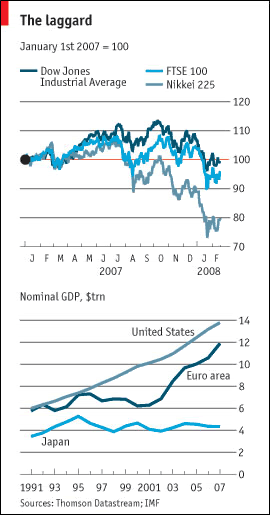
$this->bbcode_second_pass_quote('', 'T')he US could be facing a "lost decade" like that suffered by Japan in the 1990s as the markets fail to respond to interest rate cuts and the US Federal Reserve runs out of options, the head of one of the leading private equity firms said today.



PeakOil is You
US faces lost decade
US faces lost decade
 by wisconsin_cur » Thu 28 Feb 2008, 11:37:22
I think this is what Mr. Bill has been warning us about.
$this->bbcode_second_pass_quote('', 'M')r Collins, whose firm has significant expertise in Japan after leading the buyout and turnaround of Japan Telecom, said he believed a "sharp repricing of assets" was the most likely outcome.
But he said: "My fear is that we will prolong it and suffer a death of a thousand cuts after we have exhausted all the options."
"Even without a recession and with all of the policy tools available we still have hundreds of billions of dollars of losses."
Japan has only recently emerged from a period of zero interest rates.
http://www.thenewfederalistpapers.com
-

wisconsin_cur - Light Sweet Crude

- Posts: 4576
- Joined: Thu 10 May 2007, 03:00:00
- Location: 45 degrees North. 883 feet above sealevel.
Re: US faces lost decade
by Concerned » Thu 28 Feb 2008, 12:55:10
$this->bbcode_second_pass_quote('wisconsin_cur', '[')url=http://www.telegraph.co.uk/money/main.jhtml?xml=/money/2008/02/28/bcnusrates12.xml]Telegraph: US Faces Lost Decade[/url]
$this->bbcode_second_pass_quote('', 'T')he US could be facing a "lost decade" like that suffered by Japan in the 1990s as the markets fail to respond to interest rate cuts and the US Federal Reserve runs out of options, the head of one of the leading private equity firms said today.
$this->bbcode_second_pass_quote('', 'T')he US could be facing a "lost decade" like that suffered by Japan in the 1990s as the markets fail to respond to interest rate cuts and the US Federal Reserve runs out of options, the head of one of the leading private equity firms said today.
I think this is what Mr. Bill has been warning us about.
Decade?
Japan has yet to recover from the credit bubble of 1989 thats getting on to twenty years or 1/5 of a century.
Mises (Austrian economist) said paper money always reverts to it's true value.

Enjoy the unwinding, Im already enjoying all the excuses flying around.
"Once the game is over, the king and the pawn go back in the same box."
-Italian Proverb
-Italian Proverb
-

Concerned - Heavy Crude

- Posts: 1571
- Joined: Thu 23 Sep 2004, 03:00:00