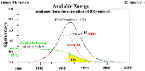
Suicidal already bankrupt governments are now placing huge additional taxes on oil (even in Alberta) plus the "renewables" (including nuclear) craze means the liquid fuels catastrophe is guaranteed by 2019.
Saudi Arabia will blowup which will blowup all of Europe which will...
ALL CITIES ON FIRE BECAUSE THERE IS NO DIESEL/GAS TO MAINTAIN ORDER
The hordes of useless electrical engineers/programmers outnumber fossil related engineers by at least 10000 to 1. 10's of trillions of bad student loans in that group alone. Every one of those fools believes mass electrification can almost entirely replace fossils...they are like the crystalline entity in Star Trek.
Nobody in the oil business will invest with ELECTRIFICATION MORONS INC. in political control determined to flood the world with negatively priced electricity for EV users only (see nissan leaf owners getting free charges already) and sending the bill to FF users. Thats the only way the EV sales can go exponential - FREE JUICE.
Now we know the real reason why Saudi Arabia is going nuts pumping oil.
The 13th Century is at max 4 years away.



PeakOil is You
Oil Industry is Unofficially Dead
Oil Industry is Unofficially Dead
 by StarvingLion » Fri 05 Feb 2016, 01:42:31
Outcast_Searcher is a fraud.
- StarvingLion
- Permanently Banned
- Posts: 2612
- Joined: Sat 03 Aug 2013, 18:59:17
Re: Oil Industry is Unofficially Dead
by onlooker » Fri 05 Feb 2016, 05:27:02
Yes it is fair to say that the more extreme effects of Peak Oil are just around the corner.
"We are mortal beings doomed to die
-

onlooker - Fission

- Posts: 10957
- Joined: Sun 10 Nov 2013, 13:49:04
- Location: NY, USA
Re: Oil Industry is Unofficially Dead
by Tanada » Fri 05 Feb 2016, 10:27:44
$this->bbcode_second_pass_quote('onlooker', 'Y')es it is fair to say that the more extreme effects of Peak Oil are just around the corner.
From time to time I have bought into this statement hook line and sinker, however I have been hearing and often repeating it since 1982. After a while I had to admit to myself in my more honest moments that 'right around the corner' has too many variables for me to actually make a scientific estimate. Since I reached this conclusion around 2010 I treat it as a game, will it be this year? Next year? When will the world actually enter undeniable terminal decline in world oil supply?
The truth is, someday we will be there, perhaps even today. But we won't know in the scientific sense until at least five years post peak, and possibly as much as ten. To confirm we are post peak a couple things have to be proven, A) everyone who can pump is pumping as hard as they can and B) the oil supply is distributed by price of the marginal barrel, IOW everyone pays the same price as that last marginal barrel of oil at some very high price, or C) the world economy is burning every barrel the world can produce at a price just below recession/depression causing levels and there is not enough oil to meet demand.
B) and C) are kind of an either or proposition, either the world economy is going broke because oil costs so much most can not afford it, or the economy stumbles along but even with everyone pumping flat out there is a shortage of supply.
$this->bbcode_second_pass_quote('Alfred Tennyson', 'W')e are not now that strength which in old days
Moved earth and heaven, that which we are, we are;
One equal temper of heroic hearts,
Made weak by time and fate, but strong in will
To strive, to seek, to find, and not to yield.
Moved earth and heaven, that which we are, we are;
One equal temper of heroic hearts,
Made weak by time and fate, but strong in will
To strive, to seek, to find, and not to yield.
- Tanada
- Site Admin

- Posts: 17094
- Joined: Thu 28 Apr 2005, 03:00:00
- Location: South West shore Lake Erie, OH, USA
Re: Oil Industry is Unofficially Dead
by onlooker » Fri 05 Feb 2016, 10:47:56
Very good points T, as Monte and others like to point out Peak will manifest itself in economic troubles. I think this combination of a turn to LTO-Unconventional Oil along with a definite slowdown in demand, I believe signals a step change along the downward slope. Of course other things factor into the health of the economy. One must also acknowledge that all this new debt to prop up Tar and Shale will be an extra drag on the economy going forward. So in my estimation signs exist of peak oil economic perturbations. Right now we seem to be on stuck in a hybrid of your B and C options. The world seems to be flat out pumping trying to lower price to boost demand which seems to have frozen after the shocks of 2008. This condition can be the precursor of a spike in prices as demand picks up while supply lags.
"We are mortal beings doomed to die
-
onlooker - Fission
- Posts: 10957
- Joined: Sun 10 Nov 2013, 13:49:04
- Location: NY, USA
Re: Oil Industry is Unofficially Dead
by Paulo1 » Fri 05 Feb 2016, 10:49:24
Totally agree with Tanada on this. I too am simply waiting to see what unfolds. I believe it will be soon, but do not accept it will be cataclysmic at first. I think there will be some head scratching and attempts to explain it all away for a good while, and that a Greer decline is more likely. Each day that seems relatively normal is a day to make something better for you and your family to rely upon. Plus, despite the economic ups and downs we live in a remarkable time. We should enjoy it while we can, and I don't mean some hedonistic consumption campaign, but just enjoy the relative peace, calm, and plenty.
- Paulo1
- Coal

- Posts: 425
- Joined: Sun 07 Apr 2013, 15:50:35
- Location: East Coast Vancouver Island
Re: Oil Industry is Unofficially Dead
by Tanada » Fri 05 Feb 2016, 11:29:07
$this->bbcode_second_pass_quote('onlooker', 'V')ery good points T, as Monte and others like to point out Peak will manifest itself in economic troubles. I think this combination of a turn to LTO-Unconventional Oil along with a definite slowdown in demand, I believe signals a step change along the downward slope. Of course other things factor into the health of the economy. One must also acknowledge that all this new debt to prop up Tar and Shale will be an extra drag on the economy going forward. So in my estimation signs exist of peak oil economic perturbations. Right now we seem to be on stuck in a hybrid of your B and C options. The world seems to be flat out pumping trying to lower price to boost demand which seems to have frozen after the shocks of 2008. This condition can be the precursor of a spike in prices as demand picks up while supply lags.
People keep repeating this meme that world oil demand is flat as if it were a verified fact. However much people repeat it however will not change the fact that world oil consumption is over 4 MILLION bbl/d higher today than it was in 2008. You can say it is biofuels and other things all you want, but whatever that liquid fuel is the fact is we burn much more of it today than we did when President Obama took office.

$this->bbcode_second_pass_quote('Alfred Tennyson', 'W')e are not now that strength which in old days
Moved earth and heaven, that which we are, we are;
One equal temper of heroic hearts,
Made weak by time and fate, but strong in will
To strive, to seek, to find, and not to yield.
Moved earth and heaven, that which we are, we are;
One equal temper of heroic hearts,
Made weak by time and fate, but strong in will
To strive, to seek, to find, and not to yield.
- Tanada
- Site Admin
- Posts: 17094
- Joined: Thu 28 Apr 2005, 03:00:00
- Location: South West shore Lake Erie, OH, USA