I just had the hope beat out of me.
When I became PO aware and went from being energy ignorant to energy aware, when the illusion of business as usual or "BAU" forever changed, when I realized there was no such thing as perpetual growth, that our monetary system and oil are inextricably linked, I immediately found myself isolated from everyone I knew stranded alone on an island of despair, scared at the prospect of a looming storm.
Like most of you here, once the illusion of a perpetual goldilocks future with retirement is dispelled, when you realize that BAU is not guaranteed, when you realize that everything you are accustomed to depends on how much oil the Arabs can pump out of the ground, and if they get in trouble, you are in trouble, you immediately start grabbing firewood and building a shelter to make yourself and life more resilent to outside forces, but even that cannot save you. This problem is far too big. Native Americans could live off the land, but our society can't. We killed off the millions of buffalo that fed a few hundred thousand natives. We replaced the buffalo with industrialism, So, it doesn't take long to realize that no matter how hard one tries, we are all in this together, for better or worse. The better is over, get ready for the worse.
Occasionally, on the horizon of future events, I would see glimmering lights of hope. Back in 2004, I thought that our government would act. I was optimistic that Rep Bartlett and others would actually get Congress to act on PO. Those days have long passed. Speeches and hearings led to nothing. Instead of doing anything to become energy independent, we just spend more money on wars in the ME. I accept that now, though, bc we can never be independent of oil. Wind and Solar will never replace it. It's taken years for me to realize this is a transportation fuel crisis. Our tractor trailer trucks will never be solar or wind powered. Our ships will never again be wind powered. So, the reality is we fight in the ME because that's all we can do, fight for the little that's left, make sure we get it and not our enemies. Despite what I may want to happen, the reality is that people will fight and kill for limited resources. So, if countries fight for oil, what will individuals do for it as it increasingly becomes more scarce, more valuable. Fight.
I then got caught up in the hype of NG. Former oilman Boone Pickens was leading the charge very strong back in 2008 to use NG to mitigate PO. Even said that exactly, but it never happened. Three years later, we still have 250 million cars on the road and only 114k use NG. All the the NG they pump out of the ground just gets put in storage tanks. We keep adding more to storage, decreasing prices making it less economical to drill, but all this NG doesn't get used for anything, not transportation anyway, which is the PO problem.
Also, according to some confidential emails released from Chesapeak Energy, it turns out that maybe NG isn't as plentiful as we thought, not as economical as we thought, but at any rate, even if it was both plentiful and economical, we aren't using it as a transportation fuel which means its PO hype. PO is a liquid fuels crisis, and until we use it to power trains, planes and automobiles, it does nothing to mitigate PO. As I said earlier, according to wiki, there are 250 million passenger cars in the US and only about 114k use NG. So, no hope there. Worldwide, there are only 12 million NG cars. Big deal.
Then, I asked myself, if US NG is the answer to PO, why are Pickens and the NG industry needing legislation to get it to happen? Why doesn't it happen based on its own economics? True capitalist always argue that government can't create solutions; energy people always say gov't needs to get out of the way and let them do there job, drill baybe drill; so if the capitalists and energy guys are right, why would the NG industry need legislation to make this NG panacea happen? The fact they need government intervention tells me, the layman, that it won't work based on the economics. Call it EROI or whatever you want to call it, if it takes legislation to make it work, its not economical on its own merits. So, that means its not a good mitigator. It just shows how complicated our system is, how entrenched the oil is into our system, how nothing we know of can replace the crude which literally and figuratively greases the skids of everything we know and do, and and how difficult to transition off of it. It means that NG isn't the answer. It is hype.
Last, there is always "demand destruction" which is economic speak for recession or depression to mitigate PO. Well, how is that any consolation for the working stiffs? Its not. Go tell the Arab Spring, OWS, the Greeks, Italians anyone that the answer is more demand destruction and see how well that goes over. They haven't liked it so far.
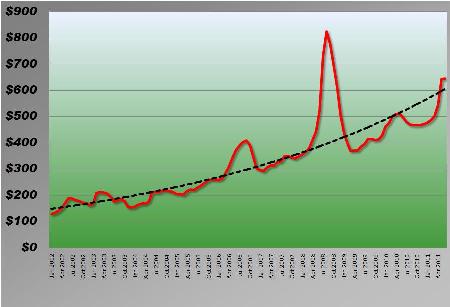
Not only is demand destruction politically unpalatable, it apparently doesn't work to keep the price of oil down. The scary thing is, even in a week economy, the price of oil is rising again. It did crash in 2008 going from $145 down to $30, but its now back up to about $100 again. Ouch. Its going up but the economy isn't growing, and that's not a good sign. That's not demand destruction. Why is that happening? Who knows, but it means the classic view of "demand destruction" doesn't necessarily mean the oil price will go down. But this is no surprise to the PO aware, who believe the price of oil will hold or go up as oil becomes more scarce. How much was oil worth in the fictional movie Mad Max? Maybe that wasn't economic fiction. Another big bout of recession in Europe might crush the price of oil temporarily, but everyone in the oil industry says it takes about $70 a barrel to get the oil out of the ground, so this isn't good.
I don't know what the answer is to BAU for our economy, meaning growth. But it takes oil to get growth bc it takes oil to make stuff and transport it. So, maybe there is oil somewhere in the artic where we aren't drilling yet, but that's years away and billions of dollars to get at it, and I'm not sure the world can handle another six years or so of no growth. The system isn't holding up now.


PeakOil is You
I just had the hope knocked out of me
I just had the hope knocked out of me
 by seahorse3 » Wed 14 Dec 2011, 18:11:55
Last edited by seahorse3 on Wed 14 Dec 2011, 19:26:37, edited 1 time in total.
- seahorse3
- Lignite

- Posts: 375
- Joined: Tue 01 Mar 2011, 16:14:13
Re: I just had the hope knocked out of me
by Shaved Monkey » Wed 14 Dec 2011, 19:26:08
Worse still the world cant handle another 6 years of growth.
It will expose the problem even faster,downturns allow people to adapt.
Use your time wisely.
It will expose the problem even faster,downturns allow people to adapt.
Use your time wisely.
Ready to turn Zombies into WWOOFers
-

Shaved Monkey - Intermediate Crude

- Posts: 2578
- Joined: Wed 30 Mar 2011, 01:43:28
Re: I just had the hope knocked out of me
by Ferretlover » Wed 14 Dec 2011, 19:48:06
I was talking about oil on other planets the other day. Afterwards, I thought about what a pointless discussion it really was. Even if we could find another earth-type planet, by the time anyone got around to develop the processes and equipment necessary to get to that planet, it would be way too late: all the earth's resources would be long gone!
... sigh...
... sigh...
"Open the gates of hell!" ~Morgan Freeman's character in the movie, Olympus Has Fallen.
- Ferretlover
- Elite

- Posts: 5852
- Joined: Wed 13 Jun 2007, 03:00:00
- Location: Hundreds of miles further inland
Re: I just had the hope knocked out of me
by eXpat » Wed 14 Dec 2011, 19:59:37
Nice one seahorse3

"I learned long ago, never to wrestle with a pig. You get dirty, and besides, the pig likes it."
George Bernard Shaw
“You can ignore reality, but you can't ignore the consequences of ignoring reality.” Ayn Rand
George Bernard Shaw
“You can ignore reality, but you can't ignore the consequences of ignoring reality.” Ayn Rand
-

eXpat - Intermediate Crude
- Posts: 3801
- Joined: Thu 08 Jun 2006, 03:00:00
Re: I just had the hope knocked out of me
by scas » Wed 14 Dec 2011, 20:35:31
If peak oil gets you in a glum certainly don't learn about...
Runaway global warming and melting permafrost..i'm always surprised when peak oilers can't see the connection between GW and PO.
Ocean acidification, overfishing, plankton and coral dieback
Freshwater depletion
Soil erosion, deforestation, and phosphate/fertilizer dependence
The ongoing 6th mass extinction
The rising population..
Our future is one of poverty, frugality, and locality. Root crops will be grown in every arable landscape. Occasionally government rations of gruel, synthetic food, and fungal proteins may arrive. People will travel by foot, bicycle, and if they're lucky, train. Perhaps we will have solar and wind power to charge our devices and a central community refrigerator. Overhead a massive military geoengineering project will try to dampen and cool runway global warming. Elsewhere nuclear-geoengineering facilities will attempt to draw CO2 out from the air and desalinate water. Wars will be fought on many fronts.
In the collapsed countries - anywhere that isn't extremely high latitude - famine, disease, and warfare will prevail.
This is the best case scenario I think. A good read is Down To The Wire, Confronting Climate Collapse by David Orr.
Runaway global warming and melting permafrost..i'm always surprised when peak oilers can't see the connection between GW and PO.
Ocean acidification, overfishing, plankton and coral dieback
Freshwater depletion
Soil erosion, deforestation, and phosphate/fertilizer dependence
The ongoing 6th mass extinction
The rising population..
Our future is one of poverty, frugality, and locality. Root crops will be grown in every arable landscape. Occasionally government rations of gruel, synthetic food, and fungal proteins may arrive. People will travel by foot, bicycle, and if they're lucky, train. Perhaps we will have solar and wind power to charge our devices and a central community refrigerator. Overhead a massive military geoengineering project will try to dampen and cool runway global warming. Elsewhere nuclear-geoengineering facilities will attempt to draw CO2 out from the air and desalinate water. Wars will be fought on many fronts.
In the collapsed countries - anywhere that isn't extremely high latitude - famine, disease, and warfare will prevail.
This is the best case scenario I think. A good read is Down To The Wire, Confronting Climate Collapse by David Orr.
- scas
- Coal
- Posts: 487
- Joined: Tue 02 Nov 2010, 06:39:52
Re: I just had the hope knocked out of me
by Beery » Wed 14 Dec 2011, 21:25:16
$this->bbcode_second_pass_quote('scas', 'P')eople will travel by foot, bicycle, and if they're lucky, train...
I hope so. But what I see is a future in which people drive cars until every scrap of fossil fuel is extracted, making the planet literally a toxic wasteland, because we just can't help ourselves. I fear I will never see bicycles as the primary form of personal transport and I fear that my daughter's children will be lucky if they can breathe without a respirator.
By the way, I don't count the bicycle as an inferior mode of transport compared to a train. I'd much rather travel by bike than by train.
- Beery
Re: I just had the hope knocked out of me
by PrestonSturges » Wed 14 Dec 2011, 22:28:50
I'm just going to keep propagating trees and keeping the axe sharp for the day oil hits $200 again. Then we can look at cutting down all the ornamental and shade trees on the street. And if things look dicey, I'll fill a couple barrels with generic 10-10-10.
Our front porch would make a very effective sun room with the addition of some polycarbonate greenhouse panels.
Our front porch would make a very effective sun room with the addition of some polycarbonate greenhouse panels.
Last edited by PrestonSturges on Wed 14 Dec 2011, 22:57:59, edited 1 time in total.
-

PrestonSturges - Light Sweet Crude

- Posts: 6052
- Joined: Wed 15 Oct 2008, 03:00:00
Re: I just had the hope knocked out of me
by Lore » Wed 14 Dec 2011, 22:48:53
$this->bbcode_second_pass_quote('Beery', '')$this->bbcode_second_pass_quote('scas', 'P')eople will travel by foot, bicycle, and if they're lucky, train...
I hope so. But what I see is a future in which people drive cars until every scrap of fossil fuel is extracted, making the planet literally a toxic wasteland, because we just can't help ourselves. I fear I will never see bicycles as the primary form of personal transport and I fear that my daughter's children will be lucky if they can breathe without a respirator.
By the way, I don't count the bicycle as an inferior mode of transport compared to a train. I'd much rather travel by bike than by train.
Bicycles in a post apocalyptic world are highly impractical for any distances. They require flat, smooth and well maintained surfaces on which to operate efficiently. Expect high maintenance in trying to cut paths through ruff terrain.
The things that will destroy America are prosperity-at-any-price, peace-at-any-price, safety-first instead of duty-first, the love of soft living, and the get-rich-quick theory of life.
... Theodore Roosevelt
... Theodore Roosevelt
-

Lore - Fission

- Posts: 9021
- Joined: Fri 26 Aug 2005, 03:00:00
- Location: Fear Of A Blank Planet
Re: I just had the hope knocked out of me
by dorlomin » Thu 15 Dec 2011, 08:36:08
$this->bbcode_second_pass_quote('Lore', '')$this->bbcode_second_pass_quote('Beery', 'B')icycles in a post apocalyptic world are highly impractical for any distances. They require flat, smooth and well maintained surfaces on which to operate efficiently. Expect high maintenance in trying to cut paths through ruff terrain.
19th century cyclists paved the way for modern motorists' roads
$this->bbcode_second_pass_quote('', 'M')any motorists also assume that roads were built for them. In fact, cars are the johnny-come-latelies of highways.
The hard, flat road surfaces we take for granted are relatively new. Asphalt surfaces weren't widespread until the 1930s. So, are motorists to thank for this smoothness?
No. The improvement of roads was first lobbied for – and paid for – by cycling organisations.
In the UK and the US, cyclists lobbied for better road surfaces for a full 30 years before motoring organisations did the same. Cyclists were ahead of their time.
$this->bbcode_second_pass_quote('', 'C')yclists' organisations, such as Cyclists' Touring Club in the UK and League of American Wheelmen (LAW) in the US, lobbied county surveyors and politicians to build better roads. The US Good Roads movement, set up by LAW, was highly influential. LAW once had the then US president turn up at its annual general meeting.
The CTC individual in charge of the UK version of the Good Roads movement, William Rees Jeffreys, organised asphalt trials before cars became common. He took the reins of the Roads Improvement Association (RIA) in 1890, while working for the CTC.
Smooth roads are easy to maintain when there is little heavy goods traffic. Tar is cheap.

 "Tar" v