Donate Bitcoin

Donate Paypal


PeakOil is You

PeakOil is You

Are you a Communitarian?

What's on your mind?
General interest discussions, not necessarily related to depletion.

Are you a Communitarian?

Unread postby pablonite » Tue 23 Mar 2010, 23:44:11

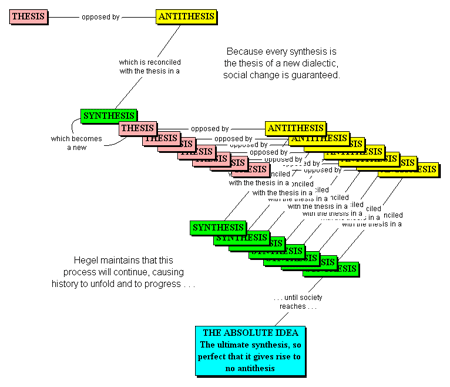
I have been reading up on the Hegelian dialectic.

Here is an excellent 2 part description or at least one interpretation of what it is with an interesting view on some American history in part 2...

Image

Part 1 with a link to part 2 at the end. The title of the post will make more sense after reading...good luck!

http://nord.twu.net/acl/dialectic.html
User avatar
pablonite
Tar Sands
Tar Sands
 
Posts: 723
Joined: Sun 28 Sep 2008, 03:00:00

Re: Are you a Communitarian?

Unread postby mos6507 » Wed 24 Mar 2010, 00:49:59

$this->bbcode_second_pass_quote('', '
')The Hegelian dialectic cannot be a conspiracy theory, because it is well-documented, and the concept of Conspiracy Theories is a cruel joke. We've all been duped by global elitists who plan to exercise complete totalitarian control over the people and property of every nation.


OK. If CT's are such a cruel joke, why is this whole essay one big conspiracy theory? What a waste of time.
mos6507
 

Re: Are you a Communitarian?

Unread postby Jotapay » Wed 24 Mar 2010, 02:29:28

Thanks Mos, for showing up and showing what an butt horn (a la Gary Busey) and one trick pony one can be. Your contributions are worth less than zero. Are you being paid to post your uninformed drivel by someone?

The Hegelian Dialectic is just as valid and real of a tactic as compound interest or the bait and switch. Denying that it exists is like saying the sky isn't blue.

Mos, so you don't sound like such a bleeding fool in the future, here is some study material for you to read up on. The Hegelian Dialectic, in all its glory.

For those who want to know what this is all about and not be distracted by Mos's BS:

http://en.wikipedia.org/wiki/Hegelian_d ... _dialectic

$this->bbcode_second_pass_quote('', '[')b]Hegelian dialectic
Georg Wilhelm Friedrich Hegel00.jpg
Part of a series on
G. W. F. Hegel
Hegelianism
Absolute idealism
British & German idealism
Dialectic
Master-slave dialectic
Works
Phenomenology of Spirit
Science of Logic
Philosophy of Right
Philosophy of History
Notable People
Immanuel Kant
Johann Wolfgang von Goethe
Johann Gottlieb Fichte
Friedrich Hölderlin
Friedrich Schelling
Arthur Schopenhauer
Søren Kierkegaard
Karl Marx
Related
Right Hegelians
Young Hegelians
Marx's theory of alienation
The Secret of Hegel
This box: view • talk • edit

Hegelian dialectic, usually presented in a three-fold manner, was stated by Heinrich Moritz Chalybäus as comprising three dialectical stages of development: a thesis, giving rise to its reaction, an antithesis, which contradicts or negates the thesis, and the tension between the two being resolved by means of a synthesis.

Although this model is often named after Hegel, he himself never used that specific formulation. Hegel ascribed that terminology to Kant.[18] Carrying on Kant's work, Fichte greatly elaborated on the synthesis model, and popularized it.

On the other hand, Hegel did use a three-valued logical model that is very similar to the antithesis model, but Hegel's most usual terms were: Abstract-Negative-Concrete. Sometimes Hegel would use the terms, Immediate-Mediated-Concrete. Hegel used these terms hundreds of times throughout his works.[19]

The formula, Thesis-Antithesis-Synthesis, does not explain why the Thesis requires an Antithesis. However, the formula, Abstract-Negative-Concrete, suggests a flaw in any initial thesis—it is too abstract and lacks the negative of trial, error and experience. The same applies to the formula, Immediate-Mediated-Concrete. For Hegel, the Concrete, the Synthesis, the Absolute, must always pass through the phase of the Negative, that is, Mediation. This is the actual essence of what is popularly called Hegelian Dialectics.

To describe the activity of overcoming the negative, Hegel also often used the term Aufhebung, variously translated into English as "sublation" or "overcoming," to conceive of the working of the dialectic. Roughly, the term indicates preserving the useful portion of an idea, thing, society, etc., while moving beyond its limitations. (Jacques Derrida's preferred French translation of the term was relever).[20]

In the Logic, for instance, Hegel describes a dialectic of existence: first, existence must be posited as pure Being (Sein); but pure Being, upon examination, is found to be indistinguishable from Nothing (Nichts). When it is realized that what is coming into being is, at the same time, also returning to nothing (in life, for example, one's living is also a dying), both Being and Nothing are united as Becoming.[21]

As in the Socratic dialectic, Hegel claimed to proceed by making implicit contradictions explicit: each stage of the process is the product of contradictions inherent or implicit in the preceding stage. For Hegel, the whole of history is one tremendous dialectic, major stages of which chart a progression from self-alienation as slavery to self-unification and realization as the rational, constitutional state of free and equal citizens. The Hegelian dialectic cannot be mechanically applied for any chosen thesis. Critics argue that the selection of any antithesis, other than the logical negation of the thesis, is subjective. Then, if the logical negation is used as the antithesis, there is no rigorous way to derive a synthesis. In practice, when an antithesis is selected to suit the user's subjective purpose, the resulting "contradictions" are rhetorical, not logical, and the resulting synthesis is not rigorously defensible against a multitude of other possible syntheses. The problem with the Fichtean "Thesis-Antithesis-Synthesis" model is that it implies that contradictions or negations come from outside of things. Hegel's point is that they are inherent in and internal to things. This conception of dialectics derives ultimately from Heraclitus.

Hegel has outlined that the purpose of dialectics is "to study things in their own being and movement and thus to demonstrate the finitude of the partial categories of understanding"[22]

One important dialectical principle for Hegel is the transition from quantity to quality, which he terms the Measure. The measure is the qualitative quantum, the quantum is the existence of quantity.[23]

"The identity between quantity and quality, which is found in Measure, is at first only implicit, and not yet explicitly realised. In other words, these two categories, which unite in Measure, each claim an independent authority. On the one hand, the quantitative features of existence may be altered, without affecting its quality. On the other hand, this increase and diminution, immaterial though it be, has its limit, by exceeding which the quality suffers change. [...] But if the quantity present in measure exceeds a certain limit, the quality corresponding to it is also put in abeyance. This however is not a negation of quality altogether, but only of this definite quality, the place of which is at once occupied by another. This process of measure, which appears alternately as a mere change in quantity, and then as a sudden revulsion of quantity into quality, may be envisaged under the figure of a nodal (knotted) line".[24]

As an example, Hegel mentions the states of aggregation of water: "Thus the temperature of water is, in the first place, a point of no consequence in respect of its liquidity: still with the increase or diminution of the temperature of the liquid water, there comes a point where this state of cohesion suffers a qualitative change, and the water is converted into steam or ice".[25] As other examples Hegel mentions the reaching of a point where a single additional grain makes a heap of wheat; or where the bald-tail is produced, if we continue plucking out single hairs.

Another important principle for Hegel is the negation of the negation, which he also terms Aufhebung (sublation): Something is only what it is in its relation to another, but by the negation of the negation this something incorporates the other into itself. The dialectical movement involves two moments that negate each other, a somewhat and an another. As a result of the negation of the negation, "something becomes an other; this other is itself somewhat; therefore it likewise becomes an other, and so on ad infinitum".[26] Something in its passage into other only joins with itself, it is self-related.[27] In becoming there are two moments:[28] coming-to-be and ceasing-to-be: by sublation, i.e. negation of the negation, being passes over into nothing, it ceases to be, but something new shows up, is coming to be. What is sublated (aufgehoben) on the one hand ceases to be and is put to an end, but on the other hand it is preserved and maintained.[29] In dialectics, a totality transform itself, it is self-related.
All my posts should be rendered to shite as this place has been overrun with enviro-noobs and Gaia-philes who know nothing about how to build a widget and sell it it to people like you and me, even though they need x-amount of widgets to live.
Jotapay
Intermediate Crude
Intermediate Crude
 
Posts: 3394
Joined: Sat 21 Jun 2008, 03:00:00

Re: Are you a Communitarian?

Unread postby pablonite » Wed 24 Mar 2010, 10:25:21

$this->bbcode_second_pass_quote('mos6507', '')$this->bbcode_second_pass_quote('', '
')The Hegelian dialectic cannot be a conspiracy theory, because it is well-documented, and the concept of Conspiracy Theories is a cruel joke. We've all been duped by global elitists who plan to exercise complete totalitarian control over the people and property of every nation.


OK. If CT's are such a cruel joke, why is this whole essay one big conspiracy theory? What a waste of time.

:lol:
Take from it what you want, but it is real and it does exist.
$this->bbcode_second_pass_quote('', '4'). Why it is almost impossible for a layman to understand the Hegelian dialectic

Hegel's theory that philosophy is the ultimate achievement of the human spirit is extremely difficult reading for a well-educated person. It's almost like reading a foreign language to the average student, and it rings false to the "healthy instincts of the plain man."

Detective Phillip Worts' 2001 article Communist Oriented Policing is a nice explanation of the influence Dialectical Materialism has had on America...


http://www.newswithviews.com/community_ ... licing.htm
$this->bbcode_second_pass_quote('', 'T')he consensus (dialectic) process

There is a myth that communism is dead and that the cold war is over. Nothing could be further from the truth.

We have all probably heard of "community policing" by now, in fact I've seen the new police cruisers in most towns I travel through with the newer acronyms indicating a "community patrol" or some such thing slapped on the side. Good read...
User avatar
pablonite
Tar Sands
Tar Sands
 
Posts: 723
Joined: Sun 28 Sep 2008, 03:00:00
Top

Re: Are you a Communitarian?

Unread postby pablonite » Wed 24 Mar 2010, 10:47:40

OK, so some people might not be interested in the abstract psychological themes constantly running through our society but it might help to first understand what the "final solution" is, or the final synthesis - and work backwards. Everything these organizations (and many many more) do regardless of the people working in them is helping to construct the final solution of world government...most are full of useful idiots.
$this->bbcode_second_pass_quote('', '.')..Political communitarianism includes market communist/socialist economic programmes, free trade, appointed citizen councils, exportable freedom programmes, faith-based funding, intervention programmes, mental health testing, emergency preparedness training, FEMA, The Vatican, The Talmud, The Earth Charter, The Universal Declaration of Human Rights, Earth Summits, sustainable development, European royals, British royals, Communist Party leaders, elected Socialists, friendly dictators, sociologists, fascists, mobsters, Fabians, international liberals, G-8, Bank of England, The City of London, billionaires, Bilderbergs, secret societies, think tanks, private foundations, philanthropists, alchemists, theosophist organizations (like 1000 Points of Light), environmental law firms (like 1000 Friends of Washington/Oregon etc.), UN, LA-21, EU, WB, ICC, NATO, WTO, GATT, NAFTA, NSC, OAS, AID, IMF, FED, IRS, SSI, UI, NEA, CFR, TR, AIPAC, NOW, ACLU, NLG, FBI, CIA, KGB, Mossad, M-15, M-16, NSA, WH, DOD, DOJ, HS, War on Terror, PNAC, War on Crime, War on Poverty, War on Drugs, War on Obesity, Neighborhood Watch, Volunteer America, ABCD, NGOs, churches, WCC, NATS, DON, SPO, COPS, IACP, USDOE, USDOA, USNF, USNP, HUD, Weed&Seed, Citizen Corps, CAOs, EPA, Crime Acts, DV Acts, DUI laws, COMPASS and much, ...


Looking around the world today I find it hard to refute the constant reinforcement and building of a world government in my lifetime. This is a valid conspiracy theory IMO and the little people really have no chance because they fail to understand it.

http://nord.twu.net/acl/evolution.html
$this->bbcode_second_pass_quote('', 'E')x-President Clinton and George Bush Jr. both define their policy objectives as communitarian (Galston 1991; D'Antonio 1994; Milbank 2001; Allen 2002), yet only recently have Americans begun to study the communitarian platform as the predetermined synthesis to the Marxist's left-versus-right conflict of ideals (American Patriots 2001; Ball 2000; Iserbyt 2001; Worts 1999; Austin-Fitts 2001).

What is communitarianism?

The obscure term communitarian was introduced into the "upper reaches of Anglo-American academia" in the 1970s (Bell 2001), but it is our "thesis" that communitarianism was actually created at the same time Marx and Engels drafted their anti-thesis to capitalism. We are convinced that philosophical communitarianism is the synthesis in the capitalism-versus-communism dialectical conflict. We are even more convinced that constant, ongoing political conflicts are not at all "natural," and that the communitarian solution is based entirely in a false ideology perpetrated by globalists with less than noble objectives.


Here in another awakening to the dialectic process. 600 wars and it has not won but it has!!!
http://www.womensgroup.org/998NEWLT.html
$this->bbcode_second_pass_quote('', 'I')n the last four years while covering the United Nations, I have come face to face, on a regular basis with communism, fascism, and socialism. I found, as a result of my own ignorance, that I could not identify them and therefore not identify the true meaning of what was being put forth in all of the documents I was reading. While I understood the goal of world government to be behind everything the United Nations was doing, I did not know how -- what modus operandi...

...The dialectic process destroys all sovereignty. The UN has worked very hard to go into all the nations of the world, coming to help them with their food needs, the children, the medical, that has simply been a front, a tool that they could use to go in and restructure, destroy the patriarchal home structure to move it to a matriarch structural relationship based structure. The UN has had 600 wars. They have not won one. And yet they have. Every nation that has been under the UN influence in war situation, when the UN eventually pulls back, their matriarch in structure, that patriarchal structure has been destroyed.
User avatar
pablonite
Tar Sands
Tar Sands
 
Posts: 723
Joined: Sun 28 Sep 2008, 03:00:00
Top


Return to Open Topic Discussion

Who is online

Users browsing this forum: No registered users and 1 guest

cron