


PeakOil is You
Book: "Ishmael" by Daniel Quinn
Book: "Ishmael" by Daniel Quinn
 by anador » Sat 21 Mar 2009, 19:13:55
This book has probably already been discussed here at length, but I have just finished it and found the deconstruction of human supremacy absolutely fascinating. The attitude it presents I find extremely refreshing and just nice to mull on.
@#$% highways
-

anador - Coal

- Posts: 455
- Joined: Thu 26 Feb 2009, 17:31:18
Re: Ishmael
by coyote » Sat 21 Mar 2009, 20:52:11
I enjoyed all three of the trilogy - Ishmael, The Story of B, and My Ishmael - for different reasons. In all three, I was attracted to what seemed to be a different and fundamentally optimistic way of looking at the issues that concern me. I particularly like Quinn's discussion of "finding the third handle" - that is, if Mother Culture offers you an either-or decision, look for the unoffered and unconsidered third choice, rather than unconsciously accepting her premises and restricting your search for solutions. Of course, when I tried to apply that to our current economic paradigm, I received a sound thrashing from MrBill...! 
For those who haven't read classical literature, the first book may seem a strange format, with the gorilla providing most of the thought - and the supposed main character acting only a sounding board, and being led by the nose through strange territory and supplying not much more than the occasional uttered agreement. Some, however, will immediately recognize the classic dialectic format for presenting new and unfamiliar ideas, used by Plato in works like Phaedo and Republic.
That the supplier of the ideas is non-human is a literary tool for providing the truly fresh eyes needed to analyze our culture in a different way. In this way, the book always reminded me of Stranger in a Strange Land, by R. A. Heinlein. In that book, the unfamiliar ideas came from someone who had been raised by a different species on another planet, to be brought back to Earth as an adult with the same fresh eyes. In Ishmael, it's a gorilla. Plato's cave, in both cases.
You can find some of Quinn's lectures, a discussion of the third handle and so on, here: ishmael.org
For those who haven't read classical literature, the first book may seem a strange format, with the gorilla providing most of the thought - and the supposed main character acting only a sounding board, and being led by the nose through strange territory and supplying not much more than the occasional uttered agreement. Some, however, will immediately recognize the classic dialectic format for presenting new and unfamiliar ideas, used by Plato in works like Phaedo and Republic.
That the supplier of the ideas is non-human is a literary tool for providing the truly fresh eyes needed to analyze our culture in a different way. In this way, the book always reminded me of Stranger in a Strange Land, by R. A. Heinlein. In that book, the unfamiliar ideas came from someone who had been raised by a different species on another planet, to be brought back to Earth as an adult with the same fresh eyes. In Ishmael, it's a gorilla. Plato's cave, in both cases.
You can find some of Quinn's lectures, a discussion of the third handle and so on, here: ishmael.org
Lord, here comes the flood
We'll say goodbye to flesh and blood
If again the seas are silent in any still alive
It'll be those who gave their island to survive...
We'll say goodbye to flesh and blood
If again the seas are silent in any still alive
It'll be those who gave their island to survive...
-

coyote - News Editor

- Posts: 1979
- Joined: Sun 23 Oct 2005, 03:00:00
- Location: East of Eden
Re: Ishmael
by mos6507 » Sat 21 Mar 2009, 22:15:30
I'm finally forcing myself to read through this like having to bite into a really bitter chewable vitamin. I know it's for my own good but it goes down really hard. I mean, this isn't a novel in a traditional sense and so it's not something you read for the character development or anything. It's total My Dinner with Andre or Waking Life. When the main character or the gorilla speaks you can hardly tell who it is because the vocabulary is identical on both ends. It's more like Quinn having a dialogue with himself. So it's really more of a creatively delivered essay than a novel. That's fine for what it is. I'm about 1/4 of the way through it. So far I've found a couple paragraphs that are very quotable for the doomer. I'm going to have to make ample use of the highlighter so I can go back to them. I have been chomping at the bit to debate anarcho-primitivism since the last flamewar and will give my (more well-read) 2c after I complete this book. It seems to illicit some of the most heated responses from peakers. Knowing what the message is and deciding for yourself where on the barometer you are is important.
One anecdote, though. An old coworker of mine that I IM back and forth every now and then, when I told him about peak oil, suggested I read this book. That was the first time I heard about it. But I never would have guessed he'd be into such concepts. He's another web developer--married with two kids in Colorado, very driven and career-oriented despite being a telecommuter.
One anecdote, though. An old coworker of mine that I IM back and forth every now and then, when I told him about peak oil, suggested I read this book. That was the first time I heard about it. But I never would have guessed he'd be into such concepts. He's another web developer--married with two kids in Colorado, very driven and career-oriented despite being a telecommuter.
- mos6507
Re: Ishmael
by Homesteader » Sat 04 Apr 2009, 03:50:02
The Story of B is required reading, IMHO.
"The era of procrastination, of half-measures, of soothing and baffling expedients, of delays, is coming to a close. In its place we are entering a period of consequences…"
Sir Winston Churchill
Beliefs are what people fall back on when the facts make them uncomfortable.
Sir Winston Churchill
Beliefs are what people fall back on when the facts make them uncomfortable.
-

Homesteader - Heavy Crude

- Posts: 1856
- Joined: Thu 12 Apr 2007, 03:00:00
- Location: Economic Nomad
Re: Ishmael
by Ludi » Sat 04 Apr 2009, 09:40:41
Q& A about Daniel Quinn's books: http://www.ishmael.org/Interaction/QandA/qanda.cfm
BTW, DQ is not a "primitivist"
BTW, DQ is not a "primitivist"
- Ludi
Re: Ishmael
by Ludi » Sat 04 Apr 2009, 13:04:01
The Question (ID Number 702)...
I recently read about Peak Oil. The theory states that we will soon (within ten years) run out of cheap oil, which is the basic resource for everything in our modern society and most importantly, our modern agriculture. The result of the oil-induced collapse will be (literally) billions of deaths. What is your opinion on this? Is it too late to save the world now?
...and the response:
As I understand the term, saving the world means preserving it as a viable home to life, including human life. At the moment, the greatest threat to this goal is the continued uncontrolled growth of the human population. I personally doubt that even our present population is sustainable, since it is by now well known that, because of our impact on the earth, we are in a period of mass extinctions. To sustain our six billion, so much biomass is being taken from the species around us that we are seriously attacking the diversity of the living community that makes the earth a viable home to life, including our own. Thus you have to see that maintaining and increasing our population of six billion is not at all equivalent to "saving the world." If the coming oil crisis results in a global famine and the death of billions (which is not unthinkable, though I personally am reluctant to make predictions about the future), then this would not work AGAINST saving the world, it would work FOR it. The period of mass extinctions would come to an immediate end. Civilization would be devastated, of course, but human life would not disappear. The alternative of continued human growth to an anticipated twelve billion would, I feel sure, produce a much more dire future and a general and irreversible ecological collapse that would doom all or most large terrestrial organisms like mammals, including humans.
http://www.ishmael.org/Interaction/Qand ... Record=702
I recently read about Peak Oil. The theory states that we will soon (within ten years) run out of cheap oil, which is the basic resource for everything in our modern society and most importantly, our modern agriculture. The result of the oil-induced collapse will be (literally) billions of deaths. What is your opinion on this? Is it too late to save the world now?
...and the response:
As I understand the term, saving the world means preserving it as a viable home to life, including human life. At the moment, the greatest threat to this goal is the continued uncontrolled growth of the human population. I personally doubt that even our present population is sustainable, since it is by now well known that, because of our impact on the earth, we are in a period of mass extinctions. To sustain our six billion, so much biomass is being taken from the species around us that we are seriously attacking the diversity of the living community that makes the earth a viable home to life, including our own. Thus you have to see that maintaining and increasing our population of six billion is not at all equivalent to "saving the world." If the coming oil crisis results in a global famine and the death of billions (which is not unthinkable, though I personally am reluctant to make predictions about the future), then this would not work AGAINST saving the world, it would work FOR it. The period of mass extinctions would come to an immediate end. Civilization would be devastated, of course, but human life would not disappear. The alternative of continued human growth to an anticipated twelve billion would, I feel sure, produce a much more dire future and a general and irreversible ecological collapse that would doom all or most large terrestrial organisms like mammals, including humans.
http://www.ishmael.org/Interaction/Qand ... Record=702
- Ludi
Re: Ishmael
by mos6507 » Sun 05 Apr 2009, 15:33:12
I have to say that I enjoyed reading Ishmael more than I thought I would--as an essay, not as a novel. I'd say I'd agree with the majority of what Quinn has to say at a core level and will continue reading his stuff in order to get a more complete picture of it. I don't really share his rejectionist view of the educational system, though.
- mos6507
Re: Ishmael
by Ludi » Sun 05 Apr 2009, 17:46:20
Quinn is not a good writer of novels - but that's pretty much the only way he has been able to get his ideas out to a mass audience.
I personally prefer "The Story of B" to "Ishmael."
I personally prefer "The Story of B" to "Ishmael."
- Ludi
Re: Ishmael
by anador » Tue 07 Apr 2009, 00:35:44
I mean, the point is also that he's not making a grand anarcho-primitivist statement trying to posture as a revolutionary. Its merely a dialogue hat allows you, the reader, and in this case the nameless man, to benfit from the external perspective provided by the gorilla.
Its less about what to do, and more about stepping back and learning not to take certain attitudes given by mother culture so seriously.
It does talk about civilization as a metaphor to flying machines and many times has stated that agriculture ad civilization CAN work, we just have to be open to experimentation and change in our lives.
That's the refreshing part, no rhetoric,no posturing, simply an 800 pound gorilla in the room getting you to admit that life is what it is.
Its less about what to do, and more about stepping back and learning not to take certain attitudes given by mother culture so seriously.
It does talk about civilization as a metaphor to flying machines and many times has stated that agriculture ad civilization CAN work, we just have to be open to experimentation and change in our lives.
That's the refreshing part, no rhetoric,no posturing, simply an 800 pound gorilla in the room getting you to admit that life is what it is.
@#$% highways
-
anador - Coal
- Posts: 455
- Joined: Thu 26 Feb 2009, 17:31:18
Re: Ishmael
by Ludi » Tue 07 Apr 2009, 18:47:24
Some people are extremely offended by what Quinn writes, they feel he is lecturing them (in the guise of Ishmael) and telling them they are wrong and bad. They get defensive and simply refuse to contemplate the ideas. People often get confused and think DQ is saying everyone has to go "live like cavemen" (hunter-gatherers) when of course he says no such thing. In fact, as I recall, he says it 's a ridiculous idea.
- Ludi
Re: Ishmael
by biofuel13 » Tue 07 Apr 2009, 22:36:19
Ludi Wrote:
"Some people are extremely offended by what Quinn writes, they feel he is lecturing them (in the guise of Ishmael) and telling them they are wrong and bad. They get defensive and simply refuse to contemplate the ideas. People often get confused and think DQ is saying everyone has to go "live like cavemen" (hunter-gatherers) when of course he says no such thing. In fact, as I recall, he says it 's a ridiculous idea."
(Where did the "Quote" button go?)
Indeed Quinn does refute the "live like cavemen" perception of his writings. For an expanded take on what his real ideas are as far as ways to move away from our current "one right way" of living I suggest reading "Beyond Civilization". I believe he wrote it as a response to peoples complaints that he doesn't point us in a new direction in Ishmael.
Edit: Ahhhh....I guess you have to log in first in order to see the "Quote" button now....ooppss.
"Some people are extremely offended by what Quinn writes, they feel he is lecturing them (in the guise of Ishmael) and telling them they are wrong and bad. They get defensive and simply refuse to contemplate the ideas. People often get confused and think DQ is saying everyone has to go "live like cavemen" (hunter-gatherers) when of course he says no such thing. In fact, as I recall, he says it 's a ridiculous idea."
(Where did the "Quote" button go?)
Indeed Quinn does refute the "live like cavemen" perception of his writings. For an expanded take on what his real ideas are as far as ways to move away from our current "one right way" of living I suggest reading "Beyond Civilization". I believe he wrote it as a response to peoples complaints that he doesn't point us in a new direction in Ishmael.
Edit: Ahhhh....I guess you have to log in first in order to see the "Quote" button now....ooppss.
"With man gone will there be hope for gorilla? With gorilla gone will there be hope for man?" --Ishmael by D. Quinn
-
biofuel13 - Tar Sands

- Posts: 606
- Joined: Wed 07 May 2008, 03:00:00
- Location: Chaska, MN
Re: Ishmael
by paimei01 » Mon 11 May 2009, 06:14:07
$this->bbcode_second_pass_quote('coyote', 'I') enjoyed all three of the trilogy - Ishmael, The Story of B, and My Ishmael - for different reasons. In all three, I was attracted to what seemed to be a different and fundamentally optimistic way of looking at the issues that concern me. I particularly like Quinn's discussion of "finding the third handle" - that is, if Mother Culture offers you an either-or decision, look for the unoffered and unconsidered third choice, rather than unconsciously accepting her premises and restricting your search for solutions. Of course, when I tried to apply that to our current economic paradigm, I received a sound thrashing from MrBill...!
Mother Culture : God has worked for 6 days creating the world, then he declared the 7th day a "rest day". So you can see from the beginning there is not even the question of "why work ?" We are taught that work is a given fact of life, like air and water. Hunter gatherers never worked. They just lived.
Not even God worked. When you do what you like, and there is nobody commanding you, that is not work

A wrong view of our civilziation :
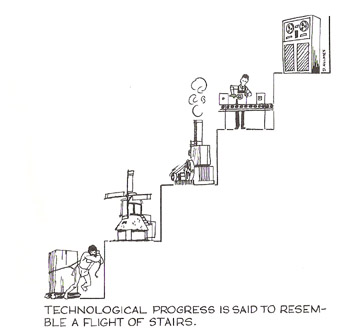
http://www.vhemt.org/scififantasy.htm
The above image is wrong because the first people were smarter than that. They did not pull rocks around they had better things to do. The man pulling the rock in this image is the first slave. And there was no though of "building civilization" in his head. Just surviving and doing what the slave master ordered.
Why are we still required to be at work 8 hours a day with all our technology ?
This is why :
http://www.orionmagazine.org/index.php/ ... ticle/2962 - The Gospel of Consumtion
http://www.storyofstuff.com/ - The Story of Stuff
http://paimei01.blogspot.com/
One day there will be so many houses, that people will be bored and will go live in tents. "Why are you living in tents ? Are there not enough homes ?" "Yes there are, but we play this Economy game". Now it's "Crisis" time !Too many houses! Yes, we are insane!
One day there will be so many houses, that people will be bored and will go live in tents. "Why are you living in tents ? Are there not enough homes ?" "Yes there are, but we play this Economy game". Now it's "Crisis" time !Too many houses! Yes, we are insane!
- paimei01
- Tar Sands
- Posts: 539
- Joined: Tue 27 Feb 2007, 04:00:00
- Location: Romania
Re: Ishmael
by mos6507 » Mon 11 May 2009, 09:31:59
I think the whole anti-work thing goes a little too far. Ask someone with a doomstead, even a permaculture ideal one who has unplugged from civilization as much as legally possible, if they work. In my definition, any time you perform a necessarily daily action to enable you to survive, whether you're getting paid a salary or not, whether you enjoy it or not, it's still work. The chipmunk outside my window works even if it's nothing but picking up the food I'm leaving him and putting it in his caches. Work is not the great injustice people make it out to be.
- mos6507
Re: Ishmael
by Ludi » Mon 11 May 2009, 09:39:42
$this->bbcode_second_pass_quote('mos6507', 'I') think the whole anti-work thing goes a little too far. Ask someone with a doomstead, even a permaculture ideal one who has unplugged from civilization as much as legally possible, if they work.
I rarely "work" in my own opinion. Someone observing me might think I'm "working" but I generally consider it living, even playing.
I don't know if I count as "someone with a doomstead" though.
- Ludi
Re: Ishmael
by paimei01 » Mon 11 May 2009, 09:54:45
If I "work" for myself with nobody telling me at what time to wake up, and I do not depend on nobody to buy my "work" else I am useless - that is not what I call "work". And with the option of stopping whenever I decide. Search for "The story of the mexican fisherman".
Not : work work work then : "sorry slave, the other slaves seem to have stopped buying, I have to fire you".
And there is no need for all this, see the 2 links from above.
$this->bbcode_second_pass_quote('', '[')b]Fredy Perlman: Against His-story, Against Leviathan! (1983)
The managers of Gulag’s islands tell us that the swimmers, crawlers, walkers and fliers spent
their lives working in order to eat.
These managers are broadcasting their news too soon. The varied beings haven’t all been
exterminated yet. You, reader, have only to mingle with them, or just watch them from a
distance, to see that their waking lives are filled with dances, games and feasts. Even the
hunt, the stalking and feigning and leaping, is not what we call Work, but what we call Fun.
The only beings who work are the inmates of Gulag’s islands, the zeks.
The zeks’ ancestors did less work than a corporation owner. They didn’t know what work was.
They lived in a condition J.J. Rousseau called “the state of nature.” Rousseau’s term should
be brought back into common use. It grates on the nerves of those who, in R. Vaneigem’s
words, carry cadavers in their mouths. It makes the armor visible. Say “the state of nature”
and you’ll see the cadavers peer out.
Insist that “freedom” and “the state of nature” are synonyms, and the cadavers will try to bite
you. The tame, the domesticated, try to monopolize the word freedom; they’d like to apply it to
their own condition. They apply the word “wild” to the free. But it is another public secret that
the tame, the domesticated, occasionally become wild but are never free so long as they
remain in their pens.
Even the common dictionary keeps this secret only half hidden. It begins by saying that free
means citizen! But then it says, “Free: a) not determined by anything beyond its own nature or
being; b) determined by the choice of the actor or by his wishes.”
Modern anthropologists who carry Gulag in their brains reduce such human communities to
the motions that look most like work, and give the name Gatherers to people who pick and
sometimes store their favorite foods. A bank clerk would call such communities Savings Banks!
The zeks on a coffee plantation in Guatemala are Gatherers, and the anthropologist is a
Savings Bank. Their free ancestors had more important things to do.
The !Kung people miraculously survived as a community of free human beings into our own
exterminating age. R.E. Leakey observed them in their lush African forest homeland. They
cultivated nothing except themselves. They made themselves what they wished to be. They
were not determined by anything beyond their own being - not by alarm clocks, not by debts,
not by orders from superiors. They feasted and celebrated and played, full-time, except when
they slept. They shared everything with their communities: food, experiences, visions, songs.
Great personal satisfaction, deep inner joy, came from the sharing.
(In today’s world, wolves still experience the joys that come from sharing. Maybe that’s why
governments pay bounties to the killers of wolves.)
S. Diamond observed other free human beings who survived into our age, also in Africa. He
could see that they did no work, but he couldn’t quite bring himself to say it in English. Instead,
he said they made no distinction between work and play. Does Diamond mean that the
activity of the free people can be seen as work one moment, as play another, depending on
how the anthropologist feels? Does he mean they didn’t know if their activity was work or play?
Does he mean we, you and I, Diamond’s armored contemporaries, cannot distinguish their
work from their play?
If the !Kung visited our offices and factories, they might think we’re playing. Why else would
we be there?
I think Diamond meant to say something more profound. A time-and-motion engineer
watching a bear near a berry patch would not know when to punch his clock. Does the bear
start working when he walks to the berry patch, when he picks the berry, when he opens his
jaws? If the engineer has half a brain he might say the bear makes no distinction between
work and play. If the engineer has an imagination he might say that the bear experiences joy
from the moment the berries turn deep red, and that none of the bear’s motions are work.
But none of them ever worked. And everyone knows it. The armored Christians who later
“discovered” these communities knew that these people did no work, and this knowledge
grated on Christian nerves, it rankled, it caused cadavers to peep out. The Christians spoke of
women who did “lurid dances” in their fields instead of confining themselves to chores; they
said hun-ters did a lot of devilish “hocus pocus” before actually drawing the bowstring.
These Christians, early time-and-motion engineers, couldn’t tell when play ended and work
began. Long familiar with the chores of zeks, the Christians were repelled by the lurid and
devilish heathen who pretended that the Curse of Labor had not fallen on them. The
Christians put a quick end to the “hocus pocus” and the dances, and saw to it that none could
fail to distinguish work from play.
Our ancestors I’ll borrow Turner’s term and call them the Possessed had more important
things to do than to struggle to survive. They loved nature and nature reciprocated their love.
Wherever they were they found affluence, as Marshall Sahlins shows in his Stone Age
Economics. Pierre Clastres’ La société contre l’état insists that the struggle for subsistence is
not verifiable among any of the Possessed; it is verifiable among the Dispossessed in the pits
and on the margins of progressive industrialization. Leslie White, after a sweeping review of
reports from distant places and ages, a view of “Primitive culture as a whole,” concludes that
“there’s enough to eat for a richness of life rare among the ‘civilized.’” I wouldn’t use the word
Primitive to refer to people with a richness of life. I would use the word Primitive to refer to
myself and my contemporaries, with our progressive poverty of life.
Not : work work work then : "sorry slave, the other slaves seem to have stopped buying, I have to fire you".
And there is no need for all this, see the 2 links from above.
$this->bbcode_second_pass_quote('', '[')b]Fredy Perlman: Against His-story, Against Leviathan! (1983)
The managers of Gulag’s islands tell us that the swimmers, crawlers, walkers and fliers spent
their lives working in order to eat.
These managers are broadcasting their news too soon. The varied beings haven’t all been
exterminated yet. You, reader, have only to mingle with them, or just watch them from a
distance, to see that their waking lives are filled with dances, games and feasts. Even the
hunt, the stalking and feigning and leaping, is not what we call Work, but what we call Fun.
The only beings who work are the inmates of Gulag’s islands, the zeks.
The zeks’ ancestors did less work than a corporation owner. They didn’t know what work was.
They lived in a condition J.J. Rousseau called “the state of nature.” Rousseau’s term should
be brought back into common use. It grates on the nerves of those who, in R. Vaneigem’s
words, carry cadavers in their mouths. It makes the armor visible. Say “the state of nature”
and you’ll see the cadavers peer out.
Insist that “freedom” and “the state of nature” are synonyms, and the cadavers will try to bite
you. The tame, the domesticated, try to monopolize the word freedom; they’d like to apply it to
their own condition. They apply the word “wild” to the free. But it is another public secret that
the tame, the domesticated, occasionally become wild but are never free so long as they
remain in their pens.
Even the common dictionary keeps this secret only half hidden. It begins by saying that free
means citizen! But then it says, “Free: a) not determined by anything beyond its own nature or
being; b) determined by the choice of the actor or by his wishes.”
Modern anthropologists who carry Gulag in their brains reduce such human communities to
the motions that look most like work, and give the name Gatherers to people who pick and
sometimes store their favorite foods. A bank clerk would call such communities Savings Banks!
The zeks on a coffee plantation in Guatemala are Gatherers, and the anthropologist is a
Savings Bank. Their free ancestors had more important things to do.
The !Kung people miraculously survived as a community of free human beings into our own
exterminating age. R.E. Leakey observed them in their lush African forest homeland. They
cultivated nothing except themselves. They made themselves what they wished to be. They
were not determined by anything beyond their own being - not by alarm clocks, not by debts,
not by orders from superiors. They feasted and celebrated and played, full-time, except when
they slept. They shared everything with their communities: food, experiences, visions, songs.
Great personal satisfaction, deep inner joy, came from the sharing.
(In today’s world, wolves still experience the joys that come from sharing. Maybe that’s why
governments pay bounties to the killers of wolves.)
S. Diamond observed other free human beings who survived into our age, also in Africa. He
could see that they did no work, but he couldn’t quite bring himself to say it in English. Instead,
he said they made no distinction between work and play. Does Diamond mean that the
activity of the free people can be seen as work one moment, as play another, depending on
how the anthropologist feels? Does he mean they didn’t know if their activity was work or play?
Does he mean we, you and I, Diamond’s armored contemporaries, cannot distinguish their
work from their play?
If the !Kung visited our offices and factories, they might think we’re playing. Why else would
we be there?
I think Diamond meant to say something more profound. A time-and-motion engineer
watching a bear near a berry patch would not know when to punch his clock. Does the bear
start working when he walks to the berry patch, when he picks the berry, when he opens his
jaws? If the engineer has half a brain he might say the bear makes no distinction between
work and play. If the engineer has an imagination he might say that the bear experiences joy
from the moment the berries turn deep red, and that none of the bear’s motions are work.
But none of them ever worked. And everyone knows it. The armored Christians who later
“discovered” these communities knew that these people did no work, and this knowledge
grated on Christian nerves, it rankled, it caused cadavers to peep out. The Christians spoke of
women who did “lurid dances” in their fields instead of confining themselves to chores; they
said hun-ters did a lot of devilish “hocus pocus” before actually drawing the bowstring.
These Christians, early time-and-motion engineers, couldn’t tell when play ended and work
began. Long familiar with the chores of zeks, the Christians were repelled by the lurid and
devilish heathen who pretended that the Curse of Labor had not fallen on them. The
Christians put a quick end to the “hocus pocus” and the dances, and saw to it that none could
fail to distinguish work from play.
Our ancestors I’ll borrow Turner’s term and call them the Possessed had more important
things to do than to struggle to survive. They loved nature and nature reciprocated their love.
Wherever they were they found affluence, as Marshall Sahlins shows in his Stone Age
Economics. Pierre Clastres’ La société contre l’état insists that the struggle for subsistence is
not verifiable among any of the Possessed; it is verifiable among the Dispossessed in the pits
and on the margins of progressive industrialization. Leslie White, after a sweeping review of
reports from distant places and ages, a view of “Primitive culture as a whole,” concludes that
“there’s enough to eat for a richness of life rare among the ‘civilized.’” I wouldn’t use the word
Primitive to refer to people with a richness of life. I would use the word Primitive to refer to
myself and my contemporaries, with our progressive poverty of life.
$this->bbcode_second_pass_quote('', '
')Theodor Adorno: Minima Moralia: Reflections from Damaged Life
(1947)
Toy shop. Hebbel, in a surprising entry in his diary, asks what takes away ‘life’s magic in later
years.’ It is because in all the brightly-coloured contorted marionettes, we see the revolving
cylinder that sets them in motion, and because for this very reason the captivating variety of
life is reduced to wooden monotony. A child seeing the tightrope-walkers singing, the pipers
playing, the girls fetching water, the coachmen driving, thinks all this is happening for the joy of
doing so; he can’t imagine that these people also have to eat and drink, go to bed and get up
again. We however, know what is at stake.’ Namely, earning a living, which commandeers all
those activities as mere means, reduces them to interchangeable, abstract labour-time. The
quality of things ceases to be their essence and becomes the accidental appearance of their
value. The ‘equivalent form’ mars all perceptions; what is no longer irradiated by the light of its
own self-determination as ‘joy in doing,’ pales to the eye. Our organs grasp nothing sensuous
in isolation, but notice whether a colour, a sound, a movement is there for its own sake or for
something else; wearied by a false variety, they steep all in grey, disappointed by the
deceptive claim of qualities still to be there at all, while they conform to the purposes of
appropriation, indeed largely owe their existence to it alone. Disenchantment with the
contemplated world is the sensorium’s reaction to its objective role as a ‘commodity world.’
Only when purified of appropriation would things be colourful and useful at once: under
universal compulsion the two cannot be reconciled.
Both quotes are from "Against Civilization" by John Zerzan
http://paimei01.blogspot.com/
One day there will be so many houses, that people will be bored and will go live in tents. "Why are you living in tents ? Are there not enough homes ?" "Yes there are, but we play this Economy game". Now it's "Crisis" time !Too many houses! Yes, we are insane!
One day there will be so many houses, that people will be bored and will go live in tents. "Why are you living in tents ? Are there not enough homes ?" "Yes there are, but we play this Economy game". Now it's "Crisis" time !Too many houses! Yes, we are insane!
- paimei01
- Tar Sands
- Posts: 539
- Joined: Tue 27 Feb 2007, 04:00:00
- Location: Romania