First a look at energy per capita since it's important to define terms.
I don't have an exact definition of energy per capita. If you do please chime in with it. I could make one up but I'm not going to. I want one with a source other than me.
In lieu of a definition I'll provide an example instead:
$this->bbcode_second_pass_quote('', '[')b]The Long Road Down: Decline and the Deindustrial Future
... skip ...
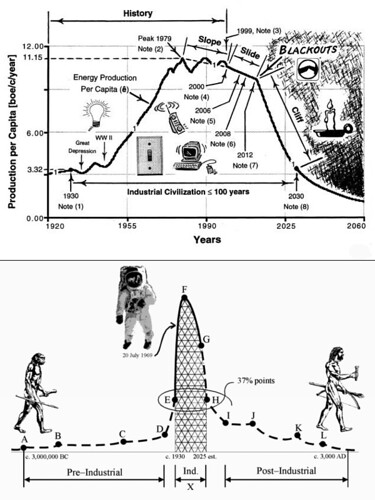
The logic of the Hubbert Curve provides the framework for Richard Duncan's Olduvai Theory , an uncompromising look at a deindustrial future. Duncan starts with White's Law, a widely accepted rule that culture evolves as the amount of energy per capita goes up. Globally, energy per capita stood at very modest levels until 1800, when fossil fuels sent it skyrocketing to its all-time peak in 1979. At that point, Duncan shows, two centuries of explosive progress began to unravel.
After 1979, global energy per capita declined as rising population outstripped modest increases in energy production. As energy production itself drops after the Hubbert Curve peaks, the decline accelerates. Follow the curve, and by 2030 global energy per capita is where it was in 1930, around a third of its 1979 value. Duncan argues that the industrial age is a pulse waveform, a single, bell-shaped, non-repeating curve centered on 1979. Since no renewable energy resource can provide more than a small fraction of the immense amounts of fossil fuel energy we've squandered in the recent past, he predicts that the millennia of low tech cultures before the industrial pulse, when nobody knew about the fantastic treasure of free energy locked up in fossil fuels, will be balanced by millennia of low tech cultures after the industrial pulse, when the treasure will be gone forever.
... snip ...



PeakOil is You
Energy Per Capita in the News
Energy Per Capita in the News
 by bratticus » Thu 22 Jan 2009, 08:55:50
-

bratticus - Permanently Banned
- Posts: 2368
- Joined: Thu 12 Jun 2008, 03:00:00
- Location: Bratislava
Re: Energy Per Capita in the News
by bratticus » Thu 22 Jan 2009, 08:57:08
And now the news
$this->bbcode_second_pass_quote('', '[')b]Big Homes, 1-Person Households are Main Causes of Consumer Energy Waste, Study Finds
... Single-person households, which have grown at triple the rate of overall population growth since 1960, use 18.4% more energy per capita than two-person households do, SMR found. They use 52.8% more energy per capita than three-person households.
$this->bbcode_second_pass_quote('', '[')b]Big Homes, 1-Person Households are Main Causes of Consumer Energy Waste, Study Finds
... Single-person households, which have grown at triple the rate of overall population growth since 1960, use 18.4% more energy per capita than two-person households do, SMR found. They use 52.8% more energy per capita than three-person households.
$this->bbcode_second_pass_quote('', '[')b]Energy changes coming to [Kentucky, USA], ready or not
... Kentucky must be visionary to build a plan that does not extend our existing vulnerabilities. ... According to the Energy Information Administration, Kentucky has the sixth-highest energy-per-capita consumption among states. Our residential sector is 24 percent more energy intensive than the national average.
$this->bbcode_second_pass_quote('', '[')b]Bill McKibben Interview
... When you go to Europe, they’re much more ready. They use half the amount of energy per capita that we use.
$this->bbcode_second_pass_quote('', '[')b]Not this, not here
... Virginia uses more energy per capita than most states, suggesting that there are ways to dial back without cutting into our quality of life or economic health. Instead, we'll be promoting our physical health.
-
bratticus - Permanently Banned
- Posts: 2368
- Joined: Thu 12 Jun 2008, 03:00:00
- Location: Bratislava